Showing posts with label South Pacific. Show all posts

Mar 14, 2026

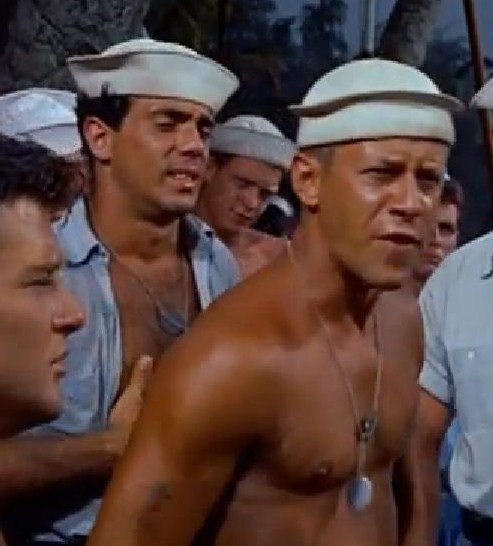
Ken Clark: "South Pacific" Stewpot, Sword and Sandal Baddie, Bodybuilder on My Sausage Sighting List


I've seen live performances of the Rodgers and Hammerstein musical South Pacific (1948), about American sailors in love with South Pacific islanders during World War II, but never the 1958 movie. Until now.

Colonialist, imerialist, and highly heteronormative plotlines.  I already knew that.

But I didn't know that beefcake abounds -- and sausages.  Wait until the minor character Stewpot leads the sailors in a paeon to heteronormativity, "There's Nothing Like a Dame."

There ain't a thing that's wrong with any man here
That can't be cured by putting him near
A girly, womanly, female, feminine dame

Was I really seeing what I thought I was seeing?


Fast forward to Stewpot's only other scene, a weightlifting contest.  Darn, he's wearing grapes.


But when you see him in jeans, his beneath-the belt gifts are obvious.  Maybe he was even cast for them.  Henry Slate played a skinny, fully-clothed Sttewpot on Broadway, but for the movie, director Joshua Logan wanted to reflect the 1950s muscle craze, so he cast 31-year old bulging bodybuilder Ken Clark. 

I checked some of Ken Clark's other works, to see if more sausages were evident.

He was born in Neffs, Ohio, a tiny town near the West Virginia border, in 1927.  After high school he enlisted in the Navy, and then worked jobs as a coal miner, construction worker, and model while trying to break into acting.  


The modeling included some of those nearly-n*de photos published in "fitness" magazines like Physique Pictorial.  We have a backside, but I couldn't find any frontsides.

His acting career begins in 1955, with a string of two-fisted man's man roles: The Proud Ones, The Last Wagon, the True Story of Jesse James.


South Pacific did not propel Ken into stardom, in spite of his physique and sausage.  The guest spots continued: A cop in Suspicion, an FBI agent in The Shaggy Dog, a cop on Alfred Hitchcock Presents (left).  But at least he got a chance to showcase his talent.  And stuff.


He starred in Attack of the Giant Leeches (1959) as a Florida game warden who teams up with a local physician (Walter Kelley).  They take off their shirts, fight giant leeches, and win the Girls.  


More after the break

Feb 15, 2026

Easter Island: Phallic Statues and Penis Festivals

If you thought Mongolia was remote for Westerners, try Easter Island (aka Rapa Nui).  From New York, you fly to Miami, then to Panama City, and finally to Santiago, Chile (about 24 hours).  From there, only one airline flies to the town of Hanga Roa on Rapa Nui, once a day (about 6 hours).

It's a tiny island, about 15 miles long and 8 miles wide, alone in the Pacific Ocean, probably settled from the Marquesas Islands, 2000 miles away.

Once the early Polynesians got there, they became very interested in the penis.

1. Most Rapa Nui men incorporated the word Ure, "Penis," into their names, but in the 19th century Christian missionaries put an end to the practice.

2. The Moai, "Easter Island Heads," are actually complete torsos, over 800 of them, 20-30 feet high, weighing over 80 tons, sculpted and installed over a period of 300 years (1200-1500 AD).  They took so much time and energy that the islanders had little time left for other pursuits, and so many trees were felled to facilitate transport that the island is now almost entirely treeless.

The noses of the figures have often been interpreted as phallic symbols.  Indeed, some scholars interpret the Moai themselves as giant phallic symbols, representing the sexual potency of the Rapa Nui men. There's a legend still common on the island that a penis served as the model.


3. Rongo Rongo, the Easter Island script, appears on dozens of tablets and ceremonial objects.  By the time the Europeans arrived, no islander remembered how to read it, and it remains untranslated.  But at least one of the glyphs is called "Tangata Ure Huki" "Man with Erect Penis"


4. The Tapati Fesival, held every year during the first two weeks of February, is a celebration of the island's history, culture, and penises.  There are parades, dances, athletic contests like haka pei (sliding down a mountainside on a tree trunk), and a race called the Tau'a Rapa Nui: men wearing only skimpy loincloths race through town carrying bunches of phallic-symbol bananas.


Jun 27, 2025

Dan Shor: Tron, Star Trek, an Excellent Adventure, the South Pacific, and the Backside that Changed the World.


Link to the n*de dudes


Sometime during the days of Blockbuster Video, we rented Strange Behavior (1981), mainly because the cover blurb said something about Galesburg, Illinois, which is near the Quad Cities. 

We weren't aware that it was written by a gay man (Bill Condon), it stars a gay man (Dan Shor), and it features something that would change movies forever.

It's got a silly plot about a crazed college professor named Dr. Le Sange (Dr. Blood), who mind-controls the town teenagers into blood-crazed monsters.

No Galesburg sites are appear mentioned; Apparently they just picked a random town in the Midwest so there would be cornfields and stereotyped farm folk. It was actually filmed in New Zealand.


The focus character is named Pete Brady, which no doubt caused a lot of eye-rolls and derisive laughs in 1981: Viewers would instantly think of the kid from The Brady Bunch (Christopher Knight, who grew up into a muscle hunk.)


This photo teases a gay-subtext buddy bond between focus character Pete Brady (har har) and Oliver (Marc McClure), but the movie is actually heteronormative, with boy-girl romance all the way down.  


I'd rather date Marc McClure, loveable nerd Jimmy Olsen in Superman (1978).

 And Dan Shor, the guy who plays Pete, is not handsome. He's got a long face, a Romanesque nose, and a lantern jaw.

But none of that is important.

What's important is a scene early in the movie where Pete Brady (har har) and his father (not Mike Brady, darn it) have just gotten up in the morning.  Pete approaches him to discuss something.  N*de.  He then moves toward the shower.  We get an extended shot of his backside.


It wasn't the first n*de backside on film, but it was the first extended shot that wasn't for a comedic purpose.

There is no other n*dity, male or female, in the film, not even a shirtless shot.  What was the directorial decision to film Dan Shor that way?

In an interview, Dan said that it was a political act, an acknowledgement of gay potential in the homophobic 1980s. It disrupted the heterosexual male gaze and paved the way for movies to present images of male beauty.

"And it sealed my popularity in West Hollywood," Dan joked.  Or maybe he wasn't joking.

More after the break

Mar 5, 2025

Russell Johnson: The Professor and His Gay Son

Everyone in West Hollywood knew Russell Johnson, who played the Professor on Gilligan's Island.  I met him once, and saw him a few times at events.  He was a gay ally, primarily due to his son David..


Everyone in West Hollywood knew David, too -- Alan (my ex-porn star roommate) dated him.  He was a fixture in the bars, at the French Quarter, and at the AIDS Project of Los Angeles.  Later he was named AIDS Coordinator of the City of Los Angeles (he died in 1994).

Russell's career began during the 1950s, with lots of roles in Westerns and sci-fi movies: look for him in the MST3K rendition of The Space Children (1958). 


In the late 1950s, he moved into tv, with guest spots on Twilight Zone, Thriller, Laramie, Rawhide, and such hip-detective series as Adventures in Paradise and Hawaiian Eye.  But Boomers will always remember him for Gilligan's Island, a "trapped far from home" sitcom about seven people who set sail from Honolulu for a "three hour tour" and end up trapped on a desert island.

The Professor was an egghead of the old school, an expert in every field of science from astronomy to zoology, who constantly amazed kids in the 1960s by concocting radios from coconuts.  His utter lack of interest in the two female castaways, Ginger and Mary Anne, gave me some of my first gay subtexts.

And some of my first beefcake, in his occasional shirtless scenes.

Although typecast as the Professor, Russell continued to work steadily during the 1970s and 1980s.  But he devoted most of his time to raising AIDS awareness and taking care of David.

His last screen role was in 1997, in Meego, about an alien boy hiding out on Earth. He played "The Professor."

Russell died in 2014.

Jan 8, 2020

Astronauts and Cave Men: It's About Time

In November 1966 I turned six, a "big boy," with a later bedtime and the freedom to watch "good tv", shows about cute boys: The Monkees, Lost in Space, Tarzan, Get Smart, Hogan's Heroes, Run Buddy Run, Time Tunnel, Flipper .  On Sunday night we had church, but with a new baby in the house we often stayed home, and I could watch It's About Time (1966-67), a "trapped far from home" sitcom from Sherwood Schwartz, creator of the hugely successful Gilligan's Island.

It was about two astronauts who got zapped into prehistory, where cave men spoke in "ug-ug" broken English and fought dinosaurs.  They move in with a cave family played by comedy legends Imogene Coca and Joe E. Ross.

Mac (Frank Aletter, right) was a sitcom pro, already the star of Bringing Up Buddy and The Cara Williams Show.  He would go on to play Professor Hayden on Danger Island, with Jan-Michael Vincent.


Hector (Jack Mullaney, left) was best known for his role in the beefcake-heavy musical South Pacific (1958), with Ken Clark as the voluminous Stewpot.  Mullaney never married and was reputedly gay.

Mac and Hector wore their astronaut costumes most of the time, but sometimes they wore animal skins that revealed tight, firm chests and shoulders.  The cave people also wore animal skins, and in spite of their fright wigs, many muscular bodies were visible in the background.


Here's another picture from South Pacific.  

There was significant bonding: the two astronauts bickered like a married couple, hugged, fell into each other's arms, and lived together, even when they returned to the twentieth century.

They gazed with tongue-lolling horniness at the cave family's daughter, but such minor concessions to heterosexism could be ignored.


And there was a "dreamy boy" for us to gaze at: Pat Cardi, who had just finished work on the dark comedy Let's Kill Uncle, played the cave family's fourteen year old son, Breen.  He wore a fright wing, but his animal skin was almost as revealing as the tight pants on Flipper.  

Unfortunately, It's About Time aired on Sunday nights, opposite the last halves of Voyage to the Bottom of the Sea and Walt Disney, so most of the intended kid audience was already occupied.


After 18 episodes, low ratings prompted a complete reversal of the premise: the astronauts return to 1960s America, bringing a cave family with them. It didn't help.  So in spite of the ecstatic tv ads and a full run of tie-in toys, games, coloring books, lunch boxes, and the like, It's About Time sank seven episodes later, and was lost to history.  Except for 60 year olds who can still recite the theme song:

It's about time,
It's about space,
About strange people in the strangest place.
It's about time,
It's about flight,
Traveling faster than the speed of light

Mar 21, 2018

Robert Goulet: 1950s Gay Icon

You may not recognize the name Robert Goulet, but he was an icon to the gay generation who survived the pre-Stonewall Dark Ages (1950-1969).

During those years, he was a fixture on Broadway, starring in such gay favorites as Dream Girl (1959), Meet Me in St. Louis (1960), and Camelot (1962), befriending such gay favorites as Judy Garland, Barbra Streisand, and Cher.

As a singer, he charted frequently during the 1960s, with the easy-listening pop tunes that the older generation liked as a remedy to the Beatles and the Rolling Stones: "My Love, Forgive ME" (1964), "On a Clear Day You Can See Forever" (1965), "Once I Had a Heart" (1966).

He starred in eight movies, often with gay subtexts:


1. Gay Pur-ee (1962).  Animated cat Mewsette (Judy Garland) leaves her quiet country life for the wicked city of Paris, and her male friends Jaune-Tom (Robert Goulet) Robespierre (Red Buttons) try to rescue her.  There's also a sophisticated male cat shipped to America as a "mail order bride."

2. Honeymoon Hotel (1964) had an interesting gay connection: he and Robert Morse (the one in the dress) check into the "honeymoon hotel" along with all of the other couples.  Heterosexual hijinks follow, but there are a sizeable number of double-takes at the "honeymoon couple," as well as the rule "you've got to have a girl in your room" to eliminate any rumors.

Here's a semi-nude photo of the boyfriend.

3. I'd Rather Be Rich (1964).  Young heiress Sandra Dee has to decide between her fiance (Andy Williams) and the man she's hired to impersonate him (Robert Goulet).

Goulet appeared on tv nearly 100 times, in specials devoted to his music, in his own series, Blue Light (1966-67), about an American journalist going undercover to spy on the Nazis during World War II, and in many guest roles: a hunky science teacher on The Patty Duke Show, a con artist faith healer on The Big Valley. a murderous doctor on The Name of the Game.


The 1950s was the era of the face, not the physique, but Goulet was not shy about displaying his tight, hard muscles for the camera.

Of course, Goulet continued to perform for thirty years after Stonewall, but he aimed his work at that same body of fans who had loved him in the 1950s, appealing to Boomers only in an occasional spoof, or when a melodious voice was needed: he provided the voice for Wheezy the Penguin in Toy Story 2 (1999), and for sensitive third grader Mikey on the Disney Channel's Recess (1998-2001).

In 2005, two years before his death, Goulet took over the role of Georges, owner of the nightclub and Albin's partner in the Broadway revivial of  La Cage aux Folles.  It was like a final shout-out to the gay fans who had followed him for half a century.

Jul 4, 2017

South Pacific: A High School Music

I don't care much for musicals, but I've had a soft spot for South Pacific (1949), the Rogers and Hammerstein musical adaption of James A. Michener's Tales of the South Pacific (1948), ever since I saw it performed live 8 times in high school.

I was in the orchestra pit, so I had no choice.  But anything that required my male classmates to parade around with their shirts off was fine with me, even if they were singing the heterosexist "There's Nothing like a Dame."


Over the years I've seen four more live versions, at my nephew's high school, Augustana College, a community theater in Ohio, and a gay synagogue in West Hollywood.  But until recently, I never saw the 1958 movie with Ray Walston (later on My Favorite Martian), Jack Mullaney (later on It's About Time), and Ken Clark (the bodybuilder with something extra). (Gay icon Robert Goulet starred in the original.)


Most musical comedies have two hetero-romantic plots, one romantic and the other humorous.  In South Pacific, the romantic plot is handled by Lt. Joe Cable (in this case, Anderson Davis in a 2008 Baltimore production).  A soldier stationed on a small island in the Pacific during World War II, he falls in love with the native girl Liat, but his family's prejudices keep them from marrying.  Then he dies on a secret mission.


Here's another Jim (Matthew Morrison, who plays Will Schuester on Glee) from the 2008 Broadway revival.


The humorous plot is handled by Nellie Forbush, one of musical theater's big-voiced, gutsy broads, who falls in love with Emile, a fey, sophisticated, gay-coded plantation owner -- they perform a gender-bending number in drag -- but rejects him because he has mixed-race children.  He goes on the secret mission, too, but returns alive just in time for Nellie to overcome her prejudice and marry him.

The prejudice theme, plus the gender-bending romance between the gay-coded guy and girl, provides adequate gay symbolism.  But you hardly need any, with all the muscles to look at.

Oct 9, 2013

The Lost Medallion: Gay-Positive Actors in a Fundamentalist Movie

Want to know what gay-positive actors Billy Unger and Jansen Panettiere have been up to lately?  Making a mess.

Actually, though The Lost Medallion: The Adventures of Billy Stone was released in March 2013, it was filmed back in 2009, when Billy was 13 and Jansen 14.  They both look and act around 10. 

A boy and a girl on an archaeological dig in the South Pacific, Billy (Billy Unger) and Allie (Sammi Hanratty) find a medallion that sends them back in time 200 years.  By the way, finding the medallion is a long, torturous process involving a mysterious book and two native Goons (yes, that's how they're listed in the credits).


I don't know how they figure out that they're 200 years in the past, but it's obviously a primitive culture, led by the boy king Huko (Jansen Panettiere), who speaks English.

Enemies attack, destroy the village, and lead everyone off to slavery except for Huko and his bff Anui (William Corkery).


The plot progresses like Karate Kid mixed with The Lord of the Rings.  There's a Damsel in Distress scene, an elderly wise man who offers cryptic advice, and a climactic battle between Billy and gay-vague Head Evil Dude, Cobra (retired man-mountain Mark Dascascos) that results in the destruction of the Medallion.  Then, using the Medallion that was just destroyed (don't ask), the kids go back to the 20th century.

Even though it's a mess, there are two redeeming characteristics:
1. A complete lack of displayed heterosexual interest, from anybody.
2. Gay-subtext buddy-bonding between Billy and Huko.

After chugging around the film festival circuit with it for awhile, writer/director Bill Muir decided to re-frame it. He added opening and closing scenes in which a modern-day fundamentalist Christian is telling the story of the Lost Medallion to some kids, explaining that it illustrates God's love.

Wait -- what?  I didn't see any religious symbolism.

Bill Muir graduated from the ultra-homophobic Moody Bible Institute, and has spent twenty years working for the ultra-homophobic Youth for Christ.  I wonder how he would feel if he knew that his movie had two gay-positive actors and a big ole gay subtext.

Somebody tell him, please?


Jul 10, 2013

The New People: Gay Hippies After Stonewall

Another attempt to cash in on the hippies, The New People premiered on September 29, 1969,  three months after the Stonewall Riots and the beginning of the Gay Liberation Movement.  It was heavily promoted, with gushing accolades in teen magazines, but it didn't get many viewers, because it came on at 7:15!  That's right, they figured that after The Music Scene, another 45-minute program, you'd have no other choice.

Except by 7:15, all of the kids were watching Rowan and Martin's Laugh-In.


The premise was Lord of the Flies meets Lost, "boys alone" with some girls.  A group of college students crash-lands on a desert island.  With no adults around, they must depend on each other to survive. George Baker (Peter Ratray, rather long-in-the-tooth at age 28) becomes the leader, though there are frequent schisms.   Plots involved issues of law and order, women's rights, racial prejudice, and hippie gurus, plus an ongoing mystery: people kept disappearing, and there were mysterious Others on the island.

Unfortunately, the mystery was never resolved. The New People tanked after 17 episodes, in spite of the full-page semi-nude spreads in teen magazines.  It's never been out on DVD, though you can see this promo on youtube.

Three of the actors have gay connections.

The summer after The New People, Peter Ratray (left) starred in the West Coast premiere of the gay-themed Boys in the Band.  In 1983-84 he played Ed in Torch Song Trilogy, and in 1995 he played Burt, the leader of the Mattachine Society, an early gay-rights organization, in Stonewall.  Otherwise he has appeared mostly on soap operas.

Davis Olivieri starred in The Naked Ape (1973), with Johnny Crawford.

Zooey Hall played Rocky, the rough Alpha Male rapist in the movie version of Fortune and Men's Eyes (1971), about homoerotic relationships in prison.  Otherwise he has played mostly heterosexual crazies.  Sal Mineo starred in the original.


Related Posts Plugin for WordPress, Blogger...