Jan 13, 2021

Shawn Stevens: The Teen Idol that Failed

In the 1970s, Shawn Stevens had the soft, cuddly, puppy-dog cute, aggressively feminine presence that pushed Shawn Cassidy, Leif Garrett,  Scott Baio, and many others into teen idol heaven.  Why did he not make it to the heights of fame, with millions of middle schoolers kissing his poster and writing "Shawn Stevens" surrounded by little hearts in their chemistry notebooks?

It could be that the field was a little over crowded, with a dozen soft, cuddly, puppy-dog cute, aggressively feminine teens and post-teens strutting their stuff. You can only fantasize about kissing so many boys in a single week.

It could be that he lacked the talent, or the connections.

But I suspect that it was his strong religious beliefs, which kept him from moving to the next level: taking off his shirt, shoving lead pipes down his pants, shifting from dreamy to sexy as his target audience grew up.

According to his very detailed biography on IMDB, Shawn was born in Morristown, New Jersey into a fundamentalist Church of Christ family (his great-grandfather was a prominent Church of Christ minister who founded several Christian summer camps for inner-city youth).  His parents were also besties with fundamentalist ex-teen idol Pat Boone.

His family moved to California when he was 13, and he became deeply involved with musical theater, starring in youth productions and singing with the upbeat group The Young Americans.

When he was 19, a small role filmed in Utah led him to a lifelong devotion to the Latter-Day Saints (aka the Mormons).

Then he got his big break: the shortlived tv drama The MacKenzies of Paradise Cove (1978), about five orphans who adopt a grizzly fisherman (think Punky Brewster times five), shot Shawn into stardom.

Suddenly Shawn was in the spotlight:

He became the National Spokesman for the March of Dimes.

He hosted the Miss Teen America contest.

The mayor of his home town proclaimed "Shawn Stevens Day."

He got Tiger Beat fave rave articles.


He got a record contract.  No actual records, but he did get to perform "New York State of Mind" on an episode of Fame, and he became buddy-buddy with androgynous superstar Leif Garrett.

1981 was a banner year: guest spots on Too Close for Comfort, Buck Rogers in the 25th Century, The Facts of Life, and Captain Kangaroo, a recurring role on a soap opera, the teenage son on Savage Harvest (about a family attacked by lions while on safari in Africa).

And then it fizzled out.  During the next few years, a smattering of guest spots, another soap opera gig, and after 1985, nothing.  Shawn began working on promotional videos for the LDS.  According to Deseret News, they resulted in 600,000 conversions, which is probably a lot more than he would have drawn to the church as a guest star on Sheriff Lobo.


Still, one wonders, did Shawn deliberately end his Hollywood career for the higher calling of Mormon proselytization, or was it unavoidable, as time and again he said "I'll do anything for my art, but I won't take my shirt off."


"Or show a basket."


Religious zeal comes with a price.

Shawn's imdb bio paints everything as joyous, bounteous, and God-directed, of course, but reading between the lines, you can see hints of failures and disappointments, and a flight into the arms of the Church.

The good news: after 30 years, Shawn is back on the big screen, mostly in Mormon or otherwise Christian productions:
The Cokeville Miracle (the aftermath of a hostage crisis with a miraculous resolution)
Sacred Vow (marital infidelity is forgiven)
Drop Off (a drunk gets redeemed)
Love Everlasting (two high school outcasts find love with each other and with the LDS)
In Emma's Footsteps (the wife of Joseph Smith carries on the Mormon work)

Plus three episodes of the post-Apocalyptic Day Zero.


So if you can handle the beaming certainty of religious zeal and an utter lack of gay characters or subtexts of any kind, you have a chance to see Shawn again.

I imagine he still refuses to take his shirt off, though.

Jan 11, 2021

"Bill and Ted Face the Music": Most Excellent Inclusivity


Bill and Ted's Excellent Adventure
(1989) starred Keanu Reeves and Alex Winter as a couple of most excellent valley dude teenagers who travel through time, tracking down historical figures for their history report.  I recall some homophobic slurs, which was de rigueur in the 1980s; but there was also significant buddy-bonding between Bill and Ted, in spite of the Medieval princesses they rescue, and between Billy the Kid and Socrates.  

Plus Alex Winter had a bitchin' bod.

I didn't see the sequel, Bill and Ted's Bogus Journey (1991), but apparently the duo go to heaven and hell and start a band with a Swedish Ingmar Bergman-style Death.

Re-releases of the films come with a content warning, endorsed by the stars: "This movie reflects historical attitudes which audiences might find outdated or offensive."  According to Alex Winter, it refers only to the homophobic slurs; "other than that, the movies are extremely wholesome."

Now maybe they could include disclamers in The Breakfast Club, Lucas, I Was a Teenage Werewolf, American Werewolf in London, Revenge of the Nerds, Pretty in Pink, Animal House...

Someone on twitter asked Alex Winter about Bill being a trans icon. He responded by posting a Black Trans Pride Flag.  I'm not sure why Bill is a trans icon.

Everything old is new again.  The duo are back in Bill and Ted Face the Music (2020), with wives and young-adult daughters (Billy and Theadora), but still heterosexual life partners, so closely aligned that neither can say "I love you" to his wife; it has to be "we love you."

For that matter, they never actuallly state that they are heterosexual.  Maybe it's a polyamorous bisexual four-way coupling.


The daughters have some masculine traits because they are imitating their fathers, and Billie is played by a non-binary actor, Brigette Lundy-Paine.  They state that the daughters have an "innocent genderlessness," with atypical costume choices and no gender expectations. As well as no romantic interests.  They could easily be read as gay or asexual.


Aside from a subsidiary "our wives left us, and we have to prove ourselves worthy to win them back" goal, Bill and Ted don't display any heterosexual interest, either.  

The plot: In order to save life, the universe, and everything, Bill and Ted must play a song that will "bring everyone together" that night.  The problem is, they haven't written it yet, so they travel through time looking for future versions of themselves who have written the song.  The bad guys send a robot (Anthony Carrigan) to kill them, but he reforms and becomes an ally.

I don't know if he's actually this buffed or it's a photoshopped image; he never appears without his robot suit.

Meanwhile the daughters help by going through time and recruiting the greatest musicians who ever lived to play the song:

1. Jimi Hendrix (DazMann Still)


2. Louie Armstrong (Jeremiah Craft), who may overdo the imitation a bit.

3. Mozart (Daniel Dorr)

4. Ling Lun (Sharon Gee), who brought music to ancient China by inventing the flute.

5. The prehistoric drummer Gromi (Patty Ann Miller)


Plus record executive Kid Cudi (playing himself) and Death (William Sadler).

The greatest musicians in history represent a variety of musical styles, two fo the five are women, and four out of five are people of color. A nice course correction  In the original Bill and Ted, all of the historical figures were men, and four of the five were white.  

Also, in Bill and Ted's Bogus Journey, the duo have sons.  They turn into daughters here to add some girl power to what was a decidedly fratboy franchise.

Of course the song brings everyone together and saves the universe.  The closing credits display people of various ages, races, and musical tastes playing music. 

A dumb, goofy, feel-good movie with almost painstaking inclusivity.  Just the thing we needed to see in the summer of 2020.

My grade: B+

See also: I was Betrayed by Keanu Reeves; Will and Scott Have a Wild Night with Keanu Reeves


Jan 9, 2021

Michael Moorcock: Bisexual Decadence at the End of Time

Michael Moorcock was a leader in the British "new wave" of science fiction, confusing mishmashes of sci fi, fantasy, and James Joyce..  I liked the beefcake covers, and his name was...um, appealing.  But the novels were impenetrable.

Except for the Dancers at the End of Time (1972-76), a series of novels set in the far, far, far, FAR distant future, when the few remaining humans have practically infinite power.  They can change the shape of the continents and the color of the sky,  instantly.  No one has been born or died for thousands of years; they can be killed, but their friends resurrect them again.

Beings with names like Lord Jagged, Werner de Goethe, the Duke of Queens, Mistress Christia the Everlasting Concubine, Lord Shark the Unknown, and the Iron Orchid spend their time in aesthetic revelry and partygoing.

Sounds like the Aesthete-Decadent Movement of the late 19th century, with power rings.

And substantial beefcake.

They can change their sizes and shapes in order to produce more aesthetically pleasing effects, and what could be more aesthetically pleasing than a gigantic lavender penis?


And the first hints of same-sex activity that I ever saw in print. 

1. Miss Amelia Underwood, a time traveler from the Victorian Era, is horrified when Jherek Carnelian nonchalantly admits to having sex with "a male friend'!

2. An alien named Yusharisp warns them that they have expended so much energy in their various schemes that the heat death of the universe is imminent.  Jherek Carnelian doesn't really believe him, but thinks it would be a lark to accompany him through the universe, warning people.

Yusharisp comes to believe that Jherek is in love with him!


Turns out that Michael Moorcock often included gay-vague or bisexual-vague characters in his novels, although he never actually portrayed any same-sex relationships.

That's a lot more gay content than most science fiction of the 1970s.  Actually, it's a lot more gay content than most science fiction today.

See also: Xanth; Samuel Delaney.


Xanth: Heterosexual Centaurs, Demons, and Ogres


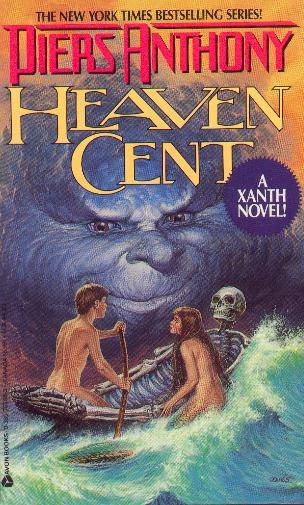
I have been reading Piers Anthony's Xanth novels, on and off, ever since the first, A Spell for Chameleon in 1979.  They are set in a fantasy land that bears a striking resemblance to the mundane Florida. Magic works, but not in the expected way.  Every human has just one power, and some of them are silly or useless. There are also unicorns, centaurs, ogres, fairies, demons, dragons, gargoyles, and golems -- the fanciful list goes on and on.


Anthony draws you in with his cleverly convoluted plots and endlessly creative puns.  Even the titles are punny: Centaur Aisle, Roc and a Hard Place, Currant Events, Stork Naked.

And the covers often involve beautifully realized beefcake (drawn by Darrell K. Sweet): utterly naked young men, beefy knights, muscular centaurs and demons.  You expect lots of homoerotic buddy-bonding inside.

But you'll be wrong.  All significant relationships are heterosexual.  Same-sex friends always betray you in the end.  And there are no gay people, anywhere.


Stork Naked proposes that in Xanth, the old tale of babies coming from storks is true; prospective parents simply send the proper forms to the stork headquarters, and wait nine months for delivery. Since no straight intercourse is required, one would expect same-sex partners to apply for babies quite often; but only male-female couples are mentioned.

Every reference to desire, love, or romantic relationships in the book, and in all Xanth books, carefully specifies that it is straight.


When a fairy tells the adventurers about a strange lake filled with “love water,” they ask: “Standard love elixir? Male loves nearest female, and vice versa?”

“Yes. I have seen creatures there. I couldn’t make out exactly what they were doing, but always male and female.”

Piers Anthony could easily let his “standard love elixirs” target the nearest person, and have the fairy say “they were usually male and female.” But he is doggedly deter-mined to keep Xanth gay-free.


In his newsletter, Piers Anthony offered three responses to a fan’s criticism of the ongoing erasure.

First, as someone who is “110% straight,” whatever that means, he could never create believable gay characters (yet he is easily able to create ogres, demons, centaurs, mermaids, and talking storks).

Second, he is afraid that his publisher will not permit such a “controversial” move (but Avon Books has published many books with gay characters).

Third, he is afraid that including a gay character will ruin sales.


Straight science fiction and fantasy fans do seem to be more homophobic than usual. On an online forum, a fan asked why so many gay men like the genre, and was told that it gives them hope: “since sf has new inventions and discoveries, there would be a great possibility for a cure for it.”

A guide to Science Fiction Conventions advised straights who are subject to a same-sex advance to “refuse politely and clearly” instead of physically attacking their “assailant.”

Since the “new wave” of sociological speculation in the 1970s, many science fiction stories have depicted some form of “alternative sexuality.” There are species with three or more sexes or none at all, species whose sex organs change every season or at random, societies where technology makes changing one’s sex as easy as changing one’s shoes. Nevertheless, every sexual encounter, every romance involves a being who is male (right now) and one who is female (right now). The message is clear: one can be attracted only to beings with complementary sex organs; same-sex desire does not exist.

Some stories are set in future or magical societies in which bisexuality is “accepted,” but not people drawn exclusively to the same sex, not gay people, especially not gay men, and any characters who happen to mention in passing that they are bisexual experience only straight passion during the course of this particular story.

The vast majority of science fiction and fantasy stories  do't  bother with "alternative” sexualities at all, or even with offhand references to bisexuality being “accepted”: there are straight men and women, period.

So why do I keep reading it?

Because occasionally I will find an Earthfasts, a Something Wicked This Way Comes, or a Lord of the Rings.

See also: Michael Moorcock.
Related Posts Plugin for WordPress, Blogger...