Jan 27, 2024

Akim and Jim: Tarzan and Boy of European comics

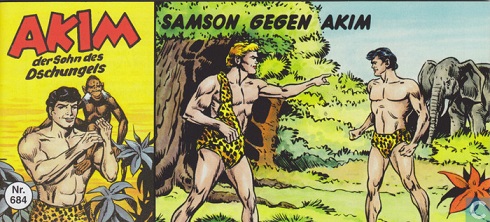
One of the more popular Tarzan clones was Akim, Son of the Jungle, created by Italian cartoonist Roberto Renzi and artist Augusto Pedrazza.  In Italy Tarzan clones are called Tarzanidi.

During his run in Italy (1950-1967), he was exported to France for 700+ issues, Germany for 500+ issues, the Netherlands, Scandinavia, and Greece (where he was renamed Tarzan).  Hundreds of issues appeared through the 1960s and 1970s, with ironic "new adventures" in the 1990s.

Amazon.fr has them for sale for between 5 and 10 euros.


Some of the rarest appeared in this single-strip per page format.  Here Akim fights the Biblical muscleman Samson.


Akim's back story is nearly identical to that of Tarzan:

Count Frederick Rank, the British ambassador to Calcutta, is shipwrecked on the wild coast of Africa along with his wife and infant son, Jim.  The parents soon die, leaving the toddler to be raised by gorillas.


Grown up, he becomes Akim, Son of the Jungle, with various animals at his command.  He marries the British heiress Rita, and they adopt a son, Jim, who turns into buffed blond man-mountain.

In most adventures, they leave Rita back at the tree house and venture out as a pair, leaving all of the gay subtexts of the 1940s Tarzan movies starring Johnny Weissmuller and Johnny Sheffield.


Sometimes Jim goes out adventuring on his own, requiring Akim to rescue him from the usual jungle poachers, cannibals, and lost civilizations, as well as aliens, mad scientists, and dinosaurs.


Whether they're speaking French, German, Italian, or Dutch, the buddy-bonding is easy to spot.

Steve Antin: Radical gay representation, from "The Last American Virgin" to "Girllicious." With lots of bulges and butts


Steve Antin's bio on the Internet Movie Database claims that he "broke all the girls' hearts" in The Last American Virgin (1982).  Same old story: gay people don't exist, so all girls and no boys swooned over his character.

Spoiler alert: Steve is gay.  

Link to NSFW version

Born in 1958, Steve broke into film playing the Jesse whose girl Rick Springfield longs for in "Jesse's Girl" (1981).  Next came The Last American Virgin (1982).  In his first major screen appearance, he plays high schooler Rick, who has sex with dozens of girls, like "every high school boy" in the 1980s -- except for his his buddy Gary (Lawrence Monoson, below), the "last American virgin."  So he and a third buddy, David (Joe Rubbo), strive to get Gary laid.  


This is not the typical 1980s "sex with girls is the meaning of life" teen comedy. Horndog Rick gets Diane pregnant and dumps her, so Virgin Gary pays for the abortion and falls in love with her, but Diane dumps him!  Then Gary dumps Rick and drives off in tears. Rather a downbeat ending. 

But there's a obvious gay subtext relationship between Gary and Rick: Gary seems to like Diane only because Rick was intimate with her.

And there's a lot of beefcake.  Far more semi-naked male bodies than female bodies.  Muscle hunks in their underwear. Jocks stripped down in the locker room.

There is even a penis size contest, with the boys gleefully evaluating packages while their classmates parade by naked.

When was the last time heterosexual male teenagers were so happy to gaze at a row of naked men?

You might almost think that this movie with a gay star had a gay audience in mind.

Steve went on to play some teenagers on tv, the spoiled rich kid/horndog in The Goonies (1985), and some action/adventure and dramatic roles, all heterosexual.  But when he became the boyfriend of mogul David Geffen, he got some gay-positive roles.

He wrote, produced, and starred in the dramedy Inside Monkey Zetterland (1992), as a retired child actor turned screenwriter who lives with his overbearing mother and wacky/sad relatives.  He's straight, but he is friends with a gay man (Rupert Everett) and a lesbian posing as a married couple.  They are plotting to bomb an insurance agency that is denying coverage to people who are HIV positive. 


It's My Party
(1996), although extremely downbeat, was a classic of gay representation.  Nick (Eric Roberts) is dying of AIDS, with only a few days of mental awareness left, so he decides to kill himself.  His family and friends come to his "going-away party," including ex-boyfriend Brandon (1980s tv hunk Gregory Harrison).  Steve plays one of their friends.  

Brian To appears nude at the party.


After It's My Party, Steve moved into writing and producing.  His Young Americans (2000) is a teen soap featuring Ian Somerhalder (left) as a boy who develops feelings for his best friend, and thinks he might be gay.  It only lasted for eight episodes, so "there wasn't time"
 for him to come out. 

But Steve has also produced The Pussycat Dolls in Girlicious.  His writing credits include Burlesque, with Cher as the owner of an all-girl burlesque club; and Proud Mary, about a hit lady saddled with a kid.

And Chasing Papi, about a guy (Eduardo Verastegui) with three girlfriends, who dump him and find their own inner strengths. 

There's something to be said for female empowerment, but it seems clear that the days of Steve Antin's radical gay representation are long past.

Butts, bulges, and dicks of Steve and his crew on RG Beefcake and Boyfriends


Jan 26, 2024

"The Boys in the Band": Any Day that Ends with a Naked Man is a Good Day


The movie The Boys in the Band, based on Mart Crowley's 1968 play, appeared in 1970.  I watched it on VHS sometime in the 1990s, and even with some leeway for being pre-Stonewall, I hated it.  A party with a bunch of screaming queens oozing with self-hatred, sniping viciously at teach other, obsessed with straight guys who don't know that they exist, trying to seduce a strraight guy who stumbled in by accident.  Yuck!

I just saw the 2020 Netflix version, and liked it a lot more.  The tone was more upbeat and positive, thanks to some subtle changes to the script (the line "if only we didn't hate ourselves quite so much" is gone) and additions to the mise en scene. For instance, we see the characters interacting after the party, eating in a restaurant, attending Mass, cuddling in a cab, having sex, building a life in spite of their homophobic society.

Some viewers thinks that Boys is "gay misery porn," but remember, it's 1968.  "Homosexuality" is a psychosis, so you are in psychotherapy searching for a "cure."  Sodomy is an imprisonable offense, gay bars are illegal and underground, and there are no gay organizations except for the highly-closeted Mattachine Society.  The world hates you.  But you are still determined to live, so you throw a birthday party.


1. Michael (Jim Parsons), who is in debt up to his eyeballs and suffering from Catholic guilt, hosts the party.  He gets a shocker when a straight college friend, Alan (Brian Hutcherson), calls out of nowhere and wants to stop in "for a drink."  You never tell straights (the term "coming out" means acknowledging that you are gay), so he asks the other guys to act straight.  

When Alan figures it out anyway yet doesn't run away screaming, Michael introduces a party game to compel him into coming out: you have to call the one person you have always loved and tell them.  He assumes that Alan will call his other college buddy, now out, whom he was obviously in love with.  But the plan backfires when Alan calls his wife.

So Alan was straight all along?  Or is he still in the closet?  Michael is devastated.  But after the party, he goes to midnight Mass and feels better.

2. Donald (Matt Bomer, right), Michael's best friend and former lover, is visiting for the weekend.  He doesn't play the game.  But he does take a shower, giving us a nice beefcake scene that did not appear in the original movie.


3.-4. Hank (Tuc Watkins, left) is in the process of divorcing his wife so he can be with Larry (Andrew Rannells).  Larry recoils at the thought of heterosexual-style monogamy, but still calls Hank during the game.  They decide to try an open relationship.


5. Bernard (Michael Benjamin Washington), who is black and has to deal with racist jokes (even from his friends), has always loved the first guy he had sex with, the son of the rich family his mother used to work for.  In a flashback, we see them frolicking naked in a pool, butts and cocks visible. He calls, gives the message to the mother, and is devastated.

6. Benard's best friend is the campy queen Emory (Robin de Jesus), who was outed and ridiculed when everyone at his high school discovered his crush on an older boy.  Later he apologizes to Bernard for his racist quips, and they are shown having dinner together.

7.-8. Harold, (Zachary Quinto) the guest of honor, is a "32 year old ugly pock-marked fag Jew" who takes lots of weird drugs and  constantly picks at imaginary facial blemishes.  They seem to all love him, but he strikes me as threatening, observing and criticizing the events like a petty tyrant.  I kept wondering what he had on them.

The Cowboy (Charlie Carver, top photo) is a dimwitted hustler hired as one of Harold's birthday presents.  They get more romantic interactions than in the original movie, kissing, cuddling, and, in the last scene, having sex (Harold has a surprisingly nice butt).  

The "call someone you've always loved" game still seems too cruel to foist upon your friends (and you can only play it once), but at least the self-loathing is gone.

My Partner: "It was awful!  Gay life as endless misery!"

Me: "But it wasn't all misery.  They had friends.  They had lovers.  Any day that ends with a naked man in your bed is a good day, in 1968 or  2020."

See also: Andrew Rannell and Adam Devine: bromance, bulge and butt pictures

Jan 23, 2024

Revisiting Brideshead Revisited: Does the groundbreaking portrayal of (temporary) gay love hold up after 40 years? WIth bonus dicks

January 18th, 1982, a Monday night.  I'm lying on the bed in the attic room my brother and I share, reading a book for my Advanced Spanish class.  Significantly it's Ciro Alegria's El mundo es ancho y ajeno: Broad and Alien is the World.  

Link to NSFW version

I always watch tv while studying.  Tonight the only options are two boring movies, MASH (doctors during the Korean War), and something called Brideshead Revisited on PBS.  It turns out to be an adaption of the Evelyn Waugh novel about 1920s Oxford undergrad Charles Ryder (Jeremy Irons) falling in love with the flamboyant, decadent, teddy bear-toting, alcoholic Sebastian Flyte (Anthony Andrews).
 

They run away to Venice together. They go slumming in Soho, along with Sebastian's sister Julia.  Then Ryder begins a romantic entanglement with Julia, and the outraged Sebastian dumps him and runs off to Morocco. 

 Later Sebastian hooks up with a sleazy German guy named Kurt, and later still he dies.  Ryder can't marry Julia because she's Catholic and he's an atheist, so they just live together.  Later he becomes Catholic.

I'm mesmerized.  In 1982, surrounded by the hetero-horniness of workplace sitcoms, my parents demanding "What girl do you like?", and the preacher at church bellowing about homa-sekshuls, just seeing two men involved in a romance is a revelation.  Sure, no one says "gay," Ryder turns straight, and Sebastian dies, but they walk arm in arm, cuddle, even go nude sunbathing!  And everyone around knows! Even Sebastian's mother.  Even Julia, who tells Ryder that "all our loves are hints and signals," leading us to God.  A same-sex romance leads us to God?  Hear that, Preacher?

40 years have passed.  I've studied a lot of LGBT history and literature, and watched a lot of gay movies, published a lot of books and articles on queering fictional texts, and recently I decided to revisit Brideshead Revisted.

You can't go home again.  Rewatching today,  I strongly dislike Brideshead.  Sebastian is a decadent, flamboyant stereotype who ends up dead.  Ryder may fall in love with him, but then he moves on to Julia.  Evelyn Waugh, like Freud, believed that gayness is a phase -- adolescents, newly potent but forbidden access to the opposite sex, turn to each other.  Their brief period of quasi-romance ends when they move on to "mature" heterosexual love.


In 2008, the BBC aired a new version of Brideshead, with Matthew Goode as Charles Ryder and Ben Whishaw as Sebastian.  This time there's no subtext: Sebastian is gay.  But there's also no romance: Ryder is heterosexual but pretending to be interested in Sebastian to gain access to his vast wealth.


It's more honest -- and there's a lot more nudity -- but nothing can match the joy of seeing same-sex romance on screen for the very first time.

Lots of nudity on RG Beefcake and Boyfriends


Jan 21, 2024

Lil' Abner: Backwoods Adonis with No Interest in Women

During the 1930s and 1940s, gay kids could pick up any daily and Sunday comic strip to see a muscular, usually shirtless teenager who was not interested in girls, plus a committed same-sex couple.

Al Capp's L'il Abner, started in 1934, chronicled the adventures of 19-year old muscleman Abner Yokum, his elderly parents, and the colorful residents of Dogpatch, U.S.A.  It was part of the contemporary hillbilly fad.

Books, movies, and radio programs were presenting the hills (Ozarks or Appalachians) as an untouched wilderness, an Eden inhabited by rustic Adonises whose muscles and rude manners provided a remedy for the ultra-sophistication of Cary Grant and Clark Gable.

The backwoods Adonis became a common image, extending through Jethro of The Beverly Hillbillies to The Dukes of Hazzard.

The prelapsarian state had one drawback, at least for heterosexual readers: no place for heterosexual romance.  So uninterested were the men of Dogpatch that Al Capp instituted a Sadie Hawkins Day, an annual festival in which man-hungry spinsters chased "skeered" bachelors, and whoever got "ketched" had to marry.

But there was plenty of room for same-sex romance, notably the man-mountain Hairless Joe and his diminuitive Indian companion, Lonesome Polecat, who live together, embark on various money-making schemes together, and even count themselves as a "married couple" on their census form.  

When they think they are going to die, they hold each other: "I want to die in your arms."They are actually frozen, so two weeks of strips featured two men locked in an embrace, and maybe kissing.


In 1952, changing sociocultural mores -- such as the increasing awareness that a man who is not interested in women may be interested in men -- prompted Al Capp to marry off Abner.  Soon he became a father.

Increasingly conservative and unfunny as time progressed, the strip pushed forward in a dwindling number of newspapers until 1977.


There were two movie versions of the strip.  Everyone remembers the 1959 version, with Peter Palmer as Lil' Abner, and a plot about a "yokumberry tonic" that turns ordinary men into bodybuilders but has the side effect of making them uninterested in women.

See also: Li'l Abner, the Musical; and I Go Pogo: The Gay Possum of Okefenokee Swamp


Related Posts Plugin for WordPress, Blogger...