Everyone was shocked in 1974 to see John Davidson nude in the centerfold of Cosmo.
First, he had quite a nice physique (his privates were coyly hidden).
Second, he was John Davidson.
Hollywood Nice, wholesome, white bread, son of a Baptist minister, star of Broadway musicals like I Do, I Do!, The Music Man, and Camelot.
Star of two Disney movies: The Happiest Millionaire (1967) and The One and Only, Genuine, Original Family Band (1968).
A singer whose first album, The Young Warm Sound of John Davidson (1964) featured such easy-listening non-classics as "Once in a Lifetime" and "Love Me Forever." Later he moved on to covers of "Let It Be," "Raindrops Keep Falling on My Head," and "Easy Come, Easy Go."
A perennial guest star on "square" tv shows that kids wouldn't be caught dead watching: Hollywood Palace, Joey Bishop, Carol Burnette -- not to mention long tenures on game shows (Hollywood Squares), reality tv (That's Incredible) and two versions of his own John Davidson Show.
But Hollywood Nice had a mischievous side.
He starred in the sex comedy Coffee, Tea, or Me (1973), about a stewardess with a husband and a lover.
Here he appears to be the bottom of a four-way encounter with the Hudson Brothers. Notice that he's obviously being groped.
He was never averse to gay content. The tv pilot Roger & Harry: The Mitera Target (1977), about two buddies (John Davidson, Barry Primus) who solve crimes, may have some gay subtexts.
And in a 1974 episode of The Streets of San Francisco, he played a drag queen whose female "alter ego" is a vicious killer.
In his 2008 two-man play, "Father/Son and Holy Ghost," he goes back to his childhood, where he and his Baptist-minister dad butted heads over religious doubts and homophobia (John's older brother Porter was gay).
Today Davidson is playing The Wizard in a national touring company of Wicked.
Beefcake, gay subtexts, and queer representation in tv and other pop culture from the 1950s to the present
Mar 25, 2014
Mar 23, 2014
Ted Shawn: A Life Devoted to Muscles in Motion
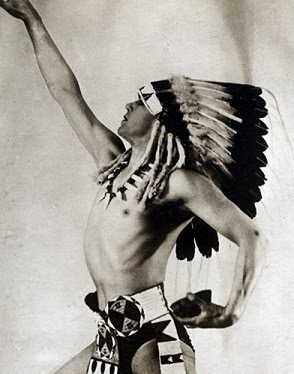
Speaking of modern dance, one of its innovators was Ted Shawn (1891-1972).
He grew up in a conservative Methodist church where dancing was forbidden, and attended the University of Denver, intending to become a minister. But after a bout of diptheria, he was prescribed dancing to restore his strength, and liked it so much that he continued, in spite of being expelled from college in 1911.
Dancing was not a viable profession for men in the early days of the 20th century. Sergei Diaghilev had just founded the Ballet Russe in 1909.
Determined to do something about the absence of male dancers, Shawn and his wife Ruth St. Denis opened the Denishawn Dance School in Los Angeles in 1914, and choreographed both male and female dancers. One of their students was dance great Martha Graham.
Soon Shawn was touring with dances inspired by classical, Egyptian, and Native American traditions, such as Xochitl and Les Mysteres Dionysiaques.
In 1929, Shawn and Ruth St. Denis divorced, and he established his own all-male troupe, "Ted Shawn and His Men Dancers."
They toured throughout the U.S., Canada, and Europe for the next 11 years, with patently homoerotic dances derived from tribal cultures: The Hopi Indian Dance, The Dyak Spear Dance, The Sinhalese Devil Dance.
Although he wrote a book entitled 10,000 One-Night Stands, Shawn was actually monogamous, with two gay romantic partners: dance great Burton Murnau, left (1931 to 1948) and stage manager John Christian (1949 to his death in 1972).
Shawn also founded the Jacob's Pillow dance school, theater, and library in Beckett, western Massachusetts. It hosts over 80 dance-related events every year, including an annual Dance Festival.
He devoted his life to mentoring male dancers, starting male dance programs in colleges across the United States, and increasing the visibility of the male form.
Mar 18, 2014
The Naked Ghost Festival of Thailand
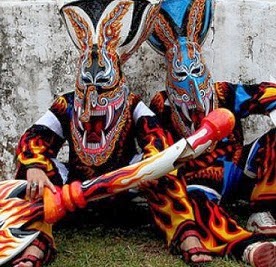
It's a small town with a folk museum and a famous pagoda, but not much else to draw tourists away from Bangkok and Pattaya. Except for the Phi Ta Khon Festival ("Ghosts with Human Eyes"), held every year at different times depending on the spiritual conditions (in 2014, on the weekend of June 27th).
It commemorates an event in the life of the Buddha's last incarnation, Prince Vessantara. He fell asleep, and his followers thought he was dead. They decided to celebrate his escape from samsara, and made so much noise that he woke "from the dead."
The festival begins begins with a Buddhist ceremony that invokes guardian spirits, followed by a procession of the men in the village, nude except for rice-husk loincloths, covered with river mud, waving giant wooden phalluses of various sizes and shapes.
The male spectators wave phallic charms (paladkik) or giant phalluses of their own, inscribed with characters meaning "Big Man." Apparently guardian spirits likes penises.
On the second day, there's another parade (Hae), with more semi-nude men, but generally more elaborate costumes of ghosts and monsters, with ornate masks. Crossdressing is common. As are penises so large that they're hard to carry.
There are prizes for the best costumes and dances. Plus phallic rockets (Bangfai Ko) and partying all night.
The third day is devoted to Buddhist sermons, prayer and meditation.
Mar 16, 2014
The Innocents: In the South of France, Everybody Wants Everybody
Movies and tv programs typically permit same-sex relationships only when they are interracial. The racial stratification "stands in" for gender stratification, male-female transposed into white-black in America, British-Indian in Britain, and in France French-Arab.
In The Innocents (1987), André Téchiné uses several French-Arab relationships to mirror the tensions between France and its former colonies.
The gay teenager Alain (stage actor Stephane Onfroy, in his only film appearance) has been living in the southern port city of Toulon with the Algerian Said (Abdel Kechiche), a thief and hustler.
Said's main client is the German musician Klotz (Jean-Claude Brialy), who has an Arab fetish.
Alain's sister Jeanne (Sandrine Bonnaire) arrives to look for a reconciliation, and moves in with Said and Alain.
She begins relationships with both Said and Klotz's son Stéphane (Simon de la Brosse), who is bisexual also, but has a mysterious antipathy to Said. She suspects that they were formerly lovers.
Confused yet? Don't be: just think "Everybody is interested in everybody," and concentrate on the beach scenes.
Turns out that Stéphane belongs a radical racist organization which set fire to an immigrant hostel, and was stabbed by Said in retribution.
They argue over Jeanne, and Stéphane has his organization target Said.
The only innocent is the gay teenager, Alain.
Many of the cast members have a gay connection.
Simon de la Brosse (1965-1998) was working as a waiter when he was discovered by gay talent agent Dominique Besnehard. for the heterosexual-awakening Pauline at the Beach (1983). He was reputedly gay or bisexual in real life.
Jean-Claude Brialy (1933-2007) was gay.
Abdel Kechiche went on to direct the lesbian-themed Blue is the Warmest Color (2013).
The movie is not out on DVD, but you can see it on Full TV
Subscribe to:
Posts (Atom)