Showing posts with label 1980s. Show all posts

Oct 10, 2026

Elvira, Mistress of the Dark

When I moved to West Hollywood in 1985, everyone was watching Movie Macabre (1981-86), starring Elvira, Mistress of the Dark (Cassandra Peterson).  A throwback to the horror movie hosts of the 1950s and 1960s, Elvira was vampire-like being with a Valley Girl accent ("As if!") and a revealing Morticia Addams outfit.
She showed bad movies like The Fall of the House of Usher (with peplum star Mark Damon not taking his clothes off), Horror Hospital (with Robin Askwith threatened by gay psycho surgeons), and Werewolf of Washington (with Dean Stockwell, werewolves, hippies, and hippie werewolves).


In a tradition that would extend to Mystery Science Theater 3000, Elvira made snarky comments about the movies.  And in the tradition of drag queen performers, she made lots of self-referential jokes about her sexual escapades and cleavage ("I'm glad to see you're back...and you're glad to see my front!").  

Gay fans loved her, and she returned the affection, appearing at AIDS benefits and Gay Pride parades through the 1980s.


And not only gay fans.  She was everywhere, branding her image to sell everything from beer to Halloween costumes.

The feature film Elvira, Mistress of the Dark (1988) sends Elvira to the small town of Falwell (named after Jerry Falwell, the poster boy for 1980s homophobia), where she befriends all of the town's outcasts, butts heads with local bigots and romances an uptight theater manager (professional hunk Danny Greene).

Since Elvira is immortal, she continues to perform, cleavage and all.  She continually hosts new versionfs of Elvira's Movie Macabre., on cable in the 2000s and now on Amazon Prime.


Oct 6, 2026

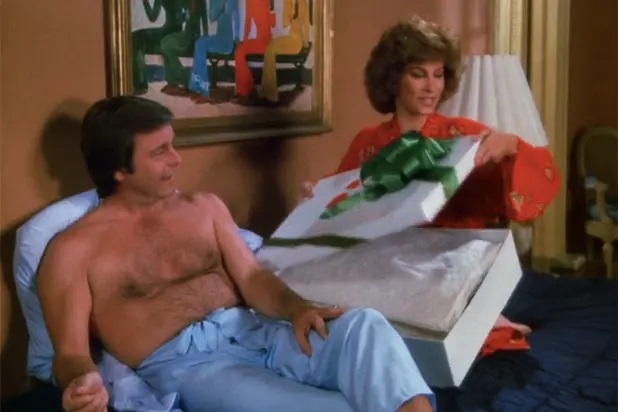
"Hart to Hart": Hairy-Chested Robert Wagner and His Wife Solve Glitzy 1980s Murders


The whodunit Hart to Hart (1979-84) just dropped on Amazon Prime, bringing back a blast of memories of my undergrad years at Augustana College and my first years in grad school at Indiana University. Even though I never saw a single episode, or even a single scene, that I remember.  I  I didn't like mysteries in general, and this one seemed to be just keying in to the 1980s love of excess that we saw on Dallas, Falcon Crest, Dynasty, and Lifestyles of the Rich and Famous. So why do I remember the series intro so well?

  An extremely elegant man and woman (Robert Wagner, Stephanie Powers) zoom matching fancy cars down a road while holding hands. The voice over explains who they are:


"That's my boss, Jonathan Hart, a self-made millionaire.  He's quite a guy.  That's his wife, Mrs. Hart.  She's gorgeous."  So men are judged by the money, and women by their attractiveness?  How sexist.  And "gorgeous ladies" are a  major turn-off. 

In the second season, they added: "She's one lady who knows ho w to take care of herself."  So she knows self-defense?  Doesn't detract from the gorgeous lady turn-off.

"My name is Max.  I take care of them.  Which ain't easy, because their hobby is...MURDER!"  Apparently audiences believed that the duo actually killed people, so in the second season the line changed to: "When they met, it was...MURDER!"

It's not as if I watched the intro before turning off the tv or leaving the room.  On Tuesday nights we watched Three's Company  at 8:00 pm (John ritter pretending to be gay so his conservative landlord would let him share an apartment with two girls).  At 8:30, ABC always broadcast a terrible filler series that nobody watched (Too Close for Comfort, 9 to 5, Oh Madeline, Shaping Up)   So I was gone long before Hart to Hart started at 9:00. 

Maybe it was just part of the zeitgeist.

According to Decider, my refusal to watch Hart to Hart was misguided: it was actually designed "for the gays": "1980s elegance, hairy chests, deliciously bad puns, and campy action."  

Could we get back to that hairy chest part?


The executive producer and most of the writers were gay, including Boys in the Band Matt Crowley.  No gay characters, of course; they were simply not allowed on 1980s tv except in "very special episodes."  No significant buddy-bonding: the only regular characters were Jonathan, Jennifer, and Max (the guy who "takes care of them.").  But I'll give it a try.


Sep 23, 2026

Harold Monro: Lost Gay Poet

The 1960s was all about heroic fantasy; hippies were all agog over The Lord of the Rings and its precursors and imitators, especially those published in Lin Carter's Adult Fantasy Series: The King of Elfland's Daughter, The Boats of the Glen Carrig, The Wood Beyond the World.  Beyond the Fields We Know.

 But by the disco era, we preferred stories about big, bright spaceships hurling through the galaxy.  So when Elsewhere: Tales of Fantasy appeared in Adam's Bookstore in September 1981, the start of my senior year in college, I bought it for nostalgia only.

The illustrations by Terri Windling involved ample nudity, mostly female, but sometimes you could see the curve of a male backside or the hint of a penis.

The stories were usually heterosexist, but I found something evocative in "Overheard on a Salt Marsh."  It's about a goblin who begs a nymph for her beads.  She refuses.

Then I will howl all night in the reeds,
Lie in the mud and howl for them.

I kept thinking that there was something gay about it, but what?  It's a male goblin encountering a female nymph, complaining that the beads are "better than any man's fair daughter."

Is it his gender-atypical desire for the beads, green glass, stolen out of the moon?

Maybe it's the desire itself, desire with all of the trappings of civilization removed, raw, savage, and terrifying.

I could find out very little about the author, Harold Monro, in those days before the internet.  He was born in 1879, opened the Poetry Bookshop in London in 1912, and managed it for the rest of his life, except for a few years of service in World War I.  He married twice, was plagued by alcoholism and depression, and died in 1932.

But as I read his other poems, I found more hints of an openness to male beauty:

Man Carrying Bale:
And the same watchful sun glowed through his body feeding it with light.
The muscles will relax and tremble.
Earth, you designed your man beautiful both in labour and repose

And same sex desire:

 Children of Love, about Cupid and Jesus meeting:
And now they stand
Watching one another with timid gaze;
Youth has met youth in the wood,
Are you afraid of his arrows, O beautiful dreaming boy?

Then in 2001, a biography of Harold Monro appeared, and I discovered that my impressions were correct. Monro was gay, but closeted, and his earlier biographers either didn't know or didn't want to tell.  Like most gay lives of the past, his was hidden, requiring you to read between the lines.


Sep 13, 2026

Stephen Geoffreys: The quirky queer teen from "Fright Night" and "976-Evil" bulks up and becomes a gay video star


Link to the n*de dudes


If you've seen Heaven Help Us (1985), about boys in a Catholic boarding school (on HBO MAX), then you've seen Stephen Geoffreys' d*ck and backside.  For now, he's the short guy expressing hetero-mania with Kevin Dillon and Patrick Dempsey.

Stephen was born in Cincinnati in 1964, attended a performing arts high school and New York University, and made his mark as a theatrical actor.  In 1984, he was nominated for a Tony for his performance in The Human Comedy, based on the William Saroyan novel.  

Then he humped...I mean jumped into movies:


After Heaven Help Us, Fraternity Vacation (1985): Two frat brothers (Tim Robbins, Cameron Dye) take their nerdy pledge Wendell (Stephen) to Palm Springs, where they compete over a bikini babe.  It got lousy reviews, even for a teen s*x comedy.


Fright Night 
(1985): Evil Eddie (Stephen), sidekick to high schooler Charlie (William Ragsdale), is heavily queer-coded; as heavily as you could be in 1985.  The Vampire (Chris Sarandon) seduces him like a potential boyfriend. Then eats him.

Queer-coded guys in horror movies!  Stephen had found his niche!  

During the next few years, he played queer-coded guys in episodes of Amazing Stories and The Twilight Zone, and in 976-EVIL (1988), his second most famous movie.  


Unfortunately, in the 1980s, queer-coded usually meant evil.  He found himself playing a nasty prison inmate in The Chair (1988), a nasty drug dealer in Moon 44 (1990), where he didn't even get to kiss Brian Thompson, and a nasty rent boy in Wild Blade (1991), reviewed as "a painfully awful piece of sludge."  

But he had performed Shakespeare and William Saroyan!  At this point Stephen gave up.  

On Hollywood, that is.  

He had developed a muscular physique, so why not find his new niche in gay films? First as Larry Bert, then as Sam Ritter, Stephen appeared in 29  over the next decade.  

More after the break. 

Sep 5, 2026

Weird Science, the movie and tv show: three gay-subtext couples, two gay-vague guys, and a lot of beefcake.


Link to the n*de dudes


Weird Science (1985) is a John Hughes brat pack comedy with a paranormal twist. Nerds Gary and Wyatt's (Anthony Michael Hall, Ilan-Mitchell Smith) are discouraged because the Girls of Their Dreams are dating a pair of belligerent, obnoxious preppies (Robert Downey Jr., Robert Rusler), and won't give them a chance.  So they use a computer to create their perfect dream girl, Lisa: she is not only attractive but super-smart, plus she has magical powers.


I forget most of the plot after 40 years, but wikipedia has helpfully filled in the details, Instead of dating them, Lisa conjures them a car, gets them fake ids, and hosts a wild party, where she thwarts their adversaries and their bullying older brother, military-school graduate Chet (Bill Paxton).

She also summons a pack of rabid bikers to kidnap the Girls, so Gary and Wyatt can mount a daring rescue and win them.


It was cheesy stuff, and entirely heteronormative.  There was a scattering of the incessant homophobia that one sees in every John Hughes movie, but spewed by the evil Chet, not by one of the good guys.  That was a big win in the era.  

Plus some strong gay subtexts between Gary and Wyatt and the prettyboy preppies Ian and Max.  And quite a surprising amount of beefcake


I wanted to do a "any gay roles/are they gay in real life" profile of one of the guys, but I can't find anything suitable.

Don't pay attention to the femme-half shirt and girly beneath-the-belt stuff.  Ilan-Mitchell Smith, now a history professor, is straight in real life.

Anthony Michael Hall, the darling of the Brat Pack, appeared in Sixteen Candles, The Breakfast Club, and Johnny B Goode, and as an adult The Dead Zone and Awkward.  Straight characters, with maybe one exception, and straight in real life.

Brat Packer Robert Downey Jr. appeared in Back to School, The Pick-Up Artist, Johnny B. Goode, became famous for Chaplin (playing the silent-era comedian), and went on to play Iron Man and Sherlock Holmes.  More straight characters, with maybe one exception, and....well, you get the idea.

At least we know that Robert Rusler is a gay ally: he befriended his Nightmare on Elm Street 2 co-star Mark Patton, and took him to some of the gay bars in West Hollywood (no, we never met).  But his tv work, in The Outsiders, Babylon 5, Snoops, Murder She Wrote, Bones, Ray Donovan...as far as I can tell, all heteronormative.  And...straight in real life.

Let's try the Weird Science TV Series.


It aired on the USA Network from 1994 to 1998. I watched on occasion, usually while on the treadmill at the gym. Gary and Wyatt are now played by Michael Manasseri and John Mallory Asher. Lisa characterizes herself as a "magic genie," and Wyatt's parents are absent, leaving his older brother Chet (Lee Tergesen) to look after/bully them.  

The "winning the Girl of Our Dreams" plotline appeared in just the first two or three episodes; later Lisa turns the boys into girls, clones them,  turns them into rock stars, traps them in a horror movie, traps them in The Twilight Zone, transports them to the Old West, and brings a video game villain to life. 

More after the break

Aug 16, 2026

It's Raining Men (Hallelujah!)


Humidity's rising, barometer's getting low
According to all sources, the street's the place to go.
Cause tonight for the first time, just about half past ten
For the first time in history, it's gonna start raining men

"It's Raining Men" was written in 1979, by gay composer Paul Jabara ("Disco Queen," "Last Dance"), and Paul Shaffer, then a member of the house band of Saturday Night Live.  They offered it to many vocalists, including Barbra Streisand, Cher, and Donna Summer, but they all refused.  Even Two Tons O'Fun (Izora Armstead and Martha Walsh), then performing as backup singers for pop star Sylvester, balked, thinking the song too weird to chart.


 Finally they agreed and released "It's Raining Men" on their third album, Success, in 1982.  They also released it as a single, and performed in the music video as the Weather Girls.

In October 1982, "It's Raining Men" hit #1 on the U.S. Dance Club Chart.  It also charted well in Europe.

There have been covers from everyone from RuPaul to Geri Halliwell to the Vamps to Miss Piggy.

In 2014, after a British politician blamed the UK's recent floods on gay marriage, a Facebook campaign was launched to get the song on the British charts again.  It hit #21.


Why is this a gay anthem?  It has nothing to do with liberation, and it's strictly heteronormative.  The men are raining down upon women.

God bless Mother Nature -- she's a single woman too
She took over heaven, and she did what she had to do
She taught every angel to rearrange the sky
So that each and every woman could find the perfect guy

Maybe because it's fun for gay men to think of being deluged by men, especially after growing up in a desert where gay romance was assumed not to exist.

It's raining men, hallelujah!
It's raining men, amen! 
I'm gonna go out, I'm I'm gonna let myself get
Absolutely...soaking....

See also: Ocho Rios


Aug 9, 2026

The Shards: Rich kid in 1980s L.A., a Primal Urge Boy, two downlow boyfriends, a serial killer, and Tom Blythe's d*ck. Plus Wes Bentley when he was cute


Link to the n*de dudes


When I was researching my profile of soap opera kid Redding Munsell, I discovered that nihilistic author Brett Easton Ellis is gay!  I did a conference presentation on some of his novels awhile ago, when I was at USC, and had him pegged as heterosexual -- and homophobic.  Now I'm interested in The Shards on Hulu, a tv series about Brett's years as an alienated, nihilistic teenager facing a serial killer.  Plus it's set in Los Angeles in the early 1980s, so maybe it has nostalgia value. 

Warning: It's produced by Ryan Murphy, who usually presents his gay characters as amoral monsters.


Scene 1
: Brett (Igby Rigney, left) tells us that The Shining opened on May 23rd, 1980, and he wanted to see it as soon as possible, because the original novel made him want to become a writer. In fact, he had already started Less than Zero.  So he had to go without the gang.  

Igby is nearly n*de on RG Beefcake and Boyfriends.

Smoking a cigarette, he drives his dad's Mercedes down the streets of Westwood (near UCLA). He parks right outside the theater (tv cliche), buys his Junior Mints, and sits down to see a tall, tan "stunningly handsome" boy who aroused "some primal urge."  After some lingering glances, the boy walks out.  Wrong screen, buddy?


After the movie, Brett can't find the boy. That's because he left the theater.  "His name was Robert Mallory (Homer Gere, left the son of Richard Gere. n*de on RG Beefcake and Boyfriends), and his arrival at my high school will coincide with a season of horror and murder that will destroy us all."  Don't give away the story!

Scene 2: Brett tells us that kids today have it easy, with no problems (except for global warming, fascism, racism, homophobia, transphobia...) His generation fought serial killers, including the most sadistic of them all.  Brett, stop giving away the story!  It's annoying!   

A girl arrives at her gigantic palace, and can't find her dog, the fish tank is half empty, and everything in the medicine chest is turned upside-down.  

Later, she goes to the supermarket to put her lost dog flier up amid the dozens of others, and sees the one for her dog, up already!  As she gets into her car, she is grabbed, knocked out, and shoved in a van.


Scene 3:
Brett and his girlfriend zoom down the Pacific Coast Highway, exuberant about being sixteen and able to drive, so they have infinite freedom!   Cut to the group having patty melts at the Hamburger Habit (I remember that place): a guy, a boy-girl couple, and a girl on each side of Brett moving in to kiss him.  Geez. at least let him finish his burger.

The group shrinks to four as they have dinner at the Galleria before playing at the video arcade, browsing at Tower Records or buying books at "any of the large bookstores that dotted the streets" in those days before Amazon took over.   I'm all for nostalgia, but this is getting egregious.  Tell me more about how everything was perfect in the Good Old Days, Grandpa.  Besides, I was there, and he's exaggerating the number of bookstores. 


I think the flashbacks have stopped.  They're at Girlfriend Debbie's place, and she's warning them not to spook her $1,000,000 Arabian horse.  Girl of His Dreams Susan and her boyfriend Thom (Graham Campbell) start making out.  Brett looks on longingly.  Adult Brett explains that Susan was the most beautiful girl in the world, and he still considers her the Love of His Life, although they never dated.  Debbie just started making out with him one day, so what are you going to do?  Are you sure you're gay, buddy?

Cut to a montage of Brett diving into his pool, getting dinner from the housekeeper, working on his writing, and doing under-the-covers stuff. 

Scene 4: Brett asks Girl of His Dreams Susan and her boyfriend if  they're coming to the last party of the summer at Debbie's house.  Thom says they'll be there, but Debbie's dad makes him uncomfortable: "He's so goddam gay!"  Got a problem with gay people, Thom?  Good thing your buddy Brett is straight.

"Yeah, he's pretty gay," Brett agrees, "But he's won two Oscars. Maybe he can help get my book made into a movie.  Ok, I checked the producers of "Less Than Zero."  Google AI insists that they're all "not gay" and make "family films."  

More after the break

Aug 5, 2026

Revisiting Brideshead Revisited: Does the groundbreaking portrayal of (temporary) gay love hold up after 40 years? WIth bonus d*cks

January 18th, 1982, a Monday night.  I'm lying on the bed in the attic room my brother and I share, reading a book for my Advanced Spanish class.  Significantly it's Ciro Alegria's El mundo es ancho y ajeno: Broad and Alien is the World.  


Link to NSFW version


I always watch tv while studying.  Tonight the only options are two boring movies, MASH (doctors during the Korean War), and something called Brideshead Revisited on PBS.  It turns out to be an adaption of the Evelyn Waugh novel about 1920s Oxford undergrad Charles Ryder (Jeremy Irons) falling in love with the flamboyant, decadent, teddy bear-toting, alcoholic Sebastian Flyte (Anthony Andrews).
 

They run away to Venice together. They go slumming in Soho, along with Sebastian's sister Julia.  Then Ryder begins a romantic entanglement with Julia, and the outraged Sebastian dumps him and runs off to Morocco. 

 Later Sebastian hooks up with a sleazy German guy named Kurt, and later still he dies.  Ryder can't marry Julia because she's Catholic and he's an atheist, so they just live together.  Later he becomes Catholic.

I'm mesmerized.  In 1982, surrounded by the hetero-horniness of workplace sitcoms, my parents demanding "What girl do you like?", and the preacher at church bellowing about homa-sekshuls, just seeing two men involved in a romance is a revelation.  Sure, no one says "gay," Ryder turns straight, and Sebastian dies, but they walk arm in arm, cuddle, even go nude sunbathing!  And everyone around knows! Even Sebastian's mother.  Even Julia, who tells Ryder that "all our loves are hints and signals," leading us to God.  A same-sex romance leads us to God?  Hear that, Preacher?

40 years have passed.  I've studied a lot of LGBT history and literature, and watched a lot of gay movies, published a lot of books and articles on queering fictional texts, and recently I decided to revisit Brideshead Revisted.

You can't go home again.  Rewatching today,  I strongly dislike Brideshead.  Sebastian is a decadent, flamboyant stereotype who ends up dead.  Ryder may fall in love with him, but then he moves on to Julia.  Evelyn Waugh, like Freud, believed that gayness is a phase -- adolescents, newly potent but forbidden access to the opposite sex, turn to each other.  Their brief period of quasi-romance ends when they move on to "mature" heterosexual love.


In 2008, the BBC aired a new version of Brideshead, with Matthew Goode as Charles Ryder and Ben Whishaw as Sebastian.  This time there's no subtext: Sebastian is gay.  But there's also no romance: Ryder is heterosexual but pretending to be interested in Sebastian to gain access to his vast wealth.


It's more honest -- and there's a lot more nudity -- but nothing can match the joy of seeing same-sex romance on screen for the very first time.

Jul 20, 2026

"I'm Not Afraid": A gay subtext romance between Miguel and the boy his parents have kidnapped. With dicks, the Nahuatl language, and a shirtless Short Guy.


Link to the n*de photos

In 2003 I saw Non ho pauro ("I'm Not Scared"), the film version of the novel by Niccolò Ammaniti: Nine-year old Michele (Giuseppe Cristiano) befriends a kidnapped boy, and discovers that everyone in his village is responsible.  

Left: Recent photo of Giuseppe.  He may not be the Non ho pauro one.

So I wasn't planning to watch the 2026 Spanish version, No tengo miedo , on Netflix.  How could they expand it into a tv series without a lot of padding?  Besides, I already know the twist ending.  So do you.


Then Yago Sandoval (who plays the kidnapped boy) posts that he and Aldo Navarro (the Michele character) have "Amistad como portal amoroso."  Portal amoroso is used to convey the transcendence, stability, and peace that comes from romantic love.  Is he referring to their own relationshp, or the characters?  There was no significant gay subtext in the 2003 movie, but just in case there is here, let's check out Episode 1.1, "Brujas" (Witches).  

Scene 1: Miguel lies amid dead leaves on the ground.  He has wet his pants.  He asks "Am I dead?"

No, his friends are calling for him.  As he walks through the ruins of an old convent, he stumbles upon a deep pit, and at the bottom a boy, chained up. 


Cut to four kids playing soccer, pretending that they're Mexico vs. Denmark in the 1986 World Cup.  A Bully hits Miguel in the crotch with the ball, then kicks it out into the jungle.  He orders  the Nerd Chuy to retrieve it, "Or I'll kill you."  

Left: The Bully is played by Mauro Guzman, who is quick to point out that he and Bruno Strauss (Chuy) are actually friends.

The Teenage Felix arrives and tells them not to go into the jungle, because a witch lives there who eats children.  Then he grabs his brother, the Bully, and drives him home.

The others ride their bicycles home, discussing why the Bully is so mean and if there really is a kid-eating witch.


Scene 2
: Teenage Felix (Cosmo Elio Gonzalez) and the Bully arrive at their run-down, trash-strewn house to see Dad keeled over due to drunkenness and the debilitating disease that they can't afford medication for.  They discuss how horrible their lives are.  Dad would like to hurt himself, but he can't afford a gun, darn.  

As the Bully goes off to fetch some rotten platanos for dinner, Dad asks, "Why don't we have a mansion yet?  You said you have a deal going on that would make us the wealthiest family in the world?"

"I'm working on it!" Felix exclaims.  He must be the kidnapper!


Scene 3
:  The kids arrive at Nerd Chuy's house to see his parents arguing with Pino (Luis Alberti, n*de on RG Beefcake and Boyfriends).  "You can't back out now!" "But I'm scared." "Have faith!"  They're in on the kidnapping, too.

Nerd Chuy stays behind to have dinner, and the two remaining kids, Miguel and his Sister, go home with Pino, their Dad.  I thought he was a single father, but his wife is there, being depressed.  They do Sister's medical treatments, which she hates, and have rice and beans for dinner for the 3,000th time.   Dad Pino promises that soon they'll be able to afford real food, and 20 tv sets so they can watch the game from anywhere in their mansion. 

The kids retreat to their bedroom, where Sister calls him Luis.  Richster Chava appears at the window to invite Miguel/Luis to watch the game in his mansion.

"But you can't go in there without permission!" Sister exclaims.

"Richster Chava can, and his parents are asleep, so they won't know I'm there."  Can't he invite a friend over?  Or are the bourgeoisie not supposed to associate with the proletariat?

Cut to Richster Chava and Miguel/Luis watching the game and being affectionate.  I'd call it a gay-subtext buddy-bond.

Scene 4: In the morning Miguel/Luis is awakened to the poor people arguing with a rich guy.  "Something must have happened!" "We had nothing to with it!" The Nerd  Chuy and his parents have vanished, and his house has been ransacked!  

Richster Chava, Miguel/Luis, and his Sister decide to investigate.  At the house, they find that Nerd Chuy's bicycle is gone.  If he was kidnapped, it would still be there. They conclude that he went to the witch's house to fetch the soccer ball, and got eaten. Then his parents went looking for him, and the witch got them, too.

They run to the jungle to investigate.  Shouldn't you take your bikes?  It was miles away yesterday. 

More after the break

Jun 5, 2026

Peter Berlin: "That Boy" uses his physique and d*ck to show us the wonders of the Gay World


Link to the n*de photos 


His actual name was Peter Berlin, but all you needed to say was That Boy, and the old guys of West Hollywood (that is, men over 30) would remember: the Boy sunning himself on the beach, the "Dancing Queen" at the disco, the leatherman glaring from the back bar, all blond hair, bronze muscles, and c*ck

He was not handsome -- actually, he had an unremarkable long horse-face.  Nor was he blond. And the world he traveled was more often graffiti- and gang-strewn Tenderloin than the Fire Island of the A-gays.  But that didn't matter.  You saw him half on screen, half in your dreams

.

There was no such thing as a closet in Peter Berlin's world, no such thing as homophobia.  Only endless nights of cruising -- but not the meaningless, destructive tricks that the straights condemned us for.  A glorious freedom that was, in itself, fulfilling enough to be the sole purpose of life.

That Boy (1974) was a defining moment of my coming out, the first gay film I ever saw, in 1984, during my second year in grad school at Indiana University.  My friend Viju and I drove into Indianapolis to go to the bars, and someone invited us to see it with him.  There was a midnight showing in a sleazy theater near Monument Circle.


Peter is not actually the boy of That Boy.  He plays an unnamed Everyman who wanders through the Castro and the Tenderloin of  a straight-free San Francisco, cruising on the street and in back rooms, looking at men, and being looked at.  He finds the gaze, being the object of desire, more glorious than the acts themselves.  But then he looks at That Boy, but the boy does not look back


Could this be the one person in the Gay World who does not desire him?  No, the boy is blind!  Peter is intrigued, and invites him for coffee and conversation. They walk hand in hand through the park and sit by the pond to look at (or hear) the ducks, making a romantic connection before heading to the back room.

Peter was born Armin Hagen Freiherr von Hoyningen-Huene. the son of a baron, in December 1942, and raised in Berlin, in a family of diplomats and fashion photographers.   After secondary school, he worked as a photographer for a German interview program, met famous people like Alfred Hitchcock and Brigitte Bardot, and cruised.  

A double life, respectable by day, sleazoid by night, was a standard part of the gay experience in the 1960s, when straights and gays alike believed that we were destined to be permanent outsiders, constantly hiding, denizens of a seedy underworld.  But Armin took pride in being gay.  He cruised in outfits of his own design, photographed himself and his tricks, turned the gay activity into a work of masculine beauty,


More after the break.  

May 27, 2026

A Roland for an Oliver: Gay Medieval Lovers

"A Roland for an Oliver" is apparently a common expression, although I've only seen it in British fiction.  It means that you're equally matched (for instance, these brothers can both bench press exactly 320 pounds each).

It's derived from the Medieval gay lovers that I first read about in The Young Folks' Shelf of Books during my early childhood.

I heard about them again in college, when my French Literature class was assigned a modern version of the 12th century Chanson de Roland, the national epic of France.


During the siege of Viana, Emperor Charlemagne agreed to let the outcome rest on single combat between two champions.  He sent his nephew, the bold, heavily-muscled Roland, the Prince Valiant of France.  Count Gerard of Viana sent his grandson, the handsome, quick-witted Oliver (or Olivier).  Their talents were complementary; they were perfectly matched.

As they fought, an angel appeared, separated them, and bade them become friends (the same thing happened to Simon and Milo a few generations later).

They spent the rest of their lives together, fighting side by side, and their love, with its divine mandate, was acclaimed in every corner of Charlemagne's Empire.

Then the Saracens began wending their way through Basque country,  In 778, the approached the pass at Roncevaux, Spain, in the Pyrenees.  If they entered France, they would take all of Europe.  Charlemagne and his troops tried to stop them.  In the heat of battle, Oliver was killed, and the distraught Roland cried:

So many days and years gone by
We lived together.
Since thou art dead, to live is pain.


Then he died as well.


Actually, the battle had nothing to do with the Moorish caliphate; Basque guerillas ambushed Charlemagne's troops, in retribution for his destructiion of their capital, to rob them.   Roland really existed, the leader of the Franks' invasion of Brittany, but there's no historical evidence for the existence of Oliver.  The Chanson de Roland  created him to be Roland's true love.


I didn't bother to point out the homoromance to my French professor, who no doubt would have insisted that Roland, like Aschenbach in Death in Venice,  wasn't Wearing a Sign.  He was betrothed to Oliver's sister, after all, and in the Italian epic Orlando Furioso, he falls in love with a woman (and flies to the moon).  

More after the break

May 19, 2026

Katts and Dog

The Canadian kid-oriented series that aired in the U.S. during the late 1980s came in all varieties. You Can't Do That on Television was sketch-comedy, Degrassi Junior High teen angst, and Katts and Dog (1988-93) teen adventure.


It aired as Rin Tin Tin, K-9 Cop in the United States and Rin Tin Tin Junior in France.  The owner of the original dog actor (1918-32) never trademarked his name, so his descendants continue to appear at animal events, and unrelated dogs have appeared in radio programs, movies, and two tv shows.  The Adventures of Rin Tin Tin (1954-59), starred Lee Aaker as a 19th century orphan being raised by the U.S. Calvary at Fort Apache.  It was trying unsuccessfully to compete with Lassie (1954-73), with the female collie owned by several boys, including Jon Provost (left, during his hippie years).  But most people remember Tommy Rettig, whose tv mom June Lockhart moved on to become the mom on the original Lost in Space.

By the 1980s, Rin Tin Tin was a distant memory.  His connection to the Katts and Dog dog, called Rudy or Rinty, is only mentioned once. 

The premise: Hank Katts (Jesse Collins) and his dog Rudy/Rinty go to work together in the K-9 division, where they rescue kidnapped boys and heiresses, keep drugs out of school, are held hostage, shoot suspects, and so on in adventures that are not always kid-friendly.  He begins dating widowed mother Maggie and mentoring her son, s Officer Hank Katts, who worked with a German shepherd named Rudy or Rinty (Rudolph Von Holstein III).  He lived with Maggie, the widow of his late brother, and her son, slim blond Stevie (12-year old Andrew Bednarski).

Homophobic televangelist Pat Robertson, whose Christian Broadcasting Network provided most of the funding for the show, disapproved of an unrelated man and woman living in the same house, so Maggie was killed, and Hank adopted Stevie.    His job was to ignore orders like "stay here where it's safe," snoop around on his own, get captured by the bad guys, and require a nick of time rescue.

He required nick of time rescues in most episodes.  Sometimes he and Hank required rescue together.


Hank and Stevie behaved nothing like foster father and adopted son.  Instead, their relationship reflected the superhero-sidekicks of the 1940s.  The two were inseparable, and engaged in activities that elsewhere would be reserved for romantic partners: going to dinners and movies, going on vacations.  They shared an emotional intimacy and an easy physicality that was rare in the cop-kid bond. 


More after the break
Related Posts Plugin for WordPress, Blogger...