Showing posts with label variety. Show all posts

Mar 19, 2026

"The Carol Burnett Show": Some 1970s beefcake and gay subtexts amid the boring dinosaur songs.


Variety shows, combining comedy sketches and songs,  are out of style now -- only Saturday Night Live survives -- but in the 1960s and 1970s, they were all the rage.  At least among the adults.  In 1970, they could watch twelve hours of variety per week, with hosts Leslie Uggams, Dean Martin, Carol Burnett, Red Skelton, Glen Campbell (left),  Jim Nabors (who was gay but not ouht), Tom Jones, Jimmy Durante, Jackie Gleason, and Andy Williams.

Kids and teenagers hated variety. Passionately. They were always on opposite something good.  If your parents forced you to watch The Jim Nabors Hour, you had to miss That Girl. If you were forced to watch The Glen Campbell Goodtime Hour, you had to miss The Mod Squad.

And the shows were horrible.  Slow songs from dinosaur times!  Comedy sketches about characters popular on radio a thousand years ago!  Bathetic closing numbers involving sad clowns or cleaning ladies!


I usually managed to get out of watching variety shows by claiming homework, or when my brother and I got our own tv set, watching something else -- anything else.  But for some reason I saw a lot of The Carol Burnett Show (1967-78)Carol, who got her start in the Broadway musical Once Upon a Mattress, played a charwoman, a ditzy secretary, Queen Elizabeth, and Vickie Lawrence's sister.  She and her comedy troupe parodied soap operas ("As the Stomach Turned") and classic movies ("Went with the Wind").  

I had no idea what they were parodying.


Famous guest stars like Rock Hudson, Tony Randall (left),  Sid Caesar, and Robert Goulet played parodies of themselves or sang.  I remember Tony singing "Have some Madeira, M'Dear," about a creep trying to get a girl drunk so he can take advantage of her.  

That was comedy in the 1970s.

There were only three reasons to watch:

I liked three things about the show:

1.  Co-host Lyle Waggoner, a former male model who appeared n*dee in Playgirl.  He played the leading-men and hunks in comedy sketches.  Unfortunately, because they were comedy, he never appeared n*de or even shirtless on the show.

More after the break

Jan 31, 2026

The Mickey Mouse Club: Which Mousketeer was the cutest? Which was gay?


When Annette Funicello died on April 8, 2013, the world mourned one of the iconic figures of the Boomer generation.  She was the first crush for many heterosexual boys and gay girls who watched her every week on The Mickey Mouse Club, and later in comedies co-starring Tommy Kirk and Frankie Avalon (left).

The Mickey Mouse Club (1955-59) was the first children's television program that starred real children, "the Mouseketeers."  They wore wore mouse ear-shaped caps and white sweaters emblazoned with their first names, and performed song-and-dance numbers interspliced with Disney cartoons, amateur talent contests, and dramatic serials.


In the early 1980s, the original series was broadcast on the Disney Channel.  My sister watched every day after school, and I saw a few episodes.  Girls outnumbered boys three to one, but if you could find them, the boys were exceptionally cute.  And in the 1950s, singing and dancing were widely labeled "sissy" pursuits, so they were all gay coded.  Turns out that only two were actually gay.


1. Bobby Burgess
(born 1941), who was very tall, well-scrubbed, and always smiling. Straight. 

He went on to dance on The Lawrence Welk Show.

2. The short, sandy-haired Lonnie Burr (born 1943) was the intellectual of the group (his website commemorates Annette Funicello's death with the Latin phrase "ave atque vale"). Straight.

He was a poet and playwright as well as an actor.


3. Tommy Cole (born 1941) was hired primarily for his singing ability, though had a handsome face and the hunkiest physique among the Mousketeers (left). Straight.

After MMC, he had a stint in the air force and then became a makeup artist.


4. Cubby O'Brien (born 1946), the kid of the show, became a professional drummer. Straight.

More after the break

Dec 18, 2025

"You Can't Do That on Television": teen sketch comedy about the horrors awaiting in adulthood, with gay subtexts and shirtless dudes


Before 1980, children's tv invariably portrayed adults as beings to love and respect..  Regardless of how mischievous and sassy the kids might be, no one ever questioned the maxim that "Father knows best": parents, teachers, coaches, and the lunch lady rarely made mistakes and always had the best of intentions. 

That all changed when the sketch comedy show You Can't Do That On Television premiered on local Ottawa tv in 1979, then jumped to the  fledgling Nickelodeon network in 1981.


At best the adults (mostly played by Les Lyle) were disgusting, incompetent fools. 

 Sometimes they were dangerous.

An endless array of kids (over 100 in all) held a mirror up to the preteen world, parodying everything from the standard (tedious homework, nonsensical school rules, horrible cafeteria food) to the edgy (racism, gender roles, divorce), and especially the anxiety over what was to come, with adolescence and adulthood just around the corner, and for gay boys, the "what girl do you like?" interrogation.

 Although gay people were never mentioned, the critique of the most cherished myths and preconceptions of childhood helped gay kids recognize that the myth of universal heterosexual desire could be critiqued as well.


Two ongoing bits reflected anxiety over desires that, the adults insisted, did not exist.  In one, a boy is about to be executed by firing squad, yells "Stop the execution," and cleverly talks his way out of it.  In another, a boy is in a dungeon, hands manacled over his head, being interrogated and tortured (usually by being slobbered on).


The boys in the cast appeared shirtless or in their underwear constantly, in nearly every episode.  Gay preteens must have been mesmerized.

The most popular were:

1. Alisdair Gillis, who went on to a long career in the entertainment industry, and died in 2025.


2. Doug Ptolemy (right), now a martial arts coach.

More after the break

Mar 4, 2025

Sonny with a Chance/So Random

Speaking of Southern Baptist Sissies, Matthew Scott Montgomery has played a nearly-gay character on the Disney Channel.

The teencom Sonny with a Chance (2009-2011) starred Demi Lovato as the Sonny, the "new girl" on the teen sketch comedy show So Random!  


Plotlines interspliced sketches from the show with the back-stage antics of Sonny and her costars, particularly the joined-at-the-hip Nico (Brandon Mychal Smith, right) and Grady (Doug Brochu).  The two were a barely-heterosexualized gay couple, physically intimate (whenever he gets scared, Nico jumps into Grady's arms), exclusive (except when one is asked out by another guy), and passionate.


The main antagonists were the stars of the teen soap MacKenzie Falls, especially dreamboat Chad Dylan Cooper (Sterling Knight, above left, partying at the gay club Tigerheat, and right, bonding with bff Zac Efron in 17).  Chad imagines himself a serious artist, vastly superior to the clowns of So Random!  But eventually he warms up to them, and begins dating Sonny.


When Demi Lovato left the series, it was revamped into a musical variety program, So Random! (2011-2012), with the cast playing "themselves" in comedy sketches and musical numbers.  Several new characters were added, including Shane Topp (left) and Matthew Scott Montgomery, who played the gay-coded Angus.  He has also played gay characters in Warren the Ape, Second Shot, and Feed.

Demi Lovato is a gay ally, but other cast members haven't made any pro- or anti-gay statements.  Sterling Knight, housemate of of Ryan Pinkston, is probably gay or bisexual, or at least gay-positive enough to take off his shirt at gay clubs.

Oct 25, 2024

Confusing Children and Angels: Laugh-In

When I was a kid, my  friends and I hated variety shows: Ed Sullivan, Red Skelton, Carol Burnette, Andy Williams, Glen Campbell (left).  They were old, square, has-beens.  And what could be more boring than someone standing in front of a microphone, singing?

But Rowan and Martin's Laugh-In (1968-73) was for us: not exactly variety, or even sketch comedy, but comedic slogans zapped across the screen at lightning speed.

1. Judy Carne yells "Sock it to me!" and gets socked.

2. Rowan and Martin give the "Flying Fickle Finger of Fate" award.

3. Zsa Zsa Gabor gets big  laughs by saying the word "bippy."

4. A Nazi spy peers from the undergrowth ("Verry interesting")

5. A spaced-out Goldie Hawn forgets her line and giggles.

6. Flip Wilson's drag persona Geraldine offers herself to all comers: "What you see is what you get."

7. Pigmeat Martin struts across the stage, jive-talking "Here come da judge!"

8. A dirty old man makes mumbling propositions to a purse-wielding spinster.

9. Gary Owens as a baritone-voiced announcer makes nonsequiter announcements.

10. Jo Anne Worley says "Blow in my ear, and I'll follow you anywhere," and giggles.

Episodes are streaming on Amazon Prime, but today they're unwatchable.  The lightning speed gives me a headache, and the jokes are sophomoric; only children would think it hilarious to say "Look that up in your Funk and Wagnells."  The cast members are just big kids, saying things that sound dirty on the playground.

But between 1968 and 1973, the jokes were bright and fresh, and risque and cool.  Most importantly, they were ours.

No beefcake, except for an occasional hot guest star, like Davy Jones of The Monkees.  
Not much bonding, not even from hosts Dan Rowan and Dick Martin, a comedy team since 1952.
No one ever acknowledged the existence of gay people.


But there was lots of gender nonconformity.  Years later we remembered it fondly, as the first hint of gay potential.

1. Alan Sues played Big Al, a feminine sports announcer who had an obsession with a bell he called his "tinkle."

Gay but never out, Alan Sues also played a fey grown-up Peter Pan on peanut butter commercials.


2. Tiny Tim, who looked like a long-haired Dracula, played the ukelele and sang "Tiptoe through the Tulips" in a fey falsetto.  He proved he was heterosexual by marrying a woman named Miss Vicky on The Tonight Show.


3. Flower child Henry Gibson appeared with a gigantic artificial flower and recited nonsequiter poems.  He was often assumed gay, although he was married to a woman for 40 years.

In his last role of note, Magnolia (1999), he played a cranky older gay man named Thurston Howell (after the millionaire on Gilligan's Islandd), competing with another guy for the attention of hunky Brad the Bartender.  He advises: "It's a dangerous thing to confuse children with angels!"

In those days we often confused children with angels.

Feb 1, 2024

Watching Monty Python's Flying Circus

When PBS came to Rock Island, it brought us a full-fledged British invasion. Sitcoms (Father Dear Father, Good Neighbors), science fiction (The Prisoner, The Hitchhiker's Guide to the Galaxy), costume drama (Upstairs Downstairs) -- and since they were on PBS, they were all educational, approved even by teachers who derided all other tv as "mindless trash."

Monty Python's Flying Circus was the most bizarre of the lot.  Ostensibly a comedy-sketch show with a regular troupe of performers, like Saturday Night Live, it had sketches that bled into other sketches, or stopped halfway through, weird semi-animated characters commenting on the action, visual puns, in-jokes, moments of sudden chaos.  In Britain, there were antecedents in The Goon Show  and This Was the Week That Was, but in America we had never seen anything like it.

And we loved it.  We repeated catch phrases over and over (I still use "Nudge nudge, wink wink!").

We discussed the inner significance of sketches with the zeal of literature scholars.

We sang "The Lumberjack Song.": "I like to put on lady's clothes and hang around in bars.."

We went to the movies, Monty Python and the Holy Grail (1975) and Monty Python's Life of Brian (1979).

In retrospect, we didn't like Monty Python very often.  Many sketches were incomprehensible, too bizarre, too busy savaging British programming conventions that we had never heard of.  And why are men in drag portraying elderly women with Yorkshire accents by definition hilarious?

But some of the sketches were -- and still are --anarchic gems.

Dead Parrot ("This is an ex-parrot!")

Hungarian Translation ("My hovercraft is full of eels.")

Nudge Nudge Wink Wink ("Is your wife...into photographs?")

Spam ("No one expects the Spanish Inquisition!")

There was a fair amount of nudity, many more exposed chests and abs than you would ever see on American tv.  Eric Idle (left) was particularly likely to be displayed in the altogether.

And  there were few swishy stereotyped gay characters, After Graham Chapman came out to the other troupe members in 1967, they were careful to avoid overt stereotyping of gay men, although their distaste for drag queens is often apparent.

In fact, a number of sketches skewered homophobia, as when one character suspects that another is a "poof," and casually shoots him.  Or a "Prejudice Game," in which anti-gay prejudice is placed on equal footing with racial and religious prejudice.

See also: Saturday Night Live.

Aug 10, 2023

March 24, 1975: Mitzi and a Hundred Guys

March 24, 1975.  The Monday before Easter.  I check the TV Guide and find a special, Mitzi and a Hundred Guys.  

I don't know who Mitzi is, but anything with a hundred guys is going on my DVR List.

Just kidding -- in those days you watched it in real time or not at all.  So I plop myself in front of the tv.  My parents are surprised that I want to see something with "singing and dancing" in it; usually I hate variety shows.

There's a lot of singing and dancing, interspliced with comedy skits like Carol Burnett.   But the hundred guys make up for the tedium.

They include  included practically every male tv star,  plus some movie and radio stars.  I divide them into:

 Hot guys that I know.

Hot guys that I don't (such as Rich Little, left).

 Ugly guys that I know.

Ugly guys that I don't.

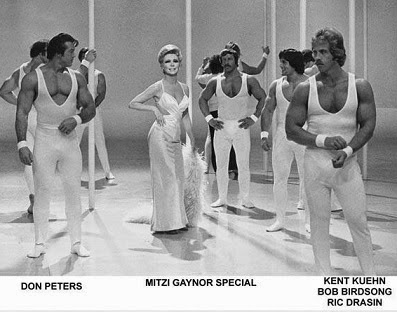
But the highlight is Mitzi crooning the Irving Berlin torch song "Always" while bodybuilders in jock straps surround her.

At least, I remember jock straps.  But, thanks to the internet, I see that they were wearing white pants.  And I can identify them.


1, Don Peters (1931-2001), a five-time Mr. America winner who also posed for the gay-porn photos of Bruce of L.A.


2. Kent Kuehn, a three-time Mr. America who appeared with Arnold Schwarzenegger in Stay Hungry (1975), the film that popularized bodybuilding.


3. Bob Birdsong (b. 1948), who appeared in two gay porn films, California Supermen (1972) and Loadstar (1973) before winning the 1975 Mr. Universe title. He later "found Jesus," got a "beautiful wife" and started a ministry.


4. Ric Drasin (b. 1944, recent photp), a bodybuilder, professional wrestler, and actor, with credits ranging from Ben (1972) and Sextette (1978) to The Shield (2004).  He is also a spokesman for Gold's Gym and a wrestling instructor.

Apr 18, 2023

Donny Osmond

Another performer who made gay teenagers swoon was Donny Osmond.  Originally the rascally "cute kid" in the Osmond group, he began his solo career in 1971, while still a 13-year old soprano, with "Sweet and Innocent." A string of hit singles and albums followed, mostly covers of pop classics from the 1950s -- with a twist.  Donny -- or his managers -- eliminated pronouns and the refrain of "girl!" to ensure that the object of his devotion could be male or female, thus doubling the potential audience.

For instance, in his cover of the Four Preps’ “Big Man,” Donny tells a former lover that he once he felt like “a big man,” but now that they have broken up, he feels small -- “boy, you oughta see me now.”

 “Boy” can be an intensifier regardless of the person being addressed, but after hearing 10,000 songs with “girl!” as every other word, it called attention to itself, making it seem to me that Donny was actually addressing a boy.

Similarly, in “Sweet and Innocent,” Donny either gender-bends himself into a girl or openly alludes to a same-sex love:

Lots of boys are gracious, and lots of boys are true,
 But they can’t make me feel the way I do when I’m with you.

In other words, he has had many previous relationships with boys. They were “true,” they didn’t seek out other partners. But his current boyfriend is far superior.

The most evocate of Donny's  albums, A Time for Us (1973), omits heterosexual desire almost completely. In the titular “A Time for Us" (penned by gay-friendly Johnny Mathis), Donny asks his beloved to imagine a future when “dreams so long denied can flourish, as we unveil the love we now must hide.” Fifteen-year old boys and girls rarely hide their loves; they are busy hiring limos for the junior prom, while parents snap photos to place on the mantle, friends pat them on the back, and teachers beam with satisfaction. But a boy's love for a boy may well be a “dream denied.”

At least, that's how I understood it in 1973.

Donny never did any shirtless shots for the teen magazines, but he was dreamy, with thick hair, brown eyes, and a bright smile, and as he grew into adolescence and then adulthood, he filled out his sequined jumpsuits well.

During my sophomore year in high school, my friend Rita used God's Infallible Promise to "get" Donny as her future husband.

An expert at reinventing himself, he transitioned seamlessly to an adult performer who still packs in the crowds.  He's guest-starred on countless television programs, showcased in Vegas, and performed on Broadway. His Broadway show Joseph and the Amazing Technicolor Dreamcoat, which became a 1999 movie, gave audiences something they'd been dreaming of for 30 years: extensive views of Donny's physique.


Donny Osmond is a devout Mormon and staunch advocate of “family values”; but, unlike his younger brother Jimmy, he's not complicit with his church's condemnation of gay people.  He happily acknowledges that about half his fans are straight women and the other half gay men.

Jan 17, 2023

Saturday Night Live and the Ambiguously Gay Bill Murray

Chevy Chase
In the spring of 1976, during my sophomore year at Rocky High, my friends started talking about a new late-night tv program, with musical numbers and comedy sketches.

"A variety show!" I exclaimed in disgust, thinking of Carol Burnett, with its boring sketches and songs from the dinosaur era.

No, this is different!  Songs by ABBA and Paul Simon!  Spoofs of tv commercials! The cast is young, our age!

So at 10:30 on February 21st, 1976, I heard the words "Live from New York, it's Saturday Night" for the first time.

The guest host was Desi Arnaz, who starred on I Love Lucy in the 1950s.  At that time I had never actually seen an episode, but I had heard of it, so I was mildly amused by sketches involving failed I Love Lucy Pilots (one was I Love Louie, with him married to jazz musician Louie Armstrong!)  


I didn't see it again until April 17th, 1976. I had never heard of the guest host Ron Nessen (Press secretary for President Ford), but I liked a short film about men singing at a urinal, and Weekend Update, with Emily Litella (Gilda Radner) riffing on "Presidential erections" (of statues).

On April 24th, 1976, the guest host was 1960s icon Raquel Welch.  The men kept trying to get her to take her top off and display her breasts.  I didn't like that, but I liked the sketch "One Flew over the Hornet's Nest," where the Bees weren't allowed to watch the Oscars on tv, and the musical guest, Phoebe Snow, singing "All Over":  "The night queen fright wig street Parade may fade, when we laugh at the statues of gods we have made."

And on like that through high school and college, watching occasionally, when I was home and there was nothing good on Creature Feature.  Pleasant but not hilarious, cozy and intimate, like the kinds of spoofs you do among friends.


Occasional gay references, especially in 1977, when Bill Murray joined the cast; he was so flamboyant, with a Castro Clone moustache and a shirt unbuttoned all the way down his chest, that we all assumed he was openly gay.  (Meatballs in 1979 "confirmed" the rumors.)

For the next few years, everyone between age 15 and 30, male or female, gay or straight, knew "I'm Chevy Chase, and you're not," "Jane, you ignorant slut," "Land Shark," "Cheeseburger cheeseburger coke coke," and "Oh, no, Mr. Hands."  It was a set of common references for everyone age 15 to 30, male or female, gay or straight.  It was one of the few places in the "straight world" where I felt like I belonged.

When I moved to West Hollywood in 1985, it came on at 1:30 pm, when I was either out or otherwise occupied.  Besides, I was living in a "good place," so I didn't need it anymore.  

During the 1980s and 1990s, I only saw a few glimpses here and there.  I remember the Church Lady, Michael Myers singing about masturbation, and a homophobic sketch about how horrible would it be to allow gays in the military.  According to Saturday NIght Live: An Oral Hisotry some of the cast members, notably Chevy Chase, were extremely homophobic.

But the phrase "Live from New York, it's Saturday Night!" still brings back memories of high school, when the whole world was fresh and new.

Jul 3, 2021

Steve Lawrence: All the Sad Young Men

Steve Lawrence and Eydie Gorme were mainstays of The Carol Burnett Show during the 1970s, appearing in 27 episodes.  He also appeared by himself on The Hollywood Palace, Ed Sullivan, Laugh-In, Here's Lucy, even Sanford and Son.


When I was a kid, I disapproved of adult music as a point of pride, so I avoided him whenever possible,  although I remember a gently anti-War song on Carol Burnett: Steve is recounting the horrors of War to his son (played by a teddy bear), who doesn't understand, and keeps asking eager questions like "Did you kill anyone?  Did you have any fun?"   Finally he says "Daddy, bring me some war," becoming a bona fide hawk (not likely for a kid during the Viet Nam era).

And "The Ballad of the Sad Young Men":

All the sad young men, sitting in the bars
Knowing neon nights, and missing all the stars

All the sad young men, drifting through the town
Drinking up the night, trying not to drown

All the sad young men, choking on their youth
Trying to be brave, running from the truth

I didn't know what "gay" meant yet, but I interpreted the song as a critique of gay men who were too stupid or scared to resist heterosexist brainwashing: they kowtowed to Big Brother, dutifully seeking out women to date and marry, and never experiencing real, true, meaningful same-sex romance.

(I may have been a little off in that interpretation: it's the title of a book of short stories by F. Scott Fitzgerald.)

Steve had the looks and the voice, but he never tried to make it as a teen idol.  Maybe he started a few years too early, in 1952, before the teen subculture really took off with Elvis and Ricky Nelson.  Or maybe his songs were too square even for the 1950s: "The Banana Boat Song," "Autumn Leaves," "Pretty Blue Eyes."   But he was on the Adult Contemporary Charts though the 1970s.

He acted in a few movies, playing a stay-at-home husband in the "women's lib" comedy Stand Up and Be Counted (1972), and as Maury Sline, manager to The Blues Brothers (1980).  

He's 85 years old in 2021, and struggling with Alzheimer's.  I haven't been able to discover if he was gay friendly earlier in his life.  Men of that generation always kept silent.

Mar 19, 2021

Don't Cry Now: David and Andy Williams

Born in 1960, twins David and Andy Williams (the latter named after their famous crooner uncle) began their teen idol career performing on Uncle Andy's variety show -- true, no kids watched, but that's how the Osmonds got their start.

Two albums followed.; Meet David and Andy Williams (1973) and One More Time (1973).  They consisted mostly of covers of old r&b classics, like "Baby Love" (The Supremes), "Going Out of my Head" (Little Anthony & the Imperials), and "I Won't Last a Day Without You" (The Carpenters).  Their vocal range and expression rivaled anything that David Cassidy could do.


Unfortunately, I didn't know it at the time.  I didn't buy their albums -- no one I know did.  And their singles weren't playing on the radio.  "I Don't Know Why" did the best, hitting #37 in March 1973.  Maybe their music was just a little to mature for kid audiences, like Craig Huxley's a few years before.

I only knew them from the teen magazines, which were predictably ecstatic, published dozens of pictures of the duo -- not a lot of shirtless or swimsuit shots, usually in soft, fluffy sweaters, with captions that might or might not be suggestive: "Come snuggle with us!"; "Check us out, top to toe!"  But who wanted to see such slim, soft, fragile-looking boys with their shirts off?  They probably didn't have any muscles at all..

They thought their career would jump-start with a January 1974 guest shot on the wildly popular Partridge Family: they had a crush on Laurie Partridge, and sang "Say It Again."

It turned out to be their swan song.  After another album and a few more guest appearances, the duo vanished.

But not really.  They opened for Roy Orbison and Susan Vega, played back-up, toured with T-Bone Burnett's band, and studied music.  They shifted their emphasis from bubble gum pop to a gutsy, hard-driving country rock, and released new albums -- Two Stories, Harmony Hotel, The Williams Brothers.

 David recognized that he was gay in 1979, and their music began to reflect the anger of facing homophobic bigotry and injustice every day, as well as other themes that can resonate with gay and heterosexual fans:

"Secretly" reveals the heartache of not being able to tell anyone about your love.

"Don't Cry Now" is a tribute to friends who died of AIDS.

"People are People": we're all the same inside, regardless of "religion, sexuality, color, or nationality."

They don't look soft and fragile anymore.


Nov 23, 2019

Razzle Dazzle:1970s Variety Shows

When I was a kid, I hated variety shows like Carol Burnett. even though the dancers wore tight pants.  So I tried my best to avoid the several thousand comedy-variety hours that populated the late 1970s.
But sometimes it was impossible.  They kept featuring movie superstars, or they were squeezed in between shows I wanted to watch, or my brother, a big fan of 1970s music, thought they were cool.

After a tv special in November 1976, The Brady Bunch Variety Hour appeared in January 1977.  It was a must-see because I wanted to know how the Brady kids had grown up. Barry Williams and Christopher Knight were dreamy, of course, but the big surprise was Mike Lookinland, still a kid when The Brady Bunch ended, but now, three years later, grown into a teenage hunk who was poured into his white leisure suit.  Bobby Brady is packing!

You could almost overlook the tacky costumes, weird numbers ("Do the Hustle") and crazy plot twists (Lee Majors and Farrah Fawcett asleep in the Brady living room?).

And the 1970s guest stars they kept trotting out to boost ratings: Vincent Price, H.R. Pufnstuf, The Hudson Brothers, Paul Williams.


But really it was about the blossoming of Michael Lookinland.

By the way Michael was the only Brady to do a lot of non-Brady projects during the 1970s, including The Mighty Isis with Tommy Norden of Flipper, a Disney movie with Mitch Vogel, and this commercial, apparently about putting him into the tighest pants they could find. 


On Saturday mornings in 1974, after Shazam!, there was nothing on but The Pink Panther and the laughtrack-infused Hudson Brothers Razzle Dazzle Show, starring three middle-aged men with blatant bulges and disco shirts opened to reveal slim hairy chests.

About those bulges....the one on the right might as well be naked.  You know exactly what he's packing.

The Hudson Brothers, Bill, Brett, and Mark, had some minor hits such as "So You Are a Star" and "The Truth About Us," but in the Leif Garrett era they weren't pretty or androgynous enough to draw a lot of teen idol attention, even though they made a whopping 16 episodes.

Brett, the youngest of the group (only 24 in 1977) has been the subject of some gay rumors.


The Keane Brothers had the opposite problem -- they were aged 11 and 12 when their show (called The Keane Brothers, naturally) appeared in the summer of 1977. The youngest kids ever to host a prime-time variety series, they were too young for most teenagers to consider adequately dreamy.

How did they get big names like Burt Reynolds, Betty White, and Andy Williams to guest star?

And whose idea was it to put them up against Donny & Marie on Friday nights?  No wonder they just lasted four episodes.


Teen magazines sort of skipped over them.  I don't know what this photo is about.  Maybe the photographer talked Tom into a shirtless shot, but he chickened out at the last minute.

And then there was Tony Orlando and Dawn, The Bay City Rollers Show, Sonny and Cher, The John Davidson Show, The Jacksons, Shields and Yarnell, Pink Lady and Jeff.

See also: The Brady Bunch Dad

Related Posts Plugin for WordPress, Blogger...