Mar 18, 2014

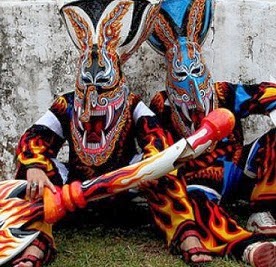
The Naked Ghost Festival of Thailand

When I visited Thailand, I was busy dealing with my ex-boyfriend Alan's drama.  So I didn't have time to drive 6 hours north of Bangkok to Dan Sai, near the Laotian border.

It's a small town with a folk museum and a famous pagoda, but not much else to draw tourists away from Bangkok and Pattaya.  Except for the Phi Ta Khon Festival ("Ghosts with Human Eyes"), held every year at different times depending on the spiritual conditions (in 2014, on the weekend of June 27th).


It commemorates an event in the life of the Buddha's last incarnation, Prince Vessantara.  He fell asleep, and his followers thought he was dead.  They decided to celebrate his escape from samsara, and made so much noise that he woke "from the dead."

The festival begins begins with a Buddhist ceremony that invokes guardian spirits, followed by a procession of the men in the village, nude except for rice-husk loincloths, covered with river mud, waving giant wooden phalluses of various sizes and shapes.


The male spectators wave phallic charms (paladkik) or giant phalluses of their own, inscribed with characters meaning "Big Man."  Apparently guardian spirits likes penises.


On the second day, there's another parade (Hae), with more semi-nude men, but generally more elaborate costumes of ghosts and monsters, with ornate masks.  Crossdressing is common.  As are penises so large that they're hard to carry.


There are prizes for the best costumes and dances.  Plus phallic rockets (Bangfai Ko) and partying all night.

The third day is devoted to Buddhist sermons, prayer and meditation.


Mar 16, 2014

The Innocents: In the South of France, Everybody Wants Everybody

Movies and tv programs typically permit same-sex relationships only when they are interracial.  The racial stratification "stands in" for gender stratification, male-female transposed into white-black in America, British-Indian in Britain, and in France French-Arab.

In The Innocents (1987), André Téchiné uses several French-Arab relationships to mirror the tensions between France and its former colonies.

The gay teenager Alain (stage actor Stephane Onfroy, in his only film appearance) has been living in the southern port city of Toulon with the Algerian Said (Abdel Kechiche), a thief and hustler.


Said's main client is the German musician Klotz (Jean-Claude Brialy), who has an Arab fetish.

Alain's sister Jeanne (Sandrine Bonnaire) arrives to look for a reconciliation, and moves in with Said and Alain.

She begins relationships with both Said and Klotz's son Stéphane (Simon de la Brosse), who is bisexual also, but has a mysterious antipathy to Said.  She suspects that they were formerly lovers.


Confused yet?  Don't be: just think "Everybody is interested in everybody," and concentrate on the beach scenes.

Turns out that Stéphane belongs a radical racist organization which set fire to an immigrant hostel, and was stabbed by Said in retribution.

They argue over Jeanne, and Stéphane has his organization target Said.

The only innocent is the gay teenager, Alain.

Many of the cast members have a gay connection.

Simon de la Brosse (1965-1998) was working as a waiter when he was discovered by gay talent agent Dominique Besnehard. for the heterosexual-awakening Pauline at the Beach (1983).  He was reputedly gay or bisexual in real life.


Jean-Claude Brialy (1933-2007) was gay.

Abdel Kechiche went on to direct the lesbian-themed Blue is the Warmest Color (2013).

The movie is not out on DVD, but you can see it on Full TV


Mar 14, 2014

Benito Cereno: Master and Slave Become Lovers

Speaking of beefcake covers on classic novels, check out this cover to the new edition of Benito Cereno (1855), by Herman Melville, the gay author of Moby-Dick and Billy Budd.

Plus there's a nice gay subtext:


Captain Delano of the ship Bachelor's Delight is approached by a mysterious semi-derelict ship, with both white sailors and slaves begging for supplies.  The captain, Benito Cereno, has an oddly physical relationship with his slave, Babo.    Gradually Delano comes to realize that the slaves have rebelled, killed most of the crew, and ordered Cereno to sail them back to Africa.  Babo, the leader of the rebellion, is tried and executed.


But it's not just a matter of a master becoming a slave.  After Babo's death, Cereno is disconsolate.  He falls into a deep depression and dies soon thereafter.  Their bond had become not only physical but emotional.  They were lovers.

The story was made into a French movie in 1969, with Ruy Guerra as Benito Cereno and Tamour Diop as Babo.


Another, The Enigma of Benito Cereno, is due in 2014; it makes Babo bisexual, with a female lover.

In 1964, Robert Lowell staged a one-act adaptation with four speaking parts: Captain Delano, his mate John Perkins, Benito Cereno and Babo.

It has been performed often, most recently with Rafael de Mussa as Benito Cereno and Jaymes Jorsling as Babo.


Mar 12, 2014

Naadam: The Mongolian Festival of Manly Arts

When I was at Indiana University (1982-84), I was ostensibly studying for a M.A. in English, but there were so many options that I ended up rushing around all over campus, taking courses in Mandarin Chinese, Russian folklore, South Asian anthropology, and even Mongolian Civilization at the Department of Central Asian Studies.

The professor told us abut the Naadam Festivals that celebrated the Eriin Gurvan Naadam, Three Manly Arts: wrestling (Bokh), horse racing, and archery.  The biggest is held in the National Sports Stadium in Ulaan Bataar and broadcast on national television, but there are smaller Naadams every July across the country.


Wrestlers wear a distinctive costume: a short jacket that just covers the arms, tight-fitting shorts, a cord around the belly, and leather boots.  There are no weight or age divisions, so it is common to see men of vastly different sizes competing.  The goal is to get your opponent onto the ground without touching his legs.

Every wrestler is accompanied by a zasuul, a combination coach and cheerleader, who encourages him with words, songs, and an occasional slap on the butt.


I was definitely interested in seeing hundreds of muscular Mongolian athletes in shorts grabbing at each other. Unfortunately, going to Mongolia was out of the question during the Cold War, and even today, it's a long haul for Americans, a 20-hour flight with layovers in Tokyo and Seoul. (Maybe worth the effort for bodybuilders, Buddhist monasteries, and the Kharkhorin Penis Stone).


But there are about 20,000 Mongolian immigrants in the United States and Canada, and every July since 2000 they have been holding their own Naadams in Vancouver, British Columbia; San Francisco; New York City; Arlington, Virginia; and Bloomington!

Because of space limitations, they usually omit the horse racing and the archery, and concentrate on the Manly Sport of Wrestling. Plus dancing, cultural displays, and food.

I never saw Westerners participating, but they did on this episode of Last Man Standing.


Related Posts Plugin for WordPress, Blogger...