Showing posts with label Victorian. Show all posts

Sep 29, 2025

"House of Guinness": Heirs to a beer empire in 1868 Ireland. With a gay brother, shirtless hunks, Irish hiphop, and a heck of a lot of d*cks


Link to the n*de dudes


I've been having trouble recently, beginning reviews of movies and tv shows and then not liking them, or when I like them, there's no gay representation or beefcake, so I can't review them here.   So this time I cheated by checked in advance: House of Guinness has a gay character, and lots of the actors have appeared n*de.

Episode 1 Prologue
: Closeup of the beer-making process, with the ingredients, water, hops, and so on.  A sweaty bare-chested bloke adds the fire.  I like this tv series already.  Then comes family, money, and rebellion.  


Scene 1: St. James Gate, Dublin, 1868:
  As Foreman Rafferty (James Norton, left) walks through the factory, a dude asks if there will be trouble today. Of course, there's always trouble with the Guinness Family. 

Outside, someone throws a beer bottle at the logo, and Prohibitionists burn an effigy of Benjamin Guinness: "A brewer of sin and debauchery!"  His funeral is today, and they are intent on preventing his procession from making it to the church.

The Temperance Movement was nearly as popular in 19th century Ireland as in the U.S., attributing almost all crime, poverty, disease, and insanity to alcohol consumption.  

Meanwhile, Fenian Leader Patrick (Seamus O'Hara) tells his followers than the Guiness heirs  are weak and divided, so this is a perfect time to free Ireland -- by attacking the funeral procession!  "Grab whatever weapons you can find, but spare the horses -- all horses are Catholic."

England occupied Ireland until 1922, forbidding the use of the Irish language, discriminating against Catholics, and promoting stereotypes that are still common today.  There were lots of revolts, rebellions, and terrorists acts, notably from the Fenian Brotherhood.

In the factory (very impressive set, lots of workers), Foreman Rafferty tells the men to arm themselves.  They have to fight to get the boss's corpse through to the church.

The battle is accompanied by the hiphop song "Get Your Brits Out," by Kneecap. Ordinarily I dislike contemporary music in a historical drama, but not when it's mostly in Irish:

Ach Stalford agus an DUP
Gach lá, taobh amuigh de mo theach
"Go back to Dublin if you want to rap"
Anois éist, I’m gonna say this once
Yous can all stay just don’t be c*nts


Scene 2:
 Iveagh House, the Guiness family home (built 1736, now the headquarters of the Department of Foreign Affairs and Trade).  Femme, decadent Edward (Louis Partridge) complains that his button-down conservative brother Arthur (Anthony Boyle) has been in London so long, he's lost his Irish accent.

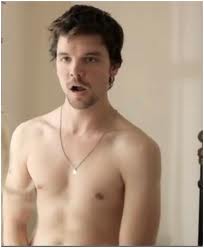
The third brother, Benjamin (Finn O'Shea, top photo) is asleep on the couch, still hung over from one of his benders.

They discuss the hypocrisy of everyone pretending to grieve, when the Irish hated him, and the English are happy that he is gone: now they can manipulate the children.  

Sister Anne tells them to shush their bickering; it's time for the funeral, and they have to act like a civilized Christian family: "Decadent Edward, change your shirt. Drunken Benjamin, change into some clothes you haven't slept in. Conservative Arthur, just change." 

More after the break

Mar 21, 2025

The cringe c*ock of "Angels and Insects"


Link to the c*ocks


 I don't usually use the contemporary term "cringe" as an adjective.  It's from a later generation, so it feels weird, but it is completely appropriate to describe the famous p*enis scene in Angels and Insects (1995).

Everyone in West Hollywood saw Angels and Insects when it premiered, due to the rumor of the p*enis.  Male frontal n*udity was vanishingly rare in mainstream movies in the 1990s, and rumor had it that this guy was actually up!

After 30 years, I've forgotten everything about the movie except for the cringe p*enis and people actually being insects, so I looked up a plot synopsis.

In Victorian England, entomologist William Addison (Mark Rylance, top photo) gets a job cataloging the insect collection of baronet Sir Harold Alabaster (Jeremy Kemp).  

The name Alabaster makes me cringe.


When you search for n*de photos of Jeremy Kemp, this pops up.  I doubt that it's the same one.

Yes, I'm stalling.


William, of course, falls in love with Sir Harold's daughter Eugenia, an insect-obsessed young lady who dresses like a bug.  Actually, all of the women do, for a symbolic reason that I don't quite understand, but the movie won an Oscar for best costumes.

Eugenia and William get married and have some kids, but he is bewildered by her bedroom behavior, coldly rejecting him one moment and being voracious the next, so he starts an affair with a servant girl named Matty.

Mark Rylance has shown his d*k on screen several times, but in this movie we just see it under the sheets.


Meanwhile, William spars with Eugenia's brother Edgar (Douglas Henshall), a bigot and all-around sleazebag.

 One day William comes home unexpectedly to find Edgar in bed with Eugenia.  His sister!

He jumps up and displays his cringe p*enis.

In an interview Douglas Henshall said that standing-up was not part of the script.  He just happened to be up because he was in bed with an attractive lady, and the director decided to go with it.

This makes the p*enis even more cringe.

Eugenia explains that she has been sleeping with her brother for years.  In fact, their children are Edgar's, not William's.


William decides to leave her and go to the Amazon to catalog insects with servant girl Matty, who has an interest in entomology.

So, a movie about incest and insects.  I still don't get it, but we left the theater feeling slightly nauseous.  Sometimes a p*enis is not enough. 


Mar 12, 2025

Alice's Queer Wonderland


I first encountered Alice's Adventures in Wonderland (1865) when I was 8 or 9, in a scene from a ballet that appeared for a few minutes on tv at my grandmother's house one summer.  Later I found the text in a volume of the Junior Classics called Stories that Never Grow Old (along with such oddities as The King of the Golden River and Jackanapes).  I didn't understand most of it , and what I did understand was either horrifying or deadly dull.  Alice falls into a constantly-changing world where bizarre characters quiz her on her knowledge of arithmetic and poetry.  Most of them want to kill her. And it turns out to be a dream.

Besides, there were no cute boys or muscular men in it, although movie adaptions often feature hot actors, like Andrew-Lee Potts as the Mad Hatter (2009), left, or Jason Byrne as Pat the Gardner (1999), below.  Lewis Carroll liked little girls (a lot), but he detested boys.


Give me a nice, normal science fiction novel, like The Wonderful Flight to the Mushroom Planet or The Spaceship under the Apple Tree.

But in the spring of 1985, just before I moved to West Hollywood, the music video of Tom Petty's "Don't Come Around Here No More" used an Alice motif.  I reread Alice and its sequel, Through the Looking Glass, and found ample gay content.


1. No character displays even a hint of heterosexual interest. Lewis Carroll was utterly baffled by romance in general, and looked in horror at the day when Alice would grow up, and marriage would "summon to unwelcome bed a melancholy maiden."  Although there are occasional s*xual threats, such as the Duchess, who digs her sharp chin into Alice's shoulder as they walk (begin Freudian analysis here).

2. Male characters often come in domestic duos: the Mad Hatter and the March Hare, the Mock Turtle and the Gryphon, the Walrus and the Carpenter, the Lion and the Unicorn.

3. For all of Lewis Carroll's fear of romance, he populates his Wonderland with phallic symbols (the Caterpiller's mushroom, the swaying flamingo mallets, Alice with the elongated serpentine neck) and castration motifs (the Red Queen's constant cry of "Off with his head!").  He is very interested in the power and threat of s*xual potency.


4. The adult characters, with their lessons and demands, are trying to force Alice into the constraint of a proper Victorian girlhood, but she will have none of it.  She mangles her lessons, rejects advice, and fails utterly at domesticity when the child in her charge turns into a pig.  Gay kids understand, perhaps better than others, the malice of adult constraints, the "what girl do you like?" chant, the "when you grow up and get a wife" threats.

5. Like The Rocky Horror Picture Show, Wonderland uses madness as a substitute for the queer, the marginal, and the outsider.  "We're all mad," the Cheshire Cat tells Alice.  "You must be [mad], or you wouldn't have come here."


Aug 8, 2023

Jackanapes: Boyfriends in a Victorian Children's Story


When I was a kid ,there were only a few books in the house, so I spent many hours leafing through the nine volume Junior Classics (1956), an anthology of antiquated stories that someone born before horseless carriages were invented thought that modern kids should read, such as Alice in Wonderland and King of the Golden River.

As a nine or ten-year old, I often found the words too hard, the references obscure, and the plots disturbing. Julia Horatia Ewing's Jackanapes (1883), from the ironically entitled Volume 5, Stories that Never Grow Old, certainly qualifies: it starts with villagers who live on the Green talking about a sexton "who would be ninety-nine come Martinmas, and whose father remembered a man who had carried arrows, as a boy, for the battle of Flodden Field."

Ok: I didn't know what a Green was, or a sexton, or Martinmas, or Flodden Field.

And when I skipped ahead to the end, Jackanapes, whoever that was, had died.  Depressing.

Years later, in my college Shakespeare class, I heard the word again: Jackanapes was the nickname of Sir William de la Pole, who appears in Henry VI.  So I returned to the story, and found a Victorian model of same-sex love: a Bart Simpson troublemaker and his friend Tony, weaker, more cautious, and described as "beautiful."  The two smoke cigars, get sick on a merry-go-round, and concoct schemes to get money to buy horses.

Fast forward twenty years, and they are British calvary officers (and not married).  In the heat of battle, Tony falls off his horse and breaks his leg.  The enemy is approaching fast, but Jackanapes rushes over and prepares to lift Tony onto his own horse.

"Jackanapes! It won't do. You must go on. Tell the fellows I gave you back to them, with all my heart. Jackanapes, if you love me, leave me!"

There was a daffodil light over the evening sky in front of them, and it shone strangely on Jackanapes' hair and face. He turned with an odd look in his eyes that a vainer man than Tony Johnson might have taken for brotherly pride. Then he shook his mop and laughed at him.

"Leave you? To save my skin? No, Tony, not to save my soul!"

Jackanapes then rescues Tony, though it means that he will die.

The rest of the novella involves the folk back home gossipping about Jackanapes' sacrifice, and the author moralizing about God and country.  But the gay subtext is strong, and clear, and survives the obscurity of the text.

Later I discovered that Victorian literature is filled with gay writers.  Julia Horatia Ewing was not among them.

Jan 11, 2023

King of the Golden River: Boy Meets Dwarf

Shortly after I was born, my parents bought a set of Colliers Encyclopedia and The Junior Classics, an anthology of mostly Victorian-era stories like Alice in Wonderland and Jackanapes. During my earliest childhood I often took them from the shelves and leafed through them, marveling at the odd illustrations.  I first tried reading them at age 8 or 9, but the antiquated language and obscure references made it well-nigh impossible.  Still, their very impenetrability was attractive, suggesting hidden codes and secrets, so over the years I tried again and again, finally encountering some amazing gay subtexts.

The King of the Golden River (1841) begins with a blustery, round person, "The North Wind," visiting an extremely girlish young man named Gluck.   From there, things get even more bizarre.  Gluck battles his older, bullying brothers, Hans and Schwartz, for a golden mug, which turns out to contain the imprisoned spirit of the dwafish King of the Golden River.  

Someone must travel to the source of the river and sprinkle it with "holy water."  The evil brothers try, but fail, and are turned into black stones.  Gluck tries, but gives the water away in acts of kindness, and is rewarded when the river turns into a river of gold.


There is no same-sex romance, but Gluck (played by Thor Bautz, left, in a gender-transgressive 2009 stage version) is quiet, sensitive, feminine, gay-coded.

And,  bucking the tradition of fairy tales ending with "they were married and lived happily ever after," he never meets a girl.  At the end of the story, he is old, wealthy, well-respected by the community, with no wife.  

That was, in itself, a revelation.


The author of King of the Golden River was John Ruskin (played by Tom Hollander, top center, in the 2009 tv series Desperate Romantics).  He was apparently heterosexual; like Lewis Carroll, he liked young girls.  But there is no evidence that he had a physical relationship with anyone.

His marriage to Effie Gray was annulled after six years, not consummated because "there were certain circumstances in her person which completely checked passion."  There have been many theories about what those circumstances were, but probably not the nude female form itself. (Effie later married his friend, pre-Raphaelite artist John Everett Millais).

He was a scholar of the Renaissance, who became aware of the practice of "the bestial vice."  Although he was quite homophobic, revealing that same-sex practices occurred at all helped to create the image of the "queer Renaissance," where gay people didn't have to hide.  Oscar Wilde said that studying under him at Oxford was one of the turning points of his career.

Apr 7, 2021

My Fair Lady: A Gay Couple in Edwardian England

My Fair Lady (1956) is one of my all-time favorite musicals, but there is no beefcake, so I'll illustrate it with some nude shots of actors who have played Henry Higgins in their other roles..

It's about an elderly gay couple in London at the turn of the twentieth century, Henry Higgins and Colonel Pickering,

Henry, an instructor of elocution, claims that language is the key to social status; he bets Pickering that he can take anyone of the lower class, give them elocution lessons, and pass them off as nobility.

Ok, why not try Cockney flower girl Eliza Doolittle?


Henry doesn't have much use for women, even as friends.  He is definitely a man's man.

Henry: Would you be slighted if I didn't speak for hours?
Pickering: Of course not!
Henry: Would you be livid if I had a drink or two?
Pickering: Nonsense.
Henry: Would you be wounded if I never sent you flowers?
Pickering: Never.
Henry: Well, why can't a woman be like you?

But he agrees.  Eliza moves into their house, and the lessons begin.


Everyone thinks that Eliza and Henry have an amorous relationship.  Henry's mother, who has suspected him of being gay for years, is delighted.

Eliza soon becomes indispensable in the household, keeping track of Henry' appointments and performing secretarial tasks.  She even gets a little crush on him.  Though he doesn't share her romantic inclinations, Henry begins to think of her as a friend and confidant.  He expects that, when the contest is over, she will stay on.

I've grown accustomed to her face
She almost makes the day begin
I've grown accustomed to the tune
She whistles night and noon


Learning not only "proper English" but art, music, and the norms of upper-class society, Eliza easily passes as an aristocrat.  Everyone congratulates Henry, not Eliza, who concludes that she was being used an experiment, and leaves in a huff.  But she is persuaded to return.

 Henry, never one for apologies, or hugs, says "Eliza, where the devil are my slippers?"  Curtain down.  The end.

That's right -- no fade out kiss.  There are hints that the two might become lovers, but they remain only hints, a heterosexual subtext in what is a rarity in musical theater, a plot about male-female friendship.


Of course, heterosexual critics and audiences try their best to force the text into the trajectory of a heterosexual romance.  Sometimes they don't even notice that Henry and Pickering are a gay couple.

Henrys: Jack Gwillam, Reg Livermore, Ian Richardson, Rex Harrison.

See also: Sherlock Holmes, Gay Icon and The Gay Connection in The Sound of Music.

Mar 31, 2021

"The Irregulars": Hetero-Horny Hunks Hired by a Heterosexual Sherlock Holmes


In the original Sherlock Holmes stories, there are a few scattered references to the "Baker Street Irregulars," street urchins that Holmes occasionally hires to gather information.  The hundreds of movie and tv adaptions of the stories have barely mentioned the Irregulars, so I was pleasantly surprised to see a Netflix tv series centering on them.

Scene 1:  Jesse, a teenage girl in a Victorian-style nightgown,  wanders through the woods encountering skeletons and monsters. Suddenly she wakes up -- just a dream!  She awakens Bea, the girl she is sleeping with, and asks "Am I losing it?"  The anacrhonistic slang is annoying, but two teenage girls sleeping together, one white, one Asian -- they must be girlfriends!

Whoops, no.  In the morning, Jesse, knowing that Bea is "desperate to find a boyfriend," gifts her with some French perfume.  "Just two sprays, and any man will want to make sweet love to you."  More anachronistis slang, and the heteronormative assumption that no gay men exist.  Ugh!


Noticing that Billy and Spike are missing, Bea rushes out into the horrible Dickensian slums that lie just beyond the glamorous world of St. Paul's Cathedral and Kensington Palace.  She pauses to sneer at 221B Baker Street, and r ushes into an underground fight club, where Billy (JoJo Macari) is making money by getting pummelled by bruisers.  Spike (McKell David) complains "I'm too pretty to be here.  My handsomeness makes me a target/"  For rape?  Is he worried about sexual assault because he's homophobic, or because he's gay?


Scene 2:
A feminine young man (Harrison Osterfield) stands in a palatial bedroom.  Maybe he's gay, one of Oscar Wilde's green carnation crowd? He looks out onto the lawn, where a cricket game is going on,  and sees a man and a woman kissing and a lady adjusting her garter.  Hetero-horniness!  I'm getting tired of this!

Turns out that he's Prince Leopold, Queen Victoria's youngest son (born 1853), kept inside all the time because of his hemophilia (in the show it's because of a "turned ankle").    For his birthday present, all he wants is to be allowed to leave the palace for a day.  

Cut to Leopold and his valet, Daimier (Edward Hogg), in a carriage going through the city.  This isn't what he meant!  

Scene 3: Bea yelling at Billy about his street fighting, while staring lustfully at his bare chest.  He was just trying to make money: they're two months overdue with the rent, and Jesse needs a psychiatrist (nope, not invented yet).

Spike tells about a dream where he's in the bath with an eel, which finds its way into his...more anxiety over anal sex.  Maybe he's gay.

Meanwhile Jesse wanders out into the street.  The others follow, and save her from being trampled by Prince Leopold's carriage.  Daimier the Vallet rushes out to yell at her for almost inconveniencing the Prince and not respecting "her betters."  This causes a row-- these kids are from the future, and don't accept the class distinctions that everyone accepted without question 150 years ago.  The Prince is mesmerized.


Scene 4:
Bea at her mother's grave, discussing Jesse's dreams and sleepwalking.  What if she's going crazy, like their mum?  Suddenly a well-dressed man approaches.  Bea runs away, but he follows her all the way home.  His name is Watson (Royce Pierreson), and he "wants something" from her, for which he will pay.

Scene 5:  He brings Bea to a rented room, and says "What happens here will remain between us."  If I didn't know the character already, I'd assume that he wants to pay her for sex. Why doesn't she think so?   

Actually, he and his "business associate" Sherlock Holmes want to hire her to investigate a case.

Business associate?  Ok, you want us to know that you and Holmes aren't romantic partners.  You're both heterosexual.  That leaves Spike, with his visions of anal intrusion.

 Four newborn babies have been stolen from locked rooms in the middle of the night.  The latest had a teenage sister sleeping in the same room.  The sister has since run away.  Since Watson and Holmes are not familiar with the haunts of teenage runaways, they need Bea to find her.  

Scene 6:  The gang starts working on the case.  Spike appears in a lavender suit -- ok, definitely gay -- and announces that he knows where the girl is.  He got the intel from his friend Pete, who owes him because he found his lost dog.

Billy: "Pete didn't lose his dog.  You stole it when you were trying to impress that girl who loves animals."

Spike is hetero, too?  I'm outta here.

Beefcake: Billy takes his shirt off.  Some of the bruisers at the fight club are hot.

Other sights:  Just an elaborate sound stage.

Anachronisms: The street kids act and talk like it's 2021.  I keep expecting them to whip out their cell phones.

Gay teases: Lots.

Gay characters: No!

Nov 14, 2020

"Come Away": Alice Liddel and Peter Pan are Half in Love with Easeful Death


I'm a big fan of all things Alice in Wonderland, and while I don't care for the Peter Pan mythos, the premise of Come Away (2020) sounded intriguing.  Alice and Peter as siblings who visit Wonderland and Neverland together?  And by the way, they're black.  Race relations in Victorian society!  So I plopped down my $19.95 to Vudu's Theater at Home service the day it started streaming.

And then I started kicking myself.  

1. Dreary, depressing, obsessed with death -- ok, no problem. -- have you actually read the Alice and Peter Pan books?  Stay a child forever, if you can.  Growing up is terrible.  You have to do icky things like get a job and get married, and then you die. 

Come, hearken then, ere voice of dread, with bitter tidings laden, shall summon to unwelcome bed ⁠a melancholy maiden!

2. Race is irrelevant Victorian society -- ok, no problem.  Maybe the black actors were cast because they aced their auditions. 

3. But it is unforgiveable to make us slosh through the melancholy, dreary, painfully depressing world of adults, where it's always winter but never Christmas (sorry, wrong book) to the bitter end, and Alice and Peter NEVER GO ANYWHERE!  

They're supposed to be exploring Wonderland and Neverland, for chrissakes!


The plot: Alice, Peter, and their older brother David live in dreary Victorian England with their progressive parents, Jack (David Oyelowo, top photo) and Rose (Angelina Jolie), having pretend adventures.  Then one day they are all playing pirates when David falls into the lake and drowns.  

The family falls apart.  Jack descends to a world of gambling, gambling debts, and child neglect.  Rose, delusional and about to die of grief, takes to her bed and drinks.  Snobbish Aunt Eleanor arrives, plotting to send Alice away to boarding school, which strikes me as an excellent idea, but is presented as a fate worse than death.  Well, a fate the same as death.  


Don't let the smiling faces fool you.  After the first five minutes, no one ever smiles again -- for the rest of their lives.

Alice and David try to ease their pain by rumbling through the Victorian underworld, encountering tawdry real-life versions of the characters and situations of Neverland and Wonderland  For instance, a Mad Hatter prototype runs the pawn shop where they are trying to raise some cash to pay Dad's gambling debts.  

But there is no Wonderland.  There is no Neverland.  There is no nothing.   

Peter, who blames himself for David's death and the destruction of the family, never manages to move on.  He "never grows up," vanishing into his father's world of gambling, drinking, and death.   Alice grows up, marries Mr. Darling -- the same thing as death -- has three kids (Michael, Wendy, and John), and writes the books as a form of grief therapy.

So if Peter Pan comes through the window, he will be Wendy's uncle?

The books were actually written by J. M. Barrie and Lewis Carroll, who were living in England during this period and occasionally smiled. Wouldn't it have been cool if Alice and Peter met them?

Or if, like, they actually had the adventures the movie promises?

This lying, deceptive piece of con-artist garbage reminds me of The Bridge to Terabithia, which also lures you in with the promise of an alternate world fantasy, only to punch you in the stomach: "Fooled you! This is a movie about a child dying, but you already paid, so we don't care."

Beefcake: No.

Gay characters: None specified.

Heterosexism: Alice and Peter are siblings, so thankfully no pre-teen falling-in-love.

My grade: F-.

Sep 27, 2020

"Enola Holmes": Sherlock Holmes' Smarter Sister Searches for Her Missing Mother/Girlfriend


Enola Holmes
 is the most watched flick on Netflix, a family-friendly, teen-friendly, girl-empowerment tale with Sherlock Holmes taking a tangential and completely unnecessary role.  

I was creeped out by it.

15-year old Enola Holmes (Millie Bobbie Brown) has been raised in Foxworth Manor by her free-spirited mother Eudoria (Helena Bonham Carter),  who taught her all sorts of things unfitting for proper Victorian girls, like archery, martial arts, playing tennis indoors, and...gasp...feminism.  Nothing wrong with that, but there is no one else in their lives.  At least Mom has secret meetings of her mysterious women's club, but Enola has no friends her own age, or of any age.  "We don't need anyone else -- we have each other."  They are constantly holding each other, hugging each other, sleeping together.  Good God, they are lovers!    

On the morning of Enola's sixteenth birthday, Eudoria disappears.  No note, no explanation, no sign that she was taken against her will, just gone.  


Enola's two older brothers arrive to take charge.  They have not visited since they fled to London many years ago, when she was a toddler (Why? Was Smother...um, I mean Mother trying to turn them into lovers, too?  I guess they figured that she was just interested in boys, so it would be safe to leave Enola alone with her.  They were wrong!).

The oldest brother, Mycroft (Sam Claflin), actually owns the house, and has been sending Eudoria money to pay for renovations that never happened and staff who were never hired.  (So Mom has basically spent ten years grifting her son.  Incest and fraud!  Nice lady!).  

He wants to send Enola to a boarding school, where she can meet some kids her own age, and maybe get over her creepy Electra complex.  But Enola considers the idea of meeting people besides her Mother/Girlfriend a fate worse than death.  "No!  Let me stay alone and be happy!  I don't need anybody else!  I have myself!"  Geez, she creeps me out.

To be fair, Mycroft is intent on the boarding school run by his "old friend" Miss Harrison (Fiona Shaw), obviously an ex-girlfriend, who teaches girls to be proper Victorian ladies and find husbands.  So it will constrain Enola's free spirit.  Still, there will be other girls there, not just Mom/Girlfriend and the housekeeper!


In order to search for Mom/Girlfriend, who left some cryptic clues to her whereabouts, Enola runs away.  On the train to London, she accidentally becomes involved in another story: someone is trying to kill the dreamy but utterly inept 17-year old Lord Tewksberry (Louis Partridge).  His father has just died, so he stands to inherit Dad's seat in the House of Lords, and cast the deciding vote on a controversial Reform Bill.  So now he has a target painted on his back.

Enola helps Tewksberry survive, and they have a few sparking moments of romance.  Uh-oh, Mom/Girlfriend will be jealous.  Then Enola sleuths out  who has been paying the hit men (it's not Mycroft).  And that's the story.  

Wait!  What about the mysterious disappearance of Mom/Girlfriend? Enola was supposed to use her sleuthing skills to unravel the clues and find her!  

Oh, she returns on her own.  But...then what's the point of all the setup?

Oh, and Enola's second brother is the famous detective Sherlock Holmes (Henry Cavill, top photo), who doesn't do anything.  He is apparently in the movie so that Enola can drop his name.

And there is no Dr. Watson.  But at least Sherlock doesn't express any heterosexual interest.

My grade: I didn't like the bait-and-switch plotline, and the mother/daughter incest is just creepy. But the sets are pleasant, and there was some racial diversity -- some black extras in the background, and Lestrade is South Asian.  C

Aug 31, 2020

The Top 9 DIckensian Hunks of "Dickensian"

If you're like most people, you had to read Dickens' A Tale of Two Cities in high school, and you know A Christmas Carol from the innumerable parodies and homages.  The only novels you've read willingly are Great Expectations and Oliver Twist.  The others are mostly a hodgepodge of half-remembered anecdotes.  Didn't they line up at the docks in America to see if Little Nell lived?  Didn't someone criticize Barnaby Rudge as "half genius, half fudge"?  Is it true that Nicholas Nickleby has 138 named characters?

Now image a tv series where many named characters from across the novles are living in London at the same time, interacting with each other.  Fun, huh?  Imagine Tiny Tim and Little Eva on a play date, or Ebenezer Scrooge courting Miss Havisham, or Bill Sykes joining Fagin in skulduggery.

The problem is, Dickensian stars many of the minor characters from the books, but none of the stars.  Oliver Twist, Pip, and Nicholas Nickleby are absent.  Other characters are changed beyond recognition.  Miss Havisham is in her 20s, not yet jilted by her fiancee, nor does it seem like such a jilting would faze the strong-as-nails, assertive, self-actualized heroine.

You're supposed to have fun recognizing the characters, but for most viewers, it won't happen -- wait, every version of A Christmas Carol shows Bob Cratchit with a wife, a teenage daughter, and a young son.  Who the heck is Peter Cratchit?  (In the book Bob has five kids).

Except for a few stars, you'd be better off taking Dickensian as a mid-Victorian murder mystery that becomes so involved and convoluted that you expect Sherlock Holmes to show up any moment.  But he's still a boy, and not Dickensian.

Let's just go through some of the main characters:

1. Amelia Havisham, cut off from  most of her father's fortune due to the sexist Victorian inheritance laws, sets her sights on the wealthy Compyson (Tom Weston-Jones, top photo)

2. She doesn't realize that he is conspiring with her brother Arthur (Joseph Quinn, left), who was also cut off because he is gay (not in Dickens).


3. Peter Cratchit (Brenock O'Connor), Bob's oldest son, begins dating Little Nell.


4 Jacob Marley is murdered, and Inspector Bucket (From Bleak House) suspects Scrooge, then Bob Cratchit.  Meanwhile he investigates Bill Sikes (Mark Stanley, left), and runs afoul of criminal mastermind Fagin (Anton Lesser)
There are various other interconnected plots, but I imagine you're anxious to get to the beefcake.


5. Oliver Coopersmith as John Bagnet from Bleak House


6. John Heffernan as Jaggers, from Great Expectations.


7. Ukweli Roach as Sergeant George from Bleak House.


9..  Winston Radjou-Pujalte as the Artful Dodger.

Oh, and Oliver Twist does finally show up.  Just as Miss Havisham is sitting amid the ruins of her cancelled wedding, and Scrooge is visited by the three Christmas ghosts.


Aug 13, 2020

Fall 1980: Billy Budd: Gay Sailor Romance

In the fall of my junior year in college, just after I cruised the Miracle Mile and bought my first gay book, I took a class in "The American Renaissance," the burst of creative energy in the mid-1800s: Emerson, Thoreau, Hawthorne, Whitman, Melville.

Our professor (not the one who taught the execrable class in Modern American Literature) admitted that Melville was "a little light in the loafers," but he tried to heterosexualize the texts as much as possible, so he merely claimed that Billy Budd (1888) was about a Christ figure destroyed by the world's evil.


The book cover tried to heterosexualize Billy Budd, too, conveniently placing a woman in the background.  But how could you miss the same-sex desire?  During the Napoleonic Wars, a young cabin boy, described over and over as stunningly handsome, draws the wordless longing of Captain Vere ("Truth") -- and the homophobic ire of Claggart, who falsely accuses him of conspiring to mutiny. While being interrogated, Billy accidentally strikes and kills Claggart, so under British naval law he must be hanged.

Billy forgives the Captain; his last words are "God bless Captain Vere."  But carrying out the sentence destroys Vere; his dying words are "Billy Budd."  I couldn't help but think of Aschenbach, destroyed by his obsession for the beautiful Tadzio in Death in Venice. 


TV adaptions of the novella have appeared twice, in 1955 (with William Shatner) and in 1959 (with Don Murray).


 There's also a 1962 feature film, with Billy played by Terence Stamp (later in Meetings with Remarkable Men and Priscilla Queen of the Desert). 


In 1951, gay composer Benjamin Britten produced an opera version, with libretto by gay novelist E.M. Forster.  It  has Vere survive to old age, when he reflects that once he knew what true beauty was.  It has been filmed in 1988 (with Thomas Allen) and 1998 (with Dwayne Croft), and remains a staple of the theater.  

Recent productions feature a shirtless, muscular Billy, such as those performed by Nathan Gunn (above) and Simon Keenlyside (left).

Also see his gay-subtext filled Benito Cereno.

Apr 28, 2020

The Origin of My Peter Pan Nightmares

Peter Pan has a long, sinister, and disturbing history.  He began in the grieving imagination of 8-year old J.M. Barrie, when his brother David died in a skating accident the day before his 14th birthday -- at least a dead boy would stay a boy forever.  He took shape in Barrie's early novels about dead and dying boys, Better Dead (1888) and Sentimental Tommy (1896), and in stories Barrie told to the five Llewelyn-Davies boys, whom he met while walking his St.Bernard in Kensington Gardens in 1897.  And when his wife, actress Mary Ansell, was swept away by a mere boy, 24 year old Gilbert Cannan, in 1908 (by the way, Cannan published a novel called Peter Homunculus in 1909).

There is no indication that Barrie had any pederastic intentions with the Llewelyns.  Boys and men mingled without suspicion in those days.  In the stories, however, Captain Hook has an arguably homoerotic love-hate relationship with the Dead Boy.  When one considers that Barrie's Captain Hook and Daddy were played by the same actor, one wonders about the elder Barrie, a strict,conservative, Calvinist.

The baby who leapt from his tram in Kensington Gardens and lived in trees like a bird (that is, died) first appeared as a named character in J.M. Barrie's very Victorian childhood-equals-death novel The Little White Bird (1902).  Next came a stage play, Peter Pan, Or the Boy Who Wouldn't Grow Up (1904), based on the pantomime tradition, which is why Peter Pan and the Lost Boys were all played by women, and there was a dying fairy (the Edwardians loved long, slow, sentimental death scenes as much as we love things blowing up).  George du Marier, uncle to the Llewelyn Davies boys, played both Captain Hook and the Darling kids' father.  Hints of child abuse, anyone?


Next Barrie adapted the stage play into a novel,  Peter Pan and Wendy(1911).   Both play and novel became sensations, especially during World War I, with so  many boys dying in the trenches of Europe -- but they were forever young.

And adaptations began: news plays, movies, novels, cartoons, stories, songs, statues, with the dead boy becoming more playful, less sinister to keep up with the changing times.  My favorite is Malcolm, the evil Peter Pan of Once Upon a Time (Robbie Kay, shown with some of his Lost Boys in the top photo).  My least favorite is the 2003 movie version,  with a barely-pubescent Jeremy Sumpter in a pedophile-dream costume, and a hetero-romance "girls are the meaning of life" conclusion.

A 1954 Broadway musical Peter Pan stayed true to its pantomime roots by casting a woman as the Dead Boy, and an older woman at that: 40-year old Mary Martin, who had previously starred in Annie Get Your Gun and South Pacific.  Cyrill Richard played both Captain Hook and George Darling  for more Freudian nightmares.  Although it was the exuberant 1950s, some other disturbing elements were retained:
1. The family is called "Darling," which is ridiculous.
2. The nanny is a dog in a nanny's cap played by a man.
3. Wendy sews Peter's shadow onto his feet. Imagine how painful that would be!
4. Blackmailing the audience to clap in order to keep a fairy from dying.
5. Amputation, mutilation, bombing, death, and near-death everywhere you turn.  Fun!
6. Growing up means dying.

Nevertheless, Neverland returned to Broadway in 1979, 1990, 1991, and 1998 (with Peter Pan played by Sandy Duncan and Cathy Rigby). 

The entire cast except for the children reprised their roles for a 1960 tv version -- restaged, so you were actually watching and hearing a stage show. This version was rebroadcast in 1963, 1966, 1973, 1989, and 1991. 

Photo: Kent Fletcher, who played Michael in 1960, forever a child in his only other film role, The Lord of the Flies (1963).

I think I saw part of 1966 rebroadcast.  I would have been 5 or 5 1/2 years old, too young for bizarre dog-human hybrids, shadows sewn onto bare flesh, murderous pirate-fathers, dying fairies, and growing up as the equivalent of death.  Since then Peter Pan has often appeared in my nightmares.


Related Posts Plugin for WordPress, Blogger...