Mar 30, 2023

"The Uncanny Counter": A Gay-Subtext "Buffy the Vampire Slayer" from Korea


The Uncanny Counter:
 "Noodle shop employees by day and demon hunters by night, the Counters use special abilities to chase down malevolent spirits that prey on humans."  Buffy the Vampire Slayer in Korea might be interesting, with demons derived from Buddhism rather than Christianity.  And it's a weekly series, which I actually prefer over dumping a whole season at once.  Plus one of the characters is bound to be gay.

Scene 1: Mom and Dad  (Gwon), drive their young son (Mun) through the dark suburban streets of Jungjin, Korea. They are planning to drop him off at his grandparents and go off by themselves, but when Mun paints them into his picture, they magically decide to stay with him.  Creepy powers, kid!

Cut to a rain-soaked young man, Detective Ga, standing on a building roof.  He calls Gwon: "Be careful!  Be sure you survive!  You have to!"  Then he jumps off the roof.

A truck crashes into the car.  The driver approaches., slowly, as Mun loses consciousness.

Scene 2:  Seven years later, the teenage Mun (Jo Byung-gyu, below) is trying to bathe his senile grandmother, who is combative and blames him for his parents' deaths: "You killed my daughter!  Why are you still alive?" Meanwhile Grandpa is making breakfast Personally, I would have Grandpa bathe ihs wife and Mun cook).  

Mun rushes to get dressed.  We see his  art awards, his superhero sketches.  He walks with a limp due to the accident.

Scene 3: On the way to the noodle shop Mun, Boy Friend, and Girl Friend (they don't get names) discuss they superhero characters for their video game or manga.  Mun insists that they stop to pick up a flier about a missing person. Maybe this will be important later?


Scene 4: The noodle shop is very famous, and packed, with a line around the block outside. It's run by people with super powers: when Young Man's kinfe breaks, Middle Aged Woman throws a new one across the room, and he catches it by the handle!. Meanwhile Young Woman carries four 50-liter jugs of water through the back alley.  Isn't the first rule of scriptwriting to identify your characters by name?. 

Young Woman has a vision of someone being killed, and rushes back into the noodle shop to announce that it's a Level 2, Maybe a Level 3.  They all leave their customers and jump into the  Mystery Machine.  Mun and his friends, who have been waiting in line, protest.

Mun and Boy Friend comment "She's pretty."  To identify themselves as heterosexual? 

Scene 5: The Demon Slayers  arrive at the demon-sighting location, put on red hoodies and black masks, and call the middle-aged Cheoi-jung, who is wearing a stupid-looking toupee.  He says he'll get there as fast as he can.

The Demon is a cute guy in a black hoodie.  They chase him over rooftops and fight him with Asian martial arts.  In the end, he gets away, Cheoi-jung is killed, and a ball of energy shoots off into the sky.  So far we've had four characters named, and three of them died immediately.

Scene 6:  Back at the noodle shop, Mun and his friends finally sit down to eat.  They gush annoyingly over how good the food is.  Even after they lealve, they continue to gush over the food.

Do we really need to spend five minutes of air hearing "it was so good!" over and over?  At least use a thesaurus!

The ball of energy zaps into Mun, who rises into the air, falls back down again, loses consciousness, and suddenly has the same bad toupee as Cheoi-jung!  

Scene 7: Mun goes home.  It's his birthday, so Grandpa made him a cake.  This is the first I'm hearing of it.  Neither of his friends mentioned that it was his birthday, or gave him presents.  Maybe that's the custom in Korea?

Scene 8: Mun washes his hair, but the bad toupee is still there.  He falls asleep and awakens in his bed on a vast, muddy lake.  An elderly woman introduces herself as Wi-Gen. And he wakes up.


Scene 9:
  In the library the next day, Mun discusses the experience with Girl Friend.   She kids him that it was an erotic dream.  Suddenly he sees the bullies extorting money out of Boy Friend. -- he finally gets a name, Ung-min.  

Mun intervenes, with a lot of gay subtext buddy bonding rhetoric: "You're my friend!  I would die for you!"

Head Bully (Lee Hong-nae), who has red hair to make him more sinister, happens to be the Mayor's son.

Scene 10: Scary Sunglass Guy climbs out of his limousine feet first. Interesting -- it's usually a woman who gets out of a car feet first, so the audience can perv on her high-heel shoes. 

He bows at the shrine set up for the memory of Cheoi-jung (who died in Scene 5). Then he visits the Demon Slayers and announces that the mourning period is over, so it's time to get back to work: the Level Three Demon captured Cheoi-jung's soul, but Wi-Gen (whom Mun dreamed of) got out and latched onto the body of a "splendid guy." He was just walking around, not even in a coma.

A boy possessed by the soul of an elderly woman!  Sounds interesting!

They are shocked.  How can someone who is not in a coma become a Counter?  

Scary Sunglasses Guy asks Mo-Tak to mentor the boy, make something of him, so they can catch the Level Three Demon who ate Cheoi-jung's soul. So, which one is Mo-Tak?

Scene 11: A male and female detective are bickering at the scene of Cheoi-jung's "suicide." Wait-- the morning period is over and they're still investigating?  Don't you mourn for like six months?

. Everyone criticizes the woman: "What an attention whore!  We need to get her married off!"  So, in Korea married women can't be cops?   

Apparently the police are in bed with the demons, so all of the evidence has been removed and destroyed.

Scene 12: The Mayor and his assistant discuss Cheoi-jung's "suicide" while passing protesters: "Keep our city safe!" "The mayor is killing our children!"  Uh-oh, the mayor is in bed with the demons, too.

Scene 13: At school. Boy Friend is angry with Mun for standing up to the bullies.  Now he'll be beat up, or even killed, which would be bad because...well, you know how I feel.   Girl Friend agrees with him: now they'll both be killed.  


Scene 14: On
the way home, Mun runs into the bullies, but they're more interested in taunting him and stealing his stuff than killing him.  Young Woman (is she Mo-Tak?) intervenes, beats up the bullies, and tells Mun "You'd better come with me."

She takes him to headquarters for pizza and an exposition dump: The Demon Slayers hunt down dead souls who have escaped from Hell   Mun thinks they're all crazy.

Aha! The Young Man is Mo-Tak (Yoo Jun-Sang, left).  He refuses to train someone so weak and wimpy.  

Middle-Aged Woman shows Mun how to visit the afterlife.  It looks different to evreyone, but for him, it's a vast muddy lake.  

More exposition dump: when bad people escape from the afterlife, they possess the body of a living person (Level 1), who gets superpowers.  The demon gradually takes over, and kills someone and eats their soul (Level 2).  The more souls they eat, the more powerful and evil they become, until they reach Level 3.   

I deduce that good people take over the living, too, and become Counters.

Scene 15: Back at headquarters, Mun says "thanks, but no thanks, the job is too dangerous, but I'll still come to your noodle shop."  They ask him to think it over.

Boy Friend calls: The bullies have kidnapped him, and Mun must meet them at the gym or they will kill him.  Rescuing your Boy Friend instead of a girl?  That's the definition of gay subtext!

Mun rushes to the gym.  They taunt him.  The end.


Beefcake: 
No, although some of the cast looks good shirtless.

Other Sights: Nice exterior shots.

Gay Characters:  Gay subtext romance between Mun and Boy Friend.

Names:  Most of the major characters don't get named.  I figured some of them out using wikipedia, but others are a mystery.   The top photo, for instance, is Jung Won-chang, who plays Shin hyuk-woo. He's not Mun, Boy Friend, Head Bully, or Mo-Tak   

My Grade: B-.  Points off for the five minutes of "These noodles are so good!"  "They are good!" "They are so good!" 

Mar 26, 2023

"Killer Klowns from Outer Space": Gayer Than You Think

Why have I not seen Killer Klowns from Outer Space (1988) before? Other than the ridiculous premise, that is.  It's a gay-subtext classic.

We open at a lover's lane, where some of the parked cars are not occupied by boy-girl couples!  There are two guys, and two guys and a girl!

Mike (Grant Cramer) and his girlfriend Debbie (Suzanne Snyder) are parked, but not kissing!

Why have I never heard of Grant Cramer before? I thought I was up on all the 1980s hunks.  It was my decade!


Let's have another look at Grant Cramer before continuing.

An ice cream truck passes by, run by the Lenny and Squiggy-like the Terenzi Brothers, Rich and Paul (Michael Siegel, Peter Licassi):  "We'll give you the stick -- you give it a lick."  Promises, promises.

Mike notes that he knew the boys from high school.  "Whenever you want a good time, you call Rich and Paul.  A night out with those guys is a real adventure."

Um...so you like hanging out with guys? Is Debbie actually your girlfriend, or a buddy?

Meanwhile, at the sheriff's station, two college boys are brought in for "boozing it up in the park."  One is wearing a New York t-shirt.  They had a bottle of wine.  Were they, like, on a date?

The Sheriff roughs them up, and when Deputy Sheriff Dave intervenes, asks if he's got a"thing" for them.

And we're only 12 minutes into this movie

Deputy Sheriff Dave is played by John Allen Nelson, seen here on Baywatch, but with blond hair.


Ok, I've got to ask, who did the casting for this movie, and why did they hire two super-hunks, when neither actually shows any skin?

On camera, anyway.

Ok...um...the story.

Mike and Debbie stumble upon an alien spaceship that looks like a circus tent, where  aliens who look like scary clowns attack them with popcorn-guns and a balloon animal that comes to life.

You have to admire the dedication to the premise.

They barely escape, and rush to tell Deputy Dave. He leads them into the station, his arm around....Mike's shoulders.

They take Debbie home and go off to investigate, Mike's hand never far from Dave's shoulder.  Dave appears to be Debbie's ex-boyfriend, and goes into a little spiel about how he still loves her, etc., etc.

Meanwhile the Klown invasion is in full force. They shoot ray guns at people to encase them in cotton candy cocoons, feed them to popcorn-monsters.  They attack a woman in the shower. She's not naked.

Lenny & Squiggy join the battle, using the clown statue on their ice cream truck to distract the Klowns.

They act like a gay couple, too.

Somehow Debbie is cocooned but still alive, so they rush to Klown headquarters to rescue her, Mike's hand on Dave's shoulder  Did those guys only just meet?

Dave sacrifices himself to save the day. The alien spaceship takes off, defeated.  Then Dave appears, unharmed, in a clown car shuttlecraft.   Debbie rushes up to hug him.  Then Mike rushes up, and all three hug.

Fade out to pies in the face.

I count three gay-subtext couples and no heterosexual hijinks except for a brief kiss.  Not even any female nudity.

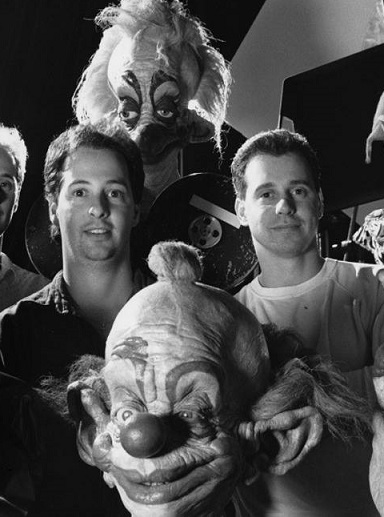
Producers/writers/directors Charles and Stephen Chiodo, along with a third brother, Edward, are well known animators, graphic artists, make up artists, and puppeteers, with projects as  I Go Pogo, Critters, The Lost Boys, Land of the Lost, Teenage Mutant Ninja Turtles, and The American Music Awards. This is their only full-length movie: apparently they created some scary clowns and wrote a script to go with them.  Gay subtexts were probably unintentional.

On the other hand, I was unable to find any reference to Charles Chiodo having a wife.  Maybe he's gay.

Mar 20, 2023

Bob Morane: James Bond without the Girls

When I was in high school in the 1970s, French class offered a practically infinite amount of beefcake-and-bonding riches.  If you tired of the Green Library, you could always move on to the Marabout Junior series, which featured adventurer Bob Morane.

Bob Morane was a former RAF pilot who worked as a reporter and freelance adventurer, often accepting secret-agent or detective assignments.  In later volumes he worked for the Time Patrol, going back to dinosaur times or fighting androids in outer space.

 There weren't a lot of illustrations, but those the books had displayed Bob with a massive chest, usually when one of the bad guys (such as Ming "The Yellow Shadow") had him strung up for weird torture.


Bob's best buddy, a Scotch bodybuilder  usually traveled with him to provide the gay subtexts, and get strung up for a series of "my hero!" rescues.


Ok, there were some girls. But I don't remember Bob actually having sex, and the girl-chasing was minimal, far less than in James Bond.


Belgian author Henri Vernes published 12 volumes of Bob Morane's adventures (1958-67).  Most have been translated into English. There have also been over 100 bandes-dessinee (which I haven't read), a 1964-5 tv series (with Claude Titre as Bob Morane and Billy Kearns as Bob Ballantine), a 1998 animated series, and some tie-in video games and toys.

Mar 18, 2023

Beefcake Dads of 1950s Sitcoms

During the late 1950s and early 1960s, there was a fad of nuclear family sitcoms, set in small town Mayfields, with a pipe-smoking Dad, a Mom who did housework in high heels, groovy teenagers, and wise-cracking preteens.  They actually weren't very popular at the time; adults preferred Westerns, swinging detectives, and musical-variety shows.  But the first generation of Boomers remembers getting their first glimpses of what family life was like -- or what they thought it should be like -- from the nuclear family sitcoms.

They generally identified with and/or mooned over the teenage boys: the muscular physiques of Bud (Billy Gray) of Father Knows Best and Wally (Tony Dow) of Leave it to Beaver, the blatant bulges of Ricky and David Nelson (Ozzie and Harriet), the teen idol cuteness of Jeff (Paul Petersen) of Donna Reed.  But there's a lot to be said for the dads, too.

Unfortunately, they weren't always as gay-friendly as their tv sons.

1. Born in 1906, bandleader Ozzie Nelson and his wife, former dancer Harriet, started The Adventures of Ozzie and Harriet on the radio in 1944. They transitioned to television in 1952, and lasted until 1966, making Ozzie and Harriet the longest-running fictional program on radio/tv.  Still not satisfied, he tried a spin-off, Ozzie's Girls, in 1976 (in which Ozzie takes in three college girls as boarders).

Ozzie and Harriet had many gay friends in real life, although no openly gay characters appeared on their show (that would have been impossible in the 1950s).


2. Robert Young (here apparently informing us of his size) was not only less than adequate physically, he was homophobic.

After his tenure on Father Knows Best ended, he starred in Marcus Welby, M.D., one of the most homophobic tv series of the 1970s.  In one episode, Dr. Welby diagnoses a man with "homosexual tendencies," but assures him that with the proper counseling, he can overcome his affliction.  In another, he treats a gay pedophile, with the implication that all gay men are pedophiles.  Gay activists protested, but the network -- and Dr. Welby -- wouldn't budge.

3. Born in 1909, Hugh Beaumont started out as a minister, but moved into acting during World War II.  Although a devout Methodist, he played his share of scoundrels, in Apology for Murder (1945) and The Blue Dahlia (1946), plus hard-boiled detective Mike Shayne.  Leave It to Beaver was meant to be a change of pace, but he was so typecast as Ward Cleaver that he took only a few roles afterwards, and ended up retiring to grow Christmas trees.

No data on whether he was a gay ally or not, but apparently his tv wife, Barbara Billingsley, was nonchalant about gay people.


4. The youngest of the 1950s sitcom Dads, ex-football star Carl Betz was only 36 when he was cast as Dr. Alex Stone, husband of the practically-perfect Donna Reed.  He had been making the rounds of tv adventure series, with guest parts on The Big Story, Waterfront, Sheriff of Colchise, Panic!, and Perry Mason, and he continued to be a sought-after performer throughout his life.

While he was playing the titular lawyer in Judd for the Defense (1967-69), one of his clients was a father who thinks that his son's friend is "recruiting" him into the "homosexual lifestyle."  Judd assures him that there's no cause for believing such a scandalous rumor.

Related Posts Plugin for WordPress, Blogger...