Showing posts with label 1960s. Show all posts

Jul 22, 2026

The Fate of "Gilligan's Island": The castaways are rescued, mentor a child star, play basketball with robots, and blast into space


What Boomer kid doesn't get all wispy and nostalgic upon hearing "Just sit right back, and you'll hear a tale, a tale of a fateful trip..."

Gilligan's Island (1964-67) was an iconic Boomer tv series, part of the "lost far from home" genre, about seven people who set out from Hawaii on a "three hour tour" and ended up shipwrecked on a desert island.  We didn't care that their escape attempts were ludicrous, or that visitors managed to make it off the island with no trouble.  


What counted was the adventure: they fought pirates, headhunters, mad scientists, Russian spies.  They found a Jungle Boy, a buffed surfer, and a Tarzan clone.

It was a "boys only" paradise, with no girls or grownups around to spoil the fun.

Ok, the Howells were grownups.  Sort of.

Ok, there were two girls, Ginger and Mary Anne, but no one acted all goofy around them.  They were like big sisters.

Although they paid lip service to the goal of getting off the island, it was obvious that no one really wanted to leave.  Back home they were failures, parodies of themselves.  Ginger was an actress relegated to horrid B-movies, but on the Island, she was a star.  The Professor was a polymath teaching high school science, but on the Island he was a genius.  On the Island they all could shine.

There was no ongoing plot arc, as is common in tv series today, nor was there a conclusion.  The last episode of the series leaves them still stranded on the island.

But iconic Boomer tv series don't stay dead for long.  There were endless reruns, and ten years later, the sequels and adaptions started pouring out of the nostalgia factory:
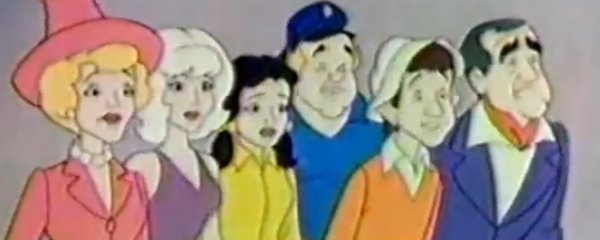
1. The New Adventures of Gilligan (1974-77) appeared as a Saturday morning cartoon opposite other sitcom retreads, The Partridge Family 2200 AD and The Pebbles and Bam-Bam Show.  Tina Louise and Dawn Wells weren't interested, but everyone else in the live-action cast returned to voice their characters.

Most episodes involved inter-group squabbles, with an 1970s "the more you know" moral:

They elect Gilligan as President of the island.
They squabble over pirate gold.
The Skipper and Mr. Howell argue.
The Skipper tries to turn Gilligan into "a real man."

The characters look considerably younger than the actors they depict.  Gilligan and Mary Anne could be in their teens, and Skipper and the Howells look barely 30.  And why is Ginger platinum blonde instead of "ginger"?


2. Rescue from Gilligan's Island (1978) was a tv movie that every grown-up Boomer kid watched.  Except instead of having them shipwrecked for a reasonable amount of time, the premise is that they've been on the island for 14 years, since 1964.  They're obviously older, well into middle age or old age, which makes their stuntwork cringeworthy.

They arrive in Hawaii to a huge crowd of well-wishers and fans (except none of their family or friends).  The moment Gilligan leaves the coast guard ship, a soldier hands him an ice cream cone.

Giving a middle-aged man an ice cream cone rather than a hefty check from the insurance company? Bogus!

Besides, they had ice cream on the island.  Crates full of anything they needed kept washing up in the lagoon.

 They try to go back to their old lives: the Professor to his research university, the Howells to their snooty friends, Ginger to the movies, Mary Anne to her farm in Kansas.  But it's the midst of the s*x-and-sleaze disco era, everything has changed, and they're miserable. Fortunately, they end up being shipwrecked on the same island again.  There's no place like home?

There's also something about spies.


3. The Castaways on Gilligan's Island
(1979).  This time they return to convert the island into a resort, where they proceed to solve guests' soap opera problems.  Apparently this was the pilot to a proposed tv series, with different problems every week, sort of like Love Boat and Fantasy Island.

First up, to appeal to the oldsters, a workaholic husband whose wife wants him to relax (played by Happy Days' Tom Bosley and The Bob Newhart Show's Marcia Wallace)

And to appeal to the kids, an unaccompanied minor (popular child star Ronny Scribner) turns out to be runaway: he's an Olympic hopeful, and the training schedule was too intense.


More after the break

Jul 10, 2026

Bugs and Porky meet a Drag King: Warner Brothers Comics


When I was a kid, my favorite comic titles were Harvey (gay-vague Casper the Friendly Ghost), Disney (Donald Duck as macho adventurer), and the Gold Key jungle adventures.  If I had allowance money leftover, Little Lulu and Archie comics were ok.

Comics featuring Warner Brothers cartoon characters Daffy Duck, Porky Pig, and Bugs Bunny were low on my list.  Not as low as Charleton Comics, but low.


The art was amateurish, with minimal backgrounds, or just blank space.  This is one of the best covers,depicting Bugs opening a door leading to another planet, where a cowboy-rabbit is racing across the desert on a camel.

And instead of the anarchic outsiders of the cartoons, the characters were stable, stolid suburbanites, with houses and jobs and girlfriends. Porky was a single dad, raising his nephew, Cicero, like a Donald Duck knockoff.

But sometimes Bugs teamed up with Porky Pig or Yosemite Sam for adventure stories.  Maybe they stumbled upon a haunted inn.  Or they answered a job ad for "undersea explorers"  Or a telegram arrived about "trouble at the ranch."  Buddy-bonding, captures, and nick-of-time rescues followed.


A continuing series had Bugs and Porky working as Indiana Jones-style adventurer-archaeologists, investigating the myth of Pegasus or discovering a lost civilization hidden under the ice of Antartica.  With no girlfriends in sight, and no damsels in distress to be won.

Unfortunately, you couldn't find the adventure stories by looking at the covers -- almost all of them displayed one-shot gags.  Who could guess that this cover art, featuring Cicero using a pogo stick to steal a lick of Porky's ice cream, hid a story about the guys finding a mysterious artifact that leads them to lost Atlantis?  

And the clerks at the drug store frowned on looking inside.  You had to just buy the issue and take your chances.


More after the break

Jul 5, 2026

The 20 Gayest TV Programs of My Childhood


These are the tv shows that helped me figure it out in the silence of my childhood and teen years (roughly 1965 to 1978), through gay-vague characters, buddy-bonding subtexts, queer codes, or beefcake.


1. Gilligan's Island.  None of the male castaways displayed the slightest interest in girls, Gilligan and the Skipper were obviously boyfriends, and there was a lot of beefcake.

2. The Beverly Hillbillies Jethro Bodine (sigh) plus a lot of Hollywood heartthrobs who weren't particularly into girls, and the nearly-out lesbian Miss Jane.


3. Dark Shadows.  I ran across the schoolyard every day to catch the last 10-15 minutes of the Gothic soap opera, with Willie Loomis in love with the vampire Barnabas.


4. Run, Buddy, Run. 
Buddy is on the run from the mob after he overhears them discussing...um...in the steam room...um...sorry, I was distracted by Buddy's chest.

5. Bewitched.  Samantha gave up the witch world for suburban heteronormativity, but she couldn't suppress her queer desires forever.  Plus a gay-in-plain-sight Uncle Arthur.


 6. H.R. Pufnstuf.  The Dragon and the Witch fight for control of Jimmy's...um...flute.  But there's really no question: he likes dudes.

7. The Mighty Hercules.  "Softness in his eyes, iron in his thighs."  That's still the way I like my men.


8. Lost in Space.  Every other boy on the block wanted to be Will Robinson.  I wanted to date him.

9. Star Trek, the Original Series.  I swear, I remember Sulu (top photo) and Chekhov sharing a room.

10. Spin and MartyThe summer camp boyfriends aired during the 1950s, but I saw them in after-school reruns during the 1970s.


More after the break

Jun 6, 2026

Give Me a Prehistoric Man


Modern man is not for me, 
The movie star and dapper Dan
Give me a healthy Joe from ages ago --
A prehistoric man.
-- On The Town

When I was about eight years old, my Grandma Davis came to visit, and took us to the store to pick out any toy we wanted. My brother Kenny asked for a bicycle, and I asked for a Cave Man Toy Set.

"Are you sure you don't want a bicycle, too?"  Grandma asked in surprise.


Certainly not.  What fun could you possibly have with a bicycle?

But just look at Cave Man Toy Set: hard-muscled guys in loincloths throwing spears and rocks at gigantic dinosaurs!  (This was before toymakers realized that dinosaurs and prehistoric humans didn't coexist).

My boyfriend Bill agreed with my decision.  We spent many hours with that Toy Set, imagining jungle explorations, nick-of-time rescues from warring tribes or brontosauri, and "my hero" hugs.

Cave men were more fun than other action figures.  Our church taught that the world was created about 6,000 years ago, so evolution was a lie, there was no prehistory, and there had never been any cave men. So in addition to the beefcake, you had the thrill of blasphemy.

My Grandma Davis wasn't entirely opposed to the idea of prehistory.  One day in her attic I found this Van Loon Story of Mankind, published in 1926, with some muscular cave men on the cover.

It looks like a children's book, but in 1926, she was 23, and she and her husband wouldn't adopt my dad and his sisters for over a decade, so I don't know who it was for.


Most museums had exhibits featuring full-sized statues of prehistoric bodybuilders.  In the Putnam Museum in Davenport, they were wearing loincloths, but in the Museum of Natural History in Chicago, they were naked!

You almost never saw or heard of a cave woman.  I got the distinct impression that our ancestors were all male, roaming around n*ked in hunter-gatherer bands.


Maybe this was before Adam and Eve, so women hadn't been created yet.

Apr 29, 2026

Gilligan's Island: Gilligan and the Skipper, a gay couple? The Professor asexual? Ginger a drag queen?


Gilligan's Island (1964-67), the tale of seven nitwits who set out from Honolulu for a “three hour tour” and end up stranded on a desert island,  has become iconic for its ineptness and naiveté. They pull endless supplies from nowhere, build anything they need (except a boat) from bamboo and coconuts, hear endless radio news stories about their situation, and get a steady stream of visitors who promise rescue, but betray them or forget the island's location.  Even Santa Claus dropped by to offer holiday cheer.

But  actually, it was no more inept or naive than other 1960s sitcoms. The Beverly Hillbillies lived as multi-millionaires in Beverly Hills for many years, yet continued to wear hillbilly outfits, eat possum stew, and refer to the swimming pool as a "cement pond." 

In case Gilligan's Island and its endless reruns came  before your time, the seven castaways are, according to the theme song:


Gilligan, a "mighty sailing man" (in red), and the Skipper, "brave and sure" (in blue).  Color tv was brand new, so they used bright primary colors.

They became partners during the War, presumably the Korean War,  and now ran an island tour service out of Honolulu.  

Five passengers sign on for the "fateful trip" that was supposed to last for three hours,  "lunch provided."

3-4. Mr. and Mrs. Howell, "the millionaire and his wife," who for some reason brought suitcases full of money on the tour.

5. Ginger (the redhead), a glamorous Marilyn Monroe-style "movie star," who has a huge number of acting credit in very bad movies.

"And the rest," until the rest complained and got a mention in the theme song.

6. "Mary Anne," a wholesome Kansas farmgirl.

7. "The Professor,"  who has a B.A. from USC, a B.S. from UCLA, an M.A. from SMU, and a Ph. D from TCU, and is an expert on the languages and cultures of the "savage" natives of the area, yet works as a high school science teacher.

Straight Boomer boys had endless debates about which they would prefer to date, Ginger or Mary Anne.  But there was a lot for gay boys to like:


1. Beefcake
First mate Gillian (Bob Denver, below) was slim, smooth, and occasionally shirtless.

Lithe, hard bodied Denny Miller, a 1959 Tarzan (top photo, appeared twice, as a "jungle man" and as as a surfer who rode a wild wave all the way in from Honolulu.


 In February 1965, Kurt Russell appeared as a jungle boy, wearing only a loincloth (he counts as beefcake when you're five years old)

Even the Professor took off his shirt a couple of times.

2. Utter lack of heterosexual interest.

There was lots of heterosexism, of course.  When the Professor wonders why headhunters would abduct only the girls, Gilligan quips “Because they’re boys!”  

When Mrs. Howell becomes the recipient of anonymous love letters, she and her husband interrogate Gilligan, the Skipper, and the Professor.  They all claim innocence.  "But that's impossible!" she exclaims.  "We've asked everyone on the island!" Ginger and Mary Anne are omitted.

More after the break

Apr 18, 2026

The gay couple of "The Man from U.N.C.L.E."


I never watched The Man from U.N.C.L.E. (1964-68).  First it was on past my bedtime, and then there were too many competing choices (The Time Tunnel, Hogan's Heroes).  But I had more than one friend who thought it was "good beyond hope."

What are you measuring, Mr. Mad Scientist?

 It was a buddy spy series, like I Spy and Wild Wild West, but with an interesting twist.  In the heart of the Cold War, we heard over and over that "Russkies" were all evil monsters plotting our destruction.   But one of the secret agents was Russian.

The premise: The USSR, the United States, and other countries have set aside their differences and formed U.N.C.L.E. (United Network Command for Law and Enforcement) to fight the evil THRUSH (acronym unknown), which wants to "subjugate the human race."


The plots were much more extravagant than anything seen on Mission: Impossible, rivaling Batman in campiness:
THRUSH tries to bring Hitler back to life.

Invents a deadly hiccup-inducing gas.

Invents an exploding hula-dancing doll.

Pat Harrington, Jr. (later on One Day at a Time) steals a rare book containing THRUSH code.

Sonny and Cher play clothes designers with THRUSH codes hidden in one of their dresses.


But the main draw was the "The Man" of the title,  American agnet Napoleon Solo (Robert Vaughn, previously seen shirtless in Teenage Caveman), and his partner, the Russian Illya Kuryakin (Scottish actor David McCallum).

  They were not only spy partners: they seemed to live together (and when traveling always took hotel rooms with just one bed).


More after the break

Mar 26, 2026

Lost in Space (the original series): Camp sci-fi with with a cute boy and a cool robot. Plus Billy Mumy all grown up.


My parents didn't approve of science fiction -- they thought it would promote atheism.  But   Lost in Space (1965-68) aired before their favorite hayseed comedies, The Beverly Hillbillies and Green Acres -- so we watched.  

In the far-future year 1999, a family of space colonists sets off for Alpha Centauri in their cool flying-saucer spaceship, the Jupiter 2.  An evil spy sabotages the ship, so they veer off course, and are "lost in space."  Presumably they have warp drive.

The first season featured realistic science-fiction adventures, but then it become more and more camp, like Batman, the competition on the other channel, culminating in a giant talking carrot that wanted to change the Robinsons into trees. 


I don't remember much, just scattered images: 

A lonely boy from the other side of the looking-glass.
A demonic being claiming that he's as human as the rest of them.
The robot saying "Danger, Will Robinson!"
An alien robot saying "Crush! Kill! Destroy!"

And I remember the fandom.  Kids loved Lost in Space.  Star Trek was too grown-up -- Captain Kirk was always kissing a scantily-clad alien babe -- but Lost had no hetero-romance (at least we didn't notice any).  


And Star Trek had no kids.  Lost had Billy Mumy (pronounced moo-mee), a busy child star with previous roles on The Twilight Zone and Village of the Giants Not only because he was cute, and knew it, getting teen idol attention at the age of twelve -- but because his character, Will Robinson, was bright and resourceful, a respected crew member, never told "you're just a kid" or "wait here where it's safe."


Star Trek had no comic relief, but Lost had Dr. Smith (Jonathan Harris), an accidental stowaway (originally an enemy spy trapped aboard while trying to sabotage the voyage, but they soon forgot about that).  Some fans think today remember him as a pedophile with an inappropriate interest in Will, but I recall their relationship was completely innocent.  They were friends because he was a big kid himself, an unrestrained id.  Plus lazy, cowardly, and  incompetent, so none of the adults wanted to hang out with him.


John Robinson (Guy Williams), the patriarch of the family (Guy Williams), didn't have much to do: Will and Dr. Smith stole the show.  But I recall that he was not at all interested in girls. He had a wife, Maureen (June Lockhart), but they behaved like colleagues, with few moments of tenderness and none of intimacy. 

Guy Williams had previously starred in several buddy-bonding projects, including Zorro (1957-59) and Damon and Pythias (1962), leading to speculation that he was gay in real life.  
    

More after the break

Mar 19, 2026

"The Carol Burnett Show": Some 1970s beefcake and gay subtexts amid the boring dinosaur songs.


Variety shows, combining comedy sketches and songs,  are out of style now -- only Saturday Night Live survives -- but in the 1960s and 1970s, they were all the rage.  At least among the adults.  In 1970, they could watch twelve hours of variety per week, with hosts Leslie Uggams, Dean Martin, Carol Burnett, Red Skelton, Glen Campbell (left),  Jim Nabors (who was gay but not ouht), Tom Jones, Jimmy Durante, Jackie Gleason, and Andy Williams.

Kids and teenagers hated variety. Passionately. They were always on opposite something good.  If your parents forced you to watch The Jim Nabors Hour, you had to miss That Girl. If you were forced to watch The Glen Campbell Goodtime Hour, you had to miss The Mod Squad.

And the shows were horrible.  Slow songs from dinosaur times!  Comedy sketches about characters popular on radio a thousand years ago!  Bathetic closing numbers involving sad clowns or cleaning ladies!


I usually managed to get out of watching variety shows by claiming homework, or when my brother and I got our own tv set, watching something else -- anything else.  But for some reason I saw a lot of The Carol Burnett Show (1967-78)Carol, who got her start in the Broadway musical Once Upon a Mattress, played a charwoman, a ditzy secretary, Queen Elizabeth, and Vickie Lawrence's sister.  She and her comedy troupe parodied soap operas ("As the Stomach Turned") and classic movies ("Went with the Wind").  

I had no idea what they were parodying.


Famous guest stars like Rock Hudson, Tony Randall (left),  Sid Caesar, and Robert Goulet played parodies of themselves or sang.  I remember Tony singing "Have some Madeira, M'Dear," about a creep trying to get a girl drunk so he can take advantage of her.  

That was comedy in the 1970s.

There were only three reasons to watch:

I liked three things about the show:

1.  Co-host Lyle Waggoner, a former male model who appeared n*dee in Playgirl.  He played the leading-men and hunks in comedy sketches.  Unfortunately, because they were comedy, he never appeared n*de or even shirtless on the show.

More after the break

Feb 17, 2026

"Journey to the Beginning of Time": Four boys fight dinosaurs in the early years of their lives, before Jules Verne, Sinbad, and "What girl do you like?"

During the 1970s, our local afternoon kid's show, Captain Ernie's Cartoon Showboat, played a serial called Journey to the Beginning of Time, about four boys on a field trip to the Museum of Natural History in New York who find a secret passage leading to a mysterious river. They paddle down the river through different geological eras, rescuing each other from mastodons and dinosaurs, learning to survive in the prehistoric wilderness.  

Finally they pass the Precambrian Era and see the dazzling psychedelic fireworks of the Earth's creation.

The serial made no sense.  The boys' costumes and hair styles changed; they got taller and shorter; the voice-over narration didn't match the action; no one wonders how they're going to get back home again; and where did boys visiting a museum get a boat, anyway?

Still, it became one of the iconic images of my childhood, maybe because it made no sense.  It was a puzzle, a mystery to be unraveled, and that puzzle involved boys facing the world together.

  In a pivotal scene, Doc loses the diary with his scientific notes of the journey, and Jo-Jo fights off a dinosaur to retrieve it.  Their subsequent moment of emotional intimacy reverberated through my childhood.


Turns out that in 1955, Czech filmmaker Karel Zeman wrote and directed Cesta do praveku ("Journey to Prehistory"), based on Jules Verne's Journey to the Center of the Earth: four boys find a living trilobite, which should have gone extinct 251 million years ago.  This propels them to their journey through time.

In 1966, William Cayton took the river sequences and filmed then filmed new opening and closing segments in the United States with different boys, figuring that the dumb kids in his target audience would never notice.  He then chopped it into installments to rent to after-school cartoon shows like Garfield Goose in Chicago -- and Captain Ernie's Cartoon Showboat.

 I noticed, but I didn't care. I was busy watching the boys bonding with each other through science fiction adventure.


1. Doc/Petr: Josef Lukás (born 1939).  This is is only film appearance.

2. Jo-Jo/Jirka: Vladimír Bejval (1942-2011) has 17 acting credits, all between 1949 and 1957, except for a 1995 tv series, where he played a doctor.

3. Ben/Tonik: Petr Herrman (1938-2018). 14 acting credits, ending in 2009.

4. Zenda: Zdenek Hustak (1940-2015).  This is his only film appearance. 

There is little or no information about any of them online, but I doubt that they would have any gay-subtext roles in Communist Czechoslovakia.


What about director Karel Zeman (1910-1989)?

He is lauded as one of the greatest animators of the 20th century; there is a Karel Zeman Museum near the Charles Bridge in Prague.

His other works available with English subtitles are:

Vynález zkázy (1958), based on Jules Verne's Facing the Flag, translated as The Fabulous World of Jules Verne.  Some pirates capture the inventor of a fabulous weapon. who falls in love.

More after the break

Feb 11, 2026

Six Linus Van Pelts, from Eric Shea in "A Charlie Brown Christmas" to Alex Saxon in "A Charlie Brown Christmas, the Musical"


A Charlie Brown Christmas
(1965) is the first of the animated specials based on Charles Schultz' Peanuts, and arguably the only one that holds up for adults.  I first saw it when I was so young that when Lucy says that she wants "real estate" for Christmas, I had no idea what she was talking about.


Linus has always been my favorite Peanuts character: witty, intellectual (an aspiring theologian), and a good friend to Charlie Brown.  If it weren't for their frequent heterosexual romances, I would identify them as a gay-subtext couple.  

And no other voice artist comes closer to capturing his inner beauty than  Christopher Shea.

Christopher  (1958-2010) voiced the wise-beyond-his-years Linus in  A Charlie Brown Christmas (1965),  It's the Great Pumpkin, Charlie Brown (1966), and three other Peanuts specials.  He starred in the Western Shane (1966), a short-lived tv version of the iconic movie, playing the "Come back, Shane!" Joey Starrett, and did a lot of guest spots.  Kids of the 1960s probably saw him in  The Invaders, Green Acres, The Odd Couple, and Here Come the Bride.


Here he buddy-bonds with Kevin Tate in Firecreek (1968).


I always thought that he played Tim Matheson's little brother in Yours, Mine, and Ours (1968), but that was his brother Erik.

His last credited role is A Little Game (1971), about a teenager (Mark Gruner) who plots to kill his stepfather.


He's hard to research because of another Christopher Shea, who appeared in more recent tv series like Will and Grace and Star Trek: Deep Space Nine, but I found his obituary: He moved to Humbolt County, in northern California, where he died in 2010, leaving a wife and two daughters.


Eric Shea, born in 1960, did the usual tv guest spots: Batman, Here Come the Brides, Gunsmoke, The Flying Nun, Room 222 -- but he snared some more substantial movie roles, such as Lucille Ball's son  in the big-family comedy Yours, Mine, and Ours (1968) (top photo, the one in the pajamas.  The other one is Tim Matheson).

More after the break

Feb 10, 2026

My Boyfriend and I Play "Fighting Prince of Donegal"

This is the Scholastic Book Club edition of Fighting Prince of Donegal, by Robert T. Reilly.

It may not look like much now, but when I was in fourth grade at Denkmann Elementary School, it appeared among the selections offered by the Scholastic Book Club.  I was entranced.

This was no wimpy fairy-tale prince in love with a princess.  He was a Fighting Prince, strong and powerful.  I had never heard of Donegal, but it was obviously a mystical, distant country with castles on high mountains, outlined against an orange moon.

My boyfriend Bill and I both ordered copies.  They wouldn't arrive for four to six weeks.

We talked about the book every day.  Would the Prince have muscles?  Would he have a best man?  Would he rescue his best man, who would then sigh "My hero?" and melt into his arms?


We made swords out of cardboard and played "Fighting Prince of Donegal."  My brother got to be the villain, who would lock Bill in the dungeon (the lilac bushes outside my house) so I could rescue him.

We often talked about what the Prince looked like.  If you read the ad very carefully, you could see that the book was originally published in 1958 and called Red Hugh, Prince of Donegal.  That meant a red-head.  He must look something like this.


Or, from an adult point of view:

We looked up Donegal in the Golden Book Encyclopedia.  It was a county in Ireland, on the northeast coast.

There was a book in the Denkmann Library called Donegal Stories, but it was all fairy tales, which we  hated.

Would those books ever arrive?


Bill's big brother Tom told us that a couple of years ago, Disney made a movie version of The Fighting Prince of Donegal, starring Peter McEnery.

"Did he rescue a boy or a girl?" I asked expectantly.

More after the break
Related Posts Plugin for WordPress, Blogger...