Showing posts with label ancient Rome. Show all posts

Dec 8, 2025

Spartacus: From Tony Curtis cruising Olivier to "House of Ashur," with gladiators, gay guys, gore, and a lot of p* enises


Spartacus (103-71 BCE) was a Thracian slave who escaped from a gladiator school with 70 of his followers and started the Third Servile War: 120,000 enslaved persons rebelling against the oppressive Roman Republic. 

In 1951, Howard Fast self-published Spartacus, a novel about the slave revolt, as a protest against his incarceration during the McCarthy Era witch hunts.  


The 1960 movie version starred Kirk Douglas as Spartacus.  It famously includes a scene, cut from the theatrical release but restored in 1991, where the power-hungry  senator Crassus and his slave Antonius (Sir Laurence Olivier, Tony Curtis) discuss being gay, in severely closeted terms, as the eating of oysters vs. the eating of snails: "It is all a matter of taste, is it not?" 


The 2004 movie (aired during two nights on the USA network) starred Goran Višnjić as Spartacus, and upped the participation of his wife, transforming the story into a heterosexual romance.


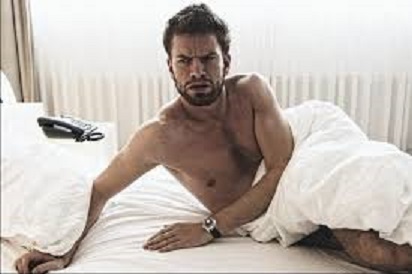
Spartacus tv series, with seasons given different names (Blood and Sand, Gods of the Arena, and War of the Damned), aired on Starz between 2010 and 2013.  It starred Andy Whitfield (left), and after his death Liam McIntyre.  A lot of n*de guys, such as Mike Edwards (top photo), James Wells (left), and Manu Bennett as Crixus (on RG Beefcake and Boyfriends).

Plus there were several gay characters, including Spartacus' best friend Agron.


Assyrian slave Ashur (Nick E. Tarabay) becomes one of the series' primary antagonists when he collaborates with the Romans in their attempt to bring down the slave rebellion.  Eventually beheaded.  Shouldn't that be Asher, one of the Twelve Tribes of Israel?

The most recent Spartacus series, Spartacus: House of Asher (2025), is a sort of sequel which posits that Ashur killed Spartacus, returned to life, and now runs a gladiator school.

From a civil war to a school?  Trying to minimize political references that could get you in trouble in the fascist state?

Ashur beefcake after the break

Aug 7, 2022

Thermae Romae Novae: An Anime about Ancient Roman Bath Houses


Thermae Romae Novae
: "The New Roman Baths," an anime based on a manga about bath houses.  And not the sexual kind, the ancient Roman/modern Japanese bath houses that you use when your apartment doesn't have a shower.  Sounds like a very limited premise, but there will doubtless be lots of scenes of semi-naked hunks.

Scene 1: Montage of people in ancient Rome getting hot and sweaty: a gladiator, a chariot racer, some guys at a feast.  A boy named Lucius (David Wald), running to bring lunch to his grandfather, is accosted by bullies.  The leader, Titus, throws the lunchbag over the bridge -- lost forever!  It's not that big a deal -- you're obviously not poor, and they had fast food stands in ancient Rome. Just buy him a new lunch.

Scene 2:  Sobbing, Lucius approaches Grandpa, an architect working on a new construcgtion project.  Grandpa consoles him, but Apollodorus, the manager, yells at him for being a wimp.  He runs away -- past a fast food place, where his teenage friend Marcus offers him a kebab.  

Scene 3:  Lucius and Marcus eating.  They discuss the new tower, built to commemorate Emperor Trajan's victory in the Dacian Wars (105=106 AD).   Marcus helped build it; he wants to be a stonemason when he grows up.  Lucius doesn't know what he wants to do. (Does he have a choice?  Don't Roman boys follow their fathers' careers).

Scene 4:  After Marcus' extremely muscular father drags him back to work, Lucius walks past the bath house, and flashes back to his own extremely muscular father telling him that thermae are not just places to bathe: "They're a celebration of our way of life."  I could say the same thing about gay bathhouses.  We zoom across the extremely muscular patrons, all men; two look like they're going to wrestle or have sex.

Next, Lucius flashes back to hearing about his father's death in a scaffolding accident.

Scene 5:  Lucius in his room, reading a scroll.  Grandpa announces that he's going to take a bath, and forces a reluctant Lucius to go with him.  Whoa, beefcake fest! A few butts, no penises.   

Grandpa explains the procedure: first a soak in the hot caldarium, then the cold frigidarium, then a body scrub and back to the caldarium.  Uh-oh, while Grandpa is off getting scrubbed, the bullies attack.  Lucius ducks under water to escape them, and comes up in a bath house in modern day Japan!  I hope there's a Latin scholar around.  

He screams, ducks under water again, and is back home, disoriented and confused.  "What just happened?"  

Grandpa is rhapsodizing about the bath house, "an essential part of our culture," where men go to "share moments together in hot water" (tell me more, tell me more, did you get very far?)   Flashback to his father going even farther: "We have the duty to build the future of Rome."  Ok, this is getting too hyperbolic.  It's just a bath house, not a temple.

After Grandpa leaves, the bullies return.  Titus insults the thermae.  This makes Lucius angry.  They fight.  The bully pounds him, until the other men pull him off.

Scene 6: Night.  Lucius and Grandpa stop by the fast-food stand for a beverage.  Lucius says that he wants to become a thermae architect.  Grandpa makes him promise to make baths "that wash away anger."  


Scene 7:
Years later, the adult Lucius (Hiroshi Abe in the 2012 movie) is living in Athens.  He goes home to visit his mom and grandma.  I'm glad he's not going to be a ten-year old through the series.  He wants to take a bath before dinner, so it's off to the old bath house of his childhood, where he runs into his former bully, the extremely muscular adult Titus.  They catch up: Titus is a butcher with a young son, and Lucius, of course, is a thermae architect.  

When Titus tells him that he is married with children, Lucius gets a strange wistful look.  Is he interested in Titus, or is he upset because he doesn't have a girlfriend?  

Postscript: A documentary about the manga artist, Mari Yamakazi, conducting research on Japan's bath house culture.  First up: the Kusatsu Onsen hot springs.  The water is so hot that it has to be cooled down through a splashing-technique called yumomi, which she will incorporate into her stories.


Beefcake: 
Everywhere, in the bath or out.  Except everyone has weird hashtag marks on their cheeks.  At first I thought they were dirt smudges, but they never go away.

Other Sights:  Lots of exteriors of ancient Rome.

Time Travel:  Barely mentioned.  One would expect it to be an ongoing theme.

Gay Characters:  No one except Titus expresses any same-sex interest, or any heterosexual interest. In the manga series, Lucius gets girlfriends in both ancient Rome and modern-day Japan, so maybe that will be happening in future episodes.

My Grade: B. 

Aug 19, 2020

"Britannia" Naked Celts and Romans Form Alliances and Have Hidden Agendas

I have seen the first three episodes of Britannia (2017-):

In 56 BC, Julius Caesar set out to invade Britain, but turned around and ran away when he found the island full of ghosts, demons, and monsters.  In 43 AD, Emperor Claudius tries again, sending the driven, "I don't believe in ghosts" career soldier Aulus Platius (David Morrissey) and 20,000 troops.


He doesn't find any monsters, but he finds the Druids, chthonic beings living amid towers of skulls,  who know how to bend minds and send you on journeys to the undeworld.  They kidnap soldier Antonius (Aaron Pierre), brainwash him, and send him back to camp with a message of doom.  The Romans execute him, but that makes no difference; they send him back with a new message, inviting Aulus on a tour of the underworld to see how futile the Roman cause is.


The Outcast (Nikolaj Lie Kaas), ejected from the Druids when he became possessed by the god Pwka (the origin of Shakespeare's Puck), believes that he is the only one who can stop the Roman invasion. We are not sure if he actually has the power, or if he's just crazy, but he provides comic relief in what is often a grim story.

The Romans must contend with two warring Celtic tribes.

More after the break


The Canti, led by King Pellenor (no connection to the Pellenor who chases the Questing Beast in the Arthurian Mythos}, whose children are struggling for control:
1. Kerra, who had a  Roman grandfather, and tries to negotiate with the Romans.
2. Phelan, married to
3. Amena, who is also married to
4. Gaulish prince Lindon (Stanley Weber) on the Druids' order.

The Regni, led by Queen Antedia, who hates the Cantii after an alliance went wrong.  The Druids ordered her to marry her son Gildas (Joe Armstrong) to Kerra, daughter of the Cantii king, but in their wedding bed Kerra castrated him.


There are several other subplots running around, involving Cait, a refugee from a destroyed Cantii village; Ania, a captured Regni who claims to be a goddess who needs impregnation from Phelan; and Brutus and Philo,, Roman deserters who the Outcast uses for his own ends.

It gets very soap-opera-like, difficult to distinguish between the characters and figure out who is on which side.  Does every Celtic woman have to have a name beginning with A?

Beefcake:  Constant. The Romans tend to have bodybuilder physiques.  The Celts are more scrawny and scraggly, with tattoos everywere.

Other Sights:  It's all forest all the time.

Gore:  Lots.  You get to see people being blinded, flayed alive, buried alive, burned, crucified.  Celts and Romans compete to see who can be the most bloody disgusting.

Gay Characters:  Nothing specified. The Outcast has Brutus and Philo hold hands, but that may be just a requirement for a spell.  The way the head druid grabs at his spirit-journey and mind-control subjects, touches their faces, and straddles them may suggest some homoertic intent, but I think it's just supposed to be creepy.

Heterosexism:  The Romans don't do a lot of male-female canoodling, but the Celts are grabbing on each other all the time.  They don't seem to have the concept of marital fidelity.

Is It Worth The Trip?  The  Druids are interesting, but there are so many characters with so little development that one has a hard time paying attention to the alliances, betrayals, hidden agendas, and miscellaneous schtupping.

Besides, I can't spell Brittannia...um...Britania...um...Britainnia...um

Anyway: spoiler alert: the Romans win.  They control the island for the next 400 years.

Dec 20, 2016

The Eagle: When Gay Subtexts Aren't Enough

The Eagle (2011) is a gay-subtext romance set in Roman Britain in 140 AD.

The plot is rather convoluted, but it seems to be about a young Roman soldier, Marcus Flavius Aquila (Channing Tatum), whose father disappeared on an expedition north of Hadrian's Wall many years ago, along with his entire Legion, plus the bronze eagle that represents "the honor of Rome."

Marcus hears a rumor that the Eagle has survived, so he sets out in search of it.  He brings along his slave Esca (Jamie Bell), who is from northern Britain and can speak the Pictish language (Gaelic is used as a stand-in).


After many scenes of the two riding through desolate wilderness, they are captured by the Seal People, the most barbaric of the Pictish tribes.  Esca buddy-bonds with their Prince (Tahar Rahim) and settles among them, explaining that Marcus is his slave.

Marcus believes that he has been tricked.

But at the proper moment, Esca reveals that he has tricked the Sea People.  They retrieve the Eagle and head back to Roman territory.  They even find the lost Ninth Legion in the process.

All of the classic gay-subtext elements are here:
1. Minimal or no heterosexual interest.
2. Men who rescue each other from danger.
3. And who walk off into the final fade-out side by side.


I still didn't like it.  It was dull and plodding, with scenes of gore juxtaposed with scenes of...well, talking.  And no attempt to provide a standard English to stand in for Latin.  Hearing Roman soldiers speark colloquial American really grates on the ears, particularly after hearing the superbly done Latinate English of Spartacus.

Plus there's no chemistry between Marcus and Esca.  They're supposed to be in love with each other.  There should be glances, gestures.  But I don't even see much of a friendship.  Esca accompanies Marcus to the north because he has no choice, he's a slave; and Marcus uses Esca for his language skills.

At the end of the movie, as they're walking off together, Esca asks "What now?"  Marcus says "You decide."

It's a cute line, but it doesn't seem deserved.  Based on what we've seen, we expect them to say "Well, thanks for your help" and part.


There's actually more chemistry between Esca and the Seal People prince (Tahur Rahim).

The director and actors insist that the movie has no gay subtexts.  Channing Tatum states that there's love in the relationship, like in any relationship, but that doesn't mean that Marcus and Esca are a couple (even though, he jokes, he and Jamie Bell have been having sex for years).

Except in 2011, writers and directors usually take pains to ensure that their characters must be read as heterosexual by adding hetero-romance or at least some longing glances here and there.  If they weren't intending gay subtexts, why not add hetero-romance?

Maybe because the movie is based on a children's novel, The Eagle of the Ninth, published by Rosemary Sutclif in 1954, the glory era of gay subtexts, where men without women was an accepted literary convention, especially in juvenile fiction.

Sutclif wrote over 100 children's novels, many about two boys or two men together.
Related Posts Plugin for WordPress, Blogger...