Jan 4, 2020

"Cells at Work": Muscular Blood Cells Fight Bacilium Monsters

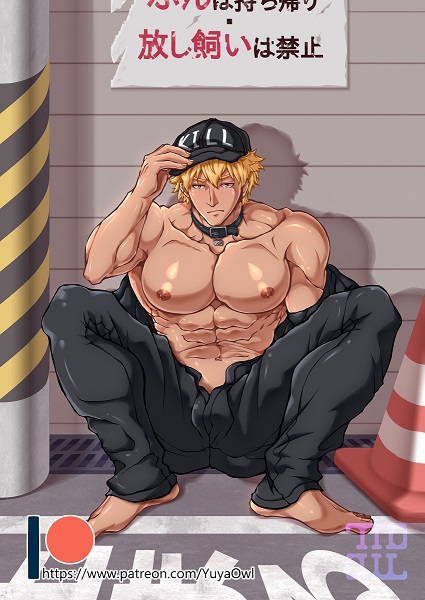
While browsing on Pixiv, I came across a lot of fan art (most too graphic for this site) starring a muscular blond guy with a baseball cap reading "Kill."  


Sometimes he was making out with, rescuing, or being rescued by a guy dressed all in white, with Japanese writing on his baseball cap (all fan art copyrighted by the artists).

A little more research, and I found out that his name was "Killer T-Cell."

And a manga series called Cells at Work (2015-), which has been adapted into an anime (now playing on Netflix).

There are 20-30 trillion red blood cells in the human body, responsible for carrying oxygen from the lungs to the other cells, and carbon dioxide back to be expelled. Cells at Work stars a red blood cell named AE3803 (Cherami Leigh in English), imagined as a red-haired delivery girl with a sealed package of oxygen, rushing down the streets and  plazas of a human body imagined as a vast city.

She gets lost on the way to the lungs, and ends up in the spleen, and then in a lymph node.

When an evil bacterium attacks, she is saved by white blood cell U-1146 (Billy Kametz), a muscular all-white teenager.  They have a history: he saved her from an evil bacterium long ago, when he was just a student in White Blood Cell School. 

Future episodes introduce many other types of cells, including the cocky, aggressive Killer T-Cell (Robbie Daymond), who is responsible for killing cancerous or otherwise damaged cells.

The plots involve conflicts between various types of cells:

When Killer T-Cell gets into an argument with his commanding officer, Helper T-Cell (Ray Chase),  Dentritic T-Cell reveals a photo album indicating that they were close friends in White Blood Cell school.  They are embarrassed, and try to destroy the album.

And responses to threats:

The body suffers from heat stroke, leading to "global warming," a depletion of fluids. and an invasion of bacillus cereus, which thrive on high temperatures.  U-1146 pursues the bacillus, but is too weak from fluid depletion to fight.  Then the body gets an injection of new fluid, reviving everyone. 

A band of staphylococcus aureus invade the nasal cavity.  They trap the white blood cells in a mesh of fibrin.  Mysterious hazmat-suited monocytes come to the rescue.  Later the monocytes take off their hazmat suits, revealing that they are really macrophages in disguise.  Whoa, plot twist!

I have so many questions.

1. If cells are anthropomorphic beings, then their bodies must also be full of anthropomorphic cells, and so on, and so on, all the way down ad infinitium.

2. They know that they are in "the body," but do they realize that it's a sentient being?  Do they think it's the entire universe?

3. They eat (glucose from food kiosks), and they have day and night, but do they have private lives?  Apartments?  Recreation?  Do they sleep? Date?  Read philosophical tracts about the nature of the universe?

4. Why is it so barbaric?  "Kill them!  Kill every one of them!" may be ok for pathogens, but it's inappropriate for human-looking enemy troops who are just following orders.   It's like in the Bible where the God tells the Israelites to take over a town and kill everyone, even the children and animals.

5. There's a lot of very technical information.  Eosonophilia are white blood cells responsible for fighting multicellular parasites, but not bacteria or viruses.  Basphilia are white blood cells responsible for histamine, which produces the inflammatory reaction to infections.  Is this entertainment or a physiology textbook?

This is all so bizarre that I forgot to check for gay characters or subtexts. I don't think the blood cells actually have romantic relationships, but there is plenty of fan shipping.

Dec 25, 2019

The Lord of the Rings: Good Beyond Hope

It's one of the iconic stories of my life, told over and over again until it becomes myth.

How, in fifth grade, I stumbled across a copy of The Hobbit in the folklore section of the Denkmann School library, and read for the first time: "In a hole in the ground there lived a hobbit."

I spent the next two days immersed in a new world, Middle Earth,with hobbits, elves, dwarves, goblins, magic swords, giant spiders, a dragon, a gollum,  and a beautiful, evocative map.

And no damsels-in-distress to gum up the works; Middle Earth was occupied entirely by men.

How, two years later, in seventh grade, the Scholastic Book Club offered The Two Towers, blatantly advertised as the "sequel" to The Hobbit.  I ordered it, waited patiently, and when it arrived, rushed home and began to read eagerly.  Aragorn, Boromir, Frodo..who were these people? This was not a sequel at all; it was the second book in a trilogy.  I had been swindled!

How I snuck a ride to the Readmore Book World downtown and bought the rest of the trilogy, and read...well, most of the Fellowship of the Ring.  The Shire scenes, with gay couples Frodo and Sam, Merry and Pippin wending through the Old Forest, fighting off Dark Riders and Barrow-Wights, meeting Tom Bombadil, reaching Rivendell, setting off with a fellowship of nine, including gay couple Legolas and Gimli.  Around the time they reach the Mines of Moria, it bogged down, and I started to skim.

The Two Towers was mostly unreadable, sheer boredom.  I skimmed through everything except for Merry and Pippin among the Ents.

The Return of the King, more of the same, with Frodo and Sam, especially Frodo, suffering for no reason, as if Tolkien delighted in torturing his heroes.  I skimmed through everything until the end, when they return to the Shire to discover that it has been broken up by the Industrial Revolution.

I couldn't bring myself to admit it for many years, but The Lord of the Rings is not a great novel, or even a good novel.  30% of it is torture porn (let's see what other horrible things can happen to Frodo!), and 60% is repetitive, ponderous, and dull.  Everyone has twelve names, everyone's sword has twelve names, and they're always stopping the action to sing.

And talk about anachronisms:  The Shire is 18th century England; one expects to hear the bothersome War of Independence being fought in the Colonies. But outside the Shire, it's the early-Medieval world of the Anglo-Saxon thanes.

Yet still I thought of it as the greatest book ever written.  I pressed it into the hands of my friends as if it were a religious tract.  I revered it as sacred writ.  I began working on my own fantasy world in imitation, with my own elves and dwarves, magic sword, and fabulous maps.

It seems like a paradox.

But the Lord of the Rings wasn't for reading.  It was for gazing at the covers.  The artist, Barbara Remington, had not read or even seen the book before drawing the covers, so she drew from magic and myth.

My favorite was The Two Towers, with its stylized sharp mountains, red sky, and dark flying riders.

It was about reading the cover blurbs, with quotes from Loren Eisley, W. H. Auden, and C.S. Lewis (none of whom I had heard of yet): "Here are beauties which pierce like swords or burn like cold iron; here is a book that will break your heart....good beyond hope."

That line is better than anything in the book itself.


It was about gazing at the maps, and marveling at all of the mysterious places. I particularly liked the edges, the places not mentioned in the books: Rhun, Far Harad, the Ice Bay of Forochel, and Carn Dum ("here was of old the witch-realm of Angmar").

It was about reading the appendixes, with the languages, the indexes, the genealogical charts, and the timelines, with the discussions of what happened to the characters after the War of the Rings ended.

And it was about discovering the fates of the gay couples:

Merry and Pippin lived together for the rest of their lives

Legolas and Gimli crossed to the Elf paradise together

Frodo crossed over alone, while Sam pursued a heteronormative life of marriage and children.  But at the end of his life, he, too crossed over.

Was there ever a book so filled with gay romances?

That's what, in the end, rendered The Lord of the Rings "good beyond hope."

See also: The Lord of the Rings

Dec 23, 2019

Who the Heck is Kumail Nanjiani, and Is He Gay?

"Kumail Nanjiana is now ripped as hell, and he is refreshingly honest about it!" my twitter feed exclaims.

Three questions:
1. Who the heck is Kumail Nanjiani?
2. Why is having a nice physique such a big deal?
3. Is he gay, posing with his boyfriend?


1. Who the heck is Kumail Nanjiani?

The twitter link goes to Comicsands, which I can't stand because there are two lines of text per page, hidden amid endless popups and slow-loading videos that scroll down with you.  So I checked wikipedia, just in case this obscure bodybuilder had his own page.

One of the 100 most influential people in the world, according to Time magazine!  Why have I never heard of him?

He was born in  Pakistan in 1978, but didn't show up on screen until a Saturday Night Live episode in 2008.  He had a recurring role on the buddy-lawyer series Franklin and Bash (2011-2014), and after that a lot of guest spots and voice roles: Prismo on Adventure Time, Skip Marouch on Bob's Burgers.

Nothing particularly influential so far.

Kumail's only significant role seems to be in The Big Sick (2017), which he also wrote with his then-wife Emily Gordon.  It's a slightly fictionalized memoir about their romance. dealing with cultural differences and Emily's life-threatening illness.  In the end, she recovers, and they break up.

It sounds awful.  Who wants to watch a movie about a life-threatening illness?  But, depressing or not, it was nominated for an Oscar for best screenplay, and pushed Kumail up into the ranks of the 100 most influential people in the world.

I'm pretty sure I could name 100 actors more influential than the star of one depressing movie, but ok, next question.


2. Why is having a nice physique such a big deal?

Apparently he was rather chunky just a few years ago.  Hitting the gym for the first time when you're over 40 is rather daunting, and Kumail deserves praise for sticking with it long enough to see results.


3. Is he gay, and posing with his boyfriend?

An article in Entertainment Weekly called Emily Gordon Kumail's "former wife," implying that they are divorced or she has died.  But Wikipedia just says that they've been married since 2007.  Which to believe?

He appeared in an episode of the Game of Thrones parody Gay of Thrones, but he doesn't play a gay character: one of the Queer Eye guys gives him a haircut.  That's entertaiment?

Also, Kumail and Emily are currently producing Little America, about the lives of immigrants.  Episode #8 features Rafiq (Haaz Sleiman), a gay refugee from Syria.

I'm going to go with "straight."

A straight guy who starred in a depressing movie and has a nice physique.  Big deal.

By the way, the other guy in the photo is Barry Keoghan, Kumail's costar in the upcoming superhero movie The Eternals.  

This is obviously a photo from a gay romance.  I wonder if he's gay in real life.

Google, here I come.

Dec 22, 2019

Tristan Strong Punches a Hole in the Sky

Teen Tristan Strong's father and grandfather were famous boxers who want him to follow the family tradition -- he has the physique for it --but he would really rather do nerd things with his best friend Edward.  They make up stories, which Edward records in a journal.

You've got my attention.  

When Edward dies,Tristan is so distraught that he starts to hallucinate, seeing a green light glowing from the journal.  No one else can see it. His parents send him to Grandpa's farm in Alabama, hoping that a change of scenery will help.

Definite gay subtext!  I'm listening.

On his first night on the farm, a strange doll-like being, the Gum Baby, appears in his room and steals the journal.  Tristan pursues her to a Bottle Tree, and accidentally punches one of the bottles, opening up a hole in the sky.  They fall through into a scalding-hot ocean, pursued by ships made of human bones.  They are rescued by Ayanna, a girl-warrior...

Uh-oh.  The Girl!  I'll just skip ahead to the last chapter to see if they fall in lo--ooo---ove.  

All clear.  Tristan is talking to the Gum Baby and someone named High John (High John the Conquerer Root from African-American voodoo?)

Ayana is piloting a boatload of survivors from a disaster of some sort, including humans and talking animals. Like Brer Fox....

What the heck is going on? 

Tristan is trapped in the Midpass, a world populated by figures from African-American folklore. Such as the old trickster god Brer Rabbit.  And John Henry, the super-muscular 19th century railroader with the powerful...um...hammer.  

His story actually involves convict leasing (African-American men were arrested for the crime of being black and put to work on railroads and in coal mines, basically slavery by another name).

Whoa, heavy.  African-American folklore was born in adversity.  

When Tristan meets John Henry, he has to stop himself from asking to touch  his..um hammer.  

Nudge, nudge, wink, wink.  Is this kid canonically gay?

That would be telling.  It's a nonstop race, with things trying to kill or eat them every moment, to the Warren, a temporary haven against the darkness that threatens to encroach all of the land.  There a council consisting of Brer Rabbit, John Henry, and a lesbian couple from the folktale "The People Could Fly" discuss the Book (which has been lost) and discover that Tristan is...guess what...the Chosen One.  

Tristan has to be the Chosen One, or else he couldn't participate in the adventure. The adults would just say "Wait here where it's safe."

He has to travel to the other side of the world to convince Anansi the Spider to come out of hiding and repair the hole in the sky. But there are complications.  

Of course.  Otherwise be lousy story.

When he meets High John the Conqueror, the ultimate Power, Tristan finds him him obnoxious, irreverent, and arrogant.

Whoa.  Now I know Tristan is canonically gay!  I'll check out the author, Kwami Mbalia.

Ok, but that's another story: he's  "a husband, father, writer, New York Times bestselling author, and pharmaceutical metrologist, in that order."  He grew up in the Midwest, graduated from Howard University, and now lives in North Carolina. This is his debut novel.

Nothing jumps out at me saying "I'm going to make the protagonist of my young adult novel gay."  But you never know....


Related Posts Plugin for WordPress, Blogger...