Dec 29, 2013

The Triplets of Belleville: Jazz-Age Lesbians and the Androgynous M

In the animated Triplets of Belleville (2003), professional bicyclist Champion is kidnapped during the Tour de France, so his grandmother, Madame Souza, goes off to search for him.

In the bustling city of Belleville, she encounters the Triplets, a famous jazz act of the 1930s now fallen on bad times.   They eke out a living as a novelty "acoustic" band, making music with a refrigerator, vacuum cleaner, and newspaper.  Madame Souza joins the act with a bicycle wheel, and eventually they become successful again.


Oh, and they rescue Champion in a colorful chase sequence.  The movie ends much too abruptly, with the now elderly Champion reminiscing about the adventure.

There is very little dialogue.  The characters are drawn grotesquely, so there's no beefcake.  So what's the gay connection?

1. No one expresses the slightest heterosexual interest, ever.


2. The Triplets, who have been living and working together for 70 years, can be read as a lesbian family rather than blood relatives.

3. Flashbacks show them performing in a Jazz Age nightclub, along with gay and bisexual icons like Josephine Baker, Glenn Gould, and Hoagy Carmichael.

4. Androgynous singer Mathieu Chedid, known as M, recorded a music video of the song "Belleville Rendez-vous."

He tells a psychiatrist about various ways to spend the last years of his life: in Singapore eating petit-fours, in Katmandu playing a "dou," and most significantly, in Acapulco, dancing with a gigolo ( a male prostitute).  

The English lyrics closet the verse to "dancing cheek-to-cheek."

But then he decides that he wants to be "wicked, twisted, swinging," like a Triplet of Belleville.

This irks the psychiatrist, who straitjackets him and gives him a tranquilizer injection.  That's the fate of those who try to escape gender and sexual confomity, like the Triplets of Belleville.


Dec 26, 2013

David Barry Gray: Not as Homophobic as Chevy Chase, Probably

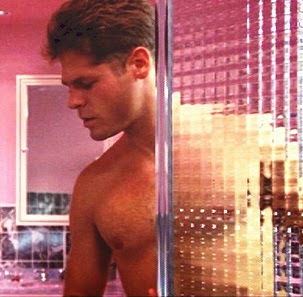
Chevy Chase may be one of the more homophobic actors in Hollywood, as his cast mates from Saturday Night Live and the National Lampoon's Vacation movies can attest, but the naked man on top of him, David Barry Gray, is not.  Not very, anyway.

Not as homophobic as Chevy Chase.

Probably.
The New York City native, heir to the Pepsi Cola fortune,  has appeared on many tv series, beginning as a teenager with William Tell (1987-88); he played William's son, Matthew.  Other series include 21 Jump Street, The Client, JAG, Medium, Ghost Whisperer, and Rizzoli & Isles.

Not a lot of gay subtext vehicles, although you could include his role in S.F.W. (1994), as the brother of hostage-survivor Stephen Dorf, and the "rescuing people from Southeast Asia" movie Soldier Boys (1995), as Lamb, who steps on a land mine (sacrificial lamb -- get it?).

Man-mountain Michael Dudikoff stars.


No gay characters, although he did star in the mega-homophobic Lawn Dogs (1997):

A lonely ten-year old girl and her only friend, the reclusive Trent (Sam Rockwell), both have problems with unwelcome sexual advances from a couple of sleazoid roommates: the girl from Brett (David), and Trent from Sean (Eric Mabius).  Not to worry, the evil gay guy is killed, but the pedophile isn't.

So he played the teenage version of homophobic President Richard Nixon, and more recently, Todd Palin, husband of homophobic Alaska Governor and VP contender Sarah Palin.  That doesn't mean he's personally homophobic.

Does it?

His sister-in-law, Ariel Winter, stars in the gay-positive Modern Family as the brainy teenager Alex Dunphy.

Doesn't that suggest that David is gay-positive?

No?

Well, at least he has a nicely toned physique.

Dec 21, 2013

Earle C. Liederman: The Grandfather of Modern Bodybuilding

Everyone's heard of bodybuilding entrepreneur, Charles Atlas, who sold thousands of "dynamic tension" resistance-training regiments from the 1930s through the 1960s with the comic strip ad, "The Insult that Made a Man out of Mac."

But few people, even bodybuilding aficionados, realize that before Charles Atlas, the mail-order muscle-building market was dominated by Earle E. Liederman (1886-1970), an associate of Eugen Sadow who advertised "Become a giant among men!" to the wimpy office boys of the Jazz Age.

The former physical education teacher, Vaudeville strongman, and professional acrobat began distributing his book, Muscle Development, in 1920, and continued with The Science of Wrestling and Secrets of Strength.  


But where Charles Atlas promised men that muscles would help them get girls, Liederman's ads were usually more inclusive, promising that muscles would make you "a business and social favorite."  And the health benefits of bodybuilding, he noted expansively, would apply to both men and women.

His lessons were typewritten, addressed personally to the student, and tailored to his/her individual needs (actually ghost-written by one of his army of assistants), with practical advice like "don't invest in many collars, as your neck size will increase dramatically."

One of his students, he claimed, was Charles Atlas himself.  Liederman himself provided the illustrations, displaying a massive physique even in his fifties.


During the Depression, he was eclipsed by Charles Atlas's graphic-savvy showmanship, and lost everything.  He hosted a physical-fitness exercise program, and in 1945 moved to Los Angeles to edit Joe Weider's new magazine, Muscle Power.  

His column, "Let's Gossip," with its dish on the sun-and-surf hijinks of the glitterati, is credited with drawing hundreds of young muscle enthusiasts to L.A., where many posed for the gay-vague Physique Pictorial and were discovered by gay casting agent Henry Willson.


After a falling-out with Joe Weider, Liederman went to work for a rival bodybuilding magazine, and died in 1970, the elder statesman of the bodybuilding movement.

I don't know if he was gay.  When you read his columns, he comes across as very fey, a drag queen Auntie, sweetie darling.  But he was married to Miss Alaska for awhile,  so I can't tell.

His course is still available online.


Dec 20, 2013

James Marsden: Former Teen Idol Plays Gay, with Kissing and Everything

You don't need a face shot to distinguish James and Jason Masden.  James has a more ripped physique, which he tends to display with constant semi-nude scenes, plus full nudity in Death at a Funeral (2010).  (Jason is cute too, of course).


A popular teen idol of the 1990s, James appearing on teencoms like Saved by the Bell: The New Class and its Canadian clone, Boogie's Diner.  His first starring role came in Second Noah (1996-97), a dramedy about a family (including the Torgerson Twins) who live near Busch Gardens in Florida.

His most famous dramatic role as a teen idol was Disturbing Behavior (1998): the new kid in town (Marsden) teams up with his new buddy (fellow teen idol Nick Stahl) and The Girl to uncover a plot to turn all of the kids into perfect Stepford Teens.

Gossip (2000) is about a college student (Marsden) and his roommates, a boy and a girl, concocting gossip for a class project. But are his roommates really his friends?


As an adult, he is probably most famous for the X-Men series, where he plays Cyclops, but he has also done some serious dramatic roles, such as The Notebook.

The Oklahoma-born actor was "a little uncomfortable" around gay people when he first moved to Los Angeles, but he soon got over it: he hangs out in gay bars, he's been interviewed in The Advocate and Out, and he's played gay characters twice, with kissing and everything.


The 24th Day (2004): Dan (Marsden) and Tom (Scott Speedman) have a one-night stand that goes wrong.

Heights (2005): a Manhattan lawyer (Marsden) about to marry a woman finds his world turned upside down when his photographer ex shows up with an exhibition about the men he's been with "on the downlow."


He also had a noteworthy appearance on Modern Family, as a free spirit who befriends Cam and Mitchell.


Related Posts Plugin for WordPress, Blogger...