Showing posts with label comics. Show all posts

Nov 1, 2026

Jimmy Olsen, Superman's First Boyfriend

Many gay boys growing up in the 1950s and 1960s dreamed of dating Superman.   In 1954, Daily Planet reporter Jimmy Olsen got his chance: he began to appear in his own comic book title, as Superman's "boy pal."

What, precisely, was a boy pal?  A boy sidekick, like Kaliman's Solin?  An adopted son, like Batman's Robin?  Jimmy wasn't a boy or even a teenager: he was tall and sturdy, with the standard comic book body-by-Michelangelo (since reporter outfits are not particularly revealing, almost every story required him to be in underwear, in a swimsuit, or ripped out of his clothes). 


The "boy pal" relationship differed considerably from ordinary friendships:

1. It was physical.  Superman and Jimmy flew with their arms wrapped tenderly around each other, a position that no one else, not even Lois Lane, rated.

2. It was romantic.  Superman gave no one but Jimmy a gift of jewelry (a special signal watch).


3. It was of public interest: “There goes Superman’s boy pal!” passersby would whisper, and when the duo quarrels in “Superman’s Enemy” (Jimmy Olsen 35, March 1959), every stage of their breakup and reconciliation made Daily Planet headlines. 

4.  It was exclusive: each had other friends and even other sidekicks, but in “Superman’s Super Rival” (Jimmy Olsen 37, June 1959), when Jimmy seems to be courting a newly-arrived superhero named Mysterio, Superman is so jealous that he challenges the rival “pal” to a fight. 

5.  It threatened heterosexual romance: in a fantasy story, “Jimmy Olsen’s Wedding,” (Jimmy Olsen 38, July 1959), Jimmy’s girlfriend agrees to marry him only under the condition that he never see or contact Superman again (one can’t imagine why). He complies for several years, but eventually he cannot bear to be separated any longer, and arranges a secret rendezvous with his “pal.” His wife discovers him in the act (of what?), shrieks in anger. and leaves him.

Such an overt same-sex romance made me scrounge to beg or borrow all of older Jimmy Olson comics I could.  The issues I could buy in the store (the series lasted until 1974) were no good; about 1965, Jimmy and Superman broke up.  Though they stayed on friendly terms, no further stories featured their romance. 

And the special signal watch was never seen again. Perhaps Jimmy returned it the day he told Superman over coffee, “it’s not you, it’s me.”

In 1972, Jimmy found a new boyfriend, an African-American cop named Corrigan, whom he sometimes even called his “pal.”

Unfortunately, the homoromance was not maintained in tv versions of the Superhero.  Smallville gave Superman two boyfriends, but neither were Jimmy Olsen.


Oct 16, 2026

The Last Boy on Earth: Kamandi and his buddy Ben

In 1972, Marvel began to publish two comic book series about gay-vague teenage boys: Werewolf by Night, about a teenage werewolf, and Kamandi, about the last human boy on Earth.

An attempt to capitalize on the popularity of The Planet of the Apes franchise (1968, 1970, 1971, 1972), it is set an a post-Apocalyptic world where sentient animals rule (everything from apes to rats), and humans are extinct.


Except for Kamandi, the last of the human survivors bunkered in Command-D (thus his name), who is raised by his elderly grandfather and emerges into chaos, hunted for sport, imprisoned in a zoo, experimented on by scientists who want to know how a human could be sentient.

Though described as "a boy" and "a tyke," Kamadi is drawn as an extremely muscular teenage with long blond hippie-hair, naked except for tight cut-off jeans.

He is captured a lot, muscles taught and struggling.  Or he fights with high kicks that display his bulging pecs and 8-pack abs almost as well.


Just as the werewolf, Jack Russell, had a middle-aged boyfriend, Kamandi soon meets other humans (he's the last boy on Earth, not the last man). He is rescued by Ben Boxer, leader of an underground human-resistance movement, and his colleagues, Steve and Renzi, who are not shy about physical displays of affection.


For the next 30 issues, Ben and Kamandi fight together, rescue each other, search the ruined cities for each other.  Kamandi occasionally meets girls, momentary dalliances that mean nothing.  And there is no question for Ben: he has eyes only for the blond muscle god.

See also: Jim Steranko

Sep 23, 2026

Boxers and Boyfriends: Joe Palooka

The most famous fictional boxer of the 20th century was probably Joe Palooka in the long-running comic strip (1930-1984).   Tall and immensely strong but gentle, Joe Palooka was the creation of Ham Fisher, who observed lots of young Polish immigrant boys hanging around boxing arenas, hoping that their muscles would bring them fame and fortune.

In slang of the era, a "palooka" was an incompetent boxer, but Joe Palooka was a star.


In his heyday, Joe was appearing on the radio, in movies, in big-little books, and in comic books.

Left: Tab Hunter lookalike Joe Kirkwood played Palooka.

You could buy Joe Palooka toys, gum, lunch boxes, board games, and a cut-out mask on Wheaties cereal.  


Pop quiz: Joe or Tab?


 In 1948, the town of Bedford, Indiana  (near Bloomington) erected a statue in his honor.  It was moved to nearby Oolitic in 1984.

More after the break

Aug 28, 2026

The Gay Artist for the Catholic Schoolboy Comic Book

A Treasure Chest of Fun and Fact was a Catholic comic book, published every two weeks during the school year from 1946 to 1972, meant to be given away at parochial schools.  Its main emphasis was religion and patriotism (since American Catholics in those days were often stereotyped as anti-American, in the pocket of the Pope).

But there were lots of humor and adventure stories, too -- sports, jungle adventures, pirates -- which made for some odd juxtapositions:

"Get to Know the Sacraments" oddly juxtaposed with "El Vaquero the Cowpunching Bear."

The history of the Canadian Mounted Police juxtaposed with "But Aunt Eileen, does modern life help to destroy true values?"


My favorite juxtaposition is from the November 19, 1959 issue.  "Tarcisius Protects the Holy of Holies," an adaption of the novel Fabiola by Cardinal Wiseman.  Tarcisius was a twelve-year old boy who was trying to save the Blessed Sacrament from desecration, when an irate crowd beat him to death.

How'd you like to read that over your Corn Flakes in the morning?

Next was a humorous story about ice hockey.


Many stories were drawn by Reed Crandall (1917-1982), a Golden Age comic book artist who also drew such superheroes as the Ray, Dollman, Blackhawk and Ka'anga Lord of the Jungle, and invented Firebrand, a muscleman in an invisible shirt.

Why invisible?  So you can perv on his pecs, duh!

He also drew E.C. Horror, the Flash Gordon comic strip, and a series of illustrations for Edgar Rice Burroughs' Tarzan books.


 His beautifully detailed drawings of muscular men inspired a generation of beefcake artists, including Frank Franzetta and Boris Vallejo.


After Crandall graduated from the Cleveland School of Art in 1939, he moved to New York with his mother and sister to seek work in the fledgling comic industry.  Eventually they moved back to Wichita, and Crandall lived by himself, a "confirmed bachelor," for many years.  He died in 1982.

"Confirmed bachelor," right.

I imagine that George A. Pflaum, the publisher of the Treasure Chest, never realized that one of his chief contributors was a gay man.

See also: Felix Beauperin: French theatrical actor has some queer codes and a nice c*ck, but has he appeared in anything I can stream?


Aug 21, 2026

Grit: Beefcake and Bonding in an Attic in Rural Indiana

Every summer, and sometimes at Christmas, we visited my Grandma Davis in Indiana.  She had an attic full of old magazines, and my brother and I used to spend rainy afternoons there, leafing through half a century worth of browning ephemera.

Today I get the impression of someone who longed for an urbane, sophisticated life as an artist in Jazz Age New York, but somehow found herself in a farmhouse in rural Indiana, with a husband who was gone weeks at a time, and spent her life lapsing between attempts to rebel and attempts to adapt:

Rebellion:  Nash's, Collier's, The Saturday Evening Post

Adaption: Better Homes and Gardens, The Farmer's Wife, Grit

Grit?

Who would name a newspaper after that gross stuff that gets in your eye after you sleep?

Maybe it was grits, the gross Southern food made out of boiled corn.

It was like a tabloid newspaper, with lots of human interest stories: a blind guy who works as a postal carrier, a woman who found her lost wedding ring in an egg laid by her chicken, a traffic accident that reunited a father and his long-lost son.

Nothing that took place anything near a city: in the world of Grit, no settlement with a population over 2,000 exist in the U.S.

No foreign countries exist, either.  Or black people.  Or Jews.  Or women who weren't housewives.  Or gay men and lesbians.

But -- there were a lot of cute 4-H Boys holding up prize sheep, providing a hint of beefcake on rainy rural afternoons.

Here's a shirtless boy in a bunkhouse at the Millstone 4-H Camp in Ellerbee, North Carolina, 1961.


There were also pages of comic strips, some the old-fashioned dinosaur strips familiar from the Rock Island Argus -- Blondie Prince Valiant, Out Our Way -- and some even older.

Beefcake titles like  Jungle Jim, Mandrake the Magician, and Flash Gordon.

Very nice physique, for a guy from the 1930s with his head wrapped in a plastic bag.


Here's an ad from Grit about selling Grit.  

$6 in 1956 is the equivalent of $50 today.  Not a bad source of income.


Grit was founded in 1885 by German immigrant Dietrich Lamade.  It was especially popular in the 1930s and 1940s, with over 400,000 weekly subscribers, competing favorably with newspapers that wouldn't deliver to rural areas.

The decline of the rural population after World War II, and competition from radio and television, led to a nosedive in subscriptions.  By 2000, there were less than 10,000 subscribers, mostly elderly.

Under new management, Grit has rebranded itself  as a bimonthly blog and print magazine for food and gardening enthusiasts, with articles on free range chickens, hybrid tomatoes, and lawn mower maintenance.


The new Grit is more inclusive, with racial and religious minorities, urban dwellers, and gay men and lesbians:

"Who do you call when you have an animal in trouble?  The ladies next door are at work, and I can no longer phone the gay guys down the street because they have me blocked since we had a shouting match about being invited to a Pampered Chef party, so I call the SPCA."

 It has over 150,000 subscribers.


Jul 19, 2026

Veronica and Betty are Going Steady, and Other Gay Hints in Classic Archie Comics


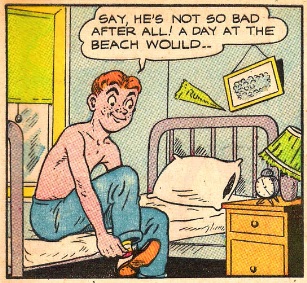
Long before Kevin Keller came out in Veronica #202 (2010) and on tv in Riverdale (2017), you could find many references to gay men and lesbians in Archie comics.


And you didn't even have to take panels out of context.  Story after story hinted about the existence of same-sex desire.


For instance, Betty finds a little black book in Betty’s Diary 34 (1990), believes it is a boy’s date book, and is surprised to find that her name is not in it. “There’s no accounting for tastes,” she muses. “I’m a much better date than Tom Cameron or Ron Cook.”  

So this boy is dating boys, and it's an everyday occurence -- Betty is not the least surprised. 

A moment later, she realizes that it is actually Veronica’s book. But for a moment, there were gay students at Riverdale High.   


It's even easier to find explicit references to female same-sex desire. In “Girls Just Want to Have Fun” (2000), the boys abandon the girls for the basketball playoffs, so the girls plan a series of “all girl nights.” Afterwards, when the boys are available for dates again, they refuse, explaining that “We discovered how much fun it was to hang out with just the girls.”


More after the break

Jul 10, 2026

Bugs and Porky meet a Drag King: Warner Brothers Comics


When I was a kid, my favorite comic titles were Harvey (gay-vague Casper the Friendly Ghost), Disney (Donald Duck as macho adventurer), and the Gold Key jungle adventures.  If I had allowance money leftover, Little Lulu and Archie comics were ok.

Comics featuring Warner Brothers cartoon characters Daffy Duck, Porky Pig, and Bugs Bunny were low on my list.  Not as low as Charleton Comics, but low.


The art was amateurish, with minimal backgrounds, or just blank space.  This is one of the best covers,depicting Bugs opening a door leading to another planet, where a cowboy-rabbit is racing across the desert on a camel.

And instead of the anarchic outsiders of the cartoons, the characters were stable, stolid suburbanites, with houses and jobs and girlfriends. Porky was a single dad, raising his nephew, Cicero, like a Donald Duck knockoff.

But sometimes Bugs teamed up with Porky Pig or Yosemite Sam for adventure stories.  Maybe they stumbled upon a haunted inn.  Or they answered a job ad for "undersea explorers"  Or a telegram arrived about "trouble at the ranch."  Buddy-bonding, captures, and nick-of-time rescues followed.


A continuing series had Bugs and Porky working as Indiana Jones-style adventurer-archaeologists, investigating the myth of Pegasus or discovering a lost civilization hidden under the ice of Antartica.  With no girlfriends in sight, and no damsels in distress to be won.

Unfortunately, you couldn't find the adventure stories by looking at the covers -- almost all of them displayed one-shot gags.  Who could guess that this cover art, featuring Cicero using a pogo stick to steal a lick of Porky's ice cream, hid a story about the guys finding a mysterious artifact that leads them to lost Atlantis?  

And the clerks at the drug store frowned on looking inside.  You had to just buy the issue and take your chances.


More after the break

Jul 1, 2026

Skeezix of Gasoline Alley: 1930s Gay Icon


When I was a kid, Dad would call me Skeezix when I misbehaved:
"Put down that comic book and clean your room, Skeezix!"

Particularly when my misbehaving had some connection to same-sex desire, like when Bill and I became a "mama and a papa", when I was disappointed at the lack of muscles at A Little Bit O'Heaven., or when I asked for a statue of a naked man for Christmas.

He never used that name on my brother or sister, just me.  I had no idea why.

One day I stumbled upon a book in my Aunt Nora's attic, starring a boy named Skeezix.  Turns out that he was from the long-running comic strip Gasoline Alley (1918-).  Originally about four buddies who hung around in an alley to talk about cars, it took a domestic turn on February 14, 1921, when Walt Wallet found a baby on his doorstep, and named him Skeezix.

The strips were now about a single dad raising a small child -- who aged in real time. Every day in the strip corresponded to a day in real life.

By the late 1930s, when my father was a kid, Skeezix was a teenager, and the undeniable star of the comic strip.  You could buy Skeezix toys, clothes, shoes, ice cream, coloring books, pin-backs, sheet music, and a full line of big little books.

He starred in three radio series and two movies (played by Jimmy Lyndon of Tom Brown's School Days fame, 

The strip was not known for beefcake -- Walt was rather pudgy -- but Skeezix got some shirtless and underwear shots, and displayed a nice physique.

And he had a buddy to bond with, Spud, who accompanied him on the adventures Skeezix in Africa (1934) and Skeezix at the Military Academy (1938).

So my father connected my homoerotic hijinks to the  shirtless, buddy-bonding, arguably gay Skeezix of his childhood.

The gay symbolism didn't last.  Skeezix got a girlfriend, Nina Clock (pronounced Nine-a).


He graduated from high school, served in World War II, and returned to run the gas station.  He married Nina, and had two kids: Chipper and Clovia.

Left: The bisexual Scotty Beckett played Skeezix's brother in Gasoline Alley (1951).


Chipper served in the Vietnam War, and became a physician's assistant as the job was just starting out.  He met his wife through a computer dating service.

Clovia grew up, managed the gas station after Skeezix retired, and married Slim Skinner.  They had two kids: Gretchen and Rover (born in 1978).


Rover grew up, graduated from high school, and married Hoogy Boogle.  They had a son, Boog, in 2004.  As of 2022, he is 18 years old, and has a girlfriend, Polly. 

The first and second generations don't appear much anymore, since Walt Wallet is over 120 years old, and Skeezix over 100, but none of the cartoonists want to mention iconic characters dying.


Six generations of Wallets, Skinners, Boggles, and Bumps, and you'd be hard pressed to find anyone in  who isn't involved in a hetero-romance.  There are no confirmed bachelor uncles or maiden aunts anywhere to provide queer subtexts (except for the outsider characters Rufus and Joel).  Gasoline Alley remains a holdout from the time when gay people were assumed not to exist.

Yet for kids growing up in the 1930s, there was Skeezix.


Jun 26, 2026

80 Years of Archie Beefcake, Part 2: The Comics


Archie Andrews was introduced in Pep Comics 22 (December 1941), and practically invented the image of the American teenager, with countless thousands of comic book stories, plus cartoons, tv series, radio series, movies, and songs.  Preteens look to Archie for a glimpse of their future, and adults, for a nostalgic look at their past.  And gay boys can find in Archie Comics more shirtless and swimsuit-clad hunks than anywhere else on the comic rack.

Archie and his pals change year by year to keep up with contemporaryh fashions, slang, and pop culture, and so has the beefcake.  In swimsuit and locker-room shots, the guys  become more or less buffed, defined, depending on the interest of the comic artist and the changing expectations of masculine beauty.


1948.

Archie is thin, even underdeveloped, with little attention to realism in his arms and shoulders.  In the 1940s, svelte men like Cary Grant were iconic.


1959.

Archie and Jughead appear in the Dan Montana house style, with some indication of pecs and maybe a line down the stomach to indicate abs.


1973.

When I was reading Archie comics as a kid, there was a lot more attention to the detail of pecs, shoulders, and biceps, particularly in the "muscle bound" Big Moose.


1989

The guy's got a chest and well defined abs, in keeping with the muscleman craze defined by Schwarzenneger and Stallone.


More after the break

Jun 7, 2026

Gay couples from your grandfather's comics: Mutt and Jeff, Alphonse and Gaston, LIttle Nemo and Flip, Chip and Dale....


Comic book historians call the period from 1890 to 1930 a golden age, with The Yellow Kid, The Katzenjammer Kids, Moon Mullins, Barney Google, Krazy Kat, Little Nemo, and so on.  I've read selections: they haven't aged well.  Even when I can understand the slang, the jokes don't make much sense.  They seem to be mostly about people hitting each other.

But there are a lot of gay subtext couples.  Did readers in 1926 wonder what Mutt and Jeff are planning, or was it obvious that they are on their honeymoon?  


Did they wonder why Flip, nephew of the Dawn Guard, was so obsesseed with preventing Little Nemo from reaching the Princess?   Did they wonder about his cigar?  (Left: Flip tries to seduce Jimmy in the Return to Slumberland graphic novel).


And what about Alphonse and Gaston?


The invention of prolific cartoonist Frederick Burr Opper, the two Frenchmen, one tall and one short, first appeared in The New York Journal in 1901, and continued intermittently until 1937.

 Jokes involved them being urbane, sophisticated, and foppish, traits antithetical to the big-shouldered Yankee masculinity of the era.

And over-polite, each graciously refusing to leave before the other as the building burns down or the bull charges at them.


More after the break

Feb 11, 2026

Six Linus Van Pelts, from Eric Shea in "A Charlie Brown Christmas" to Alex Saxon in "A Charlie Brown Christmas, the Musical"


A Charlie Brown Christmas
(1965) is the first of the animated specials based on Charles Schultz' Peanuts, and arguably the only one that holds up for adults.  I first saw it when I was so young that when Lucy says that she wants "real estate" for Christmas, I had no idea what she was talking about.


Linus has always been my favorite Peanuts character: witty, intellectual (an aspiring theologian), and a good friend to Charlie Brown.  If it weren't for their frequent heterosexual romances, I would identify them as a gay-subtext couple.  

And no other voice artist comes closer to capturing his inner beauty than  Christopher Shea.

Christopher  (1958-2010) voiced the wise-beyond-his-years Linus in  A Charlie Brown Christmas (1965),  It's the Great Pumpkin, Charlie Brown (1966), and three other Peanuts specials.  He starred in the Western Shane (1966), a short-lived tv version of the iconic movie, playing the "Come back, Shane!" Joey Starrett, and did a lot of guest spots.  Kids of the 1960s probably saw him in  The Invaders, Green Acres, The Odd Couple, and Here Come the Bride.


Here he buddy-bonds with Kevin Tate in Firecreek (1968).


I always thought that he played Tim Matheson's little brother in Yours, Mine, and Ours (1968), but that was his brother Erik.

His last credited role is A Little Game (1971), about a teenager (Mark Gruner) who plots to kill his stepfather.


He's hard to research because of another Christopher Shea, who appeared in more recent tv series like Will and Grace and Star Trek: Deep Space Nine, but I found his obituary: He moved to Humbolt County, in northern California, where he died in 2010, leaving a wife and two daughters.


Eric Shea, born in 1960, did the usual tv guest spots: Batman, Here Come the Brides, Gunsmoke, The Flying Nun, Room 222 -- but he snared some more substantial movie roles, such as Lucille Ball's son  in the big-family comedy Yours, Mine, and Ours (1968) (top photo, the one in the pajamas.  The other one is Tim Matheson).

More after the break
Related Posts Plugin for WordPress, Blogger...