Showing posts with label Luke Halpin. Show all posts

Oct 22, 2026

If It's Tuesday, This Must Be Belgium


I saw If It's Tuesday, This Must Be Belgium (1969) on tv sometime in junior high.  It was advertised as a hilarious comedy about a group of Ugly Americans on a whirlwind tour of Europe, but I recall it as heartbreaking.   In fact, I was hesitant about revisiting it, for fear that it would bring back the intense feelings of longing and loss that had me almost in  tears as a kid.

When you find something heartbreaking that the rest of the world thinks is hilarious, there must be some symbolism.


The theme song, performed by pop star Donovan, is jarringly melancholic for the introduction to a comedy:

If it's Tuesday this must be Belgium
If it's Wednesday this must be Rome
If it's Thursday this must be Montreux
I fear I never wanna go home

If this is London why ain't it raining?
The sun is shining on St. Paul's dome
If this is real then I must be dreaming
Can't wait to tell the folks back home


But after that, there's beefcake.  Lots of it.  Ian McShane, the Swinging Sixties Bachelor who herds the tourists around Europe, displays his body frequently as he falls for and loses prim librarian Suzanne Pleshette.


Luke Halpin, formerly a teenage hunk on Flipper (1964-67), wanders around Europe as a hippie in painted-on jeans as he falls for and loses apathetic teen Hilary Thompson.


Even the hunky Sandy Baron, fresh from his odd-couple sitcom Hey, Landlord (1966-67), displays a toned hairy chest as he rips his shirt off and dives into a Venetian canal to avoid a marriage-crazy relative.  (Incidentally, Sandy Baron would become famous thirty years later on Seinfeld, as the doddering oldster Jack Klompus).

But beefcake doesn't make for poignancy.

Sandy Baron's character doesn't seem to be interested in girls, but otherwise I find no significant gay content.  No male bonding, no same-sex rescues.

So why was it heartbreaking?

Maybe it was the metaphor of escape. Dozens of Boomer movies and tv programs were about people trapped in a dangerous alien world -- Gilligan's Island, My Favorite Martian, Danger Island,  H.R. Pufnstuf, Lost in Space.  They are desperate to get home, to return to their conventional lives, to their jobs and houses and husbands and wives and stark heterosexist conformity.  But If It's Tuesday has it backwards -- the alien world is a Paradise, an escape from their conventional lives to a world of light and color and infinite possibility.


At the end of the movie they all go home -- you can't stay in Oz forever.  Yo have to return to your dull factory towns, abandon your same-sex loves for the doom of job, house, wife, kids.

I wrote a poem changing the lyrics:

If this is love, then why am I crying?
These tears are falling too fast to be from joy.
If there's no hope, then why am I trying?
I wish I'd never heard of  Rome


May 19, 2021

What Kind of Flower are You: Queer Boys of the 1920s

Before World War II, teenage boys were not expected to like girls.  At Everett High School in Washington, most of the boys in the graduating class in 1925 are memorialized in their yearbook with manly "woman-hating mottos": "Tall, dashing, quick and fair, spurns all girls with vigilant care!"

In movies and literature, the teenage boy who liked girls was labeled gay, an effeminate contrast to the real, red-blooded, masculine boy who “spurned all girls with vigilant care.”   He was jeered, blackmailed, and ostracized. He was asked “What kind of flower are you?” and “Can I borrow your lipstick, dearie?”  His peers called him “honey-boy,” “panty-waist,” “mollycoddle,” and “Percy,” and the adults, “sensitive,” “gentle,” “artistic,” and “sweet.”


Sinclair Lewis’s Babbitt (1922), though hetero-horny himself, worries when his son Ted, “a decorative boy of seventeen,” offers to give two girls from his high school rides to a chorus rehearsal.  “I hope they're decent girls,” he muses. “I wouldn't want him to, uh, get mixed up and everything.”  (Ted was played by Raymond McKee in 1924 and Glen Boles in the 1934 movie version.)

His wife suggests that he take Ted aside and give him a little talk about “Things,” but he rejects the proposal: “no sense suggesting a lot of Things to a boy’s mind.”  He assumes that no seventeen-year old boy could possibly experience heterosexual desire unless he is manipulated from outside.

The next summer, Babbit discovers Ted kissing a girl, but he blames her for "enticing him," refusing to believe that any eighteen-year old could want to kiss girls of his own accord.


Richard, a boy just short of his seventeenth birthday, falls for a girl in Eugene O’Neill’s Ah, Wilderness! (1933), but he is coded as gay.  There is “something of extreme sensitiveness. . .a restless, apprehensive, defiant, shy, dreamy, self-conscious intelligence about him.”  He reads too much poetry, especially sexual anarchist Swinburne and gay icon Oscar Wilde, whose trial and incarceration for “the love that dare not speak its name” was still freshly scandalous in 1904 (the date of the plot).

“He’s a queer boy,” his mother muses. “Sometimes I can’t make head or tail of him.”

Richard has been played in movies by Eric Linden (1935), Simon Lack (1938), and Lee Kinsolving (1959), and in the theater by many actors, including Luke Halpin (of Flipper), left and T.R. Knight (of Grey's Anatomy), top photo.

In the first movies of his series (1937-1939), Andy Hardy (played by Mickey Rooney, left) had an effeminate girl-craziness and was  psychoanalyzed as "queer," suffering from a “unconscious fixation on youth.”

Henry Aldrich, gay girl-crazy star of his own movie series (1939-1944) (played by Jimmy Lydon of Tom Brown's School Days) was subject to pummeling by bullies and tense heart-to-hearts with his parents.  His buddy Dizzy usually tolerated his eccentricity,  but sometimes even he couldn’t take it anymore, and yelled “What the heck’s the matter with you, anyway?”


Nov 15, 2020

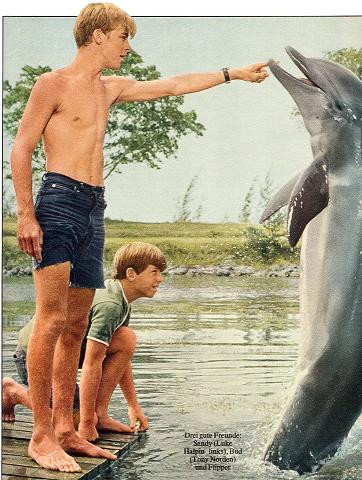
Flipper: Sandy Ricks in Trouble

It's been over 50 years since Sandy and Bud Ricks appeared on the Boys with their Shirts Off Show, aka Flipper (1964-67).

It was about two boys and their dad living in the Florida Everglades.  In each episode, one or both would get into a jam, and their pet dolphin Flipper would rush to their aid.  Sort of like an aquatic version of Lassie.

Except neither of the boys owned a shirt


Dad was shirtless sometimes, too.

And the show was in color, giving you clear, bright, beautifully detailed views of muscular chests and taunt biceps.  Especially when they were tied up, and straining at the ropes.

I never saw Flipper during its first run -- it was on Sunday night, when we were in church.  But millions of Baby Boomer kids watched, enthralled by the endless teenage beefcake, getting their first glimmers of same-sex desire.

And they remember.


My childhood favorite was Bud (Tommy Norden), with his impossibly buffed physique, but most Boomer kids seem to have favored the lithe, slim Sandy (Luke Halpin).

Today you can go to an online archive where a fan has digitized thousands of screencaps and pictures of Luke Halpin, and there's plenty of fan art.


On deviantart.com, aard4447 envisions a meeting between Sandy and Robin the Boy Wonder of Batman (1966-68).


Bondageincomics draws Sandy bound and gagged, being kidnapped, and left to drown.  If only Flipper were here!


Korak225 gives us another Sandy Ricks kidnapping scene.


And Sandy being untied by his brother Bud.

Or maybe tied.  Bud was always jealous of Sandy's teen idol status, after all.

All drawings copyrighted by their respective owners.

See also: Flipper Toys

Jun 13, 2020

Gay Teens in the Summer of Love


In Island of the Lost (1967), South Pacific Islander Tupana (Jose De Vega ) befriends a shipwrecked anthropologist and his clan. He grins at hula-dancing castaway Judy, and kisses her, and holds her hand.  When the rescue boat arrives, he says goodbye, but at the last minute he decides to forsake his homeland and swims out to join her.  At least, that is how the scene can be read.

But Tupana also befriends another castaway, Stu (Luke Halpin of Flipper); they go fishing, and learn to dance, and touch each other's shoulders, smiling.  It is Stu who actually pulls Tupana aboard the rescue boat.  We are not absolutely certain, amid the fade-out hugs, which one Tupana has decided to followed.

In 1966 and 1967, as the first of the Baby Boomers was driving off to college, or flying off to Viet Nam,  teenage boys gazing at girls were as common as tie-dye t-shirts and patchouli incense.  But, within their quest for The Girl who would give their life meaning, gay kids and teenagers often noticed them grinning at boys.


In The Fighting Prince of Donegal (1966), Renaissance Irish prince Peter McEnery rescues a princess, but he also spends an inordinate amount of time being rescued by an older man (Tom Adams).


In C'Mon, Let's Live a Little (1967), college freshman Jesse (Bobby Vee) woos the Dean’s daughter, but he also gleams at his grinning, redheaded boy friend Eddie (Eddie Hodges).  And while Jesse is off wooing a girl, Eddie sits alone in the dorm room, despondent, singing about lost love.


In It's a Bikini World (1967), teenage casanova Mike Samson (Tommy Kirk) trolls the beach in search of babes, but he also has a remarkably expressive bond with his best friend, Woody (Bobby Pickett).

In the comics, Robin and Jimmy Olsen date girls, but they are heartbroken when they believe that their superhero pals have found someone else.   Korak Son of Tarzan rescues a young African diplomat and introduces him to a girl, but not before the duo spends many panels gazing at each other with unparalleled delight


During the Summer of Love, nearly every teenage boy, whether star, buddy, or villain, was portrayed as aggressively and unequivocally girl-crazy.  Yet they often, perhaps usually, desired each other or fell in love with each other.

Their bonds were exclusive and permanent, yet always submerged beneath a girl-crazy façade.  They would gaze at each other while discussing how much they liked girls, or while competing over the same girl, or while consoling each other when their attempts at getting girls faltered.

Their bonds were intense and passionate, yet always tentative, fragile, easily disrupted.  They would express their desire through hints and innuendos, through subtexts and double-entendres, through ambiguities in spectacle or plot, through moments stolen from the “main” story, lest anyone notice. Lest anyone realize that two boys or two men could walk into fade-out sunsets together.

See also: Fighting Prince of Donegal


Aug 7, 2018

Chuck Connors


Chuck Connors may be forever remembered as the taciturn, loving, and endlessly shirtless Lucas McCain,  Johnny Crawford's dad on The Rifleman, but he had a long career before and after as a screen hunk.  Born in 1920, he started out as a pro ball player -- both baseball and basketball -- before a talent scout spotted him and cast him in Pat and Mike (1952).  Dozens of Westerns, spy movies, and war movies followed, with an occasional comedy thrown in, like the tv series Hey Jeannie (1958) and Love That Jill (1958).


The Rifleman brought him fame, of course, both for his shirtless shots and for the frequency with which he kills bad guys -- two or three per episode.  Fortunately, the kids who grew up on a diet of nonstop violence turned out fine -- the 10 year olds of 1958 grew into the 20-year old anti-war protesters of the Summer of Love.


Immediately after The Rifleman, Chuck moved back to the 20th century to play Porter Ricks in the movie version of the boy-and-pet-dolphin movie Flipper (1963), with Luke Halpin as Sandy; it later became a popular, beefcake heavy tv series.

In the Doris Day comedy Move Over, Darling (1963), Ellen (Doris) is lost at sea and presumed dead, so after five years her husband Nick (James Garner) moves on.  But Ellen resurfaces during his honeymoon.  Hijinks ensue. Chuck plays Steven Burkett, the handsome, athletic, leopard-skin swimsuit-clad man she shared a desert island with for five years.  Nothing happened, however.

Some dramas and Westerns followed, including Synanon (1965), with Alex Cord; Branded (1966-67), about a man unjustly drummed out of the army for cowardice ("what do you do when you're branded, and you know you're a ma-aa-n?"; and Cowboy in Africa (1967-68), which I never saw, but appeared to be about a same-sex couple (Chuck Connors, Tom Nardini) who run a ranch in Kenya and adopt a native boy.  It was based on the movie Africa: Texas Style, starring Hugh O'Brian.


I didn't seem much of Chuck during the 1970s; he appeared mostly in Westerns, which I didn't care for.  But he appeared again in Werewolf (1987-88), which starred hunky Eric (John J. York), a college student bitten by a werewolf; Chuck played evil head werewolf Janos Skorzeny, the object of Eric's quest to free himself from his curse.


Chuck Connors died in 1992.  He was married three times and had four children.  Recently there was a rumor circulating that he did some gay porn during his pro-ball days.  I doubt it; he wasn't part of the Physique Pictorial or Henry Willson crowd, and the footage doesn't really look like him.

But here's a censored full-frontal.  It looks a lot like him.

The uncensored photo is on Tales of West Hollywood.

Sep 23, 2017

Elijah Wood: Fear of the Buddy-Bond

Unlike his Lord of the Rings costar Sean Astin, Elijah Wood never got much play as a teen hunk, and he didn't do a lot of buddy-bonding roles; the only one that springs to mind is Radio Flier (1992) with Joseph Mazzello, and Oliver Twist (1997).

In fact, a lot of his roles drew on 1990s anxiety concerning same-sex bonds; masculine smiles hide danger, destruction, and malice:

The Good Son (1993): Mark (Elijah) discovers that his irrepressible cousin (Macaulay Culkin) is a psychotic murderer.

The War (1994): Stu (Elijah) and his friends are at war.  Oh, and he gets a girlfriend.

The Ice Storm (1997): Mikey (Elijah) has a violent brother, has sex with a girl, wanders out into an ice storm, and dies.


Or sometimes irrelevant:

The Adventures of Huckleberry Finn (1993), a version that ignores the Huck-Jim subtext.

Flipper (1994): a remake of the classic tv series with Elijah playing Luke Halpin's character. He kisses a girl.

The Faculty (1998): Casey (Elijah) discovers that the faculty are aliens, with the help of a girl who has a boorish boyfriend.


The lack of heterosexual interest and homoromantic subtext of The Lord of the Rings might exonerate him, except that during the last ten years, he hasn't done much of gay interest: a gay-vague psychopath with supernatural powers who eats women in Sin City (2005), and a gay "best friend" in Celeste and Jesse Forever (2012).

There's an Elijah Wood dating story on Tales of West Hollywood.


Sep 21, 2016

Flipper: Bodybuilder teen, twink brother, gay dad, and a dolphin


Flipper (1964-67),  was like Lassie or Skippy the Bush Kangaroo, except set n the Florida Everglades, with a dolphin instead of a collie or a kangaroo, and no women in sight. It seemed designed explicitly for the viewing pleasure of gay kids (your other choices on Saturday night were Jackie Gleason, for the grownups, and Shindig, for the teens).

It was about Ranger Porter Ricks (Brian Kelly), who lived in the Everglades National Park with his two sons, used boats more than cars, and didn't seem to own a shirt.


Nor dd his lithe, androgynous son Sandy Ricks (seventeen-year old Luke Halpin), who seemed to go to school once in a while, but otherwise was swimming, diving, boating, and getting into trouble.  He wore cut-off jeans that were way too tight for adequate modesty, and shrank even more whenever he got wet (which was all the time).


And can someone explain Bud Ricks (twelve-year old Tommy Norden)?  He's a kid with the pecs and abs of an adult bodybuilder.  Did they graft a 12-year old's head onto a grown-up's body, or what? (The same muscle spurt, incidentally, happened in comics to Richie Rich.)

Not that any gay kids were complaining.  Saturday night, summer or winter, was beefcake time.

 There was not a lot of buddy-bonding; Sandy and/or Bud needed rescuing a lot, but it was always Flipper who chirped to the rescue.  But -- and this was a big "but" for 1960s tv - none of the boys exhibited much heterosexual interest.  Porter and Bud, never.


Sandy had already grinned and flirted with a girl in the movie Flipper’s New Adventure (1964), yet he expressed an interest in girls during the tv series only twice. In “Love and Sandy” (1965), he has an unrequited crush on  a college girl (Cheryl Miller), and in “Cupid Flipper” (1966) he mistakenly believes that his girlfriend (Susan Abbot) is in love with his father. It was like a weekly vacation from the tedium of incessant "what girl do you like"?

There were lots of book tie-ins and toys available for the off-hours.

After a few 1970s tv appearances, such as The Mighty Isis, Tommy Norden retired from acting, and Brian Kelly was forced to retire in 1970 after a motorcycle accident paralyzed his right arm and leg -- he continued to produce movies like The Blade Runner (1982).  But Luke Halpin had a long career on television and in movies like Island of the Lost (1967) and  If It's Tuesday, This Must be Belgium (1969).  

See also: Flipper Toys
Related Posts Plugin for WordPress, Blogger...