Showing posts with label art. Show all posts

Jul 2, 2026

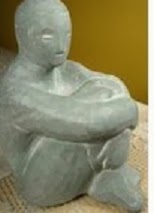
Dad buys me a n*ked man for Christmas


Link to the n*de photos


Not a real n*ked man, of course.

When I was a kid in Rock Island, three local celebrities were praised in the media, advertized in bookstores, and assigned by teachers: 
1. Jazz musician Bix Beiderbecke
2. Poet Carl Sandburg
3. Sculptor Isabel Bloom.

Born Isabel Scherer in 1908, she grew up in Davenport, across the river in Iowa, and studied at Grant Wood's Stone City Art Colony, where she met and married fellow artist John Bloom.  In the 1950s, she began producing distinctive sculptures carved out of Mississippi River stone or molded of mud mixed with concrete.  

They were absolutely atrocious. Angels, fairies, hugging children, mothers hugging babies, cats, doves, bridal couples, snowmen, Santa Clauses, the most maudlin, sentimental, and heteronormative dreck ever imagined.

But everyone in the Quad Cities loved them.  My parents loved them.There were two or three in every room.  Dozens more crossed the state with us to give to our Indiana relatives for Christmas presents.  When an out-of-town friend visited, they always went home with a Isabel Bloom fairy or hugging child.

So I should have anticipated what would happen.


I had just discovered Greek art -- rather, statues of muscular Greek gods, so for Christmas in ninth grade, I  asked for "a statue."  

I meant a desk-sized statue of a n*ked god, like the Belvedere Apollo, but Dad said, "Sure -- let's go down to Isabel Bloom's, and you can pick out the one you want."

I couldn't tell him "No, no...I wanted a naked Greek god, not some stupid boy holding a frog!", so my boyfriend Dan and I had to fake-grin our way through a mid-December visit to the crowded studio in the Village of West Davenport, as we sorted through Angel with Wreath, Unconditional Love, Lovebirds, Boy with Flag...

Eventually Dan wandered off, but my torture continued: Girl with Pumpkin, Newlyweds, Boy Offering Girl Flowers, Baby in Crib, Sleeping Cat...  

Then Dan came running excitedly from a side studio.  "Hey, what about this one?"  It was a n*de male figure, seated, his arms around his knees.   Stylized, not muscular, but a heck of a lot better than the other stuff.

"John's Thinker, " he read from the bottom. 

"Must be a statue of her husband," I said, carefully taking it from his hands.  It felt warm to the touch.  It was thrilling to think that I might be holding an exact likeness of a real n*ked man.


"No, she didn't do this statue, her husband John did," Dad said, frowning.  "It's not a real Isabel Bloom."

"That's ok.  It's different from the others.  I'll take it." 

He looked at me oddly.  "The others are lots nicer ones.  How about First Kiss?"  He held out a statue of a little boy kissing an embarrassed little girl on the cheek.

"I don't want any statues of girls."

"It's a boy and a girl.  That's like two statues for the price of one!"

Was he objecting to the price of John's Thinker?  No, First Kiss cost twice as much.  "This one's cheaper."  

"But..you could use it as a kind of model, you know.  When you want a girl to let you kiss her, just show her the statue."

"Gross!" Dan exclaimed.

"After you discover girls, I mean."


"John's Thinker, please," I said firmly.

Dad shrugged.  "Well, if you're sure that's the one you want.  But I don't know what you're going to do with it, Skeezix." 

 Later I figured out that he always called me Skeezix, after a character in the old Gasoline Alley comic strip, when I expressed same-sex desire, something bizarre and beyond imagining at the time.

I still have the statue.  And someone put an Isabel Bloom angel and cat on my father's grave.

More after the break


Mar 27, 2026

Garcia Lorca: The Homophobic Gay Poet and his Boyfriend

When I was studying Spanish literature at Augustana College, I never, in a million years, would have guessed that Federico Garcia Lorca (1898-1936) was gay (or that his boyfriend surrealist painter Salvador Dali).

How could I suspect, when his three most famous plays are:

1. Yerma (1934), a tragedy about a woman who can't have children.


2. Bodas de Sangre (Blood Wedding, 1933), about two men who kill each other over the love of a woman.

3. La Casa de Bernarda Alba (The House of Bernarda Alba, 1945), about a woman who can't stand her daughter's lack of chastity.  This one has no male characters at all. 


And when his poetry is all about heterosexual longing:

"The Lizard is Crying": boy and girl lizards are crying because they lost their wedding rings.

"Two Mariners on the Beach": one dreams of "the golden breasts of Cuban girls."

"Thamar and Amon": he "was gazing at the round and low moon, and he saw in the moon his sister's very firm breasts."

(Painting of Lorca as St. Sebastian is by Alice Wellinger)


"Ode to Walt Whitman" is even homophobic.

 Lorca decries the "pansies" (maricas) of New York, horrible perversions of the spiritual love described by Walt Whitman.  They don't just gaze longingly at each other, they actually touch each other!  Disgusting!

Pansies of the cities, of tumescent flesh and unclean mind,
Mud of dreams, harpies, unsleeping enemies of Love
Pansies of the world, murderers of doves!
Let there be no quarter!
Death flows from your eyes!


Wow.


But he was definitely gay.


More after the break

Feb 15, 2026

Easter Island: Phallic Statues and Penis Festivals

If you thought Mongolia was remote for Westerners, try Easter Island (aka Rapa Nui).  From New York, you fly to Miami, then to Panama City, and finally to Santiago, Chile (about 24 hours).  From there, only one airline flies to the town of Hanga Roa on Rapa Nui, once a day (about 6 hours).

It's a tiny island, about 15 miles long and 8 miles wide, alone in the Pacific Ocean, probably settled from the Marquesas Islands, 2000 miles away.

Once the early Polynesians got there, they became very interested in the penis.

1. Most Rapa Nui men incorporated the word Ure, "Penis," into their names, but in the 19th century Christian missionaries put an end to the practice.

2. The Moai, "Easter Island Heads," are actually complete torsos, over 800 of them, 20-30 feet high, weighing over 80 tons, sculpted and installed over a period of 300 years (1200-1500 AD).  They took so much time and energy that the islanders had little time left for other pursuits, and so many trees were felled to facilitate transport that the island is now almost entirely treeless.

The noses of the figures have often been interpreted as phallic symbols.  Indeed, some scholars interpret the Moai themselves as giant phallic symbols, representing the sexual potency of the Rapa Nui men. There's a legend still common on the island that a penis served as the model.


3. Rongo Rongo, the Easter Island script, appears on dozens of tablets and ceremonial objects.  By the time the Europeans arrived, no islander remembered how to read it, and it remains untranslated.  But at least one of the glyphs is called "Tangata Ure Huki" "Man with Erect Penis"


4. The Tapati Fesival, held every year during the first two weeks of February, is a celebration of the island's history, culture, and penises.  There are parades, dances, athletic contests like haka pei (sliding down a mountainside on a tree trunk), and a race called the Tau'a Rapa Nui: men wearing only skimpy loincloths race through town carrying bunches of phallic-symbol bananas.


Feb 14, 2026

Male Nudity in Italian Class

The only good thing about Hell-fer-Sartain, Texas, where I taught at a horrible state college after getting my M.A., was the free tuition for faculty.  There wasn't a lot at that I wanted to take, but they did offer Italian.

It didn't start out well:
Roger e un ragazzo americano. Maria e una ragazza italiana. Roger e Maria sono amici. . .

Roger is an American boy visiting Italy. He goes to a cafĂ© and tries to pick up a local girl. In the first lesson we learned “What is your name?”, "Your country is beautiful," and "How old are you."

Roger learns the time so he won’t be late for the cinema, learns the names of food so he can order in the restaurant, gets an overview of national history as they tour the museums.  In Chapter 10, we learn the Italian word for "kiss" (bacio).

Why do even language-learning dialogues have to be about  boys and girls gazing at each other?  


I never thought of Italy as a "good place."  The only fiction I read about Italian men  in love was The Little World of Don Camillo, and movies set in Italy seemed to involve mostly horny heterosexuals: Roman Holiday (1953), La Dolce Vita (1960),  Island of Love (1963).  Pasolini was gay in real life, but his moves were entirely heterosexist.  I had never seen Ernesto (1979).

But one weekend I drove two hours into Houston, to the Wilde-and-Stein Bookstore, and bought Ganymede in the Renaissance, about how Renaissance artists used the myth of Ganymede, a mortal boy swept up by Zeus to become his catamite.

And I discovered a whole gay world in Renaissance Italy, artists, writers, statesmen.

1. Leonardo Da Vinci. He gets a girlfriend in modern straightwashing biopics, but he was gay.

2. Michelangelo.  He gets straightwashed a lot, too. 

3. Donatello, who sculpted the famously effeminate David, a counterpart to Michelangelo's more macho version.

4. Benvenuto Cellini.  His Autobiography was on the list of recommended readings in my class in Renaissance History in college.  I didn't read it, and the professor never said a word.


5. Caravaggio, played by Dexter Fletcher and Nigel Terry in the 1986 movie.

6. Aretino, who wrote Il Marescalco, about a gay man forced to marry a woman, but fortunately she turns out to be a man.

7. Ariosto.  I bought his Orlando Furioso in a Ballantine Adult Fantasy edition, but it was about winning The Girl.


8. Matteo Bandello, who wrote 12 Novelle, one about a gay man.

9. The painter Giovanni Antonio Bazzi, nicknamed "Il Sodoma"


See also:  "Da Vinci's Demons": An absurdly heterosexual Da Vinci, a bi guy who only likes ladies, two monstrous gay predators

Pasolini's "Arabian Nights": The less well-known tales told with pe* nises and homophobia


"Caravaggio's Shadow": As time goes by, the gay Baroque painter becomes more and more straight. With n*de Italian men

Sep 13, 2025

Icarus: The boy who flew too close to the sun


I mentioned before that artists interested in depicting men without women around have only limited mythological and religious themes to choose from, and most involve tragedy.

Take the tragedy of Icarus:
According to Greek mythology, skilled inventor Daedalus and his son Icarus were imprisoned in Crete.  To escape, Daedalus made them wings from bird feathers, held together with wax.  The plan would have worked, except that Icarus flew too close to the sun, so the wax on his wings melted, and he plunged to his death.


In the ancient world, and through the Middle Ages, the story was used to illustrate the folly of over-confidence, trying to do more than you are able.  But more recent artists and writers have a different take: strive to be all that you can.  You may fail, but at least you were able to fly.

Or they just like to portray a muscular nude Athenian youth, before, during, or after his flight.

Daedalus and Icarus (1645), by French painter Charles LeBrun, shows the moment when Daedalus rouses Icarus to try on his wings.

Icarus and Daedalus (1869), by Lord Leighton shows the same scene, but now they're on top of the tower, and a thin swath of fabric keeps Icarus from full nudity.


The Lament for Icarus (1898), by Herbert James Draper, substitutes naked nymphs for the mourning Daedalus, but it has a particularly striking dead hero (modeled by Luigi di Luca)


More Icarus after the break

Jun 8, 2025

Fred with Tires: The Iconic West Hollywood Photograph

This is one of the iconic photos of West Hollywood.  Nearly everyone I knew had a print in their living room or bedroom.  It was a fixture in our homes, like the family photos that heterosexuals keep on their mantles:

A buffed young man carrying tires through an auto shop, his male-model face and expensive hairstyle contrasting with his working-class surroundings, a sweaty, macho, implicitly heterosexual grease monkey emerging from his closet, transformed into an object of homoerotic desire.

He represented all of small-town joys that we left behind in the Straight World, and the much greater joys we found with our friends and lovers in our new home.

I didn't know where it came from until yesterday: it's "Fred with Tires" by fashion photographer Herb Ritts (1952-2002).


He grew up in a wealthy household in Los Angeles (his next door neighbor was Steve McQueen), and attended Bard College.  His photography career began in 1978, when he and buddy Richard Gere had car trouble on a road trip, and he began photographing the future star in front of their jalopy -- not shirtless but sultry, bulging, a canny evocation of working class machismo combined with pretty boy sensitivity.

The next year, a photo of John Voight made it to Newsweek.

Pleased with the critical reaction, Ritts began photographing other celebrities, such as Brooke Shields and Olivia Newton-John.  He specialized in female supermodels like Naomi Campbell and Cindy Crawford.  He published a number of books on fashion photography, and became a renowned expert in the field.

He was also a well-known commercial photographer, with work for Levis, Revlon, Brut, Chanel, Maybelline.


Although he was gay, out since college, in a committed relationship with partner Erik Hyman, his artistic emphasis was always on the feminine.  There are only a few male celebrities in his archive, and those few are rarely shirtless, displaying a sensuality but not overt eroticism.  This color photo of Justin Timberlake is an exception.


So how did we get "Fred, with Tires"?  In 1984, Herb hired a UCLA undergrad named Fred for a raincoat ad in the Italian magazine Per Lui.

 He hated the raincoats, so he had Fred pose in jeans instead.  The editor hated the photos -- too sultry, too erotic, too gay -- but ran them anyway.  And the last, taken when Fred was tired, sweaty, and little annoyed, anxious to finish up and go home -- perfectly captured the West Hollywood moment.

The original hangs in the Getty Museum, and prints became fixtures in our apartments, emblematic of home.

May 19, 2025

Nathaniel Choate: Gay African-American Sculptor of 1960s New York

When I was living in New York, I had a friend who lived near the  Klitgord Center,  at the corner of Jay and Tilly Street in Brooklyn, the heart of the New York City College of Technology.  Every day he, and thousands of other people, walked past its gigantic 2-story mural memorializing some of the joys of college: Art, Drama, Music, Recreation, Health, and Recreation.

"Health" was a muscular man on the parallel bars, naked or wearing a skimpy jockstrap.

The Klitgord Center was demolished in 2013.

Recently I investigated the mural, and tried to find out something about the artists.


Sculptor Nathaniel Choate (1899-1965) was one of the few African-American men to graduate from Harvard in the 1920s.  Afterwards he studied in France, and traveled extensively in Morocco and Sudan, perhaps looking for the "good place" that drew dozens of gay men to North Africa.  He returned to the U.S. in the 1930s, and taught in Pennsylvania and New York.  He never married.

His subjects were usually muscular African men, such as "Alligator Bender" at Brookgreen Gardens in Myrtle Beach, South Carolina.


Tile artist Francis Von Tury (1901-1992) was born in Hungary, had a studio in Perth Amboy, New Jersey, and was a leading proponent of ceramics as both an art form and an industrial tool.  He never married, either.

Most of his work is stylized, but there are some interesting male figures, like this fisherman on a blue tile.

I don't know if the two men were friends, or lovers, before they began their collaboration.

Apr 9, 2025

Donelan: It's a Gay Life

When I was in grad school in Bloomington, I was able to get copies of The Advocate at the adult bookstore.  One of my favorite features was a series of single-panel New Yorker-style cartoons, "It's a Gay Life," by Donelan,  lampooning the culture of 1970s gay neighborhoods: brunch, boyfriends, leathermen, queens, cruising, decorating, activism....

"Oh, please, girlfriend.  Isn't brunch a little too early for attitude?"


Some cartoons were about the reaction of straights, those who knew -- and were ok with it.  In a clueless, stereotyping way.

"I know a homosexual.  George knows a homosexual.  You must have so much in common.  So here we are.


Others who didn't know, and didn't want to know.

"Did your roommate just say he was going to 'freshen his makeup'?"


I was most drawn to the cartoons depicting gay men in pairs and groups.  There was a whole society out there somewhere, a place where being gay was commonplace, even expected, where straights were the interlopers and strangers.

"I'd be more impressed if you could name me one man here you haven't dated."

I wanted that world.


Gerald P. Donelan grew up in Plymouth, Massachusetts, and moved to San Francisco in the 1970s.  He published "It's a Gay Life" from 1978 to 1993.  There were two  reprints of his cartoons: Drawing on the Gay Experience (1987) and Donelan's Back (1988).  His work also appeared in Frontiers and in the Meatmen series of gay comic anthologies.

Today his work seems a bit dated, keying into feminine stereotypes a bit too much.  But in the height of the homophobic 1980s, it was a revelation.

"Tell me again the difference between eclectic and tacky."

See also: Howard Cruse.


Mar 10, 2024

Grant Wood: More Than Pitchforks and Cornfields

When I was growing up in Rock Island, we had a lot of local celebrities.  Grant Wood wasn't one of them, even though he was the most famous American artist before Andy Warhol, and he was local, from Anamosa, Iowa, just north of the Quad Cities. He spent his life in the area, overseeing Stone City Art Colony nearby, and teaching at the University of Iowa, about 45 minutes away.


We ignored Grant Wood because of American Gothic, the second most famous painting of all time, and the most parodied.

It gave the Midwest a bad name.  The goggle-eyed farmer with pitchfork looks like he's about to go storming off to protest civil rights, or gay rights, or violence in comic books.  The weepy woman, her beauty faded by the boredom and isolation of farm life, dreams of escape.

Even today, if I admit to being from the Midwest (I usually don't), I get "How awful it must have been for you!  Nothing to do but watch the corn grow and fight all those redneck bigots!"
Um...no.  We had more to do than watch the corn grow: we had symphonies, live musicals, operas, ballets, art galleries, and museums. And about those bigots:  Iowa had the first class in Gay Studies in the world, and was one of the first states to get gay marriage.

So I didn't know much about Grant Wood until I started investigating John Bloom, who sculpted the statue of a naked man that I got for Christmas in junior high.


In 1926, the aspiring artist won a prize for an oil painting, "The Burial," at the Iowa State Fair.  The judge, celebrity painter Grant Wood, invited him to join his new Stone City Art Colony.  For the next two years, they lived together, in a converted ice wagon (rather a small space!). Together they worked on murals for libraries and post offices all over the state.

In 1934, when Grant went to the University of Iowa, he took John with him.

In 1935, Grant married Sara Sherman Maxon (the marriage ended in divorce three years later).  John moved to Davenport, where he married Isabel Bloom in 1938.

Sounded a lot like a spurned lover.

Sure enough.  A new biography, Grant Wood: A Life, by R. Tripp Evans, reveals that Grant was gay.  When he got to the University of Iowa, some faculty members in the Art Department suspected, and they already looked down upon Grant for rejecting the status quo of European Impressionism -- ergo his screen marriage and giving John Bloom the boot.

After his divorce in 1938, Grant had a series of handsome male "roommates."  This riled the homophobic faculty so much that, superstar or not, they wanted him out.  They waited the fall of 1941, when he was on sabbatical, and invited a writer from Time magazine to investigate "sexual improprieties."  The University President managed to put a kibosh on the story and quickly moved Wood into a new division.  However, he didn't get a chance to return to the faculty that loathed him.  He died of pancreatic cancer in February 1942.

But if you look carefully at his work, you can see the glimmers of homoerotic desire.

And even that stupid American Gothic isn't heterosexist.  Everybody thinks the woman is the farmer's wife, but she's his daughter.

Mar 1, 2024

N.C. Wyeth: Keeping Gay Desire Hidden

During the first half of the twentieth century, kids who got adventure books as presents, or checked them out of the library, were sure to find beautiful illustrations by N.C. Wyeth (1882-1945), like this naked warrior in a biography of Charlemagne.

The American regionalist illustrated over 100 books, including The Last of the Mohicans, Treasure Island, Kidnapped, Robinson Crusoe, The Yearling -- just about everything that boys read for pleasure during that era, making him as famous as Norman Rockwell or J.C. Leyendecker.

He also drew hundreds of magazine covers, advertisements, patriotic images, and murals, as well as a repertoire of 1,000 paintings.


N.C. (Newell) Wyeth belonged to the Brandywine School, known for its dependence on bright, vivid colors, realism to the point of grotesqueness, and serious, ponderous themes.  He frequently offered beefcake images -- two or three pictures in nearly every book display the interplay of muscles on a bare torso or nude backside.  But with two odd quirks:

1. N.C.'s nude men are almost always obscured, their faces hidden or their bodies engulfed in shadow, as in the illustrations from The White Company (left) or The Mysterious Island (below). It's as if displaying the face and physique together would be too dangerous, give too much voice to secret desires.


2. They are almost always in conflict, wrestling, fighting, attacking, subduing or being subdued, as in this illustration from Drums. It's as if he feared what would happen if two men approached each other in respect, friendship, or love.

In real life, N.C. was nothing like his stolid, stable, respectable illustrations would suggest.  He was an aesthete, a gourmand and a bon vivant, who held court in his house in Chadds Ford, Pennsylvania and summer home in Maine, partying with all of the greats of the Jazz Age, including Lillian Gish, Charlie Chaplin, F. Scott Fitzgerald, and gay novelist Hugh Walpole.  

More after the break

DH Lawrence and the Naked Cornish Farmer

D.H. Lawrence (1885-1930) was the darling of the grad English students when I was at Bloomington, maybe because he was more accessible than James Joyce or T.S. Elliot, but still Great Literature, and he wrote about sex.

A lot.

The heterosexual girls seemed to gravitate toward Lady Chatterley's Lover (1926), a Harlequin Romance with bad words.


The heterosexual boys liked Sons and Lovers (1913), about a boy who is in love with his mother.

No one ever mentioned Women in Love (1920), and I hadn't yet seen the 1969 movie starring Oliver Reed and Alan Bates (top photo).

Turns out it's about two sisters who become involved with a gay couple.  Actually they're all bisexual.  One of the men dies, and the other is told, "There can't be two kinds of love."


Aaron's Rod (1922) is about a flutist who leaves his wife and kids to go to Florence with his boyfriend and show his "rod" to men and women.

Lawrence was rather critical of heterosexual romance, Instead spinning wild fantasies of all-male Arcadias.

But he also created horribly homophobic characters, and criticized Walt Whitman for his gay subtexts in Studies in Classic American Literature. 

D.H. Lawrence had several same-sex relationships, notably with a farmer named William Henry Hocking, whom he apparently encountered naked on the beach in Cornwall.  He spent the rest of life searching for someone as perfect, just as Ernst Josephson spent his life searching for the "beautiful boy with a violin" he met in Norway.

But he also warned writer David Garnett against pursuing his "homosexual tendencies," and he hated the gay men he met in the Bloomsbury Group, such as Duncan Grant and John Maynard Keynes; they made him "mad with misery and hostility and rage."

Do you get the impression that this guy was a little nuts?


He tried his hand at painting, and exhibited 25 works at the Warren Gallery in London in 1929.  But they were mostly of nude Italian men with their penises flapping around, including his lover Piero Pini.

The police raided the gallery and seized 13 paintings. They were later returned, on the condition that Lawrence never again show them in England.   When his wife, Freda Lawrence, died in 1956, she willed them to her friend Saki, who willed them to Taos art collector George Sahd.  They're in Taos, New Mexico today.


Priest of Love (1982) stars gay actor Ian McKellen as D.H. Lawrence, Graham Faulkner in a five-second flashback as a nameless Cornish farmer, and Massimo Ranieri (left) as Piero Pini.  It displays his bisexuality in a couple of "you have to be looking for it" scenes.


Feb 26, 2024

David and Goliath: From King James Bible to Gay Men's Bedrooms

The Philistine warrior Goliath was BIG: nine feet nine inches (enough about the nine feet, let's hear about the six inches).  His suit of armor weighted 125 pounds.  He challenged King Saul and the Israelites, but they were too scared to approach him.

The shepherd David agreed to fight him, but the sword and armor was too bulky, so he took his clothes off and fought with just a slingshot.  He immobilized the giant, then rushed up with a sword and decapitated him.

Don't read too far, though, since in 2 Samuel we discover that David didn't do the job at all; it was Elhanan the Bethlehemite.

The story of David and Goliath in 1 Samuel was a mainstay of Sunday school classes, probably because it showed a little guy triumphing over a big guy.  And because it's rather fun to imagine a nude, muscular shepherd boy striding across the battlefield, his penis swinging, the warriors all gazing in awe at his beauty.


The Biblical writers probably intended for David to be well into adulthood, in his late twenties, but artistic depictions generally make him 14-15.  And leave his pants on, as in this painting by French artist Gabriel Ferrier (1847-1914)


Peter Paul Rubens (1577-1640) made him the right age, but upped the clothing, giving him a tunic and pants.


This Italian engraving by Marcantoni Raimondi (1480-1534) gives David a massive body and a penis, with a cloak flapping behind him.


More Davids after the break


Related Posts Plugin for WordPress, Blogger...