Showing posts with label Doris Day. Show all posts

Jul 14, 2026

The 12 most homophobic, heterosexist, and horrible songs

Heterosexism is commonplace in the "girl! girl! girl!' banter of popular music.  But some songs are so heterosexist, homophobic, or otherwise horrible that I literally can't stand to hear them.  If they come on tv, I click the channel, and if I can't find the remote, I run from the room.  If they're playing in a store, I leave. And heaven help the friend who starts singing one of them!

I'm not including songs that were intended to be homophobic, like "My Girl Bill" and "Big Bad Bruce."

1. "It's a Man's World" (James Brown, 1966)

It's a man's world, but you're nothing...nothing at all, without a woman (or a girl).

This from a guy who dresses like a 1950s housewife.


2. "She Bangs" (Ricky Martin, 2000).

A gay guy singing about how much he likes the way a girl moves, and then a pun on "shebang" and a dirty phrase for s*x.  Can't get any more Uncle Tom than that.


3. "Stand Tall" (Burton Cummings, 1976)

December of my junior  year: I was home sick, looking for a gay comic book, and thinking "No way am I a f*g!"  And I heard on the radio:

Stand tall, don't you fall, don't go and do something foolish
All you're feeling right now is silly human pride.

Right, not gay, don't do anything foolish.


4. "Lady" (Kenny Rogers, 1980).

I was in college, not out because of course no one came out in those days, negotiating the incessant "No homosexual has ever been a great writer" from professors and the "what girl do you like?" chants of my family and friends.  And I heard:

Lady, I'm your knight in shining armor, and I love you.
Let me hold you in my arms forever more....


5. "When Doves Cry" (Prince and the Revolution, 1984).

 I'm on my way to Hell-fer-Sartain State University in ugh...Texas or the worst year of my life, and this ultra-feminine, super-gay coded guy starts singing about a heterosexual breakup:

How can you just leave me standing, alone in a world so cold?
Maybe I'm just too demanding
Maybe I'm just like my father, too bold


6. "Have Yourself a Merry Little Christmas" (Judy Garland, 1944).

I've heard the first few words of this monstrosity many times, as I'm rushing to turn off the tv or run from the mall.  Once I was visiting my partner's cousins, and their kid started playing it..  I ran upstairs and hid in the bathroom for ten minutes, but when I emerged it was still playing!  


More (gulp!) after the break.


Mar 21, 2022

Cary Grant: Hints and Closets in the 1930s

On November 29, 1986, Cary Grant died in Davenport, Iowa, right across the river from my home town of Rock Island.  I was living in West Hollywood at the time, but still, it felt weird to know that a film legend had died right next door.

Cary Grant had a brilliant career, usually playing suave, sophisticated types driven mad by a free spirit or a series of catastrophes.  Must-sees include Topper (1936), Suspicion (1941) directed by Alfred Hitchcock, The Bachelor and the Bobby-Soxer (1947), To Catch a Thief (1955), North by Northwest (1959) by Hitchcock again,and  That Touch of Mink (1962) with Doris Day.  Many of his movies have gay subtexts.

In Bringing Up Baby (1938), his character answers the door in a frilly women's nightgown (because a woman stole his clothes), and declares "I just went gay all of a sudden."  He continues: "I am sitting in the middle of Time Square, waiting for a bus."  This is one of the first uses of "gay" in its modern sense, augmented by the reference to cruising.  It's an ad-lib, not in the shooting script. How would he know it?

The perennial question is, was he gay?

The facts of the matter are:

1. He met Randolph Scott in 1932, and the two lived together, on and off, for the next ten years ("to save on expenses," heterosexist biographers claim) and remained close friends for the rest of their lives.

2. But neither have been associated with any gay stars, or with the gay subcultures of Hollywood in the 1950s, 1960s, or 1970s.

3. Friends and acquaintances noted that he was often seen in the company of young men.


4. He was married five times. His first two wives "accused" him of being gay, his last three denied the rumors, stating that they had sex a lot.

5. He sued Chevy Chase for suggesting that he was gay.

6. His daughter stated that he liked the rumors, because they motivated women to "cure him" through sex.

7. His last movie, Walk, Don't Run (1966), is obviously about a gay romance.

8. He never acknowledged his gay fans.

9. My friend Randall claims that he had a three-way with Cary Grant and Groucho Marx in 1958.  The story is on Tales of West Hollywood.

Answer: there's a ton of evidence for both gay and heterosexual identity.  Most likely he was bisexual and highly closeted.

Jan 18, 2021

Annie Get Your Gun: Beefcake and a Gay Couple

I have mixed feelings about Annie Get Your Gun, the 1946 musical that was made into a half dozen movies, revived a dozen times, and remains a favorite of high school and college drama clubs.  Maybe because I got confused, thinking it was about a guy with his arms and legs blown off (that's Johnny Got His Gun).  

It's actually about real-life sharpshooter Annie Oakley (1860-1926), who joins Buffalo Bill's traveling Wild West Show in the 1880s and competes with the star, Frank Butler.

There's something to be said for a big, tough, rastlin' backwoods gal who can shoot guns, but why make her so all-fired eager to give it all up for a man?

I'm quick on the trigger with targets not much bigger than a pin point, I'm number one.
But my score with a feller is lower than a cellar- Oh you can't get a man with a gun.

Wait -- I know the answer.  Heteronormativity.

But she goes even farther, proclaiming it as universal human experience, "doin' what comes naturally":

My tiny baby brother, who's never read a book, knows one sex from the other --
All he had to do was look!

And the object of her affection is rather a cad, leaving a chain of seductions wherever he goes:

There's a girl in Tennessee who's sorry she met up with me
I can't go back to Tennessee -- I'm a bad, bad man!

The kicker: Annie is a better shot than Frank, but in the big match, she deliberately loses, so he will like her.  What kind of message is that for young heterosexual girls?  Squash your talents in order to get a man!


But some the songs are catchy, especially the show-stopping "There's No Business Like Show Business," which became the unofficial anthem of Hollywood.

There is a small gay subtext in the relationship between Buffalo Bill and his manager, Charlie Davenport.


And some beefcake: Annie is mentored by Indian performer Sitting Bull, who adopts her into his tribe.  Costumer designers often decide that the Indians should display their physiques.


Besides, Annie has been played by some of the biggest gay icons of the stage, including Betty Hutton, Ethel Merman, Judy Garland (actually fired from the 1950 film), Bernadette Peters, and Doris Day.

Notable Franks have included Bruce Yarnell, John Raitt, Harve Presnell, Tom Wopat, and Patrick Cassidy,

See also: The Sound of Music; The Pajama Game.

Mar 18, 2020

The Pajama Game: 1950s Beefcake

There once was a man who loved a woman
She was the one he slew a dragon for.

The American musical has traditionally been a vehicle for unvarnished heterosexism, two interspliced boy-meets-girl plotlines and as many songs about "love! love! love!" as a Cody Simpson album.  But with so many gay actors, writers, directors, choreographers, and producers, gay subtexts invariably sneak in.

The Pajama Game (1954) ran for 1,063 performances on Broadway, with revivals in 1973 and 2005, and a movie version in 1957 (starring Doris Day).  The title sounds risque, but it's actually about the Sleeptite Pajama Factory in Cedar Rapids, Iowa.

Romantic plot #1: Manager Sid and worker Babe, who is petitioning for a 7.5 cent raise.
Romantic plot #2: Boss's assistant Gladys and her jealous boyfriend "Hine-sie" Hines.


Gay subtext #1: Hines seems more interested in Sid than Gladys.
Gay subtext #2: Gladys has many masculine-coded traits, veering close to a stereotypic movie lesbian.
Gay subtext #3: Beefcake.  At the end of the movie, Sid and Babe unveil the new pajama style, Sid shirtless, barechested, and muscular, so risque that it was shocking in 1954.


  John Raitt (left) is the archetypal Sid, appearing in both the original Broadway and the movie versions.  University performers include Chris Ellis (top photo) and Stephen Boyd (above).


The Pajama Game is a favorite of high school and college drama clubs, for both actors and fans who can see their favorite hunk semi-nude.  Usually skittish directors insist that he perform with a t-shirt instead, as Harry Connick Jr. did in the recent Broadway revival.


Aug 7, 2018

Chuck Connors


Chuck Connors may be forever remembered as the taciturn, loving, and endlessly shirtless Lucas McCain,  Johnny Crawford's dad on The Rifleman, but he had a long career before and after as a screen hunk.  Born in 1920, he started out as a pro ball player -- both baseball and basketball -- before a talent scout spotted him and cast him in Pat and Mike (1952).  Dozens of Westerns, spy movies, and war movies followed, with an occasional comedy thrown in, like the tv series Hey Jeannie (1958) and Love That Jill (1958).


The Rifleman brought him fame, of course, both for his shirtless shots and for the frequency with which he kills bad guys -- two or three per episode.  Fortunately, the kids who grew up on a diet of nonstop violence turned out fine -- the 10 year olds of 1958 grew into the 20-year old anti-war protesters of the Summer of Love.


Immediately after The Rifleman, Chuck moved back to the 20th century to play Porter Ricks in the movie version of the boy-and-pet-dolphin movie Flipper (1963), with Luke Halpin as Sandy; it later became a popular, beefcake heavy tv series.

In the Doris Day comedy Move Over, Darling (1963), Ellen (Doris) is lost at sea and presumed dead, so after five years her husband Nick (James Garner) moves on.  But Ellen resurfaces during his honeymoon.  Hijinks ensue. Chuck plays Steven Burkett, the handsome, athletic, leopard-skin swimsuit-clad man she shared a desert island with for five years.  Nothing happened, however.

Some dramas and Westerns followed, including Synanon (1965), with Alex CordBranded (1966-67), about a man unjustly drummed out of the army for cowardice ("what do you do when you're branded, and you know you're a ma-aa-n?"; and Cowboy in Africa (1967-68), which I never saw, but appeared to be about a same-sex couple (Chuck Connors, Tom Nardini) who run a ranch in Kenya and adopt a native boy.  It was based on the movie Africa: Texas Style, starring Hugh O'Brian.


I didn't seem much of Chuck during the 1970s; he appeared mostly in Westerns, which I didn't care for.  But he appeared again in Werewolf (1987-88), which starred hunky Eric (John J. York), a college student bitten by a werewolf; Chuck played evil head werewolf Janos Skorzeny, the object of Eric's quest to free himself from his curse.


Chuck Connors died in 1992.  He was married three times and had four children.  Recently there was a rumor circulating that he did some gay porn during his pro-ball days.  I doubt it; he wasn't part of the Physique Pictorial or Henry Willson crowd, and the footage doesn't really look like him.

But here's a censored full-frontal.  It looks a lot like him.

The uncensored photo is on Tales of West Hollywood.

Jun 19, 2013

Rockford Files: Buddy of the Week

When I went to graduate school in Bloomington, Indiana in 1982, everyone kept assuming I was from Rockford, Illinois, and therefore a big fan of The Rockford Files (1974-80).  It was useless to point out that 1) I was from Rock Island, not Rockford; and 2) The show wasn't set in Rockford; that was his name.

I rarely watched -- it aired on Friday nights, when I was usually out or busy with friends -- but those few episodes I saw had some gay-subtext promise.


Jim Rockford (James Garner) was an antiheroic detective, who never used a gun and hurt his hand during fistfights.   He lived in a ramshackle trailer, where he frequently sought the advice of his comic-relief father (Noah Beery Jr., a Tarzan clone in the 1935 Call of the Savage).


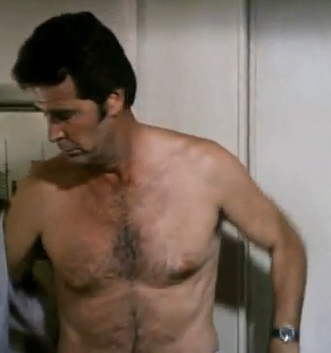
There were no girl-of-the-week exploits, as on Magnum PI and other 1980s detective dramas; the episodes I remember had no hetero-romance at all, but had Jim Rockford helping out the male buddy-of-the-week.

Gay-vague street-smart informer Angel (Stuart Margolin) hopes to profit from an illegal garbage collection business.

The son of an old friend, a fraternity pledge (Bill Thornbury), goes missing.

Longsuffering police contact Davis Becker (Joe Santos) is framed for murder


I missed the two gay themed episodes:
1. "Requiem for a Funny Box": A washed-up comedian is murdered, and one of the suspects is the gay guy he's been blackmailing.
2. "The Empty Frame": A gay couple hire Rockford to retrieve some stolen paintings.

James Garner previously starred in the Western Maverick (1957-62), as an antiheroic gambler, paired up with various brothers and cousins played by Jack Kelly, Roger Moore, and Robert Colbert.


Over five decades he appeared in many other productions of gay interest, such as Move Over Darling (1963) with Chuck Connors and Doris Day; Victor/Victoria (1982), with Julie Andrews as a fake drag queen; The Glitter Dome (1984), with a lesbian villain; and 8 Simple Rules (2003-2005), with Martin Spanjers.

Related Posts Plugin for WordPress, Blogger...