Showing posts with label Scotty Beckett. Show all posts

Jul 1, 2026

Skeezix of Gasoline Alley: 1930s Gay Icon


When I was a kid, Dad would call me Skeezix when I misbehaved:
"Put down that comic book and clean your room, Skeezix!"

Particularly when my misbehaving had some connection to same-sex desire, like when Bill and I became a "mama and a papa", when I was disappointed at the lack of muscles at A Little Bit O'Heaven., or when I asked for a statue of a naked man for Christmas.

He never used that name on my brother or sister, just me.  I had no idea why.

One day I stumbled upon a book in my Aunt Nora's attic, starring a boy named Skeezix.  Turns out that he was from the long-running comic strip Gasoline Alley (1918-).  Originally about four buddies who hung around in an alley to talk about cars, it took a domestic turn on February 14, 1921, when Walt Wallet found a baby on his doorstep, and named him Skeezix.

The strips were now about a single dad raising a small child -- who aged in real time. Every day in the strip corresponded to a day in real life.

By the late 1930s, when my father was a kid, Skeezix was a teenager, and the undeniable star of the comic strip.  You could buy Skeezix toys, clothes, shoes, ice cream, coloring books, pin-backs, sheet music, and a full line of big little books.

He starred in three radio series and two movies (played by Jimmy Lyndon of Tom Brown's School Days fame, 

The strip was not known for beefcake -- Walt was rather pudgy -- but Skeezix got some shirtless and underwear shots, and displayed a nice physique.

And he had a buddy to bond with, Spud, who accompanied him on the adventures Skeezix in Africa (1934) and Skeezix at the Military Academy (1938).

So my father connected my homoerotic hijinks to the  shirtless, buddy-bonding, arguably gay Skeezix of his childhood.

The gay symbolism didn't last.  Skeezix got a girlfriend, Nina Clock (pronounced Nine-a).


He graduated from high school, served in World War II, and returned to run the gas station.  He married Nina, and had two kids: Chipper and Clovia.

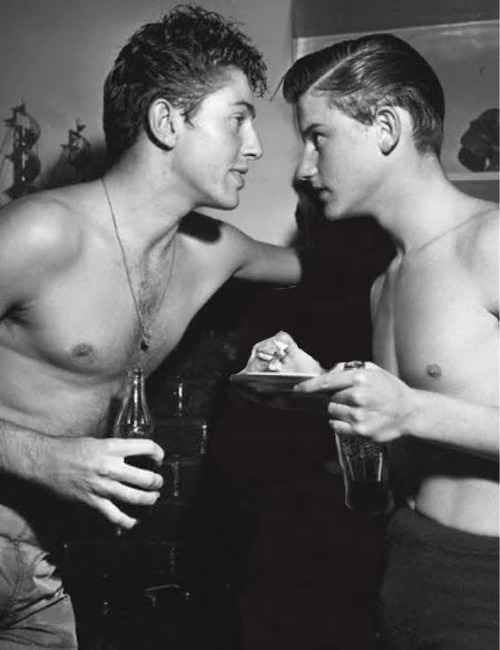
Left: The bisexual Scotty Beckett played Skeezix's brother in Gasoline Alley (1951).


Chipper served in the Vietnam War, and became a physician's assistant as the job was just starting out.  He met his wife through a computer dating service.

Clovia grew up, managed the gas station after Skeezix retired, and married Slim Skinner.  They had two kids: Gretchen and Rover (born in 1978).


Rover grew up, graduated from high school, and married Hoogy Boogle.  They had a son, Boog, in 2004.  As of 2022, he is 18 years old, and has a girlfriend, Polly. 

The first and second generations don't appear much anymore, since Walt Wallet is over 120 years old, and Skeezix over 100, but none of the cartoonists want to mention iconic characters dying.


Six generations of Wallets, Skinners, Boggles, and Bumps, and you'd be hard pressed to find anyone in  who isn't involved in a hetero-romance.  There are no confirmed bachelor uncles or maiden aunts anywhere to provide queer subtexts (except for the outsider characters Rufus and Joel).  Gasoline Alley remains a holdout from the time when gay people were assumed not to exist.

Yet for kids growing up in the 1930s, there was Skeezix.


Nov 3, 2020

The Life of Riley: Bullying Boys into Girl-Craziness

Before World War II, teenage boys were expected to be concerned with the gang, or with one special pal, and think of girls as "poison."  Those boys who expressed an interest in girls prior to graduating from high school were ridiculed by their peers as pansies and Percies, evaluated by school psychologists, and subjected to tense heart-to-heart talks with their parents.

But after the War, the image of the adolescent masculinity shifted from "woman-hating" to "girl-crazy," and some of the long-running radio teenagers who had previously been concerned solely with paper routes and bad report cards suddenly began casting longing glances at their female schoolmates.  You can find the exact date: Chester Riley’s son Junior (Scotty Beckett) on  Life of Riley in January 1948; The Great Gildersleeve’s wisecracking nephew Leroy (Walter Tetley) in March 1949; and Ozzie and Harriet’s eldest son David Nelson in November 1951

Left and below: in 1948, MGM arranged for  Scotty Beckett (later Corky of Gasoline Alleyand his friend Roddy McDowall to go on a "see, they're not gay!" double date with Elizabeth Taylor and Jane Powell, but they seem to have ended up cuddling with each other.


The teenage boy had to be bullied, cajoled, and if necessary forced into girl-craziness; it could not be taken for granted.

In the January 1948 episode of The Life of Riley, for instance, blustering working-class family man  Chester (William Bendix) is horrified to discover that his fifteen-year old son, Junior, plans to bring a boy to the big New Year’s Eve dance.

He tries to explain about “the birds and bees,” sexual difference, but Junior insists that he already knows about “all that jazz.”


So Chester puts his foot down: there are “boy people” and “girl people,” he argues, and “boy people” should only take “girl people” to dances.  “Don’t you like girls?” he asks in a timid, hesitant voice, afraid of the possible answer.

When Junior admits that he likes girls “sometimes,” Chester takes charge, forcing the boy to break his same-sex date and telephone the boss’s daughter.  She is noncommital, so Chester forces him to call the offspring of another VIP (resulting, of course, in two dates for the dance, both impossible to break).  He is as hysterical in his insistence that Junior should like girls as fathers of the pre-War generation were hysterical in their insistence that their teenage sons should not.

Chester continued trying to "encourage" his son into girl-craziness when the show moved onto television, and Scotty Beckett was replaced by Lanny Reese (above) and even the obviously-grown up Wesley Morgan (left).

Nov 2, 2014

Roddy McDowall: Hiding in Plain Sight

Gay male actors born before Stonewall pretended to be heterosexual as a matter of survival.  They had "Hollywood marriages."  They brought heterosexual dates to events, and gave interviews about the type of woman they preferred.  Some, like George Takei and Richard Chamberlain, came out in old age, when their careers were over or almost over.  Some, like Charles Nelson Reilly and Paul Lynde, had such a fey stage presence that they figured it was obvious, no  need to come out. And some like Liberace, denied the "allegations" to their dying breath.

Roddy McDowall never denied anything, but he never said anything, either.  He "hid in plain sight," taking advantage of the homophobic myth that gay men don't exist, or if they do they're mincing, lisping pieces of fluff.

So, in this photo shoot, Roddy and fellow gay actor Tab Hunter cook weiners and cake in their underwear, and apparently no one in the 1960s had any idea.


Born in 1928, Roddy got his start as a child star, bringing wartime angst to the screen with boy-and-dog or boy-and-horse vehicles.  In his teens, he played Malcolm in Macbeth and David Balfour in an adaption of Robert Louis Stevenson's Kidnapped. 

He made the transition from child star to young adult seamlessly, playing prissy gay-vague characters, usually costarring with a more macho muscleman: Stuart Whitman in Shock Treatment (1964), Robert Redford in Inside Daisy Clover (1965), Dave Draper in Lord Love a Duck (1966).

His friends were usually muscular, too, such as Scotty Beckett and fellow gay actor Farley Granger. (There was originally a girl between them, but she's been photoshopped out).


During the 1970s, Roddy started making movies again, mostly playing fey, easily-ruffled characters, sometimes comic relief, sometimes villains. Sci-fi, horror, adventure, black comedy: The Poseidon Adventure, The Legend of Hell House, Arnold, Embryo, The Flood!, The Cat from Outer Space, Double Trouble, The Evil Inside Me....  Sadly, he may be best remembered for the gay-vague Galen in the Planet of the Apes franchise.

Occasionally guest spots on tv series, but only two starring roles, on The Fantastic Journey and Tales of the Gold Monkey, which I remember fondly because I dated one of the cast members.

Most of his characters in 261 movie and tv roles were gay-coded, but none were gay.

That's something gay actors of the closet generation would never do.


The key was to not say anything, and occasionally pose for a photo shoot entitled "Calling All Girls."

He died in 1998.


Related Posts Plugin for WordPress, Blogger...