Showing posts with label Tab Hunter. Show all posts

Sep 5, 2024

Charlie's Angels: Yes, there was a gay connection

You've got to be kidding.  What interest would gay boys or men have in the 1976-81 drama about three women (originally Farrah Fawcett, Kate Jackson, and Jaclyn Smith) who graduated from the police academy, found their talents underutilized by a patriarchal system, and went to work as private detectives?

Who use their brains to solve the murders and their brawn to knock out the bad guy?

Who go undercover in health clubs, spas, cruise ships, and other places crowded with men wearing only towels and swimsuits?

That's why.

1. There was quite a lot of jiggling, of course, but there was also an immense amount of beefcake.

Where else could you see game show host Bert Convy in a speedo?


Or Dirk Benedict take off his Battlestar Galactica uniform?

Nearly every hunk in Hollywood guest starred, and usually took off his shirt: Timothy Dalton, Bo Hopkins, Tab Hunter, Randolph Mantooth, Vic Morrow, Dack Rambo, Tom Selleck, Robert Ulrich, and Lyle Waggoner.


Even Norman Fell, Mr. Roper of Three's Company.


2. Several episodes featured predatory lesbians, swishy-queen gay men, or demented transvestites.  But that was the way LGBT people were nearly universally portrayed in 1970s detective and cop shows.  And the homophobia was diluted by the gay-vague Bosley (David Doyle), the Angels' longsuffering assistant.

3. In the end Charlie's Angels was about empowerment, saving the day in spite of people assuming that you were weak, flamboyant, feminine.


4. And, like The Golden Girls,  it was about the friendship.

Most of the Angels were gay allies. Kate Jackson starred in Making Love (1982), which featured the first positive portrayal of gay men in a Hollywood film.

Farrah Fawcett, who died in 2009, was unfailingly gracious to her gay fans.

Jaclyn Smith played the mother of a gay son in Family Album (1994).  Incidentally, her husband was played by Michael Ontkean, Kate Jackson's husband in Making Love. 

In the 2019 film reboot, the director wanted to make Sabina (Kristen Stewart) gay.  Although bisexual in real life, she refused, but eventually agreed to a scene where she flirts briefly with a woman. 

Jan 21, 2023

Beefcake and bonding in "Bringing Up Father"

When I was a kid, all of the good comic strips -- Peanuts, the Wizard of Id, Doonesbury -- were  in the Moline Dispatch.  In Rock Island, all we got were bargain-basement knockoffs and doddering relics last popular before the invention of radio: Out Our Way, Our Boarding-house with Major Hoople, Barney Google and Snuffy Smith.  They were unfunny, incomprehensible, and downright disturbing.  And the most disturbing of the lot was Bringing Up Father by George McManus, which got its start in 1913!

It starred Jiggs, no first name, an elderly, pudgy person, and his wife Maggie.  They both had pug-dog noses and scary, pupil-less eyes and used dashes instead of periods to end their sentences  -- see how bizarre that looks -- it's just wrong --


They had a daughter, drawn as a 1920s glamour girl, who didn't have a name -- her parents called her "Daughter."

Other male characters were drawn as beady-eyed scarecrows, and the women were all glamour girls.

Jiggs and Maggie were noveau-riche. Jiggs longed to return to the old neighborhood, to have working-class corned beef and cabbage at Dinty Moore's diner.  But Maggie doted on her newfound status.  She kept going to teas, receptions, operas, and dinners with people whose names were horrible puns.

When Jiggs got out of line, Maggie unlashed a torrent of abuse, calling him an "insect" and a "worm," and assaulting him with pots and pans and a rolling pin from the kitchen.

Obviously a critique of the myth of the heterosexual nuclear family as most evolved, most stable, most normal of all family types.

For some crazy reason, toy producers in the 1920s thought that kids loved the stories about Jiggs trying to sneak out of the house to drink with Dinty Moore. They produced toys of all types, including dolls, cutouts, and Big Little Books.

There were dozens of movie adaptions and comedy shorts, beginning in 1915.  In 1928, Daughter (named Ellen) got a boyfriend played by Grant Withers (top photo). The last film appearance of Maggie and Jiggs was in the The Man Who Hated Laughter, a 1972 installment of the Saturday Superstar Movie, based on yet another ludicrous belief that the ancient strip attracted child readers. 


By the 1960s, the writers were throwing in contemporary references -- or at least references that were only about 10 years out of date, like this beatnik from 1968.

Anachronisms that merely added to the discomfort.

Recently I bought From Sea to Shining Sea, a compendium of strips from 1939-1940 written primarily by McManus's assistant, Zeke Zekley.  It featured a continuity in which Daughter marries a British nobleman, Lord Worthnotting.  The family celebrates by taking them an extended cross-country honeymoon.

Wherever they visit, Maggie and Daughter go shopping, leaving Jiggs and Lord Worthnotting to go skiing, hiking, camping, and sightseeing on their own.


Before the continuity is over (and Lord Worthnotting vanishes from the strip), the two have buddy-bonded so extensively that one could almost mistake them for the newlywed couple.

Apparently Zeke Zekley knew something that McManus didn't.


When McManus died in 1954, Zekley was in line to take over the strip, but the syndicate gave the job to Vernon Green instead, who returned to the nuclear-family-foibles.

Zekley went on to draw his own strips, including those used in The Tab Hunter Show (1960-1961), with the gay beefcake actor playing a horny "bachelor cartoonist."

He died in 2005.


See also: The ABC Saturday Superstar Movie

Nov 2, 2014

Roddy McDowall: Hiding in Plain Sight

Gay male actors born before Stonewall pretended to be heterosexual as a matter of survival.  They had "Hollywood marriages."  They brought heterosexual dates to events, and gave interviews about the type of woman they preferred.  Some, like George Takei and Richard Chamberlain, came out in old age, when their careers were over or almost over.  Some, like Charles Nelson Reilly and Paul Lynde, had such a fey stage presence that they figured it was obvious, no  need to come out. And some like Liberace, denied the "allegations" to their dying breath.

Roddy McDowall never denied anything, but he never said anything, either.  He "hid in plain sight," taking advantage of the homophobic myth that gay men don't exist, or if they do they're mincing, lisping pieces of fluff.

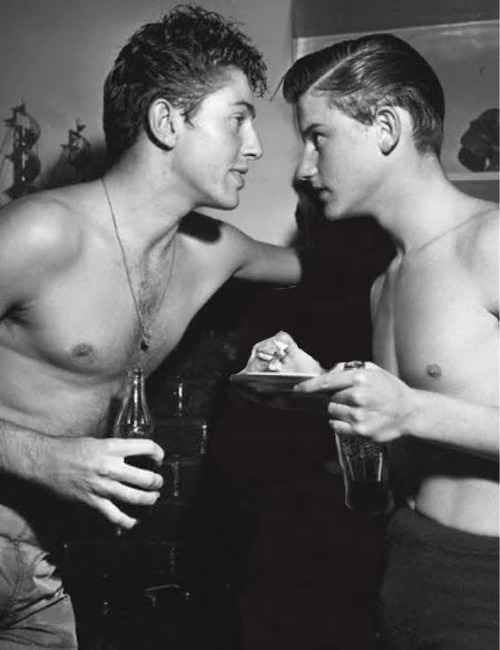
So, in this photo shoot, Roddy and fellow gay actor Tab Hunter cook weiners and cake in their underwear, and apparently no one in the 1960s had any idea.


Born in 1928, Roddy got his start as a child star, bringing wartime angst to the screen with boy-and-dog or boy-and-horse vehicles.  In his teens, he played Malcolm in Macbeth and David Balfour in an adaption of Robert Louis Stevenson's Kidnapped. 

He made the transition from child star to young adult seamlessly, playing prissy gay-vague characters, usually costarring with a more macho muscleman: Stuart Whitman in Shock Treatment (1964), Robert Redford in Inside Daisy Clover (1965), Dave Draper in Lord Love a Duck (1966).

His friends were usually muscular, too, such as Scotty Beckett and fellow gay actor Farley Granger. (There was originally a girl between them, but she's been photoshopped out).


During the 1970s, Roddy started making movies again, mostly playing fey, easily-ruffled characters, sometimes comic relief, sometimes villains. Sci-fi, horror, adventure, black comedy: The Poseidon Adventure, The Legend of Hell House, Arnold, Embryo, The Flood!, The Cat from Outer Space, Double Trouble, The Evil Inside Me....  Sadly, he may be best remembered for the gay-vague Galen in the Planet of the Apes franchise.

Occasionally guest spots on tv series, but only two starring roles, on The Fantastic Journey and Tales of the Gold Monkey, which I remember fondly because I dated one of the cast members.

Most of his characters in 261 movie and tv roles were gay-coded, but none were gay.

That's something gay actors of the closet generation would never do.


The key was to not say anything, and occasionally pose for a photo shoot entitled "Calling All Girls."

He died in 1998.


Related Posts Plugin for WordPress, Blogger...