Beefcake, gay subtexts, and queer representation in tv and other pop culture from the 1950s to the present
Nov 21, 2018
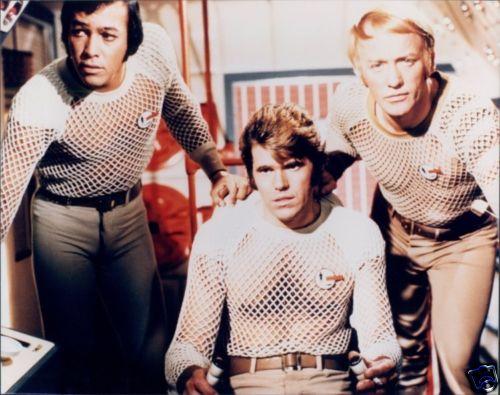
UFO: the Shirtless SHADO Warriors
Before books like Whitley Strieber's Communion (1985) and Budd Hopkins' Missing Time (1988) popularized the idea of aliens grabbing people from their beds to perform scientific experiments on, the tv series UFO (1970-71), part of the 1970s British invasion (The Prisoner, The Tomorrow People, The Hitchhiker's Guide to the Galaxy), had a similar premise: in the near future, the worlds' governments become aware that aliens are abducting people to harvest their organs. They set up the secret organization SHADO to combat them from a fake movie studio, a submarine, and a base on the Moon.
Oddly, everyone at SHADO headquarters, men and women both, wear see-through shirts, so there was a huge amount of beefcake for a science-fiction series.
At first the protagonist was former American astronaut Edward Straker (Ed Bishop).
In the second episode, lone wolf British test pilot Paul Foster (Michael Billington) witnesses a SHADO operation, and is given the choice of signing up or being killed. Foster decided to join, and Michael Billington soon became the standout star, and a favorite of teen magazines.
In the third episode, Foster is brainwashed by the aliens into attempting to kill Straker. Later Foster is captured by the aliens, and Straker has to come to the rescue. The grudging love-hate relationship continued through the series, and provided fodder for many slash fiction stories.
Only 26 episodes were aired, but there were two novels, comics, toys, action figures, a board game, and eventually a video game. And from 1975 to 1977, the same universe was used for Space: 1999, in which the Moonbase (and the moon with it) is swept away from the Earth's orbit for interstellar adventure.
Later Michael Billington played two-fisted heroes on many British tv series (The Onedin Line, Spearhead, The Collectors) and attended innumerable fan conventions. He never married. He died in 2005, five days before his UFO costar Ed Bishop.
Nov 6, 2018
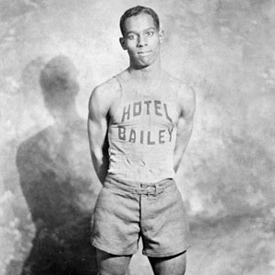
Teenie Harris and the African-American Physique
Charles "Teenie" Harris (1908-1998) grew up in the Hill District, Pittsburgh's African-American neighborhood, and became a professional basketball and baseball player in the Negro League.
Later he opened up a photography studio and began publishing in the Pittsburgh Courier, Flash, and elsewhere. Although he published "glamour portraits" of celebrities such as Muhammad Ali, President Kennedy, and President Eisenhower, his main interest was in documenting everyday life: men and women going to work and school, playing, partying.
60,000 of his photos have been digitized by the Carnegie Museum of Art, and many offer a rare glimpse of African-American beefcake of the era.
1. Camp Weldon Johnson, Beaver County, Pennsylvania, 1941.
2. More from Camp Weldon Johnson, 1941.

3. Two men at an interracial pool party in 1946 (quite revolutionary at the time).
4. Centre Avenue YMCA Pool, 1951.
5. Golden Gloves Contenders, 1951
6. East Liberty YMCA, 1953. Men teaching lifeguard techniques.
7, Boxer Wendell Turner with boy scouts, 1961.
Later he opened up a photography studio and began publishing in the Pittsburgh Courier, Flash, and elsewhere. Although he published "glamour portraits" of celebrities such as Muhammad Ali, President Kennedy, and President Eisenhower, his main interest was in documenting everyday life: men and women going to work and school, playing, partying.
60,000 of his photos have been digitized by the Carnegie Museum of Art, and many offer a rare glimpse of African-American beefcake of the era.
1. Camp Weldon Johnson, Beaver County, Pennsylvania, 1941.
2. More from Camp Weldon Johnson, 1941.

3. Two men at an interracial pool party in 1946 (quite revolutionary at the time).
4. Centre Avenue YMCA Pool, 1951.
5. Golden Gloves Contenders, 1951
6. East Liberty YMCA, 1953. Men teaching lifeguard techniques.
7, Boxer Wendell Turner with boy scouts, 1961.
Nov 2, 2018
The Beefcake Curse of "Nightmare on Elm Street 3: Dream Warriors"
I was never much of a fan of 1980s psycho-slasher movies, especially the Nightmare on Elm Street series. Freddy Krueger was arrested for killing 30 kids, but got released because "someone didn't sign the dotted line." That's idiotic. So a group of concerned parents lynched him and burned him alive. That's uncomfortably close to the various real-life threatened kids scares of the 1980s. And now he has a vendetta against the kids, coming at them in dreams. Wouldn't he come after the parents?
5. Ira Helden as Will. Wow. I don't get it. Many guys in their 50s are attractive. Is the cast of Dream Warriors cursed?
I also hated the song the tormented kids sang "Grab your crucifix." There are other religions besides Roman Catholicism, you know.
But when I was in South Carolina, I watched Nightmare on Elm Street 3: Dream Warriors, and it wasn't awful. The surviving girl from the first group of Freddy's victims, atrociously wooden Nancy (Heather Langencamp), is now a sleep-disorder specialist working at a psychiatric institution, where she and the hunky Neil (Craig Wasson, left) help a new group of kids being tormented in their dreams. They will do anything to avoid falling asleep, including committing suicide.
1. The sarcastic and very hunky Philip (Bradley Gregg, top photo)
2. The kick-ass black kid Kincaid (Ken Sagoes, left)
3. Mousy Jennifer
4. Belligerent street kid Taryn
5. Extremely cute Dungeons and Dragons nerd Will, who is confined to a wheelchair (Ira Helden, left)
6. Extremely cute Joey (Rodney Eastman), who is too traumatized to speak
The special effects are ludicrous. Freddy as a giant snake swallowing somebody?
Freddy's back story is ludicrous: his mother was accidentally locked in an asylum for the criminally insane over the holiday weekend, and was raped repeatedly. She gave birth to "the bastard son of 100 maniacs." Well, I guess she wasn't married, but was that really the main problem? And you can't be the son of 100 people. And criminality is not inherited.
But I liked how the dream warriors came together, each using their special skills to defeat Freddy.
How "the bait," the person they're trying to save,is a boy not a girl.
How there's only the tiniest bit of hetero-desire, in the scene where Joey is accosted by a hot nurse who ludicrously strips ("do you like my body, Joey?"), kisses him, and turns out to be Freddy. Also a moment of sexual harassment. Otherwise no one hooks up, not even Nancy and Neil.
And the beefcake. Other than the naked nurse, there's no female pulchritude. But the boys (actually actors in their 20s) get underwear scenes and shirtless shots, or they're so extraordinarily cute that who cares if they take their shirts off?
I checked to see if they've retained their incredible hunkiness after 30 years.
1. Bradley Gregg as Philip. Yikes.
2. Ken Sagoes as Kincaid. He's got a sort of Uncle Fester vibe going on.
5. Ira Helden as Will. Wow. I don't get it. Many guys in their 50s are attractive. Is the cast of Dream Warriors cursed?
6. Rodney Eastman as Joey. OMG, the years have not been kind.
Come on, Craig Wasson, you're my last hope.
I give up. He's naked in this shot, but believe me, you don't want to see it.
The curse of Dream Warriors strikes again.
Oct 28, 2018
Bob's Burgers: The Most Gay-Positive Sitcom on TV
Since 2011, Bob's Burgers has been airing on Sunday night, in the company of Family Guy and American Dad. But it is quite different from those programs.
1. The father and mother in the nuclear family are not insensitive jerks.
2. They accept their children's idiosyncracies, instead of berating and belittling them (on American Dad) or maiming and murdering them (on Family Guy)
3. There are no sociopaths (like Roger Smith and Stewie Griffin), who kill, maim, and express same-sex interests all in the same scene, as if they are all equally disgusting.
4. There are few if any jokes involving menstruation, masturbation, vomiting, golden showers, diarrhea, or body fluids in general.
5. No one ever collapses in a pool of blood.
6. No one ever expresses hatred of blacks, Asians, Native Americans, Jews, Muslims, women, gay men, lesbians, or transgender persons.
In short, you never think you're watching a Nazi recruitment film scripted by potty-mouthed third graders.
It's about a small, struggling burger joint in a resort town in New Jersey, run by aspiring chef Bob Belcher (voiced by H. Jon Benjamin, top photo) and his New York accented wife, Linda (John Roberts). Plotlines generally involve restaurant problems, such a visit from the health inspector, competition with the pizza place across the street, or buying a food truck -- and the problems of the three kids:
1. Shy, socially-awkward teenager Tina (Dan Mintz).
2. Chubby preteen Gene (Eugene Merman), an exuberant nonconformist who may be gay.
3. Preteen rebel Louise (Kristin Schaal), who always wears bunny ears (no one in the family seems to care).
Heterosexism appears on occasion. A boy band has only female fans, and when Gene gets a secret admirer, everyone assumes that it must be a girl. But not often. Usually same-sex desire and relationships are seamlessly integrated into everyday life.
Bob gets a part-time job as a taxi driver, and finds himself driving a group of drag queens home from the bars. Does he:
a. Freak out, but learn tolerance.
b. Rescue the drag queens from homophobic harassment.
c. Invite them to the restaurant.
Answer: C. Invite them to the restaurant.
At Christmastime, Bob decides to reconcile with his estranged Dad, Big Bob. They meet in a gay bar called the Junkyard. Why?
a. Neither of them realize that it's a gay bar until they get hit on; then they freak out but learn tolerance.
b. Big Bob tells Bob that he's gay and closeted; that's why he withdrew from the family.
c. Big Bob likes hanging out there with his gay friends.
Answer: C. Big Bob just likes hanging out there.
Gene announces that he is gay. What happens?
a. The family freaks out but learns tolerance.
b. The family goes overboard with acceptance,
c. Nothing.
Actually, this episode hasn't appeared yet, and it's not likely to, because stories require conflict and, at least on Bob's Burgers, there wouldn't be any. Being gay is perfectly ordinary; the family wouldn't have a reaction to it.
By the way, John Roberts, the voice actor who plays Linda, is gay.
1. The father and mother in the nuclear family are not insensitive jerks.
2. They accept their children's idiosyncracies, instead of berating and belittling them (on American Dad) or maiming and murdering them (on Family Guy)
3. There are no sociopaths (like Roger Smith and Stewie Griffin), who kill, maim, and express same-sex interests all in the same scene, as if they are all equally disgusting.
4. There are few if any jokes involving menstruation, masturbation, vomiting, golden showers, diarrhea, or body fluids in general.
5. No one ever collapses in a pool of blood.
6. No one ever expresses hatred of blacks, Asians, Native Americans, Jews, Muslims, women, gay men, lesbians, or transgender persons.
In short, you never think you're watching a Nazi recruitment film scripted by potty-mouthed third graders.
It's about a small, struggling burger joint in a resort town in New Jersey, run by aspiring chef Bob Belcher (voiced by H. Jon Benjamin, top photo) and his New York accented wife, Linda (John Roberts). Plotlines generally involve restaurant problems, such a visit from the health inspector, competition with the pizza place across the street, or buying a food truck -- and the problems of the three kids:
1. Shy, socially-awkward teenager Tina (Dan Mintz).2. Chubby preteen Gene (Eugene Merman), an exuberant nonconformist who may be gay.
3. Preteen rebel Louise (Kristin Schaal), who always wears bunny ears (no one in the family seems to care).
Heterosexism appears on occasion. A boy band has only female fans, and when Gene gets a secret admirer, everyone assumes that it must be a girl. But not often. Usually same-sex desire and relationships are seamlessly integrated into everyday life.
Bob gets a part-time job as a taxi driver, and finds himself driving a group of drag queens home from the bars. Does he:
a. Freak out, but learn tolerance.
b. Rescue the drag queens from homophobic harassment.
c. Invite them to the restaurant.
Answer: C. Invite them to the restaurant.
At Christmastime, Bob decides to reconcile with his estranged Dad, Big Bob. They meet in a gay bar called the Junkyard. Why?
a. Neither of them realize that it's a gay bar until they get hit on; then they freak out but learn tolerance.
b. Big Bob tells Bob that he's gay and closeted; that's why he withdrew from the family.
c. Big Bob likes hanging out there with his gay friends.
Answer: C. Big Bob just likes hanging out there.
a. The family freaks out but learns tolerance.
b. The family goes overboard with acceptance,
c. Nothing.
Actually, this episode hasn't appeared yet, and it's not likely to, because stories require conflict and, at least on Bob's Burgers, there wouldn't be any. Being gay is perfectly ordinary; the family wouldn't have a reaction to it.
By the way, John Roberts, the voice actor who plays Linda, is gay.
Subscribe to:
Posts (Atom)