Mar 9, 2022

The "Better Nate Than Ever" Series: Gay Theater Kid from Pennsylvania


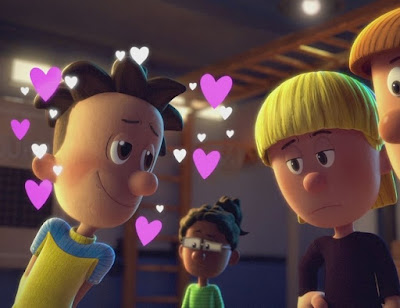
I have reconciled myself to the fact that the Better Nate Than Ever series by Tim Federle has nothing to do with the Big Nate series by Lincoln Peirce.  The characters just have the same name and age, the authors have both introduced coming-out story arcs, and googling on "Big Nate," "Lincoln Peirce," and "gay" brings you directly to a review of Better Nate than Ever.  

After you stop looking for connections, you find a very funny series of young adult novels about a gay theater kid.  Every book is written in the first person and present tense, which adds immediacy.  However, nothing can be included that Nate doesn't know at that moment, leading to some awkward attempts to position him in exactly the right spot to overhear vital information. 

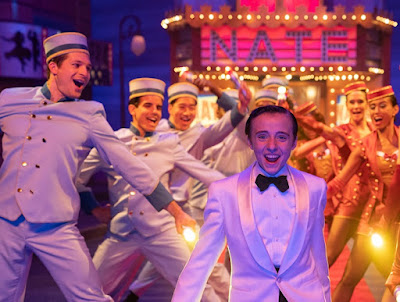
In the first book of the trilogy, Better Nate Than Ever, 13-year old Nate sneaks from his small town of Janksville, Pennsylvania to audition for the part of Elliot, the boy who befriends a stranded alien visitor, in E.T.: The Musical.  Most of the story involves interesting real-life details of the extenuated audition process. 

Although Nate says that his sexual identity is "undecided," there are a few clues.  He sees two guys kiss through the open door of a bar, and no one beats them up; later he says that this was his favorite part of New York.  Plus he befriends Aunt Heidi's hot roommate, and watches him from the back as he walks down the street: "the pants fit very well," Nate comments. (The roommate will not appear in the 2022 movie version.)
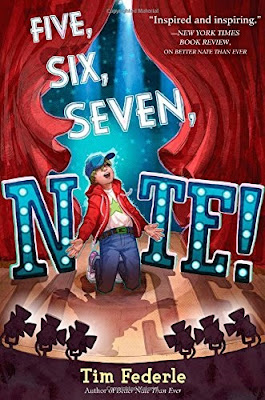

In the second book, Five, Six, Seven, Nate, Nate is cast, but not as Elliot: as the back-up understudy for E.T,, which means he has to learn all the lines and dances, but will only go on if both the actor cast as E.T. and his understudy fail.  Most of the book involves the interesting details of prepping and rehearsal for a stage play.  Plus Nate starts dating Jordan, the practically perfect experienced child actor cast as Elliot (he doesn't appear in the 2022 movie version, either.)

In the third book, Nate Expectations, the musical has closed, and Nate, now 14, is back home, in high school.  He and his friends produce a musical version of Great Expectations for English class, but can't perform it because they can't get the rights to the songs.  

There are also asides about Nate's parents trying to signal that they're ok with his gay identity without actually saying anything.   Plus Jordan, now cast in a tv show, begins ghosting Nate, and a new boy, Ben, starts expressing interest, culminating with a gigantic song-and-dance number to ask him to the Homecoming Dance.  We don't actually see the dance: the book ends when the English teacher assigns Nate a thousand-word essay on how he became his "best self," and he decides to title it Better Nate than Ever.

Now, if only someone could figure out how this all is connected to Big Nate.

See also: Better Nate Than Ever.

Mar 7, 2022

Spin and Marty: Summer Camp Boys in Love

In the spring of 1955, William Beaudine began casting an adaptation of the novel Marty Markham, about a wealthy mollycoddle who learns to be a regular fella at summer camp.   When buzz-cut jock Tim Considine auditioned, he was deemed too macho to play Marty, but far too charismatic to pass on, so a minor character in the novel, Spin Evans, was expanded for him.


 Marty was cast with David Stollery, a fey redhead who starred with Tim in Her Twelve Men (1954).

The Adventures of Spin and Marty premiered in November 1955 as a serial segment of Disney’s late-afternoon kiddie show The Mickey Mouse Club.


Though the original novel contains no homoromance, the tough-sissy contrast seems tailor-made for a revival of Tom Brown’s School Days or Cadets on Parade, and the series wastes no time in meeting the beefcake quota, displaying both stars' muscles and the respectable physique of an older boy (Sammy Ogg).  (Kevin Corcoran starred as tagalong annoyance Moochie.)

However, there is no instant camaraderie, no moment of falling in love.  In the first twenty episodes, Spin and Marty despise each other.  They often stare at each other, but they come face-to-face only for pranks, insults, and fights.  Late in the season, as counselors break up their latest fight by holding them upside down, Spin and Marty seem to really see each other for the first time.  Their shield of rage vanishes; they grin, and then laugh, and suddenly, inevitably, they are “together.”

In the remaining episodes, their fellow campers and the adults behave as if they have always been inseparable companions.  Intimacy appears, and passion when each tries to sacrifice himself for the other.  They even achieve homoromantic permanence: in the last scene, as the other campers prepare to go home, they are invited to stay on as ranch hands.

Viewers – grade schoolers and no doubt not a few high schoolers – were mesmerized by this hostility melting into love, and they responded with an urgency unknown in the days of Tom Brown’s School Days.  Books, comics, sheet music, and 45-rpm records flew off the shelves, continuing to evoke the homoromantic Arcadia for two years after the series ended.  Today, when the other live-action segments of The Mickey Mouse Club have faded into obscurity, many Boomers recall Spin and Marty fondly, as icons of their childhood.  Many recall them, clearly and unequivocally, as a gay couple.

In November 1956, Tim Considine and David Stollery returned for The Further Adventures of Spin and Marty.  Now Spin has an impressively tight, hard-lined chest and stomach, while Marty is lean and lanky (and decidedly feminine).  They are on display often and earnestly, as are all of the boys, presented in swimsuit and underwear shots as often as in Toy Soldiers decades later. But their homoromantic idyll is threatened: a girl’s camp has just opened up across the lake, and after some initial hesitation, they spend the series posturing, competing, and arguing over who gets to date Annette Funicello.  Then, when Marty is drowning, Spin rushes to the rescue.  The crisis makes them realize how much they care for each other and they renew their commitment, swearing off trivial distractions like girls.  Homoromance has triumphed.


But not for long.  In The New Adventures of Spin and Marty (November 1958), seventeen-year old Spin is dating Annette, and Marty is dating her fellow Mousketeer Darlene Gillespie.  Whatever passion they once felt for each other has been forgotten; they are not now, nor ever have been, more than buddies.

A fourth season of Spin and Marty was scripted, but never filmed.  Instead Tim Considine went on to star as in a Hardy Boys adaption with Tommy Kirk and Kevin Corcorran. and as the eldest of My Three Sons on television before retiring, and David Stollery left Disneyland to become an automobile designer, and marry once. They still run into each other from time to time, at fan conventions, but they have not stayed in touch.


Mar 5, 2022

Dennis the Menace


Newspaper comics aren't for kids.  They never have been.  We couldn't understand Blondie and Dagwood or Hi and Lois; if the husbands and wives hated each other so much, why didn't they just leave?  Comics starring kids, like Peanuts,  were even worse; references to contemporary sports and politics that we knew nothing about, using words that no real-life kid would even think of.

Dennis the Menace was an exception, a single-panel strip detailing the adventures of Boomer kid Dennis Mitchell, drawn as about five years old but enjoying the freedoms of someone much older.  Hank Ketchum's single panel strips first appeared in 1951, and could be seen in thousands of newspapers through the sixties, as well as an iconic sitcom and a featue film, as millions of parents of Boomer kids saw a reflection of their own lives.

 I encountered Dennis through the series of cheap paperback reprints that appeared regularly in garage sales and library book sales every summer: Dennis the Menace...Teacher's Threat, Dennis the Menace -- Nonstop Nuisance, almost thirty titles in all.


I noticed 3 things right away:

1. Dennis was my exact opposite.  I was quiet, mild-mannered, and didn't like to play outside.  He was rambunctious, aggressive, destructive, uninhibited, a “little savage."

I was occasionally scared, and I cried when I was upset, but Dennis never waivered from his hypermasculinity. He displayed not a moment of weakness.  He was, as adult characters kept saying, "all boy."

2. His foil, Margaret, was an absurdly exaggerated "girl."  Although extremely intelligent, she pushed a doll carriage, jumped rope, played “dress up,” and could think of no possible future except as a housewife, or maybe an airline stewardess.  She was not shy about her intentions: first civilizing Dennis, teaching him manners and fashions, and then marrying him.


But Dennis would have none of it:

He slugged Margaret in a Tunnel of Love because he thought she was trying to kissing him.

At a party, he anticipated that Margaret would want to play “post office,” a kissing game, so he brought a stamp to put on her nose.

3. Dennis was not only uninterested, he couldn't even recognize heterosexual desire when he saw it.

When he saw an adult couple kissing, he concluded that “They’re fighting.”

 A sailor kissing his girlfriend: “Makes you wonder what kinda guys they got protecting our country."

A cowboy with a woman on his arm: “She must be his sister.”


His Dad and neighbor Mr. Wilson ogling a cheesecake calendar: “They’re talking about football. 40-23-36 is signals.”


It didn't last.  Sometime during the 1970s, the reprint books introduced Italian immigrant Gina, tall and slim, in a mod outfit.  No prissy girl-stereotype, she liked skateboarding and soccer, didn’t disapprove of dirt and bugs, and could beat up any boy. Dennis was entranced. Maybe he never met a girl that he had anything in common with before.

"Gina makes me feel all funny inside," he announced to his parents.  And met his heterosexual destiny.

But in the 1960s, Dennis gave gay kids the freedom to not to be interested in "the opposite sex," in spite of what parents, teachers, and peers kept telling us.


Mar 4, 2022

Better Nate Than Ever: Gay Kids, Wacky Aunts, and Beefcake


Big Nate
is a comic strip character who first appeared in 1990.  Since then, there have been many collections, a series of chapter books  with pun titles, some activity books, a musical, and an animated tv series (with Nate voiced by Ben Giroux).  A live action movie, Better Nate Than Ever, js set to appear in April 2022.  Creator Lincoln Peirce writes that in the original chapter book (2013), he included a subplot about a boy coming out, which caused homophobic schools to cancel his speaking engagements and libraries to ban all of his books.  But he also got "a lot of support" and won a Lambda Literary Award.  

I didn't want to wait for the movie, so I bought the book.  

Nate, age 13, lives with his working-class parents and older brother Anthony in a suburb of Pittsburg.  He loves musicals, and acts out various scenes with his friend Libby, who has a crush on him.  However, when she moves in for a kiss, he backs away.  He states that his sexual identity is unknown: "I'm 13.  Macaroni and cheese is my favorite dish.  How do I know who I want to hook up with?"

You generally know who you're attracted to at a very young age, even if you're not thinking in sexual terms yet.   But let's go with it.


The other chapter books and the tv series portray Nate as aspiring artist and chess player, never mention a musical, and give him friends named Francis and Teddy but not Libby.  He concocts wild plans to meet girls,  has had three girlfriends,  and dissolves into a slurry of hormones when he sees Jenny, the Girl of His Dreams.  

In the comic strip, we see the same characters and hetero-horny hijinks.  Nate is currently accusing his buddy Francis of being a jinx who caused their favorite sports team to lose.  

What's going on?   


Better Nate Than Ever
is not included in the list of Big Nate novels, nor are its sequels, Five Six Seven Nate (2014) and Nate Expectations (2018), "wonderful evocations of what it's like to be a theater kid."

Turns out that this is a new evocation of the character, written by Tim Federle (with Lincoln Peirce's permission, one assumes).

Nate's interest in musicals, and singing and dancing in general, gets him a lot of homophobic harassment.  His older brother calls him a "homo" and asks if he's practicing Gays and Dolls.  His father disapproves of his goal of becoming an actor and "hanging out with a bunch of queers."  Even his mother complains that the neighbors can see him prancing around in the back yard "like a fairy." 

He and Libby see a call for open auditions for the role of Elliott in E.T.: The Musical, to be held in New York City.  The day his parents happen to be going out of town.  They come up with a plan: Nate will "borrow" his mother's ATM card, take the bus five hours into New York, audition, then get back on the bus and home before Mom and Dad notice.  

The book details Nate's very funny adventures on the bus and at the audition, with some subplot involving his freespirited Aunt Heidi.  Nate tries to get a guy to ask her out, but he states that he "only dates men."  Nate is shocked for a moment, but then says "Hey, that's great!"   No subplots about boys coming out.  Could I have gotten the wrong book?

The 2022 live action movie will star Rueby Wood as Nate,  Lisa Kudrow as his wacky Aunt Heidi, and Joshua Bassett as older brother Anthony.


Joshua Bassett came out as gay while starring in High School Musical: The Musical: The Series (actually he said that he identifies as LGBTQ+, but there are many letters in the alphabet, and it's ok to still be figuring out which applies to you).  His Anthony  plays a bigger role than in the novel, as an ally rather than an antagonist (and he gets a shirtless shot in the trailer).  

Joshua promises that there will be "gay kids" in the movie, but I don't see any likely prospects on the IMDB cast list.  Unless it's Nate himself.   

Related Posts Plugin for WordPress, Blogger...