Showing posts with label musical. Show all posts

Apr 15, 2026

Blake Michael: The "Dog with a Blog" brother starts a band, stalks a teacher, vanishes into corporate. With Blake and Dano d*cks


Link to the n*de dudes


I haven't been watching Disney Channel programs regularly since the days of Hannah Montana, so all I heard of Dog with a Blog (2012-15) was buzz about how ridiculous the premise was: three kids discover that their dog is sentient, can talk, and actually has a blog where he discusses his experiences and tries to find other dogs.  How is that more ridiculous than a pop star pretending to be a regular girl, both daughters of a famous country-western music singer, and no one suspecting for an instant?
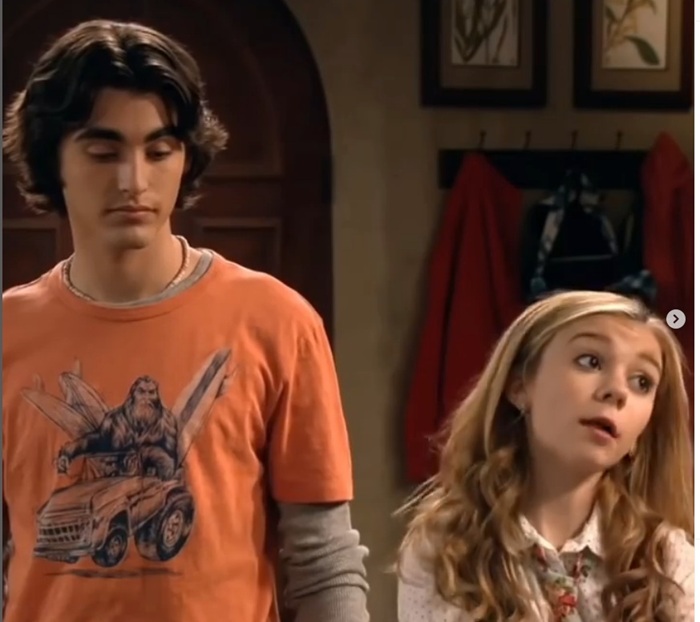


 But I reviewed an episode, and called it "The Disney Channel's Worst Show" due to its aggressive homophobia. Critics lambasted it for  "lackluster writing' and absence of any actual blogging.  Still, it averaged 3 million viewers in the first season, and was nominated for three Emmies.  

The main players, other than the dog, were Chloe and Avery, two tween sisters from a blended family.  But there was also a teenage brother, Tyler (Blake Michael).


Plus Dad Bennett (Regan Burns, Big D*ck Mitch on The Righteous Gemstones) and Avery's enemy/crush (L.J. Benet), who now has abs but smiling smugly as girls in bikinis surround him. 

There are n*de photos of Regan in my review of Episode 4.8  I haven't found any of L.J.  But there are some of Blake.

Blake got his start in modeling at age three, and had his first on-screen role at age eight, playing a restaurant patron in Chosen (2004).  Small parts in October Road, Out of Jimmy's Head, and The Mortician followed.


He had a starring role in Lemonade Mouth (2011), which I never saw because I thought the term referred to some kind of terminal cancer.  It's actually the name of a bad that five high schoolers who start a band -- I guess disgusting names are de rigeur for rock bands.  The boys are Charlie (Blake) and Wen (Adam Hicks).  Both get girlfriends, and the remaining girl gets a boyfriend, and so on, and so on.  Heteronormativity fulfilled. 

Sorry, this is the only photo I could find where the two guys are together, not bookending the three girls.


More after the break

Mar 19, 2026

"The Carol Burnett Show": Some 1970s beefcake and gay subtexts amid the boring dinosaur songs.


Variety shows, combining comedy sketches and songs,  are out of style now -- only Saturday Night Live survives -- but in the 1960s and 1970s, they were all the rage.  At least among the adults.  In 1970, they could watch twelve hours of variety per week, with hosts Leslie Uggams, Dean Martin, Carol Burnett, Red Skelton, Glen Campbell (left),  Jim Nabors (who was gay but not ouht), Tom Jones, Jimmy Durante, Jackie Gleason, and Andy Williams.

Kids and teenagers hated variety. Passionately. They were always on opposite something good.  If your parents forced you to watch The Jim Nabors Hour, you had to miss That Girl. If you were forced to watch The Glen Campbell Goodtime Hour, you had to miss The Mod Squad.

And the shows were horrible.  Slow songs from dinosaur times!  Comedy sketches about characters popular on radio a thousand years ago!  Bathetic closing numbers involving sad clowns or cleaning ladies!


I usually managed to get out of watching variety shows by claiming homework, or when my brother and I got our own tv set, watching something else -- anything else.  But for some reason I saw a lot of The Carol Burnett Show (1967-78).  Carol, who got her start in the Broadway musical Once Upon a Mattress, played a charwoman, a ditzy secretary, Queen Elizabeth, and Vickie Lawrence's sister.  She and her comedy troupe parodied soap operas ("As the Stomach Turned") and classic movies ("Went with the Wind").  

I had no idea what they were parodying.


Famous guest stars like Rock Hudson, Tony Randall (left),  Sid Caesar, and Robert Goulet played parodies of themselves or sang.  I remember Tony singing "Have some Madeira, M'Dear," about a creep trying to get a girl drunk so he can take advantage of her.  

That was comedy in the 1970s.

There were only three reasons to watch:

I liked three things about the show:

1.  Co-host Lyle Waggoner, a former male model who appeared n*dee in Playgirl.  He played the leading-men and hunks in comedy sketches.  Unfortunately, because they were comedy, he never appeared n*de or even shirtless on the show.

More after the break

Jan 17, 2026

Mark Lester: Jack Wild's boyfriend moves on to sleazy hetero cringe, buddy-bonds with Michael Jackson, shows his backside on the grass


It seems that every kid is forced to see Oliver! (1968)   Their parents think that the musical is somehow educational because it's roughly based on Oliver Twist.

I saw it on DVD a few years ago, after two doses of the live musical, in high school and in L.A.  Not my favorite: all about child abuse, domestic violence, and other fun stuff, with a heterosexist "true love" plot.  


But I liked the gay-subtext buddy-bonding between the streetwise Artful Dodger (15-year old Jack Wild) and the cherubic innocent Oliver (10-year old Mark Lester).


I knew Jack Wild from H. R. Pufnstuf, but I heard nothing more about Mark Lester for many years. During the early 2000s, I was writing an article on demonic children in the movies, and I found that the cherubic Mark Lester spent his pubescence playing violent or creepy, or both.  His characters seemed uncomfortable with their bodies, ravaged by uncontrollable desires, and obsessively heterosexual.

In Eyewitness (1970), also released as Sudden Terror, 12-year old Ziggy (Mark) witnesses a murder on the Mediterranean island of Malta,  and is pursued by the killer.  He goes on the lam, along with his girlfriend.


In Melody (1971), 10-year old Daniel (Mark) falls in love with a girl and decides to marry her. The adults disapprove of a 10-year old getting married, but it's the heart of the counterculture, and "true love" is always right.

Jack Wild plays his gay-subtext budd.


In What the Peeper Saw (1972), also released as Night Hair Child and Diabolica malicia, 14-year old Marcus (Mark) isattracted to his father's new wife (Britt Eklund).  She shares his interest, and they start a relationship. They conspire to kill Dad so they can be together. But is she really conspiring to kill Marcus? 

In Who Slew Auntie Roo (1972), 14-year old Christopher (Mark)  tries to rescue his sister from the demented Mrs. Forrest (Shelley Winters), who is holding her prisoner in the attic. 

More after the break

Jan 5, 2026

Shock Treatment: Romance is Not a Children's Game


In the spring of 1982, I went to a midnight showing of Shock Treatment, which was widely advertised as "the sequel to The Rocky Horror Picture Show!"  

Actually, I saw it five times, because in the days before video rentals, DVDs, and streaming services, once a movie left the theater, it was gone for good.


It starred Brad and Janet from the original movie, played by different actors (Cliff de Young, Jessica Harper): Barry Bostwick was unavailable, and Susan Sarandon wanted too much money.

Cliff DeYoung (top photo) had been the lead singer of the 1960s band Clear Light, and the star of Sunshine (1973), about a struggling musician with a dying wife. Ugh!  But his signature song, "My Sweet Lady," charted at #14.  He also appeared in Hair on Broadway, and went on to over 80 tv and movie appearances, including Star Trek: Deep Space Nine, The X-Files, Get a Clue, and Diagnosis: Murder. 

Jessica Harper had toured in Hair with Cliff, and starred in Phantom of the Paradise, Love and Death, and Suspira.  She would go on to over 50 movie and tv roles, seven albums, and eleven children's books.

No other characters from Rocky Horror, no references to Rocky Horror, no sweet transvestites, no gay relationships, no references to gay people except for a racist/homophobic anecdote!


But once you get over your initial disappointment, Shock Treatment presents an interesting conceit: the world is a tv studio, and everyone a player (shades of Shakespeare).  Everyone is under surveillance, everyone is acting in a show within a show within a show.  There are no private moments; everyone is always being observed, commented on, controlled.  Sort of like social media today.

And they're trapped.  Like many stories with gay symbolism, there is no way out.  This is the whole universe.

The story is a heterosexist fable: studio owner Farley Flavors is in love with Janet, so he hires Drs. Cosmo and Nations McKinley (Richard O'Brien, Patricia Quinn, reprising their incestuous brother-sister romance from Rocky Horror).  They institutionalize Brad as "an emotional cripple" in their  psychiatric-hospital Faith Factory program.  To make Janet forget about Brad, they groom her to star in her own show.

Jessica Harper has a much stronger voice than Susan Sarendon, the original Janet.  Shock Treatment is worth watching just to hear her paeon to egotism, "The Me of Me"

Deep in the heart of me, I love every part of me
All I can see in me is danger and ecstasy
I'm willing to die for me.
One thing there couldn't be is any more me in me

More after the break

Dec 6, 2025

15 gay facts about "White Christmas": gay actors, beefcake dancers, drag, Spartacus, and the source of your holiday depression


I'm not a big fan of the Holiday Season -- too big, bright, and noisy, with forced exuberance, and way too much melancholy.  I try to stay away from Christmas songs, movies, trees, holly, mistletoe, parties, and depression.  But I'll make an exception for White Christmas (1954).

1. It's not a Christmas movie.  It's a backstage musical that just happens to end at Christmastime.  Backstage movies were well-known for gay subtexts.


2. The song "White Christmas," by Irving Berlin (who was Jewish), first appeared in the backstage musical Holiday Inn, with Big Crosby and Fred Astaire. 

3. It's been covered by everyone, including gay favorites Bett Midler and Lady Gaga.


4. White Christmas is about two showbiz partners, Bob and Phil (Bing Crosby, Danny Kaye), who find their relationship threatened by women.


5. A musical based on the movie, Irving Berlin's White Christmas, opened in St. Louis in 2000. Lara Teeter (a guy with a girl's name) played Bob, and gay actor Lee Roy Reams played Phil Davis.

6. Phil has also been performed by Tony Yazbeck (top photo) and David Elder, who Google Images thinks is cowboy star Clint Walker (left).


7. The women in the movie, Judy and Betty (Vera-Ellen, Rosemary Clooney), are sisters.  At least, they perform as sisters, although their numbers would work well in a drag act.

God help the mister who comes between me and my sister
And God help the sister who comes between me and my man!


More after the break

Aug 11, 2025

Everybody's Talking about Jamie: A 16-Year Old Aspires to Drag Stardom


For movie night, we almost always get post-apocalyptic, sci-fi, or Marvel Comics Universe.  But last night, we watched a musical: Everybody's Talking About Jamie on Amazon Prime.  

Newcomer Max Harwood plays Jamie New (great name!), a 16-year old gay boy in Sheffield, England who dreams of becoming a drag queen because performing in drag always means instant fame and fortune.  (Um...no.  Most drag queens perform as a hobby; only a few make a living from it).  


He has the full support of most students, including his best friend Priti (the only Muslim girl in school), plus his Mom and her best friend, a woman named Ray.

His only detractors are a group of homophobic, Islamophobic bullies led by the boorish Dean Paxton (Sam Bottomley, top photo and right, who is 20 years old and a gay and Muslim ally in real life).

Plus the Career Education Teacher, Miss Hedge, who claims that she's opposed to drag because it won't lead to a successful career, but actually just disapproves of feminine boys.  


Also, in a subplot, Jamie's father (Ralph Ineson, but without the scraggly hair and muscular chest) wants nothing to do with him, but Jamie's Mom has been sending him cards and presents under Dad's name.  When the deceit comes out, Jamie has a meltdown and angrily breaks up with his Mom (yes, they have a quasi-romantic relationship, most evident when Mom sings about a "lost love" who broke her heart when he left, and she means Jamie: "my man...my son...my man!").

Turns out that Jamie was traumatized early in childhood, when Dad caught him trying on makeup and called him "disgusting," "a freak," and so on.  Ever after, he's considered himself "nothing," and he thinks that becoming a drag queen will make him "somebody."


Seeking out a dress, Jamie goes to a drag shop in Sheffield (Sheffield, England has drag shops?), where he meets Hugo, aka legendary drag queen Loco Chanelle (Richard E. Grant, who is not a drag queen in real life, but he has starred in Twelfth Night, My Fair Lady, Doctor Who, and some Marvel Comic Universe movies).  Hugo demonstrates that drag is not about being famous, it's about fighting homophobic oppression.  With his mentoring, Jamie performs as Mimi Me at the local drag club (yep, Sheffield has drag clubs, too), and gets a standing ovation.

Now all that remains is to go to the prom in a dress.  Miss Hedge, who apparently has full power to dictate proper prom attire, absolutely forbids it, but gives in when the students rebel en masse.  Even the bully Dean Paxton promises to be nice "just for one night," and he and Jamie go into the prom hand-in-hand.  

Beefcake: None.  

Gay Characters:  Jamie and the drag queens, presumably, although here "gay" really means feminine.  Jamie never expresses any same-sex interest.

Heterosexism:  None.  No one but Ray expresses any heterosexual interest, unless you count Jamie's Mom being in love with "my man."

Implausibility:  A drag store and a drag club in Sheffield, but no other gay kids at Jamie's school.  Are 16-year olds admitted to bars in England?

Soundtrack:  Some of the songs are annoyingly repetitious.  

My Grade: B.

Apr 12, 2025

Adrian Zmed After Dark

On an episode of The Simpsons, the family goes to a review featuring the once-famous:
     We are the stars that you thought were dead,
     Like Bonnie Franklin and Adrian Zmed.

People who weren't watching television or going to moves during the early 1980s probably thought "I didn't think Adrian Zmed was dead, I never heard of him."  But during that brief few years, the sultry black-haired Romanian-American actor -- and his amazingly ripped physique -- was everywhere.

He sang and danced as a John Travolta clone in Grease 2 (1982), also starring Maxwell Caulfield.

He partied with Tom Hanks in Bachelor Party (1984).

He bonded with William Shatner in the police drama T.J. Hooker (1982-85).


He hosted Dance Fever

He guest starred on Bosom Buddies, Love Boat, Hotel, Glitter, and Empty Nest.


He appeared in Battle of the Network Stars (a reality series that was really an excuse to get male tv stars into speedos).  He didn't win any awards, but he got to hug Scott Baio.

His full-body speedo shots were more than enough to draw the attention of gay fans, but his characters always had a blatant interest in same-sex chums, regardless of whether they got the girl in the end.

In Grease 2, for instance, the plot revolves around an "opposites attract" between greaser Johnny (Zmed) and uptight British newcomer Michael (Maxwell Caulfield).

And, unlike most beefcake stars of the 1980s, he was aware of his gay fans, and actually played to them.  He remains a strong gay ally, like his "bosom buddy" Tom Hanks.

By the late 1980s, the Adrian Zmed train had stalled, perhaps overloaded by overexposure.  Though he has never stopped acting, the era of speedo shots is long gone.

Mar 12, 2025

What's the Gay Connection in "The Sound of Music"?

When I was living in West Hollywood, people kept saying things like:
"I can't go out tonight -- The Sound of Music is on!"
"Which Sound of Music character are you?"
"The Sound of Music is playing at the community theater.  We have to go!"

I have never seen it all the way through.  It gives me bad vibes.

It's my fourth grade teacher's fault.  She told us about Anne Frank and The Sound of Music at the same time, and I got them mixed up, thinking that the musical ended with everyone dying in a concentration camp.

When I used to hear the songs, they gave me a frisson of dread, since I thought they were being sung by the prisoners at Auschwitz.

But even without the horror, they made no sense.  Look at "Do, Re, Mi":

Do, a deer, a female deer.  It's a doe. 

Ray, a drop of golden sun.   It's a ray, not a drop.

Mi, the name I call myself.  No, it's a personal pronoun in the accusative case.

Fahhhh, a long, long way to run.  It's  pronounced far, not fahhhh.


Ti, a drink with jam and bread.  Who drinks tea with jam and bread?  For that matter, what the heck is jam?

Or "My Favorite Things":

Cream colored ponies and crisp apple strudels.  Ponies don't come in cream colors, and strudel is a soft pastry, not crisp.

When the dog bites -- when the bee stings.  If a dog bites you, thinking of "favorite things" wouldn't help -- you need a rabies shot. And why would you feel sad when bitten or stung?  It's not sad, it's painful.

"Oh, no," everyone kept telling me.  "It's the greatest musical of all time!  And the gayest!"

So I've been looking for the gay connection.

Not in the plot: it's just a "servant inspires joie de vivre in dysfunctional family" story, done to death on tv: Hazel, Charles in Charge, Mr. Belvedere, Give me a Break, The Nanny.  Here the nanny is future nun Maria (Julie Andrews), and the family belongs to the stern Captain Von Trapp of the Austrian army (Christopher Plummer).  After they learn joie de vivre, the family hits it big as professional singers, and finally they escape from the Nazis by climbing over the hillside into Switzerland.


There is no beefcake or buddy-bonding.

There are no gay or gay-vague characters, except maybe Max Detweiler, who becomes the children's agent.

 In 1965 he was played by Richard Haydn, who was gay in real life.  This scene does not appear in the movie.

Maybe there's a gay connection in the cast?

Julie Andrews, of course, went on to play a woman disguised as a drag queen in Victor/Victoria (1982).


Christopher Plummer  won an Academy Award at the age of 82, for playing a gay man who comes out after retirement in Beginners (2010).  In the top photo, he seems to be having a little loincloth malfunction in The Royal Hunt of the Sun (1969).

Nicholas Hammond (left), one of the two boys in Von Trapp's mostly female family, played Spider-Man on tv (1977-78), where he is adequately cute.  He was married for only four years, and is rumored to be gay.

Not a lot of gay connection there.

What about the real life Von Trapp Family, lead by patriarch Georg Ritter Von Trapp (1888-1947)?  Ok, they were professional singers long before they met Maria, and they were Italian citizens who didn't need to escape Germany -- they just bought train tickets.  After the War, they opened a lodge in Stowe, Vermont.  

Most of the kids eventually married, although Agathe may have been gay: she ran a kindergarten with her "friend of 50 years," Mary Louise Kane.

Still not a lot of gay connection.

The Sound of Music Live! (2013) starred Carrie Underwood as Maria and Stephen Moyer (left) as Captain Von Trapp, Christian Borle (second photo), who plays a lot of gay characters, made his Max Detweiler as gay-vague as possible.

Not much there, either.

So the gay connection of The Sound of Music consists mostly of bulges?

See also: Charles in Charge


Feb 2, 2025

One Night in Bangkok, Three Hundred Nights at Mugi

From 1985 to around 1993, I was in Mugi, the gay Asian bar in Hollywood, at least once a week, sometimes twice.  Probably 300 times in all.   And every single time I was there, they played "One Night in Bangkok."  It was ingrained into my brain; even today I often catch myself singing:

One night in Bangkok, and the world's your oyster.
The bars are temples, but the pearls ain't free.


Oddly enough, when I visited the real Bangkok in 1988 to "rescue" Alan, I never heard the song once.

I guess the owner was a little short on Asian-themed pop songs.  "One Night in Bangkok" was composed for the musical Chess (1984).


Yes, there was a musical about chess.  It was based on the match between chess superstars Bobby Fischer and Boris Spassky at the 1972 World Chess Championships,an American and a Russian, one of the epic battles of the Cold War.

I haven't seen it -- reviews complain that it is over-long, over-wrought, clunky, and exceedingly dull.  And it sounds rather homophobic. .

Chess champion Freddie Trumpeter (played by Murray Head in the British version and Philip Casnoff in the American) must face gay "accusations."  His father states that he's "probably queer," and his Soviet opponent, Anatoly (Tommy Korberg, David Carroll) calls him a "fruit" (a "nut" in the American version), and steals his girlfriend.

"One Night in Bangkok" appears on the night before an early match between Freddie and Anatoly.  Freddie wanders around town, trying to stay focused.


He dislikes Bangkok, "Oriental city," with its "muddy old river," its decadence, and its evil: "I can feel a devil walking next to me."

He disapproves of the drag queens: "the queens we use would not excite you."

And especially the feminine gay men: "you'll find a god in every golden cloister, and if you're lucky, then the god's a she."

Not the message you want to send to patrons of a gay Asian bar!

But at least gay people and transvestites are mentioned, a rarity in the 1980s.


See also: The Theme Song of 1000 Nights in a Leather Bar.

Jan 4, 2025

"Kiss Me, Kate" Updated and Gay-ified


I'm not much for musical theater, but I have a fondness for Kiss Me, Kate (1953), about the on- and -off stage antics of contemporary players performing a musical version of Shakespeare's Taming of the Shrew.  The lyrics just need a bit of tweaking.

For instance, early in Kate,  Petruchio sings that he's come to Padua to marry a wealthy woman.  He doesn't care about her looks or personality; she could even be assertive and powerful.

I shall not be disturbed a bit
If she be but a quarter-wit.
If she only can talk of clothes
While she powders her gosh-darned nose. 
 Still the damsel I'll make my dame.
In he dark they are all the same.

The gay version:

 I've come to boyfriend wealthily in Padua.

If wealthily, then happily in Padua.

I heard you mutter "Zounds, but what  a cad you are."

I shall take him without a flinch, if his cock be a quarter inch.
If he only can talk of cars, if he spends every night in the bars
If he never goes to the gym, if his pronouns are they/them, not him.
Still the boyfriend I'll take to my bed -- at least they will give me head

I heard you say "Gadzooks, completely mad you are."

I won't be concerned at all, if he's short, ugly, old, or tall
If his politics are red, not blue, if his chums are homophobes and rude
I know that didn't rhyme, I'm running out of time
If he's wealthy, I'll make him mine: they all look the same from behind.


Off-stage, Lois Lane (no relation to Superman) proclaims to her boyfriend that she prefers an open relationship:

I would never curl my lip at a dazzling diamond clip 

Though the clip meant "Let 'er rip," I'd not say "nay."

How about: 

I would never shake my head at a guy who's good in bed 

Though the bed meant "Give me head," I'd say "Ok."

She continues:

There's an oil man known as Tex who is keen to write me checks.

 Tex's checks, I fear, mean that sex is here to stay.

Gay version: There's a hung man known as Block, who is keen to show me his cock

Block's cock, I say, means that we are gay to stay...


And two gangsters sing that knowing some Shakespearean quotes will enhance your ability to seduce or sexually assault women:

If your blonde won't respond when you flatter  her, tell her what Tony told Cleopaterer.

Gay version: If the guy in your bed tries to block your cock, tell him what Gratiano told Shylock. 

They continue:

 If she fights when her clothes you are mussing, "What are clothes? "Much Ado About Nothing."

Gay version: If he bites when your cock he is.... sorry, I got nothing.


And the chorus boys complain that it's too hot to get laid tonight:

I'd like to meet with my baby tonight, get off my feet with my baby tonight

But no repeat for my baby tonight cause it's too darn hot.  

I'd like to stop by my baby tonight, and blow my top with my baby tonight

 But I'd be a flop for my baby tonight, cause it's too darn hot.

That one is gay enough as it stands.

See also: 10 Reasons that Kiss Me Kate is a Gay Classic

Dec 24, 2024

5 Heterosexist and 5 Gay-Inclusive Christmas Specials

Have you ever noticed that most Christmas specials are annoyingly heterosexist? Here are the worst examples:

1. Mr. Magoo's Christmas Carol (1962): Why is Magoo/Scrooge so miserable?  He was so obsessed with money that he lost Belle, the girl of his dreams.  So he atones by helping a heterosexual nuclear family, Bob Cratchett, wife, daughter, and three sons.


2. Rudolph the Red-Nosed Reindeer (1964):  Ok, it's about accepting difference.  The "misfit toys" are all adopted out, Rudolph uses his glowing red nose to save the day, and Hermey the Elf gets to become a dentist. But Rudolph gets a girlfriend, Clarice ("She thinks I'm cute!") and Hermey dances with a female elf at a party.

In the closing "Holly Jolly Christmas," Burl Ives sings that there's a girl waiting for you (a boy) under the mistletoe: "kiss her once for me."  When a woman sings that song, it becomes "kiss him once for me."


3. Frosty the Snowman (1969): only a subtle a hetero-romantic subtext about a little girl in love with the snowman, but the sequel, Frosty's Winter Wonderland (1976) is all about the snowman finding a wife.

4. Santa Claus is Comin' to Town (1970): a heterosexual love story between the young-adult Santa Claus (then known as Kris Kringle) and the future Mrs. Claus (a teacher named Jessica).  At least Kris (voiced by former teen idol Mickey Rooney) is a cute redhead.

5. The Year without a Santa Claus (1974). Mr.s Claus saves the day.  And heterosexual monogamy.


But not to worry, there are a few inclusive ones.  Here are the best:

1. A Charlie Brown Christmas (1965): a reference to the Little Red-Haired Girl and Lucy's obsession with Schroeder, but otherwise about nurturing and friendship.

2. How the Grinch Stole Christmas (1966): the Grinch is a green-furred outsider who dislikes Christmas, so he and his dog Max set out to ruin the holiday for the residents of Whoville by stealing all of their stuff.  When he discovers that the townsfolk are happy together even without stuff, he relents, returns everything, and joins in the celebration.

No same-sex plotlines, but at least there's no hetero-romance, and few if any heterosexual nuclear families.

3. Olive the Other Reindeer (1999): a dog (Drew Barrymore), a penguin (Joe Pantoleono), and a flea (Peter MacNichol) save Christmas, and no one falls in love with anyone.

4. Billy and Mandy Save Christmas (2005): the cast of The Grim Adventures of Billy and Mandy discover that Santa Claus has been transformed into a vampire. While looking for a cure, the Grim Reaper develops a homoromantic bond with a flamboyantly feminine, gay-coded vampire named Baron Von Ghoulish (voiced by gay actor Malcolm McDowell).  They even sing about how much they like each other.

5. Prep & Landing (2009).  Two high-tech Elves buddy-bond while saving Christmas.

Dec 4, 2024

Are the Pantos Gay?

I have studied English literature, watched British tv, known people from Britain, visited several times, but before last year I had never heard of a pantomime, except as something mimes do.  Apparently people raised in Britain have fond memories of going to pantos at Christmastime, but nobody ever talks about it.

It's is a type of musical comedy performed during the Christmas season, using well-known stories.   Next winter, for instance, you will be able to attend the pantos of Cinderella, Jack and the Beanstalk, Peter Pan, Puss in Boots, Aladdin, Dick Whittington, Treasure Island, and Robin Hood (prices range from $12 to $30 U.S.)

IThe basic plot must be familiar, since it will be skewed, augmented with satiric bits, slapstick, references to current events, and ad-lib scenes.  The audience, mostly children, will interact with the cast, boo the villain, ask questions, shout "He's behind you!", and even argue: "Oh, no it isn't!" "Oh, yes it is!."

There are five standard characters, plus a chorus and various comedic players:

1. The Principal Boy, traditionally played by a girl in drag, but now more often a tv star, such as Ray Quinn of The X Factor as Aladdin (top photo), or a boy band hunk.

That explains why, when I saw Peter Pan back in the 1960s, Peter was played by Mary Martin.  And why the audience had to shout "I believe in fairies" to save Tinker Bell's life.  Panto roots.  But it doesn't explain the creepy dog in the nanny cap, or why people who aren't sick need to take "medicine."

2. The Dame, usually the Main Boy's mother, traditionally played by a man in drag.


3. The Comic Lead, the Main Boy's zany friend or servant, often played by another celebrity, such as  wrestler Nick Aldis as the Genie in Aladdin (left).

4. The Love Interest, an attractive woman with whom the Principal Boy will fall in love. If the original story lacks hetero-romance, not to worry, one will be added.  For instance, in the Wizard of Oz panto, Dorothy falls in love with someone named Elvis.

5. The Villain, male, female, or a drag performer.


Questions immediately arise: why the drag?  What does it mean to watch a woman in male drag fall in love with a woman?  Does it ameliorate the heterosexism of the boy-and-girl plotline?  Are the pantos gay?

Maybe not.  Maybe the drag serves to accentuate rather than challenge gender norms.

Although there have been pantos for adult gay audiences, such as Peta Pan (a lesbian version of Peter Pan), Get Aladdin, and Snow White and the Seven Poofs, some gay writers who grew up with the pantos felt that they weren't "for us" 

And attempts to incorporate gay characters or situations into the traditional panto have met with hysterical hand-wringing of the "It's for kids!!!!" sort.

If you still haven't met your beefcake quota after seeing a panto, check out the Boxing Day Dips, hundreds of people -- mostly cute guys -- dashing into the ocean nude, or at least wearing as little as the censors will allow.

Jul 5, 2024

Joseph and the Amazing Gay Dreamcoat

I'm not a big fan of musicals, but Joseph and the Amazing Technicolor Dreamcoat (1972) is one of my favorites, for three reasons

Reason #1: The utter absence of a hetero-romantic plot, almost unheard-of in musical theater.

It's a Mod version of the picaresque adventures of Joseph (from the Bible), favorite of his father, given a Coat of Many Colors.

His brothers, jealous, set out to kill him, but have a change of heart and sell him to slave traders instead.  He ends up in Egypt -- depicted as a glittery Las Vegas -- as a slave to sleazy merchant Potiphar.


Potiphar's wife tries unsuccessfully to seduce him -- "I don't believe in free love," he yells in 1960s slang.  Or maybe he doesn't particularly care for girls.  

Falsely accused of attempted rape, Joseph is thrown in prison, where he begins interpreting other prisoners' weird dreams, thus drawing the attention of the Pharaoh (an Elvis-like pop star).   Pharaoh makes Joseph his right-hand man. The brothers arrive, and Joseph toys with them a bit before reconciling.

Reason #2:  Pharaoh likes Joseph -- a lot.  Big gay subtext.


Reason #3: Joseph spends most of the play with the Dream Coat off.  And nearly everything else off.  The Pharaoh usually gets an opportunity to flex.

There have been innumerable revivals, in Britain and the U.S., with Joseph played by James Royce Edwards, Paul Jones, David James-Carroll, Bill Hutton, Mike Holoway, David Cassidy, his brother Patrick Cassidy, Jason Donovan, Lee Mead, and Keith Jacks (top photo).  Former teen idol Donny Osmond starred in the 1999 movie version.


But that's not all.  Joseph is a favorite of high school and college theater departments; apparently there have been 20,000 productions since 1972. So you have a good chance of seeing Stars of Tomorrow performing Joseph and the Pharaoh at a little theater near you.


Related Posts Plugin for WordPress, Blogger...