Mar 30, 2023

"The Uncanny Counter": A Gay-Subtext "Buffy the Vampire Slayer" from Korea


The Uncanny Counter:
 "Noodle shop employees by day and demon hunters by night, the Counters use special abilities to chase down malevolent spirits that prey on humans."  Buffy the Vampire Slayer in Korea might be interesting, with demons derived from Buddhism rather than Christianity.  And it's a weekly series, which I actually prefer over dumping a whole season at once.  Plus one of the characters is bound to be gay.

Scene 1: Mom and Dad  (Gwon), drive their young son (Mun) through the dark suburban streets of Jungjin, Korea. They are planning to drop him off at his grandparents and go off by themselves, but when Mun paints them into his picture, they magically decide to stay with him.  Creepy powers, kid!

Cut to a rain-soaked young man, Detective Ga, standing on a building roof.  He calls Gwon: "Be careful!  Be sure you survive!  You have to!"  Then he jumps off the roof.

A truck crashes into the car.  The driver approaches., slowly, as Mun loses consciousness.

Scene 2:  Seven years later, the teenage Mun (Jo Byung-gyu, below) is trying to bathe his senile grandmother, who is combative and blames him for his parents' deaths: "You killed my daughter!  Why are you still alive?" Meanwhile Grandpa is making breakfast Personally, I would have Grandpa bathe ihs wife and Mun cook).  

Mun rushes to get dressed.  We see his  art awards, his superhero sketches.  He walks with a limp due to the accident.

Scene 3: On the way to the noodle shop Mun, Boy Friend, and Girl Friend (they don't get names) discuss they superhero characters for their video game or manga.  Mun insists that they stop to pick up a flier about a missing person. Maybe this will be important later?


Scene 4: The noodle shop is very famous, and packed, with a line around the block outside. It's run by people with super powers: when Young Man's kinfe breaks, Middle Aged Woman throws a new one across the room, and he catches it by the handle!. Meanwhile Young Woman carries four 50-liter jugs of water through the back alley.  Isn't the first rule of scriptwriting to identify your characters by name?. 

Young Woman has a vision of someone being killed, and rushes back into the noodle shop to announce that it's a Level 2, Maybe a Level 3.  They all leave their customers and jump into the  Mystery Machine.  Mun and his friends, who have been waiting in line, protest.

Mun and Boy Friend comment "She's pretty."  To identify themselves as heterosexual? 

Scene 5: The Demon Slayers  arrive at the demon-sighting location, put on red hoodies and black masks, and call the middle-aged Cheoi-jung, who is wearing a stupid-looking toupee.  He says he'll get there as fast as he can.

The Demon is a cute guy in a black hoodie.  They chase him over rooftops and fight him with Asian martial arts.  In the end, he gets away, Cheoi-jung is killed, and a ball of energy shoots off into the sky.  So far we've had four characters named, and three of them died immediately.

Scene 6:  Back at the noodle shop, Mun and his friends finally sit down to eat.  They gush annoyingly over how good the food is.  Even after they lealve, they continue to gush over the food.

Do we really need to spend five minutes of air hearing "it was so good!" over and over?  At least use a thesaurus!

The ball of energy zaps into Mun, who rises into the air, falls back down again, loses consciousness, and suddenly has the same bad toupee as Cheoi-jung!  

Scene 7: Mun goes home.  It's his birthday, so Grandpa made him a cake.  This is the first I'm hearing of it.  Neither of his friends mentioned that it was his birthday, or gave him presents.  Maybe that's the custom in Korea?

Scene 8: Mun washes his hair, but the bad toupee is still there.  He falls asleep and awakens in his bed on a vast, muddy lake.  An elderly woman introduces herself as Wi-Gen. And he wakes up.


Scene 9:
  In the library the next day, Mun discusses the experience with Girl Friend.   She kids him that it was an erotic dream.  Suddenly he sees the bullies extorting money out of Boy Friend. -- he finally gets a name, Ung-min.  

Mun intervenes, with a lot of gay subtext buddy bonding rhetoric: "You're my friend!  I would die for you!"

Head Bully (Lee Hong-nae), who has red hair to make him more sinister, happens to be the Mayor's son.

Scene 10: Scary Sunglass Guy climbs out of his limousine feet first. Interesting -- it's usually a woman who gets out of a car feet first, so the audience can perv on her high-heel shoes. 

He bows at the shrine set up for the memory of Cheoi-jung (who died in Scene 5). Then he visits the Demon Slayers and announces that the mourning period is over, so it's time to get back to work: the Level Three Demon captured Cheoi-jung's soul, but Wi-Gen (whom Mun dreamed of) got out and latched onto the body of a "splendid guy." He was just walking around, not even in a coma.

A boy possessed by the soul of an elderly woman!  Sounds interesting!

They are shocked.  How can someone who is not in a coma become a Counter?  

Scary Sunglasses Guy asks Mo-Tak to mentor the boy, make something of him, so they can catch the Level Three Demon who ate Cheoi-jung's soul. So, which one is Mo-Tak?

Scene 11: A male and female detective are bickering at the scene of Cheoi-jung's "suicide." Wait-- the morning period is over and they're still investigating?  Don't you mourn for like six months?

. Everyone criticizes the woman: "What an attention whore!  We need to get her married off!"  So, in Korea married women can't be cops?   

Apparently the police are in bed with the demons, so all of the evidence has been removed and destroyed.

Scene 12: The Mayor and his assistant discuss Cheoi-jung's "suicide" while passing protesters: "Keep our city safe!" "The mayor is killing our children!"  Uh-oh, the mayor is in bed with the demons, too.

Scene 13: At school. Boy Friend is angry with Mun for standing up to the bullies.  Now he'll be beat up, or even killed, which would be bad because...well, you know how I feel.   Girl Friend agrees with him: now they'll both be killed.  


Scene 14: On
the way home, Mun runs into the bullies, but they're more interested in taunting him and stealing his stuff than killing him.  Young Woman (is she Mo-Tak?) intervenes, beats up the bullies, and tells Mun "You'd better come with me."

She takes him to headquarters for pizza and an exposition dump: The Demon Slayers hunt down dead souls who have escaped from Hell   Mun thinks they're all crazy.

Aha! The Young Man is Mo-Tak (Yoo Jun-Sang, left).  He refuses to train someone so weak and wimpy.  

Middle-Aged Woman shows Mun how to visit the afterlife.  It looks different to evreyone, but for him, it's a vast muddy lake.  

More exposition dump: when bad people escape from the afterlife, they possess the body of a living person (Level 1), who gets superpowers.  The demon gradually takes over, and kills someone and eats their soul (Level 2).  The more souls they eat, the more powerful and evil they become, until they reach Level 3.   

I deduce that good people take over the living, too, and become Counters.

Scene 15: Back at headquarters, Mun says "thanks, but no thanks, the job is too dangerous, but I'll still come to your noodle shop."  They ask him to think it over.

Boy Friend calls: The bullies have kidnapped him, and Mun must meet them at the gym or they will kill him.  Rescuing your Boy Friend instead of a girl?  That's the definition of gay subtext!

Mun rushes to the gym.  They taunt him.  The end.


Beefcake: 
No, although some of the cast looks good shirtless.

Other Sights: Nice exterior shots.

Gay Characters:  Gay subtext romance between Mun and Boy Friend.

Names:  Most of the major characters don't get named.  I figured some of them out using wikipedia, but others are a mystery.   The top photo, for instance, is Jung Won-chang, who plays Shin hyuk-woo. He's not Mun, Boy Friend, Head Bully, or Mo-Tak   

My Grade: B-.  Points off for the five minutes of "These noodles are so good!"  "They are good!" "They are so good!" 

Mar 26, 2023

"Killer Klowns from Outer Space": Gayer Than You Think

Why have I not seen Killer Klowns from Outer Space (1988) before? Other than the ridiculous premise, that is.  It's a gay-subtext classic.

We open at a lover's lane, where some of the parked cars are not occupied by boy-girl couples!  There are two guys, and two guys and a girl!

Mike (Grant Cramer) and his girlfriend Debbie (Suzanne Snyder) are parked, but not kissing!

Why have I never heard of Grant Cramer before? I thought I was up on all the 1980s hunks.  It was my decade!


Let's have another look at Grant Cramer before continuing.

An ice cream truck passes by, run by the Lenny and Squiggy-like the Terenzi Brothers, Rich and Paul (Michael Siegel, Peter Licassi):  "We'll give you the stick -- you give it a lick."  Promises, promises.

Mike notes that he knew the boys from high school.  "Whenever you want a good time, you call Rich and Paul.  A night out with those guys is a real adventure."

Um...so you like hanging out with guys? Is Debbie actually your girlfriend, or a buddy?

Meanwhile, at the sheriff's station, two college boys are brought in for "boozing it up in the park."  One is wearing a New York t-shirt.  They had a bottle of wine.  Were they, like, on a date?

The Sheriff roughs them up, and when Deputy Sheriff Dave intervenes, asks if he's got a"thing" for them.

And we're only 12 minutes into this movie

Deputy Sheriff Dave is played by John Allen Nelson, seen here on Baywatch, but with blond hair.


Ok, I've got to ask, who did the casting for this movie, and why did they hire two super-hunks, when neither actually shows any skin?

On camera, anyway.

Ok...um...the story.

Mike and Debbie stumble upon an alien spaceship that looks like a circus tent, where  aliens who look like scary clowns attack them with popcorn-guns and a balloon animal that comes to life.

You have to admire the dedication to the premise.

They barely escape, and rush to tell Deputy Dave. He leads them into the station, his arm around....Mike's shoulders.

They take Debbie home and go off to investigate, Mike's hand never far from Dave's shoulder.  Dave appears to be Debbie's ex-boyfriend, and goes into a little spiel about how he still loves her, etc., etc.

Meanwhile the Klown invasion is in full force. They shoot ray guns at people to encase them in cotton candy cocoons, feed them to popcorn-monsters.  They attack a woman in the shower. She's not naked.

Lenny & Squiggy join the battle, using the clown statue on their ice cream truck to distract the Klowns.

They act like a gay couple, too.

Somehow Debbie is cocooned but still alive, so they rush to Klown headquarters to rescue her, Mike's hand on Dave's shoulder  Did those guys only just meet?

Dave sacrifices himself to save the day. The alien spaceship takes off, defeated.  Then Dave appears, unharmed, in a clown car shuttlecraft.   Debbie rushes up to hug him.  Then Mike rushes up, and all three hug.

Fade out to pies in the face.

I count three gay-subtext couples and no heterosexual hijinks except for a brief kiss.  Not even any female nudity.

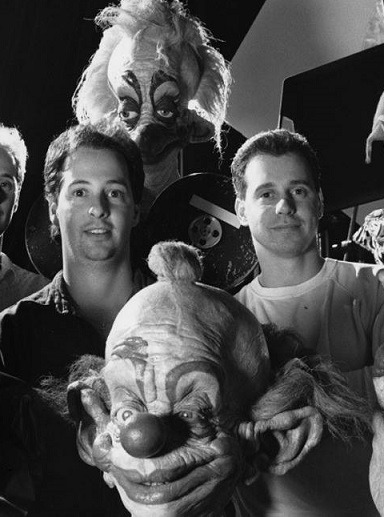
Producers/writers/directors Charles and Stephen Chiodo, along with a third brother, Edward, are well known animators, graphic artists, make up artists, and puppeteers, with projects as  I Go Pogo, Critters, The Lost Boys, Land of the Lost, Teenage Mutant Ninja Turtles, and The American Music Awards. This is their only full-length movie: apparently they created some scary clowns and wrote a script to go with them.  Gay subtexts were probably unintentional.

On the other hand, I was unable to find any reference to Charles Chiodo having a wife.  Maybe he's gay.

Mar 20, 2023

Bob Morane: James Bond without the Girls

When I was in high school in the 1970s, French class offered a practically infinite amount of beefcake-and-bonding riches.  If you tired of the Green Library, you could always move on to the Marabout Junior series, which featured adventurer Bob Morane.

Bob Morane was a former RAF pilot who worked as a reporter and freelance adventurer, often accepting secret-agent or detective assignments.  In later volumes he worked for the Time Patrol, going back to dinosaur times or fighting androids in outer space.

 There weren't a lot of illustrations, but those the books had displayed Bob with a massive chest, usually when one of the bad guys (such as Ming "The Yellow Shadow") had him strung up for weird torture.


Bob's best buddy, a Scotch bodybuilder  usually traveled with him to provide the gay subtexts, and get strung up for a series of "my hero!" rescues.


Ok, there were some girls. But I don't remember Bob actually having sex, and the girl-chasing was minimal, far less than in James Bond.


Belgian author Henri Vernes published 12 volumes of Bob Morane's adventures (1958-67).  Most have been translated into English. There have also been over 100 bandes-dessinee (which I haven't read), a 1964-5 tv series (with Claude Titre as Bob Morane and Billy Kearns as Bob Ballantine), a 1998 animated series, and some tie-in video games and toys.

Grit: Beefcake and Bonding in an Attic in Rural Indiana

Every summer, and sometimes at Christmas, we visited my Grandma Davis in Indiana.  She had an attic full of old magazines, and my brother and I used to spend rainy afternoons there, leafing through half a century worth of browning ephemera.

Today I get the impression of someone who longed for an urbane, sophisticated life as an artist in Jazz Age New York, but somehow found herself in a farmhouse in rural Indiana, with a husband who was gone weeks at a time, and spent her life lapsing between attempts to rebel and attempts to adapt:

Rebellion:  Nash's, Collier's, The Saturday Evening Post

Adaption: Better Homes and Gardens, The Farmer's Wife, Grit

Grit?

Who would name a newspaper after that gross stuff that gets in your eye after you sleep?

Maybe it was grits, the gross Southern food made out of boiled corn.

It was like a tabloid newspaper, with lots of human interest stories: a blind guy who works as a postal carrier, a woman who found her lost wedding ring in an egg laid by her chicken, a traffic accident that reunited a father and his long-lost son.

Nothing that took place anything near a city: in the world of Grit, no settlement with a population over 2,000 exist in the U.S.

No foreign countries exist, either.  Or black people.  Or Jews.  Or women who weren't housewives.  Or gay men and lesbians.

But -- there were a lot of cute 4-H Boys holding up prize sheep, providing a hint of beefcake on rainy rural afternoons.

Here's a shirtless boy in a bunkhouse at the Millstone 4-H Camp in Ellerbee, North Carolina, 1961.


There were also pages of comic strips, some the old-fashioned dinosaur strips familiar from the Rock Island Argus -- Blondie Prince Valiant, Out Our Way -- and some even older.

Beefcake titles like  Jungle Jim, Mandrake the Magician, and Flash Gordon.

Very nice physique, for a guy from the 1930s with his head wrapped in a plastic bag.


Here's an ad from Grit about selling Grit.  

$6 in 1956 is the equivalent of $50 today.  Not a bad source of income.


Grit was founded in 1885 by German immigrant Dietrich Lamade.  It was especially popular in the 1930s and 1940s, with over 400,000 weekly subscribers, competing favorably with newspapers that wouldn't deliver to rural areas.

The decline of the rural population after World War II, and competition from radio and television, led to a nosedive in subscriptions.  By 2000, there were less than 10,000 subscribers, mostly elderly.

Under new management, Grit has rebranded itself  as a bimonthly blog and print magazine for food and gardening enthusiasts, with articles on free range chickens, hybrid tomatoes, and lawn mower maintenance.


The new Grit is more inclusive, with racial and religious minorities, urban dwellers, and gay men and lesbians:

"Who do you call when you have an animal in trouble?  The ladies next door are at work, and I can no longer phone the gay guys down the street because they have me blocked since we had a shouting match about being invited to a Pampered Chef party, so I call the SPCA."

 It has over 150,000 subscribers.


Mar 18, 2023

Beefcake Dads of 1950s Sitcoms

During the late 1950s and early 1960s, there was a fad of nuclear family sitcoms, set in small town Mayfields, with a pipe-smoking Dad, a Mom who did housework in high heels, groovy teenagers, and wise-cracking preteens.  They actually weren't very popular at the time; adults preferred Westerns, swinging detectives, and musical-variety shows.  But the first generation of Boomers remembers getting their first glimpses of what family life was like -- or what they thought it should be like -- from the nuclear family sitcoms.

They generally identified with and/or mooned over the teenage boys: the muscular physiques of Bud (Billy Gray) of Father Knows Best and Wally (Tony Dow) of Leave it to Beaver, the blatant bulges of Ricky and David Nelson (Ozzie and Harriet), the teen idol cuteness of Jeff (Paul Petersen) of Donna Reed.  But there's a lot to be said for the dads, too.

Unfortunately, they weren't always as gay-friendly as their tv sons.

1. Born in 1906, bandleader Ozzie Nelson and his wife, former dancer Harriet, started The Adventures of Ozzie and Harriet on the radio in 1944. They transitioned to television in 1952, and lasted until 1966, making Ozzie and Harriet the longest-running fictional program on radio/tv.  Still not satisfied, he tried a spin-off, Ozzie's Girls, in 1976 (in which Ozzie takes in three college girls as boarders).

Ozzie and Harriet had many gay friends in real life, although no openly gay characters appeared on their show (that would have been impossible in the 1950s).


2. Robert Young (here apparently informing us of his size) was not only less than adequate physically, he was homophobic.

After his tenure on Father Knows Best ended, he starred in Marcus Welby, M.D., one of the most homophobic tv series of the 1970s.  In one episode, Dr. Welby diagnoses a man with "homosexual tendencies," but assures him that with the proper counseling, he can overcome his affliction.  In another, he treats a gay pedophile, with the implication that all gay men are pedophiles.  Gay activists protested, but the network -- and Dr. Welby -- wouldn't budge.

3. Born in 1909, Hugh Beaumont started out as a minister, but moved into acting during World War II.  Although a devout Methodist, he played his share of scoundrels, in Apology for Murder (1945) and The Blue Dahlia (1946), plus hard-boiled detective Mike Shayne.  Leave It to Beaver was meant to be a change of pace, but he was so typecast as Ward Cleaver that he took only a few roles afterwards, and ended up retiring to grow Christmas trees.

No data on whether he was a gay ally or not, but apparently his tv wife, Barbara Billingsley, was nonchalant about gay people.


4. The youngest of the 1950s sitcom Dads, ex-football star Carl Betz was only 36 when he was cast as Dr. Alex Stone, husband of the practically-perfect Donna Reed.  He had been making the rounds of tv adventure series, with guest parts on The Big Story, Waterfront, Sheriff of Colchise, Panic!, and Perry Mason, and he continued to be a sought-after performer throughout his life.

While he was playing the titular lawyer in Judd for the Defense (1967-69), one of his clients was a father who thinks that his son's friend is "recruiting" him into the "homosexual lifestyle."  Judd assures him that there's no cause for believing such a scandalous rumor.

Charlie Brown, Linus, and Gay-Coded Peanuts

I didn't read  Charles Schulz's Peanuts in the newspaper; our Rock Island Argus offered only a cheap imitation called Winthrop. My knowledge of Peanuts came through Fawcett paperbacks acquired at garage sales during the 1970s and treasuries acquired at the Waldenbooks at the Mall during the 1980s.

Not a lot of gay content.

1. Only two significant same-sex friendships (Charlie Brown-Linus and Peppermint Patty-Marcie), and neither display the intensity, physicality, or exclusivity that might push them from friendship to romance. (Christopher Shea provided the original voice for Linus.)

 Marcie calling Peppermint Patty "Sir" does not signify lesbian identity.  Lesbians do not call each other "Sir."


Plus, every character, almost without exception, is involved in an unrequited heterosexual romance: Lucy is in love with Schroeder, Sally with Linus, Peppermint Patty and Marcie both with Charlie Brown, Charlie Brown with the Little Red-Haired Girl.  Linus and Snoopy never zero in on one crush, but they each get many girlfriends.

In one 1985 continuity, Charlie Brown merely has to say "Eleanor" for Linus to collapse, and "Fifi" for Snoopy to collapse in agony over their lost loves.

Heterosexual desire validated over and over again, same-sex desire absent.  It was a world where gay kids felt alien and unwanted.


But there was an exception.  Like Jughead in the Archie comics, Schroeder is not interested in girls.  He not only rejects Lucy's advances.  He not only lacks a heterosexual crush of his own.  He never expresses any interest in any girl, ever. 

Of course, Schroeder never expresses any interest in boys, either, but he had a passion for music, specifically classical music.  Mostly Beethoven, because Schulz thought the name sounded funny, but also Bach, Schubert, Brahms, Handel.  His artistic interest and ability is gender-transgressive in a world devoted to sports (continuities are devoted to baseball, tennis, golf, ice skating, and so on).  He alone resonated with gay kids as "one of us."  He alone saw the world in a way they could understand.


Mar 15, 2023

The Gay Villages of Sonia and Tim Gidal


When I was little, my search for a "good place" often led me to the My Village books.  Tim Gidal (1909-1996) was a a pioneer in the field of photojournalism and a respected academic at the New School for Social Research.  In the interest of fostering international understanding, he and his wife Sonia published My Village in India (1956), a photo-story about the everyday life of a real ten-year old boy in a rural village.

It became so popular that they started scouting out villages in other countries, eventually traveling to 23:

1956: Austria
1957: Yugoslavia, Ireland
1958: Norway
1959: Israel, Lapps (Norway)
1960: Bedouins (Jordan), Greece
1961: Switzerland
1962: Spain, Italy
1963: Denmark, England
1964: Germany, Morocco
1965: France
1966: Finland, Japan
1968: Korea, Brazil
1969: Ghana
1970: Thailand
They only stopped when the couple divorced.


Each story was written in present tense and covered a few days in the life of a 10-12 year old boy: shepherding in Yugoslavia, fishing in Norway, tending to a vineyard in France.  He also went to school, played with his friends, talked to other villagers, went to a festival or took a field trip to a big city, and sometimes solved a minor mystery.  On the way you learned something about the history, language, and culture of the country (probably for the first time).

No gay people or same-sex romances were ever mentioned.  So why did these books offer a glimpse of a "good place"?


1. The boys were all exceptionally cute, from my preteen vantage point, and in warm climates they often stripped down to swim or fish or frolic.  Even in cold climates: the Norwegian boy stripped down for bed, and the Finnish boy was photographed completely nude in a sauna.


2. Their fathers, older brothers, and neighbors all lived off the land: they were farmers, shepherds, fishermen, loggers.  That meant endless photographs of muscular adult men.


3. American media of the 1960s was full of preteen boys "discovering" girls.  But the Village boys never expressed the slightest interest in girls.  Indeed, they didn't seem to know any, other than their sisters.

4. However, they often came in pairs that were extremely expressive by American standards: always hugging, wrapping their arms around each other, lying side by side, even kissing each other on the cheek.  To my preteen mind, it was obvious that they were boyfriends.

See also: Looking for Love in the Encyclopedia

Mar 11, 2023

The Top 10 Dour Hunks of "The Last of Us"


If you're watching several post-Apocalyptic tv shows at the same time, it becomes difficult to remember which pandemic just killed almost everyone (Station Eleven), which resulted in a world full of plodding, snarling zombies (The Walking Dead), and which resulted in vampire-like beings (The Strain).  Then there's The Last of Us on HBO, where mutated fungus in flour-based products results in near-instantaneous transformation into a creature covered with nauseating bulbous tumors. 

 I'm still watching, but every time a bulbous monster appears, I keep my eyes closed, or scroll through the social media on my cell phone.  As a result, I'm not entirely sure what's going on, so don't yell at me if I get something wrong.  These are just my impressions.  But I did notice some beefcake.

1. Construction worker Joel (Pedro Pascal, top photo) lost his daughter on the first night of the Apocalypse (she is presented as the protagonist, just to mess with viewers' heads). Twenty years later, he is living in Boston, a horrifying dystopia much worse than anything conjured up on The Walking Dead, a police state where they have public executions of anyone who breaks any of the hundreds of repressive laws.  Hardened and dour, he is working as a smuggler along with his non-romantic business partner Tess. 


2. Joel's screw-up younger brother Tommy (Gabriel Luna) also survived, but the two are estranged because Tommy went over to the Dark Side or something.

Joel and Tess are hired to deliver sassy 14-year old Ellie to a location I can't remember.  She's special because she's the first person in history to be immune to the fungus, so her blood can be used to make a vaccine.  

On the way out of decrepit, decayed Boston, partner Tess is inundated by disgusting bulbous monsters.  Then it's just the two, trudging through the pristine forests that are just outside the city.  Wait -- outside of Boston there are miles and miles of suburbs.  They stop in various places for supplies and fight the disgusting bulbous monsters.


3. For a reason I'm not clear on, they have to stop by Bill and Frank's -- a gay bear couple (Nick Offerman, left, Murray Bartlett, below) who live in a very nice house with hot water and electricity, pair rabbit stew with Beaujolais, and play Linda Ronstadt songs on the piano. 


4,  In Episode 3, we see their 20 year relationship from beginning to end.  Bill, a survivalist, was hiding in an underground bunker when the military rounded up everyone else in town to kill (to prevent infection?).  He lived alone for several years, until Frank showed up.  He had never been romantic with anyone before, but apparently his only human contact in years sparked some interest.  

I like the scene where they are preparing for sex for the first time: Bill takes his towel off, and Frank's eyes bug out -- apparently the bear is quite well-hung.  I don't like them both being isolated, interacting with no humans other than Joel and Tess, and being dead.


5. Next, in Missouri for some reason, Joel and Ellie encounter dour revolutionary Kathleen and her dour nonromantic partner Perry (Jeffrey Pierce).


6. The revolutionaries want to find and kill hardened bandit Henry (Lamar Johnson) and his deaf, sick, autistic brother Sam (how vulnerable can you get?).  But Joel and Ellie bond with the two.  They fight disgusting bulbous monsters together.  But Sam is bitten!   You know this won't end well.


7.  This doesn't technically count, but in the video game version of The Last of Us, deaf, sick, autistic Sam is a teenager, played by Nadji Jeter.


8. Joel and Ellie finally reunite with Joel's younger brother Tommy (was that the game plan?), who is living in Jackson, Wyoming with his pregnant wife.  But they argue, and the two leave. 

 In Colorado for some reason, Joel is severely injured.  And guess what: in Episode 7, the teenage Ellie is revealed to be a lesbian!  She had a girlfriend back in whatever horrible dystopian place she was living in before Boston, but the girl got monster-ized.

While Joel is fighting his life-threatening injury, Ellie encounters dour cult leader David  (Scott Shepherd) and his nonromantic partner James, who threaten and traumatize her in various ways before she kills them.  


9. I spend most of each episode desperately trying to avoid looking at the disgusting bulbous monsters on the screen, but I got a brief glimpse of Philip Prajoux (right), playing one who infects Joel's nonromantic partner Tess by exuding tentacles into her mouth.


10. Riley Davis (bottom) reputedly plays a "Young Firefly Soldier" (Fireflies are terrorists or freedom fighters, depending on which side you are on), whom Joel provides with drugs in Episode 2.  

I'm including him without a shirtless photo because I spent ten minutes paging through references to a woman named Riley Davis on the old McGyver tv series and looking at the instagrams of 12 people named Riley Davis, all women.  This actor has four citations on the IMDB, but not The Last of Us or Lions in Waiting, which is the source of this photo.

Oh, well.  The last episode of The Last of Us airs on March 12th.

Mar 5, 2023

"The White Lotus": A Shockingly Homophobic Portrayal of a Gay Man, Created, Written, and Directed by the Devil


I lived in Florida for four years, and never went near the beach.  You'll never get me on a boat.  Even going over a bridge pushes up my anxiety level.  So I wasn't sure about the HBO Max series White Lotus, set in a beach resort in Italy.  But someone told me that there were gay characters in Season 2, so here goes....

Scene 1: A beach resort featuring bikini models sitting under umbrellas.  A woman with her breasts hanging out of her swimsuit starts a conversation with two women who just arrived from America.  She's leaving in a few hours, but she praises the hotel, the staff, the food, and the wine.  So she spent her entire trip on a beach that looks like every beach everywhere?  Why not try to actually see the country?  Her semi-bare butt goes into the water for one last swim -- and she bumps into a dead body!

Cut to hotel staff Rocco and Valencia watching body bags being hauled away.  Several bodies of guests have turned up!


Scene 2: 
 A week earlier.  Two heterosexual couples on a boat, one distant and arguing, the other snuggling, kissing, and nose-rubbing.  Then a depressed woman, Allora, walking through town.  Her friend Mia asks what's wrong: "Massimo has a new girlfriend, and I'm jealous."  Mia drags her away: it's almost time for the boat to arrive.  So is this a flashback in a flashback, before the girls get on the boat with the heterosexual couples?

A boat arriving while the staff waves.  "Smiles, everyone, smiles!'   Allora and Mia look on from afar, wondering which one "he" is.  He who?  A new boyfriend met on Tinder?


Down on the dock, Employee Valencia tells the Old Guy: "I'm surprised you are here.  It's a long way from L.A., and you are quite old."  Way to insult your guests!  Next an unidentified older-younger same-sex couple; Cameron (Theo James, above) and wife, the kissing, nose-rubbing couple); Ethan (Will Sharpe, left) and wife, the distant, arguing couple (he forces her to drink wine); and a flowsy rich lady with a hundred suitcases, Ms. McQuaid. "I am your host, Mr. Roarke.  Welcome to Fantasy Island." 

Scene 3:  The White Lotus resort is in an  old hilltop convent, nowhere near the beach -- but with a view of Mount Etna. What kind of beachside resort is this, where you have to take a bus to get to the beach?

  Employee Rocco tells the two couples, who are apparently all friends, the story of the testi morti: a Moor came to Sicily and seduced a local woman.  When she discovered that he had a wife and kids back home, she cut off his head. It's a warning for husbands not to cheat. 

Then he shows  them that the two rooms connect through a secret doorway.  Ethan is up for wife-swapping, but his wife disapproves: "We won't be using that."   When the kissing, nose-rubbing couple leave, Ethan starts yelling at her.  Jerk! Not into it means not into it.


Meanwhile, the older-younger same-sex couple turn out to be father Dominic and young adult son Albie (Adam DiMarco), traveling with Grandpa Bert, who flirts with a female employee until the others reigns them in.  They're here to visit their ancestral town. 

So far the only potentially gay guest is Albie, so I'll fast-forward to his story.

Minute 24: Albie gets out of the pool (nice chest shot, but every other guy in the vicinity is fully clothed0.  He sits down next to Portia, a teenage girl who just got off the phone with a friend telling her to "get some dicks" while on vacation.  SHe starts crying because "they" have half a billion dollars but won't let her have any fun.  Albie consoles her.


Minute 46:
They kiss.  Ok, so Albie is straight.  All of the other guests are married, hetero-horny, or both.  Who is the gay one?

Research reveals that he is Quentin, one of those aristocratic, decadent, fey Quentin Crisp types (parents don't know that their kid is gay when he is born, so why do gay guys on tv always have tired stereotype names, like Quentin and Blaine?).  This closeted jerk pays a group of straight men to have sex with him and introduces them as "my nephew and his friends."   He's also a drug addict and a murderer.  Pure homophobic sleaze.  

Wait -- I didn't notice before, but this series is created by, written by, and directed by MIKE WHITE, aka The Devil,  the most disgusting homophobe in Hollywood.  This is the jerk who wrote and starred in Chuck and Buck, about gay relationships being only for adolescents experimenting on their way to a "normal" heterosexual adulthood -- then had the monumental gall to advertise it in gay magazines!  Apparently those poor souls who get stuck in their adolescent "gay phase" turn into decadent, fey drug addicted murderers.


Run away. Run away fast.  

Related Posts Plugin for WordPress, Blogger...