Showing posts with label Tolkien. Show all posts

Nov 30, 2025

Golden Cities, Far: In junior high, we write a heroic fantasy novel with absolutely no connection to "The Lord of the Rings"


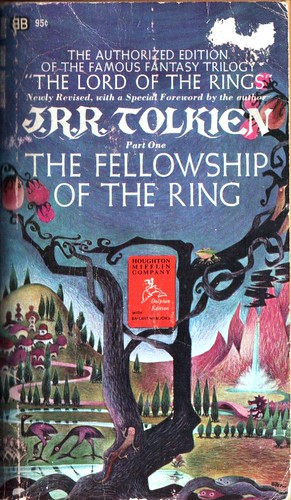
I discovered The Hobbit in sixth grade, The Lord of the Rings in junior high, and thought it the best thing ever written. Heroic fantasy!  Elves, dwarfs, and wizards fighting the Dark Lord in an alternate Medieval world!  Infinitely superior to sword and sorcery (about mighty-thewed barbarian heroes in an ancient world), and to those dreary naturalistic novels about high school basketball stars that teachers were always pushing at us.  Even better than science fiction.

Around eighth or ninth grade, my friend Darry and I started working on our own alternate Medieval world -- if we couldn't find a "good place" in our world, why not make one of our own?   

We developed a gazetteer-full of new countries, wrote historical timelines spanning thousands of years, compiled detailed genealogical charts, and invented a dozen languages of Elves, Dwarves, and Men (well, some words in each). We got ideas from fantasy novels, myths, folklore, the histories of obscure countries, and anything else we could get our hands on:


The country of Runoe after forgetting the name of Runde Island in My Village in Norway.

The forest-dwelling Colemonas of Jotunheimr after the Norse giants and Coleman camping equipment. 

The Dark Lord, Moi, after a book in the junior high library, In Search of Moi (we hadn't studied French yet, so we pronounced it Moh-ye)

We worked every day at lunchtime and after school, on Saturday and Sunday afternoons, during holidays.


Fantasy worlds must be used as the setting for novels, so by eighth grade we were working on a plot about a Midwestern teenager named Jim swept away through a time-space warp to the world of Toulbium, where he gathered companions to fight the Dark Lord Moi.

Everyone we told about the story screamed “You’re plagiarizing The Lord of the Rings!”

 But we patiently pointed out that:

1.  Jim is rescued by Ray when he enters the world of Toulbium.  Frodo and Sam  Frodo and Sam already know each other.

2. Jim and Ray travel west to Montenia, not east to Mordor.


3. There are Eluses instead of Elves.  

4. Jim is black.  There aren't any black characters in Tolkien.

5.  Montenia is surrounded by dark forests, whereas Mordor is bounded by mountains.

6. Instead of throwing the One Ring into Mount Doom, Jim throws a magic sword into Pair Daedeni, the Cauldron of Life.

7. Jim becomes a born-again Christian. (I was Nazarene, remember?)


Every Saturday we took the bus downtown to Readmore Book World to spend our allowance on heroic fantasy novels for research.  They were part of the Ballantine Adult Fantasy series, bright, shining paperbacks with evocative titles: The King of Elfland's Daughter, The Broken Sword, The Wood Beyond the World, Beyond the Golden Stair, Golden Cities Far.

But there were some problems:  

More after the break

Sep 7, 2022

"The Lord of the Rings: The Rings of Power": Elves, Humans, and Proto-Hobbits Face Off against the Dark Lord

 I've read the Lord of the Rings trilogy, and seen the movies, but I never paid much attention to the appendixes, the Silmarilion, the Book of Lost Tales, and the various other Middle Earth ephemera.  So I went in to the new Amazon series The Rings of Power, about the events of the First Age, with few fanboy expectations.  I watched the first 66 minute episode on Amazon Prime.


Scene 1:
  I always thought that Undying Lands, where the Elves went when they tired of Middle Earth, was a sort of heaven, but here it's a regular place, lit by lamps instead of the sun, and the Elves aren't actually Undying -- they're  newly-created, so they just assume that they won't die.  And there are bullies -- all black-haired -- who gang up on the young Galadriel (blond) before her brother Finrod (Will Fletcher, above) intervenes.  They exchange aphorisms.

Scene 2: Galadriel narrates a whole trilogy worth of plots: the evil god Morgoth extinguishes the lamps, so the Elves have to leave the Undying Lands and go to war in Middle Earth.  He's defeated, but his henchman Sauron is still around, so the Elves spend hundreds of years patrolling, looking for him or his Orc-minions.

The narration ends with Galadriel and her troops (actually six people) still looking for clues to Sauron's whereabouts.  She pushes on and on, into the north country, until her troops, led by Thondir (Fabian McCallum), tire of her constant aphorisms and lay down their swords, stating that they are going home.

Scene 3:  The Harfoots, who will eventually evolve into Hobbits, are nomadic hunter-gathers that look and act like Irish Travelers.  A young girl named Nori is frustrated with her circumspect existence, and wants adventure (like a certain Bilbo Baggins centuries hence),


Scene 4
:  When Galadriel finally makes it back to the Elf Middle Earth headquarters, her boyfriend Elrond (Robert Aramayo, left) tells her in aphorisms that the troops didn't mutiny: she did, by disobeying countless orders from the High King Gil-Galad (Benjamin Walker) to give up the search.  But he forgives her.  He has declared that the danger is over, so all of the Elves can return to the Undying Lands.

Scene 5: Nori of the Harfoots, still being frustrated and longing for adventure.

Scene 6: Galadriel and boyfriend Elrond talking in aphorisms some more.


Scene 7:
  The early Anglo-Saxon village of Men, a racial group that went gung-ho for Morgoth 70 years ago, and now is being closely monitored by their Elf overlords.  So, Hitler died about 70 years ago.  Should we be carefully monitoring the Germans?  They hate the Elves, and especially stoic Vulcan-like Arondir (Ismael Cruze Cordova), who is constantly snooping around, looking for problems. It doesn't help that he has a human girlfriend, a healer named Bronwyn-- interracial (or inter-species?)  relationships are strictly forbidden by both humans and Elves.  

Suddenly Arondir and his colleague Medhor (Augustus Prew, left) are called back to the base: High King Gil-Galad has called off the search and is sending them all home.  Good news, right?  Well...um...


Scene 8
: Girlfriend Bronwyn and her teenage son Theo (Tyroe Muhafidin) are preparing herbs.  Arondir drops by to tell her he's leaving, but first he'll go to the eastern town of Horndern to investigate some cattle being poisoned by evil grass.  She offers to go along, since she grew up there.

"Ok, but be careful -- the people of Horndern are all Morgoth-lovers."  Bigot!

Meanwhile, son Theo wants to show his friend Rowan (Ian Blackburn) a cache of treasure he found in an old barn.  Well, they're not really friends -- Rowan makes fun of him for having no father and a mother who's involved with an Elf.  The treasure includes a weird dagger marked with Dark Lord Sauron's symbol, which starts to glow and pull Theo to the Dark Side.

Scene 9: Galadriel and her group sing as their boat sails toward the Undying Lands, here pictured as a bright light.  Meanwhile, High King Gil-Galad and Elrond, back in Middle Earth, discuss in aphorisms that the evil might not have been vanquished after all.  The Harfoots agree -- "the sky looks strange."

Back on the ship, Galadriel remembers one of her dead brother's aphorisms and at the last minute refuses to go into the light.  She jumps off the ship -- and is left floating in the middle of the ocean.  I hope she knows how to teleport!

Scene 10: Everyone in Middle Earth watches as a a flashing light zooms across the sky.  A comet!  No, it can't be -- whatever it is crashes near the Harfoot camp.    Nori rushes to investigate and finds a flaming thicket, and in its midst a naked old guy.  I'm guessing Gandalf.  He's one of the istari, sent directly from God to help Middle Earth.  The end.

Beefcake: None.

Other Sights:  Lots of woodlands, some exteriors of Elvish castles.

Heterosexism:  Two boy-girl relationships are centered so far.

Gay Characters: None specified so far, and no same-sex pairings for gay subtexts.  I doubt that there will be any.  

My Grade: All  of the mysticism and magic of the Undying Lands has become banal, the Elves are portrayed as a bit totalitarian, and the gay subtexts that informed the original are gone.  C.

May 12, 2019

J.R.R. Tolkien, the Heterosexual Who Wrote about Men in Love

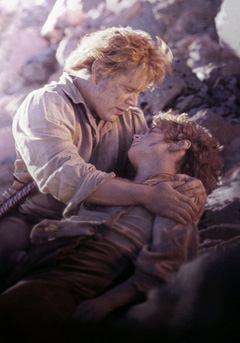
J.R.R. Tolkien (1892-1973) was one of the iconic authors of my childhood, his Lord of the Rings trilogy one of the first gay novels I ever read.  I didn't even know what "gay" meant yet, but I knew about Sam carrying Frodo up the slopes of Mount Doom, Merry and Pippin putting their beds next to Aragorn's, Gimili forsaking Middle Earth to follow Legolas to the Elven lands.

I didn't know anything about Tolkien himself, except that he was a scholar of Medieval literature from England.  I assumed that he was gay, of course.  What straight guy would evoke so many same-sex romances, and omit women, and desire for women, from Middle Earth?

Later I found out a few more details: he served in World War I, he was married to Edith throughout his life, he had four children, and he was a devout Roman Catholic (religion, too, was entirely absent from Middle Earth).  On the other hand, he was deeply involved in an informal group called the Inklings, men (including C.S. Lewis) who got together to drink, dream of Medieval worlds, and form those strong quasi-homoerotic bonds of Oxford best boys.

I certainly don't want to see the movie Tolkien (2019), which takes place before he even begins writing the novels and centers heterosexual romance as the great inspiration of his life. What's next, giving Oscar Wilde a great hetero-romance just because he was married to a woman?

So let's skip the details and see if Tolkien has any gay characters or beefcake potential.

1.  Nicholas Hoult (top photo) as good old John Ronald Reul himself.

2.  Anthony Boyle (second photo) as  Geoffrey Bache Smith, a childhood chum killed in the War.

3.Tom Glynn-Carney (left) as Christopher Wiseman,who invites Tolkien into his social group, his "fellowship," as it were.


4. Craig Roberts as Sam Hodges, a soldier Tolkien serves with,  maybe Sam to his Frodo?


5. Patrick Gibson as Robert Gibson, a fellow artist killed in the War.

That's about it,unless you want to take a look at the uncredited Bargeman, Drunken  Student #2, Rugby Spectator, and Moroccan Waiter.

See also:The Lord of the Rings


Nov 2, 2012

The Lord of the Rings


I had a friend in high school who claimed to have read J.R.R. Tolkien's  Lord of the Rings trilogy straight through 38 times (for a fast reader, that would take 2 hours per day, every day, for 5 years). I barely made it through once, with lots of skimming, , but I returned to certain passages over and over again.  They were "good beyond hope."

A company of men.  Working together, fighting, rescuing each other, hugging, saving the world.

Heterosexual desire almost absent: Tom Bombadil is devoted to Goldberry, the Ents pine away for the Entwives, Aragorn pines for Arwen (though not as much as in the movie series), and a few poems and songs say things like "Little Princess Mee -- Lovely was she," but nobody read them anyway.

And lots of same-sex romance.


1.  Everyone today sees a romance between Frodo and Sam, especially as portrayed by Elijah Wood and Sean Astin in the movie series.  But I didn't see it.  Tolkien was highly class conscious, and Frodo and Sam are master and devoted servant.  At the end of the story, Frodo goes to the Undying Lands by himself, and Sam goes home to his wife.

But I did notice that Frodo is gay.  He surrounds himself with men and never once mentions a woman.  (He reveres Galadriel, but as a goddess to be worshipped, not as an object of desire). 


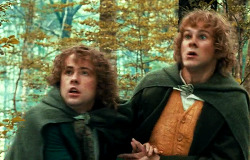
2. Merry and Pippin (played by Dominic Monaghan and Billy Boyd in the movie) are devoted to each other.  They go through deadly danger for each other, and when they are split up, each pines for the other.  After the War of the Ring, they go to work for Aragorn, so they can stay together forever.


3. The Elf Legolas and the Dwarf Gimli (played by Orlando Bloom and John Rhys-Davies in the movie) are sworn enemies, working together only to fight a greater evil.  But as the novels progress, they develop a grudging admiration, then a friendship, then a romance.  Neither seeks out a wife.

After the War of the Rings, when Legolas goes to the Undying Lands, Gimli comes with him. Tolkien comments:

It is strange that a Dwarf should be willing to leave Middle Earth for any love, or that the Eldar (Elvish Gods) should receive him, or that the Lords of the West should permit it. . .More cannot be said about this matter.

This is a curious way to end the discussion, suggesting not that Tolkien has no more information on the subject (of course he does, he wrote the books and he could invent any information he wanted), but that he is forbidden from saying more.  What is forbidding him?  It seems that, in attempting to understand Legolas and Gimli, their love for each other, and their motive for forsaking Middle Earth together, Tolkien is drawing dangerously close to acknowledging a love that he dare not acknowledge, and he abruptly forbids himself from considering the matter further.

 Tolkien was no doubt quite as homophobic as others of his generation, or moreso, a conservative Roman Catholic who eschewed the modern era.  But his subject matter  -- Medieval epics like Beowulf and The Nibelungenlied -- traditionally minimize heterosexual exploits to concentrate on the manly love of comrades.  Tolkien couldn't help but acknowledge it, on some level, whether he wanted to or not.
Related Posts Plugin for WordPress, Blogger...