In the Euripides play Hippolytus (428 BC), we learn why Phaedra was so interested in the lad. He rejected Aphrodite, the emblem of heterosexual love, for Artemis, the "chaste" goddess of the hunt. Angry at the slight -- how dare there be any non-heterosexuals in the world! -- Aphrodite caused Phaedra to fall in love with him, thus leading to his death (this is a scene from a performance at the National Theater of Athens).
Beefcake, gay subtexts, and queer representation in tv and other pop culture from the 1950s to the present
Sep 30, 2022
Hippolytus, the Gay Charioteer of Greek Myth
In the Euripides play Hippolytus (428 BC), we learn why Phaedra was so interested in the lad. He rejected Aphrodite, the emblem of heterosexual love, for Artemis, the "chaste" goddess of the hunt. Angry at the slight -- how dare there be any non-heterosexuals in the world! -- Aphrodite caused Phaedra to fall in love with him, thus leading to his death (this is a scene from a performance at the National Theater of Athens).
Sep 28, 2022
Mickey Rooney: Gay-Vague Teen Hunk of the 1940s
Born Joe Yule in 1920, Mickey got his start as "Mickey McGuire," a preteen rapscallion in a popular series of silent movie shorts. In the mid-1930s, he moved on to teenage dramas, many with the strong gay subtext common in the era.
In Little Lord Fauntleroy (1936), his rough street kid Dick falls in love -- quite literally -- with the upper-crust Ceddie (Freddie Barthlomew).
In The Devil is a Sissy (1936), his rough street kid Gig is torn between regular guy Buck (Jackie Cooper) and upper-crust Claude (Freddie Bartholomew).
Audiences never tired of two teenage boys gazing into each other's eyes.
But Mickey -- and MGM -- hit paydirt with the Andy Hardy series, 16 movies (1937-1946) about a rambunctious small town teenager. Who was girl-crazy, a new and bizarre characteristic for teens in mass media of the day (previously boys were expected to become interested in girls at the end of adolescence, not at the beginning).
At first parents and peers -- and audiences -- disapproved of Andy's interest in girls, thinking it made him effeminate.
The producers countered by displaying Andy's muscles as much as possible. He strips down for bed; he bounces down the stairs shirtless; he goes swimming, even in winter, and in a revealing Speedo-style swimsuit. As much as 30% of each Andy Hardy movie is devoted to beefcake shots of Mickey's body and bulge.
Here Jackie Cooper (left) is a little more obviously bulgeworthy.
The strategy worked. The Andy Hardy movies hit the top of the box office, and Mickey Rooney was named the most popular star in Hollywood three years in a row.
He also starred with Judy Garland in three popular movie musicals about kids winning or saving things by putting on a show.
Plus he continued the male-bonding romances in Huckleberry Finn, Boystown, A Yank at Oxford and Men of Boystown.
Mickey Rooney was always nonchalant about gay people, even in the 1940s, perhaps because his own heterosexual interests were so very obvious, with nine wives and innumerable affairs.
In the 1950s, when gay beefcake hunk Rock Hudson hit on him, he was bemused but not offended: "I like girls," he said. "I thought everybody knew that."
Mickey Rooney kept working into his 90s, with starring roles in such movies as Wreck the Halls (2008) and The Empire State Building Murders (2008), and small but memorable roles in The Muppets (2011), Driving Me Crazy (2012), and Dr. Jekyll and Mr. Hyde (2014).
Sep 25, 2022
The "Quantum Leap" Reboot: Hunky Scientist Gets Zapped into the Past
Quantum Leap (1989-1994) starred the hunky Scott Bakula as Sam Beckett, a scientist who gets randomly zapped into the bodies of people who lived during his lifetime.. He then helps them solve the personal crisis of the week. In 97 episodes, he jumped into all sorts of people, once a dog, once himself, but never anyone gay (although, in a "controversial" 1992 episode, he jumped into a naval academy cadet and saved a gay classmate from homophobes).
I watched the first episode of the 2022 reboot, to see if they have maintained the hunkitude or increased LGBT representation, or both.
Prologue: We hear about Sam Beckett's time-jumps. Attempts to bring him home always failed, and eventually the project was abandoned. Until now.
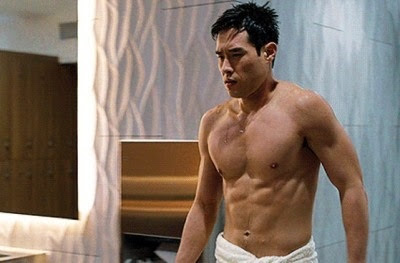
Scene 1: In a darkened lab, a woman wearing a scorpion ring types furiously into a computer. When her calculations are complete, she texts Ben Song (Raymond Lee, top photo), who is being congratulated by various people at a fancy apartment. He stops to kiss his wife in an extremely tight close-up (we even see their drool), and suggests that they sneak out for sex. Ensuring that we know he is heterosexual from the first moment! What are they afraid of?
The female bodyguard interrupts the smooch to complain that "Ian's about to take out the DJ because he won't play the Kinks." Ian is an androgynous person with fluffy blond hair, a pink suit, and nail polish. They are played by Mason Alexander Park (Desire in The Sandman), who is nonbinary in real life. They are not really threatening violence.
The work team consists of Wife, Female Bodyguard, Middle-Aged Black Guy (Ernie Hudson, one of the original Ghostbusters), and the only named character so far, Ian.
Ben is asked to make a speech. He talks about how much he loves his wife, and kisses her a few hundred more times.. I fast foward through the schmaltz.
Seene 2: In the lab. Ben puts on a skin-tight white suit (nice bulge) and climbs into a gyroscope. He awakens in working-class clothes, driving a car, with David Bowie singing on a small portable tv. The guy next to him says: "Desperate times, right?"
"How did I get here?" Ben asks. Didn't he expect to time-jump? Isn't that what he climbed into the gyroscope for? The guy misunderstands and answers: "A million bad decisions." He then puts on a ski mask and goes to rob a store or a bank.
Ben climbs out of the car, disoriented. Walkmen. Telephone booths. The Goonies and St. Elmo's Fire playing at the theater. I don't think I'm in Kansas anymore. A poster tells him the date: July 13, 1985, the day of Live Aid (a global concert to benefit Africa). He checks his wallet: this body is Nick Rounder, from Pennsylvania.
Ben's wife, Addison, approaches. "Why did you leap? We weren't anywhere near ready for a human subject!" He doesn't know her, or what a leap is; he's lost his memory! She explains: "I'm a hologram from the future. You're a time-traveling scientist...." Then the robbers emerge with a casket and expect Ben to be the getaway driver.
Problem: he can't drive a stick shift. Addison teaches him how. He also doesn't know how to get to "the restaurant on York." She checks her GPS. Why couldn't they abandon the robbers and go off on their own?
Police chase through Philadelphia. They arrive at the restaurant hideout. Ben's friend asks why he acted so weird. The Scary Guy in Charge looks suspicious.
Scene 3: Addison is zapped back to the lab, due to a kink in the system. Ian tells her what she already knows: they could send things to the past, but not bring them back. So why did Ben suddenly grab a skintight suit, turn on the gyroscope, and zap away, knowing that he would get stuck? "Maybe he figured out a way to come home, but his memory is wiped."
Middle Aged Black Guy comes in, reassuring the General that the power surge was completely normal; everything is going according to plan. "Say hello to James for me." Is the General a woman, or a man with a same-sex partner?
They wonder some more about why Ben zapped into the past -- and wiped the security cameras, so no one would see what he was doing.
Scene 4: Back online, Addison returns to 1985, and asks Ben why he leaped without telling anyone. He doesn't remember. "The system sends you back to people who need help, so if you help Nick the Robber, maybe it will bring you home." Wouldn't that create a time paradox?
She explains all about the Quantum Leap project, for him and for the audience. He accepts the "you're a scientist from the future inhabiting someone else's body" explanation very quickly. Of course, he was surprised by the 1980s technology and culture, so mayb,e he remembers some things about 2022.
The other robbers tell him that it's time to open the crate: C-4 Explosives. They're going to blow up a building! The Scary Guy (Michael Malarkey) suspect that Ben/Nick is getting cold feet, but his buddy vouches for him. They are very chummy. Maybe they are a gay couple? "Ok, but if you scfew this up, I will kill you."
Scene 5: Back at the lab, everyone scurries to look up Nick Rounder. No record of him in Philadelphia in 1985. But the C-4 went off in front of the Museum of Modern Art on July 13th, the day of Live Aid. No one was hurt.
"Why would he go back in time to stop an explosion that didn't hurt anyone?" Ian asks. Maybe no one was hurt because he stopped it?
Meanwhile, in 1985, Ben/Nick and his Friend walk out into the street, arguing about whether they should go through with the bombing or not. Suddenly Friend's wife and daughter show up. Darn, I thought they were a gay couple. They finished the dialysis treatments early, so they decided to stop by. Ok, Friend's got a dying wife, so he needs money. Not quite as cliched as a dead wife, but close.
Sorry, the guy has not yet been named, and no one in the cast listed on IMDB looks like him.
Addison zaps in with the dets: Ben's purpose in 1985 is to keep his friend, Ryan (finally, a name!), from being killed tonight.
Ryan is played by Michael Welch. I didn't recognize him on IMDB because his photo depictes a young teenager, and this guy is well into his 30s, with a red beard.
I'll stop the scene by scene there.
Beefcake: Just Ben's bulge in a white suit.
Gay Characters: Ian is nonbinary, but no info on their sexual orientation.
Heterosexism: Incessant. Dying wife, "you mean so much to me," and so on. Making the wife Ben's holographic companion will only increase the heterosexism.
Mysteries: What was Ben being congratulated for in the first scene? The project wasn't nearly ready to launch.
Why did Ben decide to leap?
Why save Ryan in particular; the end-of -episode wrap-up just mentions that he and his wife and daughter lived happily every after, but doesn't tell us why Ben cared about him.
The woman typing furiously in the first scene does not belong to the group -- who is she?
Up Next: Ben is an astronaut just before liftoff. And of course he knows nothing about flying spaceships!
My Grade: D.
Sep 22, 2022
"Murder is a Drag": Jonathan and Jennifer Don't Solve a Murder, Max Does "Some Like It Hot"
As promised, here is my review of Hart to Hart, the 1980s whodunit that just dropped on Amazon. Decider promsed me bare chests, 1980s glitz, ridiculous plots, and lots of gay double-entendres. I choose Season 2, Episode 9, "Murder is a Drag," because it's probably about a murder at a drag club.
Scene 1: Jonathan ("he's quite a guy") and Jennifer ("she's gorgeous") are getting ready for the opera, one of those lifelong passions that people have on tv for one episode, never to be mentioned again. No hairy chest yet! Jonathan hates opera, and tries to lure her into bed so they'll miss it, but no dice. Then he tries "I have nothing to wear!", but she demonstrates his 350 suits.
Scene 2: An endless line of elegantly dressed male-female couples heading into the thteater. Jonathan has lost the tickets! They rush to buy replacements, but it's sold out. Well, maybe someone has some extras.
At that moment a thief picks a man's pocket and finds some money and two tickets. Jonathan thinks he's a scalper and buys them for $100.
Scene 3: Pan of the audience. Suddenly the man sitting next to Jonathan offers him "The first $100,000 now. Call this number on Friday for instructions." Then he falls over, stabbed in the back. A murder! Must be Tuesday!
Scene 4: The theater has been cleared. Jonathan, under arrest for murder, is being interrogated. I guess they couldn't afford a police station set. "I'm no murderer. I'm Jonathan Hart, self-made millionaire, quite a guy." The cop is not impressed. Then their police confidant, Lt. Kirkwood (Jim McMullen), shows up to spring them.
Kirkson explained: you got the seats of a hit man who was hired to assassinate an important person (we don't know who). Harry Carney, a man connected with the scheme, tipped us off, and was murdered for it. Wait -- why would they murder him at the opera, in the seat next to the hit man? Wouldn't that blow his cover?
At the police station, they discuss the case further. Jonathan: "This whole night has been a disaster. First I can't find anything to wear to the opera, and now a murder.." I thought you'd be pleased ("their hobby is murder"). "And they'll be expecting me to make a hit." "Make the call on Friday, and we'll trace it and find the baddies."
Scene 6: Baddie Mr. Six, dressed in a silk bathrobe, playing solitaire. His assistant informs him that the hit man has received his payment. He'll call on Friday for the details, then kill the "courageeous district attorney," and you can continue with your drug business.
1. If there's enough evidence to indict, why would killing the d.a. change anything? 2. Why not just tell the hit man who to kill, without all the weird complications? This is ridiculous.
Then the real hit man, McGarity (James Luisi), shows up, blustering about the mixup. "So I'll do the original hit, plus take care of the guy who got my seat. On Friday we'll trace his call and find him and kill him."
Scene 7: Jonathan at work. Not a very elegant office -- where's the panoramic view of L.A.? Detective Kirkson drops by for the call. Hit man McGarity: "You're invited to a costume party tomorrow night. Your target will be there. You'll be told who it is at the time." Why not just tell him now?
Turns out that the trace worked for the baddies -- they know that it's Jonathan Hart -- but not for the cops.
Scene 8: Out in the parking lot, Detective Kirkson took Jonathan's assigned parking space. He offers to move his car -- and boom! It's only been a few minutes. How did the baddies have time to plant a car bomb?
Scene 9: The butler Max ("I take care of them") is serving breakfast. There are three settings -- he ate with the bosses! How egalitarian! But now he vanishes. Jonathan and Jennifer discuss all of the bigwigs who will be attending the costume party tonight. As a L.A. bigwig, wouldn't Jonathan have been invited anyway?
Scene 10: The Harts check out the mansion where the party will be held. At the same moment, two new cops arrive ,on order to protect them: Sgt. Ewell and Sgt. Tate (Norm from Cheers!) How did the cops know that they were going to the mansion? If they were tailing the Harts, they would certainly notice, right?
Inside, the hostess provides them with the party guest list. Not much help, there are 500 names on it (not the Harts? these people aren't as fancy as they think. She gives them the names of several guests with enemies who might want them dead.
Uh-oh, the Big Bad Mr. Six and his assistant are working as caterers. Wait -- why would they infiltrate the party? They hired a hit man to do it.
Scene 11: Time for the party. The Harts are dressed as Rhett Butler and Scarlett O'Hara. Max wants to go, too, but Jonathan says no, too dangerous. He leaves. Suddenly the Big Bad's assistant arrives to take Mrs. Hart hostage and force Jonathan to do the job. Wait -- the real hit man said he would do the job, and then kill Jonathan. Why force a random stranger to do it? He wouldn't have the skill set. This doesn't make sense.
Max returns to find the Harts missing. Deducing that something is wrong, he heads to the party.
Scene 12: Assistant takes Mrs. Hart to a very roomy, well-lit caterer van and compliments her gorgeousness. She counters that "she is one lady who knows how to take care of herself," but not to worry, he's just going to tie her up. But after Jonathan is killed and she's a widow, maybe.... So he only rapes single women?
Inside the party: a very small room, 15 or so heterosexual couples in ridiculous costumes disco-dancing. The cops have come as Laurel and Hardy. Where's the vsst ballroom with 500 people?
Scene 13: Max isn't allowed into the party -- no costume. So he sneaks into the service entrance -- unguarded -- and up the stairs to a bedroom, looking for a bedsheet to become Julius Caesar. He has to hide in the walk-in closet when Batman and Wonder Woman come in for sex. Batman: "It's ok. Robin and I are separated." He means a female Robin, no doubt, but it's still a gay reference.
Next option: the closet contains dresses, a wig, and and a makeup table, so Max dresses in drag. He exits, past the kissing couple. "Where did you come from?" Wonder Woman shrieks. "I came out of the closet." Har-har.
Meanwhile,the real hit man/bartender drugs the cops' drinks. Another cronie, dressed as Red Riding Hood, asks Jonathan to dance so she can hand him the gun and tell him that the target is the District Attorney. Why not just tell him...oh, never mind. This is ridiculous.
In order to talk to Max, Jonathan asks him to dance. "I do this every night," Max says. "You lead." So Max dances with men a lot? Or is he joking?
The Tin Foil king does a Some Like It Hot, importuning Max with plaints of love. "She's not who you thnk she is," Jonathan warns. "What woman is?"
Scene 14: At 10:00 pm, Jonathan pretends to shoot the Courageous District Attorney. Then Hit Man shoots at him and misses (very inept hit man, innit?). Everyone runs out in a panic. Presumably more cops are on hand to arrest the hit man and the Big Bad. Jonathan and Max rush to rescue Jennifer, but she has already freed herself.
The Tin Foil King follows and asks Max to dance. He consents. The party is still going on after the shootings?
Scene 15: After-party milk and cookies. How wholesome! Max comes in fuming, because the Tin Foil King was "all lovey-dovey" while drunk, but when he sobered up, he dumped Max. "Not even cab fare home." Wait -- Max drove to the party. Did they go to the Tin Foil King's place for a make-out session?
They stare, thinking that Max has come out as gay. Jonathan gives him tips on how to deal with a broken heart. But I doubt that this will ever be mentioned again.
Bare Chests: None.
Glitz: None. The Harts live rather modestly. Maybe they get glitzier in later seasons.
Gay References: The whole Some Like It Hot homage.
Ridiculous Plot Holes: Tons.
My Grade: B.