Showing posts with label Mario Lopez. Show all posts

Jul 6, 2026

The 20 TV shows that we watched in West Hollywood: a gay brother, some "confused" guys, squabbling drag queens, Seinfeld, and Mario Lopez (sigh)


I lived in the heart of the Gay World, West Hollywood, San Francisco, and the East Village, from 1985 to 2001.  There wasn't much time for television, with our part time jobs, classes, AIDS volunteer activities, church activities, and endless nights of cruising, but a few shows were not to be missed.  They had strong gay subtexts, actual gay characters, or lots of muscular men.


1. The Golden Girls. Everybody watched the Girls before heading out to the bars on Saturday night, but you had to be careful.  Usually they were relatively gay-friendly, but suddenly, without warning, Blanche would reject her gay brother, or Rose would be horrified to discover that lesbians exist.

2. Mama's Family.   Another pre-bar show, with Vickie Lawrence as the elderly, crotchety Mama, Ken Berry as her dimwitted son, and Allan Kayser as her grandson, cast for obvious reasons.


3. Brothers.  We had to go to a friend's house to watch this Showtime sitcom about three grown-up brothers, two macho, grunting types, and one gay.

4. Dynasty.  Squabbling rich ladies with drag queen hair, some beefcake,  and a "confused" guy who veers between gay and straight.

5. Murder, She Wrote.   My friend Alan forced me to watch Jessica Fletcher solve murders every Sunday night.  One episode had a gay-light character: a fellow mystery writer whose whodunits are filled with "Greek boys mincing about."


6. Pee-Wee's Playhouse
Man-child Pee-Wee has hunky and drag queen friends, plus a genie who lives in a jewelry box. "Swish?  Did somebody say swish?"

7. Saved by the Bell.  Saturday morning teencom with Mario Lopez taking his shirt off.  'Nuff said.


8. Married...with Children.  A raunchy send-up of the heterosexual nuclear family, with occasional only-slightly-homophobic references.  Ed O'Neill would go on to play the patriarch of Modern Family, and David Faustino would bulk up and become a gay ally.

9. Eerie, Indiana.  I dig shows about quirky small towns, and Omri Katz, who would go on to star in gay films, had a gay-subtext buddy-bond with fellow paranormal investigator Justin Shenkarow.


10.  Mystery Science Theater 3000: Joel and the Bots riffed on cheesy movies every Saturday morning, and all day on Thanksgiving.


More after the break

Jan 1, 2026

The Golden Girls: Homophobic Gay Favorite?

When I was livingin West Hollywood,  Saturday night meant picking up tangerine chicken to eat on tv trays while watching Throb, Mama's Family and The Golden Girls, then heading out to the bars.

The Golden Girls' theme song "Thank You for Being a Friend" still brings back memories of those Saturday nights of lights and music, checking out the musclemen, searching for Mr. Right (or Mr. Right Now), and schmoozing with friends.

It featured four senior citizens who live together in a Miami:

1.Former Southern Belle Blanche (Rue McClanihan), the s*xually active one.

2. Dimwitted Rose (Betty White), who is from St. Olaf, Minnesota.

3. Sensible Dorothy (Bea Arthur).

4. Her mother, the sarcastic Sophia (Estelle Getty).

(Their kitchen table could only seat three, so Sophia had to find some excuse to hover around instead of sitting).


The real Miami has a population of 500,000, 2.8 million in the metro area, but on The Golden Girls, it was a small town where everybody knows everybody and you run into friends on the street.

The real Miami is 70% Hispanic, but on The Golden Girls it is exclusively white.

The real Miami was the site of Anita Bryant's homophobic Save the Children campaign in the 1970s, and in spite of the generally gay-friendly cast,  The Golden Girls could be quite homophobic:


1. In 1986, Dorothy's lesbian friend Jean visits after her partner Pat dies.  Everyone assumes that Pat was a guy.  Then Jean develops a crush on Rose, who is unaware that LGBT people exist.  When she is apprised, she is shocked and horrified. 

2. In 1988, as Sophia prepares to marry Max Weinstock (Jack Gilford), Blanche cannot restrain her disgust at a feminine caterer (Raye Birk, left, photo cropping his limp wrist)

"You're about to fly right out of here, aren't you?" she asks, alluding to the stereotype of gay men as "fairies."  

"Well, excuse me for living, Anita Bryant," he snaps back, before revealing that he has an ex wife, to gales of audience laughter.  Those wacky fairies!  

He returned in 1991 to cater Dorothy's wedding.

Raye Birk, a retired professor of theater at USC, is straight in real life.  He played played a mailman on Cheers, the assistant principal on Wonder Years,  a terrorist on Due South, one of Tim's grunting, sweating buddies on Home Improvement, and a fairy.

More after the break

Jul 8, 2025

Michael Cade: California Dreams, Chaplin, Devils, and That Chest. With a n*de Aaron and the Greek God Pan


After Saved by the Bell (1989-1993) demonstrated that Saturday mornings didn't have to be all cartoons, every kid in the country suddenly started eating their Cheerios to impossibly buffed teenagers in impossibly affluent high schools.  California Dreams (1992-1997) may not have been the best of the Saved clones-- I don't know if "best" is operant here -- but it was the most beefcake heavy.  

The premise: two Iowa teens, Matt (Brent Gore) and Jenny, move to California, where they form a band called California Dreams.  Wait -- why are you dreaming about California, when you live there?  

We pause this profile to quote the famous "California Dreamin'", which I heard many times during dark dank winters in the Midwest as I plotted my move to the gay freedom of West Hollywood:

All the leaves are brown, and the sky is gray. 
I've been for a walk on a winter's day.
If I didn't tell her, I could leave today.
California dreamin' on such a winter's day.


Most of the Saved clones had the same basic characters: the schemer, who works every angle yet fails every class, and still gets into Harvard; the surly outsider who resents the schemer getting everything so easily; the goofball who litters his speech with nonsequiters; the popular girl, who ends up with the schemer; and the smart girl, who ends up with the surly outsider.  In California Dreams, Michael Cade, left, is the schemer, band manager Sly Winkle (sly wink, get it?)

William James Jones, left, is surly outsider Tony Wicks, the band's drummer and sometime soloist. 

In Season 2, Aaron Jackson joined the cast as Sly's cousin Mark Winkle, performing the goofball role. 

William and Aaron were cute, but they didn't get a lot of teen idol attention. Michael and That Chest were the definite stars. Shirtless photos littered the teen magazines and the gay celebrity websites.

I didn't watch California Dreams often -- on Saturday mornings, we usually watched Joel and the Bots on Mystery Science Theater 3000, then had lunch, browsed bookstores, bought groceries at the Gay Safeway, and went to the gym.  In the evening, we watched Mama's Family and The Golden Girls, then went cruising at Mugi or the Faultline...uh-oh, I feel "The Way We Were" coming on.

Can it be that it was all so simple then, 
Or has time rewritten every word?
If we had the chance to do it all again
Tell me, would we?  Could we?

Sorry, these profiles from pre-2000 shows make me nostalgic.


Michael was born Michael Ocello in Elmwood Park, New Jersey in 1972.  He was interested in acting, but avoided drama club so he wouldn't be bullied -- "when I was in high school, being in the drama club wasn't cool," he notes in a teen magazine interview. Sounds like he was worried that people would think he was gay, which was a major concern in the late 1980s.


But the day he graduated in May 1990, he started taking acting lessons.  After a year, a few commercials, and a lot of bare chests, he moved to California where he could be open about his...um...acting.  It took only a few months for his chest to get a guest shot on Baywatch as Young Bobby, brother of focus character Eddie (Billy Warlock)

Michael also appeared in Chaplin (1992), the biopic of the silent movie star, as his nephew Sydney Chaplin Jr.


More after the break. 

Jan 3, 2024

Mario Lopez: The hottest celebrity, the nicest celebrity, or both? With bonus butt, bulge, and maybe more.


I first saw Mario Lopez on March 14, 1987, on an episode of The Golden Girls  He played one of Dorothy's students who is in danger of being deported to Mexico.  He was fourteen years old, but he already had the hair, the dimples, and the impish smile that made you want to smile back. It was impossible to be in a bad mood while looking at that smile.

Link to NSFW version

The beefcake came later -- when Mario played A.C. Slater, the sullen working-class athlete who paired with smooth-talking operator Zack Morris on Saved by the Bell and Saved by the Bell: The College Years (1989-1993).  Why wasn't his character Hispanic? Because nearly the only Hispanic characters on tv had names like Drug Dealer #1.


Mario broke away from teen hunk-types with the homoerotic (but gay-free) horror movie The Journey: Absolution (1997).  His character was not Hispanic.


In 1997, he played gay athlete Greg Louganis in Breaking the Surface: The Greg Louganis Story.  Playing a gay character was quite brave in the 1990s; Hollywood insiders warned that it would end his career.

But he went on to play Dr. Mike Hamoui on Nip/Tuck (2008-2010), getting naked in the shower room and causing unexplainable longings in the ostensibly heterosexual plastic surgeons.

And lots more.  I could post a thousand beefcake photos of Mario Lopez, but really, there aren't many people in the world who aren't familiar with his physique.  It's the most photographed in Hollywood.


But I'm still fixated on that smile.  Has anyone ever seen Mario not smiling, except when he's acting on screen?  He even smiles at the papparazzi who follow him on his morning jogs.

For that matter, has Mario ever said a bad word about anyone?  Has anyone ever said a bad word about him? (Ok, I criticized him for making a heterosexist statement on his website, but he has certainly made up for it by being a long-term gay ally.)

He's on lots of lists of "Hottest Celebrities," but he probably should be on the list of "Nicest Celebrities," too.

In case you haven't seen them for awhile, I posted some bulge, butt, and possibly more on RG Beefcake and Boyfriends

Oct 16, 2023

Estrada versus Lopez

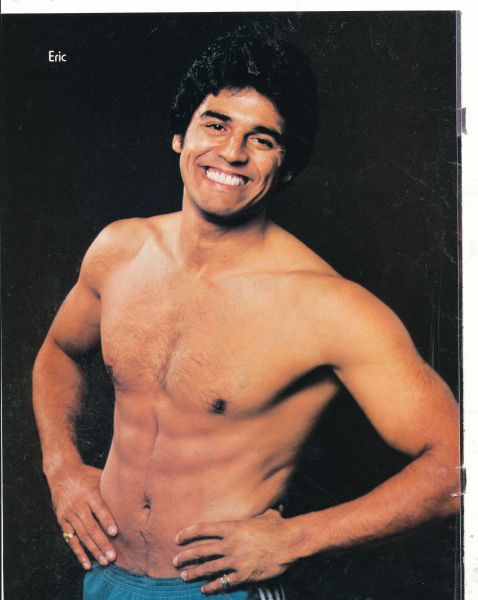
Erik Estrada was sort of the Mario Lopez of the 1970s: Hispanic, built, always smiling, constantly winning "World's Sexiest Men" awards, and photographed shirtless every ten seconds.


But there were some significant differences.


Erik is best known as Officer Ponch on Chips (1977-83), a role which allowed him to consort with beach-babes and big-brother troubled teens (such as Leif Garrett), while never establishing any significant homoromantic bond with his partner, Jon (Larry Wilcox).  Mario's characters frequently enjoy homoerotic buddy-bonds.

Perhaps due to the popularity of Chips, Erik was heavily identified as a police officer.  He played parodies of his character several types, he actually was a reserve police officer in Muncie, Indiana, and he lent his name to several police-related organizations.  Mario seems to have a wider range of roles to choose from.


And the most important difference: Mario Lopez has played gay characters several times and is a strong gay ally.  Erik Estrada has never played a gay character and has never made a public statement supporting gay people.  To be fair, he hasn't said anything homophobic, either.

In 2012, a photo of his Ponch character was found on a supervisor's desk at the notoriously homophobic Atlanta Police Department, marked with an anti-gay slur.  It was unclear whether Ponch was "accusing" the supervisor of being gay, or the supervisor was "accusing" Ponch.


Either way, Erik Estrada had no comment.


Jul 9, 2022

Saturday Morning Beefcake: the 1990s

When I was growing up in the 1960s and 1970s, Saturday morning tv was strictly for little kids. By junior high, I watched only the live-action programs like H.R. Pufnstuf, Sigmund and the Sea Monsters, and Lidsville.  By high school, I had abandoned even those.

In the late 1980s, Saturday morning became cool again.  Everybody watched Pee-Wee's Playhouse  and  Saved by the Bell.  For some reason, most gay men preferred  Slater (Mario Lopez, right) to Mark-Paul Goesselaer's prettyboy operator Zack Morris.

Between 1993 and 2001, there was a whole lineup of teencoms to watch with your boyfriend and whatever guy you had brought home to "share" the night before. They all had the about the same plot: a group of high schoolers go out for sports, consider cheating on tests, take part-time jobs, date, and start bands.  There was always  a Zack Morris clone and a Slater clone, plus sundry stereotyped athletes, nerds, cheerleader-type girls, and brainy-type girls.

Boring stuff.  But who was watching for the plots?

1. Running the Halls starred blond goldenboy Richard Hillman as the Zack Morris clone who got into constant trouble with the vice-principal.   Hillman  also had small roles in Detroit Rock City and Teenage Caveman.  He died of AIDS in 2009.


2. California Dreams followed Iowa teens to their new home in California (shades of Beverly Hills 90210!), where naturally they started a band.  It starred Michael Cade's abs.


Fortunately, Book Circus had a full selection of teen magazines with Michael Cade centerfolds.


3. Saved by the Bell: The New Class was set right at Bayside High, with the vice principal and the nerd Screech still there.  It changed teen hunks frequently, but Christian Oliver is probably the best-remembered Zack Morris clone. 

You can also see Christian Oliver in the 2012 film Blow Me.


4. Hang-Time was oddly set in small-town Indiana rather than Malibu, and involved basketball rather than surfing.   It went through a lot of cast changes, too, with new groups of teen hunks every season.  Danso Gordon (left, recent photo) played the Slater clone.  Today he performs mostly in evangelical Christian movies like Heaven is Real.  I doubt that he would be happy learning that hundreds of gay men in West Hollywood thought that he was hot.


5.City Guys was set at Manhattan High School (apparently there is only one high school in Manhattan), with a diverse cast of two black guys, not just one, plus the Hispanic Al, played by Dion Basco (far left, from the cast of Naked Brown Men).

Sep 7, 2018

Burt Reynolds Naked on a Bear Skin Rug


The most famous male nude photos in history:
1. Johnny Crawford's full-frontal nude shot advertising The Naked Ape (1973).
2. Burt Reynolds's nude centerfold in the April 1972 issue of Cosmopolitan


The 36-year old actor specialized in serious dramatic roles, mostly Westerns about surly, downtrodden Native Americans (Navajo Joe, 100 Rifles, Sam Whiskey).  He had just finished filming Deliverance (1972), about four big-city businesmen who go camping in rural Appalachia, and encounter slack-jawed, gap-toothed hillbilly savages.  He expected it to get him a best-actor Oscar and acclaim as a serious actor.

Then Cosmo editor Helen Gurley Brown approached Paul Newman about doing a nude centerfold.  He refused, so she approached Burt.

Burt lay supine on a bearskin rug in a parody of the popular baby photos, grinning mischievously, coyly hiding his sex organs.  It was not an erotic photo.

But it was groundbreaking.  Nude male photography was still in its infancy -- only a few years ago, it was judged de facto obscene.  This was the first time that any man had ever appeared nude in a mainstream publication.

It was a victory for women's liberation.  Helen Gurley Brown reminisced: "Men liked to look at women naked.  Nobody talked about it, but women liked to look at men naked."  A few months later, Douglas Lambert was inspired by the photo to launch Playgirl magazine, featuring pictures of naked men: "It came to me -- that's what women want."

Both of them were disgustingly heterosexist, trying their best to pretend that they were unaware that  some men like to look at men naked, too.   But men were watching.  Burt Reynolds became a gay icon without ever playing a gay character.

The photo made Burt a celebrity, but kept him from being taken seriously as an actor.  Deliverance was snubbed at the Oscars, and he spent the 1970s in Southern-Redneck comedies like White Lightning (1973), Hooper (1978), The Best Little Whorehouse in Texas (1982)and the Smokey and the Bandit series (1977, 1980, 1983), often with his bff Bert Convy.

It has been recreated by  many other celebrities, including Neil Patrick Harris and Mario Lopez.

See also: Bert Convy: Spending the 1970s Nude

Oct 14, 2016

Saved by the Bell: Thinking of reasons for Mario Lopez to take his shirt off

Mario Lopez has been unfailingly pro-gay (except for a tweet proclaiming his love for love for Chick-Fil-A, which was quickly removed).  But what about his Saved by the Bell buddy Mark-Paul Gosselaar?

He hasn't been quite as vocal in his support, but he seems cool with gay fans: "There are people out there who desperately want me to be gay. I don't have the heart to set the record straight."

My friend Infinite Chazz claims to have dated him.


Born in 1974, the child star burst -- literally -- into teen idol fame in 1989 when he was hired to play one of the supporting players in the Hayley Mills vehicle Good Morning, Miss Bliss, about a caring junior high teacher.

But after a year it became Saved by the Bell, with Zack Morris, Mark-Paul's glib teen operator the undisputed star.  It lasted for four years, spawned two spin-off series and innumerable Saturday morning clones, and gained 24 Young Actor Awards nominations.

The plots of Saved by the Bell mostly involved demonstrating that the teens were heterosexual -- falling in love with the wrong person, deciding if the kiss meant anything, having two dates on the same night -- with a smattering of minor social problems, like smoking or cheating on tests.

 But same-sex desire was always lurking just beneath the surface.  Zack, gay-coded as blond, pretty, stylish, fashion-conscious, and vain, is often the butt of jokes about misdirected or misinterpreted desire.

When Zack qualifies for the track team so they can beat Valley High, Principal Belding (Davis Haskins) hugs him and cries "I love you!"  Seeing the suspicious looks from passing students, Belding backtracks into an arm-clasp and "I like you!"  More suspicious looks, so he backs off altogether and says "Uh...I mean good job, son."

There's a knock at Zack's bedroom door.  Thinking that it's his girlfriend, Zack opens it wide and exclaims "I love you!"  The school weirdo Screech walks in, waits for audience howls to die down a bit, and says "I love you too...but only as a friend."

Strangely, none of these jokes involve Zack and his constant companion, sullen jock Slater (Mario Lopez).  Maybe they can't occur with passionate partners, or they would bring their unstated romance too close to the surface.

After Saved by the Bell, Mark-Paul played mostly conventional, even old-fashioned heterosexuals: a horny college boy in Dead Man on Campus (1998), a computer exec who moves back to his quaint small town in Hyperion Bay (1998-99); plus the standard detectives and cops.  His Detective John Clark on NYPD Blue (2001-2005) had a number of risky sexual encounters with women to assuage his grief after his girlfriend dies.

And there was very little beefcake, at least on screen.  An accomplished athlete, Mark-Paul was often photographed swimming, scuba diving, and engaged in other sports that involve bulges or bare chests.

In Franklin and Bash (2011-2014), Mark-Paul returned to buddy-bonding, playing Detective Bash to Brecklin Meyer's Detective Franklin.  Though both are horndogs, the homoerotic subtext is strong and obviously intentional, an attempt to cash in on the 2000s bromance fad.

Truth Be Told (2014) was a buddy comedy starring Mark-Paul and Tone Bell as odd-couple best friends.

And fans got to see more of Mark-Paul's still impressive physique than they have in twenty years, in spite of  TV Guide's  heterosexist assurance that he goes shirtless only "for the ladies."

See also: Infinite Chazz is Dumped by Mark-Paul Gosselaar.


Related Posts Plugin for WordPress, Blogger...