Showing posts with label cops. Show all posts

Feb 27, 2025

Reacher, Episode 3.1: The man-mountain bonds with a college boy with a drug-dealer dad, and there are plot twists and d*cks

Link to the n*de dudes


I see that Reacher is in its third season on Amazon Prime. "When retired Military Police Officer Jack Reacher is arrested for a murder he did not commit, he finds himself in the middle of a deadly conspiracy full of dirty cops, shady businessmen, and scheming politicians."

What's the big deal?  "Crime he did not commit" has been a cliche since "The Fugitive" in 1963, and every single movie and tv show has dirty cops.  No way would I consider watching something so trite and......


...um...


...boring....um....


I mean, I can't wait to start watching.  I'm reviewing Episode 3.1, "Persuader"

Recap: Reacher (Alan Ritchson) travels from town to town, helping people with their problems, mostly requiring him to shoot machine guns, kick guys in the balls, and throw them off balconies into trash piles, then take a Trailways bus somewhere else.

Scene 1: Establishing shots of Havenhurst University in Abbotsville, Maine.  Not real places, but they could mean Bowdoin College, the safety school for lots of valedictorians.  Reacher pulls up to the Vinyl Vault downtown, grimaces, and brings his record collection in to sell.

While he's bickering with the shopkeeper, Steve (David Daniel Stewart) drives up in his pick-up truck.  Suspicious, Reacher watches as he deliberately plows into the car, pushes it into a telephone pole, kills the driver, and drags the whimpering college student Richard Beck (Johnny Berthold, below) from the back seat into his truck.

Reacher intervenes and shoots out the tires.  Steve opens fire, but Reacher shoots him in the arm and retrieves the whimpering Richard, loads him into his van, shoots a cop ("I didn't know -- I thought he was pulling a gun"), and zooms away, with more cops in hot pursuit.  The campus police?  Can they even make arrests?


Scene 2: 
A well choreographed chase, with a lot of sudden turns and smashed cars -- the staging must have cost a fortune.  They stop so Reacher can steal a new car.   He tells Richard to call for a ride; "tell them you're in shock and can't remember what I looked like." 

But Richard wants more help; the kidnappers could still be around.  "No.  I'm a drifter who used an unlicensed gun to kill a cop.  I gotta disappear."

"At least take me home. My dad's rich, and can help you disappear."

"Nope."

Bats eyes. "Pretty please?"  Offer to go downtown.

"Well, ok." 

Back story: Richard was kidnapped before, five years ago.  Dad wouldn't pay the ransom until the kidnappers cut off his ear. 

More after the break

Lanigan's Rabbi

 I didn't meet anyone who was Jewish until my junior year in high school, when a rabbi's son named Aaron was in my English class.  He was lean and wiry, with thick black hair and expressive hands, with a preference for lumberjack shirts and a sky-blue yarmulke. He was always surrounded by a crowd of girls who knitted him sweaters and baked him cookies and sighed a lot, but occasionally I managed to push through the crowd to ask him a few questions about kosher laws or Hebrew School or his bar mitzvah, anything I could think of to keep his attention.

At the same time, our English teacher assigned Chaim Potok's My Name is Asher Lev and I read on my own his gay Jewish Romeo-and-Juliet story, The Chosen.

So I must have been very receptive during the spring of 1977, when two tv series with homoerotic Jewish subtexts appeared, Busting Loose and Lanigan's Rabbi.


On Sunday nights, NBC had a recurring series, The NBC Sunday Mystery Movie, with an alternating series of detectives.  My friends and I weren't impressed.  We called McCloud McClod, and Colombo Clod-Dumb-Bo.  But Lanigan's Rabbi became must-see tv, "good beyond hope."

Lanigan (Art Carney, right) was police chief in a small town in California. When he investigated a murder in a synagogue, he had to collaborate with Rabbi Small (Bruce Solomon, left), whose keen mind, trained in Talmudic scholarship, figured out whodunit.  They continued to be thrown into mysteries for three more episodes, with corpses including guest of honor at a Man of the Year celebration, a miserly millionaire, and the guy who accused Lanigan of malpractice.

The stories were by-the-books stuff, not very interesting.
Bruce Solomon, who also played a cop on Mary Hartman, was very attractive, but his shirt never came off.
Art Carney was 58, too old to be of interest.
 And they both had wives.

What was the gay angle?


It was about two men from different worlds finding common ground, mutual admiration, and finally a deeply intimate bond.  Why did the Rabbi keep tagging along on Lanigan's investigations?  Was it the joy of sleuthing?  Or were they in love?


Mar 3, 2024

What Happened to the Asian Beefcake?

During the 1960s, there were only five male performers of East or Southeast Asian ancestry in regular or recurring role on tv: the cook Hop Sing (Victor Sen Yung) on Bonanza, the valet Kato (Bruce Lee) on The Green Hornet, Sulu (George Takei) on Star Trek, and two assisting detectives on Hawaii Five-O.  Mostly servants and sidekicks.  Only Sulu was ever displayed shirtless, and that was to signify that he had become mentally unstable.

In spite of Bruce Lee's influence in popularizing Asian muscle, the 1970s were even worse: Keone Young (right) as a science-nerd teenager on Room 222, the dissolute, hard-gambling dtective Yemana (Jack Soo) on Barney Miller, teen hangout proprietor Arnold (Pat Morita) on Happy Days, and Sam (Robert Ito), lab assistant on Quincy, M.E.  Hawaiian singer Don Ho had a brief daytime tv show.


There weren't even any Asians in commercials.  I remember one: in 1974, a laundry guy (Calvin Jung, left) claims that he gets clothes clean with an "ancient Chinese secret."  But the joke is: he and his wife both speak colloquial American English ("My husband, some hotshot!"), and he actually uses Calgon detergent.  According to Jung, just speaking with an American accent was a breakthrough.

There were some hunks among the sidekicks and servants, but again, not a button out of place.

A breakthrough of sorts came in the late 1980s.  On 21 Jump Street (1987-91), Ioki (Dustin Nguyen) was one of the detectives assigned to go undercover in a high school.  He didn't get quite the on-screen exposure of his white costars (Johnny Depp and Peter DeLuise), but lots of shirtless shots and artistic nudes appeared, and he bared almost all in Playgirl. 


Dean Cain, Clark Kent in the Superman update Lois and Clark (1993-97), was a veritable sex symbol, shirtless or underwear-clad in nearly every episode, his massive pecs and shoulders a mainstay of teen magazines.


In the 2000s,  Daniel Dae Kim (left) and Ken Leung lent their sculpted physiques to Lost.  

But they were exceptions.  Today, Asian representation on tv is almost as bad as gay representation: less than 2% of regular or recurring roles, lots of servants and sidekicks, lots of humorously asexual nerds, without so much as a flexed bicep.

Oct 16, 2023

Estrada versus Lopez

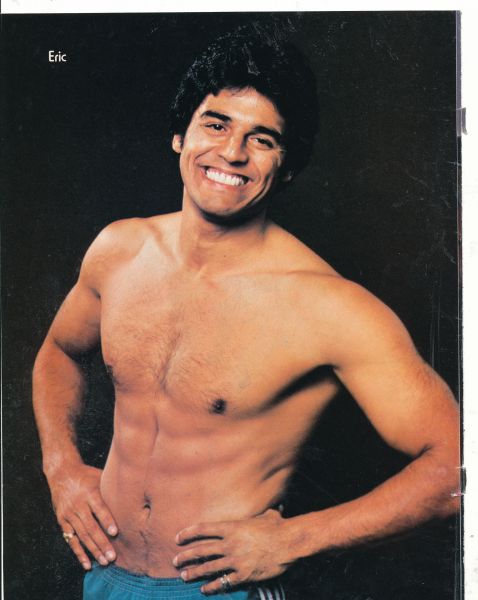
Erik Estrada was sort of the Mario Lopez of the 1970s: Hispanic, built, always smiling, constantly winning "World's Sexiest Men" awards, and photographed shirtless every ten seconds.


But there were some significant differences.


Erik is best known as Officer Ponch on Chips (1977-83), a role which allowed him to consort with beach-babes and big-brother troubled teens (such as Leif Garrett), while never establishing any significant homoromantic bond with his partner, Jon (Larry Wilcox).  Mario's characters frequently enjoy homoerotic buddy-bonds.

Perhaps due to the popularity of Chips, Erik was heavily identified as a police officer.  He played parodies of his character several types, he actually was a reserve police officer in Muncie, Indiana, and he lent his name to several police-related organizations.  Mario seems to have a wider range of roles to choose from.


And the most important difference: Mario Lopez has played gay characters several times and is a strong gay ally.  Erik Estrada has never played a gay character and has never made a public statement supporting gay people.  To be fair, he hasn't said anything homophobic, either.

In 2012, a photo of his Ponch character was found on a supervisor's desk at the notoriously homophobic Atlanta Police Department, marked with an anti-gay slur.  It was unclear whether Ponch was "accusing" the supervisor of being gay, or the supervisor was "accusing" Ponch.


Either way, Erik Estrada had no comment.


Oct 8, 2023

Max Gail the Bodybuilding Cop

On Barney Miller (1975-82), an ensemble comedy about the cops and criminals in a wacky New York precinct, Max Gail played the naïve/dumb hunk Wojo, a precursor to Woody on Cheers and Joey on Friends. But he was quite a hunk, massive as a bodybuilder in pants so tight he could barely sit down, with soft brown hair, a disarming little-boy grin, and square hard hands that jutted uncomfortably from his wide 70’s cuffs. At least one episode showed him shirtless. Who cared if he always failed the detective’s exam?


But Wojo offered more than beefcake. In its early seasons, Barney Miller featured two swishy gay criminals, and there are hints that Wojo’s attempts to bond with them masks a turmoil in his own mind, a growing realization that he, too, has such “feelings.” In “Quarantine” he demands of Mr. Driscoll, “Haven’t you ever tried it with a girl?” then waxes silent,when the criminal admits that he has indeed tried “it” to the point of siring a son. 


 Wojo himself tries “it” valiantly and exhaustively for awhile, but then his heterosexual profligacy fades in the face of increasing joy with squard room comrades and outside friends. 

In “Wojo’s Problem," Wojo discovers that he is sterile, and Officer Levitt (Ron Carey) exclaims "But you're so. . .big!" "That's got nothing to do with it!", Wojo snaps. Sterility comes dangerously close to a metaphor for gayness.

In “Inquisition," Wojo accidentally “outs” a gay cop, who will probably be fired. He says dismally “I feel like such a Judas.” Dietrich quips “At least you didn’t kiss him.” Could kissing be a possibility?

In “Examination Day," Wojo finally passes the detective's exam, and he excitedly makes a phone call:

We can pick up a little food, go to my place, and start celebratin’. But better be ready. . .’cause this time I’m a sergeant. [Notices Barney staring at him in disapproval, flashes a guilty grin, covers the phone with his hand.] Just telling a few friends the good news.

Presumably the writers expect us to conclude that Wojo is talking to a woman, but he never specifies a gender. If it is indeed a woman, why would Barney evidence such strong disapproval? The cops make personal calls all the time, and certainly Wojo is justified in announcing the good news. Maybe Wojo is planning a romantic dinner with a man.

After Barney Miller, Max Gail played beefy, balding hunks in many movies and tv series, including Whiz Kids, with Matthew Laborteaux. He has played gay characters several times, most notably on The Drew Cary Show, with Batman Adam West as his partner.

Jul 6, 2021

"Beyond Evil": Gay Cops Chase a Korean Serial Killer


Two guys face each other.  Younger: "I'm going to move here."  They get even closer.  Older: "What about me interests you so much?"  They get even closer, their faces inches apart.  Younger: "What about me interests you so much?" 

Whoa, palpable sexual tension!  The hottest scene I've seen in months.  Is this a gay love story?  

No, it's Beyond Evil, a Korean drama about two cops, a serial killer, yadda yadda yadda.  0% of the action-adventure movies released during the last 20 years have had gay leads.  Each must think that the other is the killer, so their closeness represents not attraction but threat.  


But what about this shot?  Standard Korean gesture of gratitude?

I'm going in.

Scene 1: Night, in the marshes.  A young cop finds something terrifying.  Panicking, he yells for middle-aged cop Dong-Sik, who comes running.  Close-up of what he found (I can't tell what it is).


Scene 2:
Daytime, the year 2000.  A florist drives through the city and delivers flowers to a church. A choir is practicing.  Yu-yeon, a teenage girl, is playing the piano.  Two women discuss how wonderful she is -- intelligent, a good Catholic -- while her twin brother Dong-Sik is a lazy bum.

Cut to the young Dong-Sik playing the guitar and singing in an empty cafe.  The teenage girl in charge tells him to get out: he just bought one cup of coffee, which doesn't give him the right to sing for two hours.  They argue; he threatens to hit her, then leaves. 

Scene 3: The over-accomplished Yu-Yeon gets a text from her brother Dong-Sik, sneaks out of the house, and walks through the dark, scary marshes.  The street lights go out; there's someone behind her!  Cut to her body lying in the marsh, her hands tied so it looks like she is praying.

In the morning, Mom goes outside to get the newspaper, and sees all of Yu-Yeon's fingertips lined up!


Scene 4:
2020.  Top-of-his-class hotshot cop Ju-Won drive through town, passing a lot of posters about the missing girl (never taken down, even after 20 years?).  Meanwhile, middle-aged cop Dong-Sik (left) is investigating an altercation at a beauty parlor.  Suddenly one of the women grabs his hair, and he goes ballistic and arrests everyone.  "Him and his temper!" the guys at the station complain.  

At the station, the chief yells at Dong-Sik for wasting everyone's time. "They were gambling!"  "But only 10 or 20 won!" "So what?  Many a mickle makes a muckle!"  Where the heck did the translators find that obscure Scottish phrase?

Hotshot Ju-Won arrives.  He doesn't even start today, but he's so dedicated that he came early. 

While Hotshot is being processed, the other cops gossip.  He was top of his class at police academy, scored 100% on his fitness test, and he's handsome!  Plus his Dad is the deputy commissioner, the #2 Cop in all of Korea!  Dong-Sik fumes with jealousy. As a teen, he lived in his sister's shadow, and now this!

Scene 5: A man comes into the station complaining that his son didn't come home last night.  Maybe he was murdered, like that girl 20 years ago!  Dong-Sik tells him that in Korea, you can only report someone missing if they are a juvenile or mentally disabled.  They will have to classify his son as a runaway.  

Later, Dong-Sik is crossing the street when his hip injury acts up.  He takes his pain pills.  Hotshot Ju-Won, driving past, sees him hobbling along, but doesn't offer him a ride.  Jerk!


Scene 6:
  Manyang Butcher Shop. Dong-Sik and his friends having dinner.  All men, including his "best friend," the rather feminine Jeong-je....hmm.  Jeong-je's sister Ji-Hwa joins them.  They discuss who the Hotshot Ju-Won will be paired with. Jeong-je doesn't want him: "Not my type."  Does that mean the same thing in Korean as in English?

Dong-Sik doesn't want him either, because his father, Deputy Commissioner Han Gi-Hwan, stopped the investigation into his sister's disappearance, back when he was a local police inspector 20 years ago.  Grr!

Flashback to the Deputy Commissioner having dinner with his hotshot son.  Every graduate of the police academy has to spend  six months in a boring hick town.  After that, it's on to glamour and excitement -- if he doesn't screw up.  Apparently Hotshot is not so hot after all.  

Scene 7: Morning.  Dong-Sik introduces himself to Hotshot, who refuses to shake hands.  Jerk! 

Inside the police station, everyone except Dong-Sik volunteers to partner with the handsome Hotshot (wouldn't you?).  Hotshot says he'll take anybody except Dong-Sik the "nutjob."  The Chief thinks that guys who don't like each other are more professional on the job, so he partners them.  


Scene 8:
In the squad car, while the germophobic Hotshot (left) wipes everything down, Dong-Sik brings up the snub at the crosswalk.  He denies it until Dong-Sik remembers every detail, including his license plate number. "Be careful," he says threateningly.  "There are no secrets in this town. You are always being watched."

They get a report of Mr. Bang, an elderly man with dementia, wandering in the marshes, and set out to look for him.  Hotshot doesn't like swatting through six-foot tall reeds, or getting his brand-new spiffy shoes all muddy.  Eventually they find Mr. Bang -- someone Dong-Sik knew as a teenager!  He gets combative, and they have to roll around in the mud to subdue him.

Scene 9: They bring Mr. Bang home.  A middle-aged woman tells them that every October he goes berserk and tries to break into an old shed. "Aren't you sick of this?" she asks Dong-Sik.  "Don't you think he should go into a nursing home?" What does Dong-Sik have to do with an elderly man with dementia?

Scene 10: After they clean up, the other cops warn Hotshot about marsh duty.  "Didn't your friends tell you about it?"  Hotshot says that he has no friends, just people who try to cozy up to him because of his family connections. Awww, a poor little rich boy.  Dong-Sik thinks he has no friends for another reason, being a stuck-up jerk. 

The Chief says he was thinking of inviting Hotshot out to dinner, but he wouldn't want him to think he was cozying up because of his family connections.

Scene 10:  Hotshot hesitates, but finally decides to go to the dinner.  Dong-Sik and some other cops are there.  The Chief introduces Jeon-je, the feminine guy from Scene 6, and makes sure they sit together.  Matchmaking?  Jeon-je's sister arrives and makes the faux-pas of mentioning Hotshot's famous father.  Hotshot tells them that he doesn't like hearing his father's name.  They make fun of him.

Scene 11: Leaving the dinner, Hotshot sees Dong-Sik working at the butcher shop.  He must not make enough money as a cop.  He asks what the woman in Scene 8 has on Dong-Sik, that she can call him with family problems, and he comes running.  "I killed Mr. Bang's daughter," Dong-Sik replies. When Hotshot gapes in shock, he says he was only joking. Or was he....

Dong-Sik: You're so gullible.  I like you.

Hotshot: I don't want you to like me.

Dong-Sik: It's not up to you, is it?  I'll like you if I want to.


Scene 12: 
 Hotshot having dinner with his former tutor Kwan Hyuk (that same night?).   Hyuk mentions a girl, and Hotshot says "I'm not interested."  "I know -- I meant for me.  I want to become the Deputy Commissioner's son, one who never lets him down."   Ok, that does it, Hotshot is gay.

Kyuk gives him the file on Dong-Sik's sister's disappearance 20 years ago, and he takes it to his elegant apartment to read.  Dad texts: "Keep a low profile until things calm down.  Do not disgrace me."  That does it, Hotshot is gay.

Scene 13: Nine months ago.  Hotshot lecturing to some assembled cops: 20 years ago, Dong-Sik's sister disappeared, and Mr. Bang's daughter was murdered, on the same day.  The cases we are working on now have the same MO.  It must be the same killer.  I believe that it's Dong-Sik!

 Scene 14: Dong-Sik supervises as they install a new poster about his missing sister.  Then he gets a call that Mr. Bang is wandering the marshes again, and sets out -- with his former partner, Ji-Hun!  The Captain sends Hotshot out anyway.

By the time he gets there, it's night.  We replay Scene 1: Ji-Hun finds the scary thing.  I still can't tell what it is, but Dong-Sik recognizes the remains of his sister. The end.

Beefcake: None during the show, but fortunately every Korean actor has some shirtless shots posted online.

Gay Characters: I think both Dong-Sik and Hotshot are gay.

Mystery: Who is the serial killer? Obviously not Dong-Sik, and Hotshot is too young. I'm betting on his father, the Deputy Commissioner who called off the search for the missing sister.

My Grade: A if they stay gay.  C+ if Hotshot gets a girlfriend,

(He doesn't.)

Feb 25, 2021

David Soul


David Soul never quite made it as a teen idol.  Maybe because he wasn't visible enough.  He appeared on The Merv Griffin Show in 1966-67 wearing a mask (so people would like him for his music, not his face).


He appeared in a 1967 episode of Star Trek, but in alien makeup that made him unrecognizable.


He appeared on the beefcake-heavy Western Here Come the Brides (1968-70), but his star was almost completely overshadowed by Bobby Sherman.


But he did fine as an adult actor.  In Starsky and Hutch (1975-79), he played the shy, intellectual, gay-coded Detective Hutch to Paul-Michael Glaser's tough, streetwise Detective Starsky.


The duo was explicitly a romantic couple, not shy about displays of physical affection, openly stating that they loved each other.  Producer Aaron Spelling called it "tv's first heterosexual love affair."  And although they investigated the usual 1970s crimes involving strippers, call girls, and various women with large breasts, there were very few girlfriends introduced to distract them from their buddy-bonding.  
Of course, there was also lots of homophobia.  Gay-themed episodes of 1970s sitcoms usually involved a visiting high school buddy announcing that he's gay, but drama series always had a gay murder victim, and in order to investigate, the detectives had to enter  his sleazy underworld, full of pomaded misfits who simper and leer at each other.

During Starsky and Hutch, David found his singing career taking off.  His "Don't Give Up on Us" hit #1 on the charts in the U.S. and in Britain.  Unfortunately, his songs tended to be heterosexist.    In "Silver Lady," which hit #1 in Britain, he's a drifter until he finds salvation in the lady's arms.

He also found time to fall in love with Lance Kerwin in Salem's Lot (1979).

Currently a British citizen, David  does a lot of acting on stage and in film.  He is careful to point out that he is not gay in real life; however, he is a strong supporter of gay rights.

Oct 21, 2017

The Unexpected Beefcake of Steve Guttenberg


I've never met Steve Guttenberg, but after seeing him in so many movies, tv series, and off-Broadway plays,  he seems more familiar than some of the celebrities that I've actually met.

His physique is especially familiar, since he displays his muscular chest, shoulders, and biceps in nearly every movie, often to indicate confusion or embarrassment.

He's got nothing to be embarrassed about.


At last count, I've seen twenty of his movies, beginning with The Chicken Chronicles (1977), when the 19-year old transformed the teen sex comedy into something more, and The Boys from Brazil (1977), where his character is killed in the first scene.

Comedies like Police Academy (1984), where his Carey Mahoney gleefully pretends that he had sex with the uptight police captain.(For more homoerotic subtexts combined with homophobia, see Bachelor Party, by the same director).


Science fiction like Cocoon (1985), about a group of senior citizens who use alien technology to rejuvenate themselves.


Dramas like The Bedroom Window (1987), where his Terry Lambert has an affair with the boss's wife and becomes the main suspect in a murder.


Not a lot of buddy-bonding roles, but lots of gender transgressions that give his characters a gay-vague subtext even as they pursue women.  And he forms a lot of alternate families, as Short Circuit (1986), 3 Men and a Baby (1987), and Home Team (2000).


And lots of gay-positive roles, like Can't Stop the Music (1980), where he plays the gay-vague manager of the gay-vague Village People (and incidentally wears the tightest shorts known to Disco).

To Home for the Holidays (1995), where a gay couple is invited to the festivities.

To P.S. Your Cat is Dead (2002), where he plays a homeowner who captures -- and kisses -- a gay burglar..

To Mojave Phone Booth (2006), about various people affected by a phone booth in the desert, including a lesbian couple.

In his memoirs, The Guttenberg Bible, Steve talks about his early naivete (he didn't realize that the Village People were supposed to be gay) and about the shock of realizing that some men found him attractive.

He's gotten over it since.

Jul 23, 2016

David Cassidy: Man Undercover

Teen idol careers are painfully short, 3 or 4 years.  The 12 year olds who discover your picture in Teen Beat and moon over your bubblegum pop will eventually turn into teenagers, start dating boys of their own, and relegate you to childhood memories.  Unless you can reinvent yourself as a adult performer, you've had it.

David Cassidy, whose last charting single was in 1972 in the U.S. (though he was still selling records in Germany and the U.K.), tried to reinvent himself as a serious dramatic actor.  In 1978, he played a cop who goes undercover as a high school student in "A Chance to Live", an episode of Police Story.


He was nominated for an Emmy, and NBC was so impressed that they created a series for his character, giving undercover cop Dan Shay (David) a wife, a daughter, and a superior officer to butt heads with (Simon Oakland as Sgt. Abrams).

Unfortunately, they didn't learn from the example of Bobby Sherman in Getting Together.  They made a lot of mistakes.

Mistake #1: The title.  Everybody thought that David would be playing himself, a sort of teen idol secret agent.

Mistake #2: the wife and kids. Teen idols should be single, so the fans can fantasize about getting them for themselves.

Mistake #3: his costumes. All tight jeans and shirts unbuttoned to the navel.  It was the style in 1978, and it was nice to see a basket, but it didn't mesh with the androgynous shoulder-length hair.


Mistake #4: the middle aged superior officer (Simon Oakland).  Too hippie vs. establishment for the 1978.  Dan should have had a peer partner.

Mistake #5: instead of going undercover in a high school, Dan went undercover as a different ludicrous character every week, to snoop out a different ludicrous crime.  See if you can tell which is which:

He went undercover as a: biker, college student, drifter, high school student, hot rodder, junkie, medical patient, pimp, prisoner, trucker, weapons buyer.

To crack the crime of: baby selling, biker gang, drugs, homicide (several times), and supermarket break-ins.

Mistakes #6 and #7: Premiering it on Thursday nights, opposite the youth-hits Barney Miller and Soap, in November, when everyone is too busy preparing for the holidays to try out new tv shows.

Eight episodes aired during the Thanksgiving-Christmas season 1978, and another two were burned off in the summer of 1979, and David Cassidy: Man Undercover went into the records of "worst series ever."

David Cassidy found the experience painful.  After 1979 he concentrated on his music, and limited his tv and film work to occasional guest star spots. Recently he starred in Ruby and the Rockits with his brother Patrick and current teen idol Austin Butler.

See also: David Cassidy's Comic Book Career

Jan 4, 2016

The Shield: TV From the 2000s, Homophobia from the 1960s

You already know the most homophobic contemporary movie -- Chuck and Buck, the savagely homophobic "comedy" by Mike White.

Outside of Fox's animated sitcoms, TV series tend to go for erasing gay people from existence rather than excoriating them, but I found an exception.  Excoriations of gay people week after week for six years.

It's The Shield (2002-2008), a police drama set in contemporary Los Angeles.

Contemporary?

In the real L.A. in the 2000s, there were gay police offices.  The LAPD advertised for recruits at gay pride festivals.  Police cadets got  training in LGBT issues.

But on The Shield, all of the cops are intensely homophobic.  "Queers" and "fags" drop from their lips every five seconds, along with the usual heterosexism that we find everywhere on tv.

The key character, Detective Vic Mackey (Michael Chiklis)  is a blustering homophobe -- but so is everybody, so not a problem.  But he is also boorish, stupid, vulgar, racist, sexist, violent, corrupt, and unfamiliar with the concept of "due process."

Oh, he loves his wife and kids -- so much so that when they leave him and go into hiding, fearing for their safety, he pays private investigators $20,000 to track them down.  Then he bursts in and starts yelling.

I guess that's supposed to be positive?

One of his nemeses is detective "Dutch" Wagenbach (Jay Karnes), who's actually intelligent and therefore the butt of constant jokes.  He grinds my gears by offering far-out psychoanalytic interpretations of every suspect, proclaiming that he "studied criminology."

Um...criminology doesn't teach you that nonsense.

But even Dutch is a first rate homophobe.  He asks, "What do they think causes people to be queer?  Is it biological, so they can't help themselves.  And if so, should we condemn them?"

Who's condemning them, Dutch?  I suppose the writers' perception of the intended audience as homophobic.

Criminals are homophobic too -- way homophobic.

There are occasional gay characters -- swishy queens who all have AIDS.
"Are you sure he has AIDS?"
 "Just look at him."

One of the cops, Julian Lowe (Michael Jace), happens to be gay.  Completely angst-ridden, overcome by guilt: it's a terrible urge inside him that he hates and can't get rid of.

He participates in a brutal gay-bashing with his fellow cops, tries to commit suicide, then tries to become "ex gay" through prayer and sex with a woman.

Oh, and he's also being blackmailed -- Vic is threatening to reveal his gayness to the precinct, where he will certainly be fired in disgrace.

Um...anti-discrimination laws for police officers have been in place in L.A. for 30 years.

By the way, the cops are uniformly racist, too.  When a Muslim asks why he is a suspect when he hasn't done anything, he is told: "Because a group of men who look like your twin brothers killed 3,000 Americans."

Um...there are Muslim Americans....

Even though I can't find shirtless shots of the regulars, there is a lot of beefcake on the show.  Criminals -- mostly drug dealers and gang bangers, with an occasional serial killer thrown in -- are often shown lounging around shirtless or in their underwear.  Danny Pino, a drug dealer that Vic extorts and then kills, always finds a way to cover up the bulge in his black briefs.

But, really, a precinct full of racist, sexist, homophobic jerks -- who writes this stuff?

Ok, it was created by Shawn Ryan, who was born in 1966 and grew up in Chicago, and was a staff writer on Nash Bridges and Angel.   In an interview, he said that the "Boys in the Bar" episode of Cheers, in which the bargoers recoil in homophobic horror from two guys that they think are gay, influenced how he "thought about homosexuals."

Homosexuals?  Is this, like, 1973?

On The Shield, it is.

See also: Chuck and Buck.

Dec 16, 2015

Jason Gedrick


Born in 1965, Jason Gedrick broke into show business with The Heavenly Kid (1985), a comedy in which the nerd (Jason) wins The Girl with a little help from a dead teenager from the 1950s (Lewis Smith).  In the process, he bonds with the teen angel (and exhibits the usual 1980s homophobia), and shows off an implausibly buffed physique.

The actioner Iron Eagle followed (1986): avid video-gamer Doug (Jason) rescues his dad from Islamic terrorists, with a little help from an older pilot (Louis Gossett Jr.), who is distraught over the many kids that he has seen die over the years, and isn't about to watch Doug die, too. More buddy bonding.


Promised Land (1987): Davey (Jason) and Danny (Kiefer Sutherland) pursue an elite-working class friendship through high school and failed marriages.

Teen magazines paid some attention to him, displaying his dark, sultry pout and lean muscles.

Gay teens in the 1980s saw a pattern developing: his characters always had girlfriends but found meaning with guys.

The pattern continued in Rooftops (1989): a homeless teen named T, who lives on rooftops, has a girlfriend, but is also in love with a boy.  When his boyfriend is killed by drug dealers, T vows to use his dance-combat skills to clean up the neighborhood.


The pattern continued in Backdraft (1991), with Kurt Russell, and Crossing the Bridge (1992), with Josh Charles.

And we saw more of Jason's body in the nude shower scene.


I lost track of Jason in the 1990s.  He apparently moved into television, playing a college boy in Class of 96 (1993), a Hollywood star accused of killing a teenage girl in Murder One (1995-96), and an ex-con trying to go straight in EZ Streets (1996-97), plus significant roles Desperate Housewives, Luck, Necessary Roughness, and Dexter.  I haven't seen any of them.


But in 2007, for old time's sake, I saw Jason in  Kings of South Beach (2007).  He plays Chris Troiano, a New Yorker who moves to Miami to escape the Mafia and start a new life.  He opens a nightclub and takes bouncer Andy (Donnie Wahlberg) under his wing.

Andy is actually an undercover cop who must choose between his love for Chris and his job.

There is a palpable chemistry between Andy and Chris which almost moves from subtext to text.

Oct 31, 2014

Paul Michael Glaser: From Starsky to AIDS Activist

Paul Michael Glaser was half of the quintessential gay couple of the 1975-1979 tv series, Starsky and Hutch (with David Soul): two cop partners who loved each other, a lot.

Although they didn't play up the gay subtext, they were ok with it, merely issuing an occasional wink-wink protest like "Anyone who watches the show can see that Starsky and Hutch like women."


After Starsky and Hutch, Paul starred in a few tv movies, but then his attentions were drawn elsewhere.  In 1985 he and his wife Elizabeth discovered that she had contracted HIV through an emergency blood transfusion, and unwittingly transmitted the virus to their children, Ariel (born 1981) and Jake (born 1984).

During the 1980s, when AIDS was being advertised as a "Gay Disease," people assumed that Paul was gay, and had infected his wife and children.  They experienced the same fear and homophobic harassment that gay people with AIDS were experiencing.

But they didn't let homophobia affect their relationship with the gay community.  They were always staunch supporters of gay rights.


After Ariel died in 1988, Elizabeth began the Pediatric AIDS Foundation.  She became a national advocate for AIDS awareness and research, speaking at the Democratic National Convention in 1992.  She died in 1994, and Paul took on the management of the organization.


Jake has grown up living with HIV.  He is now an AIDS advocate and actor.


Related Posts Plugin for WordPress, Blogger...