Showing posts with label Fleischer Studios. Show all posts

Sep 12, 2024

Karol Krauser, the First Superman

The first Superman cartoons appeared in 1941, only three years after the Man of Steel first appeared in Action Comics.  They were produced by the Fleischer Studio, which also gave us Betty Boop and Popeye.  The Fleischers liked to work with real models, rotoscoping their movements to guide the animators, but for many years the model for the 17 Superman cartoons was unknown.

He turns out to be Karol Krauser, real name Karol Piwoworczyk, a young bodybuilder and wrestler.  The Superman website and wikipedia give few other details, but I managed to find some newspaper articles about him.


He was born in Krakow, Poland in 1912, attended the Polish Cadet School in Gniezne and the University of Krakow, and then worked as a physical education instructor at the Zwiazek Strzelecki, Polish military academy.

 At the beginning of World War II, he moved to New York and became a professional wrestler, dubbed the "Polish Apollo."   His first recorded match is in Bridgeport, Connecticut, on February 24, 1939.  By 1941, a newpaper article calls him the "popular Polish heavyweight champion.


He worked as a model for the Fleischers in 1939 and 1940, posing whenever they needed a muscleman, as in the Superman cartoons.


In 1945, Karol married female wrestler Zosia or Zoska Burska.   The best man at his wedding was none other than Stan Laurel of the comedy team Laurel and Hardy.

Most professional wrestlers retire in their 30s, but in 1953, at age 42, Karol and Edward Bogucki began a tag-team act as the Mad Russians, Karol and Ivan Kalmikoff.  During the Cold War, they became popular villains, winning several NWA competitions.


In 1962, Karol split from  Ivan and teamed up with Eric Pomeroy, billed as Stan or Igor Kalmikoff.  They appeared in several matches.

Karol died of a heart attack on September 12, 1964, after a match in Salt Lake City.


Feb 18, 2022

"The Cuphead Show": Will Updating 1930s Fleischer Studio Animation Give Us Some Gay Characters?


 The Cuphead Show
, based on a video game, is drawn in the animation style of the Fleischer Studio of the 1930s: a worled where human, animal, and objects interact, bouncing constantly, singing to the latest jazz songs, and falling prey to the "heebie jeebies."  It has been criticized for not acknowledging the racism of those early cartoons, but really, why should it?  Movies and tv shows set in earlier generations almost always pretend that racism, sexism, and homophobia did not exist.  

Cuphead (Tru Valentino, left) and Mugman (Frank Todaro), who live in the Inkwell Isles (an homage to Fleischer's "Out of the Inkwell"), have teacups for heads, with bent straws protruding from the top and liquid sloshing around inside.  They form the standard aggressive/passive, "let's have an adventure"/ "that's not a good idea" pair.  


In the first episode, "Carn-Evil," they are brothers or foster brothers, living under the guardianship of Elder Kettle.  Cuphead talks Mugman into blowing off their job of painting a fence to go to a carnival, which turns out to be a "carn-evil": The Devil (Luke Millington-Drake), who scats like Cab Calloway, is using it to harvest souls.  

Gay subtext: Some hugging and rescuing each other..

1930s cartoons were not good at continuity: Betty Boop changes randomly from child to adult, and Bimbo could be her boyfriend, friend, or pet dog.  But in the second episode, "Baby Bottle," Cuphead and Mugman are still children, left home alone for the day.  A baby...um...penis with a condom partially rolled onto it?  --  is left on their doorstep.

Gay subtext: They move into maternal and paternal parenting roles, with marital-couple fights: "It's like you didn't even want to have this baby!"  

The third episode, "Ribby and Croaks," follows the boys as they try to break into a riverboat nightclub run by two Brooklyn-accented frogs.  

Gay subtext: the frogs sing about how there's only one women in their life, their "Mudda."  

Beefcake:  None.


Gay Characters:
  Cuphead and Mugman have the usual gay-subtext relationship, coupled with a lack of heterosexual interest.  In the last episode, they meet a girl cuphead (actually a chalice-head) who charms people into giving her stuff.  But they don't find her entrancing; they just want to know her secret, so they can charm people into giving them stuff, too.

But in a contemporary show on Netflix, I expect actual recognizeable gay characters.  I didn't see any.

Villain:  In the first episode, the Devil says "Cuphead still owes me his soul!"  So I expected him to be the Big Bad of an ongoing story arc, but he doesn't appear in any of the episodes I watched.

1930s Homages:  After the first episode, not many.  One gets the impression that the Fleischer-esque animation was just a tease; the producers expect the show to stand on its own merits.  

My Grade:  The Cuphead Show doesn't really stand up on its own.  I'd rather watch the old Betty Boop cartoons.  C.

See also: The Gay Symbolism of Betty Boop


Mar 3, 2019

Betty Boop Comics: Masculine Women, Feminine Men

I love Betty Boop.  I don't care if she's a heterosexual sex symbol, with an oversized head, long legs, a low-cut dress, and a squeaky baby-doll voice, she's assertive, confident, independent, and gay-positive (for the 1930s).

But, other than the various notepads, mugs, shoes,makeup kits, shower curtains, Christmas tree ornaments, aprons, clocks, t-shirts, lamps, pillows, bedpreads, diaries, and Alabama Crimson Tide football logos, I thought she existed solely through cartoons:


1931-1933: 23 black and white and color cartoons from Fleischer Studios, some masterpieces of surrealism: "The Old Man of the Mountain," "I Heard," "Bimbo's Initiation," "Minnie the Moocher"


1934-1939: 67more, mostly unwatchable, with Betty a middle-aged spinster in sensible shoes.  Her dog, kid brother, or elderly friend have the adventure, while she sits at home saying "be careful."

Let's rewatch "Minnie the Moocher" instead.

So I was surprised to discover that there were Betty Boop comic strips, drawn by Bud Counihan and distributed by King Features from 1934 to 1937.  First they starred Helen Kane, the original voice of Betty Boop, but after 14 weeks Betty herself took precedence.  She was a Hollywood movie star, with gags mostly involving backstage issues, which presumably audiences in the Golden Age of Movies would find interesting:

Betty has so much trouble getting to the set that she is exhausted.  Fortunately, her scene involves sleeping (used twice).

She has to do retakes of all of her dangerous stunts, but when it comes time to kiss her leading man, she only gets one take.

They can't afford to pay extras for a crowd scene, so she leaves the studio and attracts a mob of fans

She can't cry on cue. Her director reads her a sad story, but no tears.  He suggests that she think of something unpleasant from her past, but nothing bad has ever happened to her.  Finally he berates her for being a bad actress, and now she can cry.

The gay connection: all of Betty's leading men are queens with mascara-ed eyes and limp wrists, who sashay across the stage, saying "Oh...um...I guess we have to kiss now, dearie."

When she has to choose from among seven of them, she chooses a mannekin instead, claiming that it's more lively than any of the lavender-soaked poofs.

Even Van Twinkle, the superstar she dates, is rather poofy. Plus when he breaks up with her, he says "I value your friendship, but..."

Soon Betty's kid brother Billy, a scrappy Brooklyn boy, comes to live with her.  He's cast in movies, too, and causes his own problems. Like he refuses to do a hand-stand because there's a rip in his pants.

That's Von Twinkle's poofy kid brother in the top hat and monocle.


Later in the series, Aunt Tillie, a tough, barking Amazon with tattooed biceps, moves in with Betty.She is also cast in movies, naturally.  She can't find a leading man who can withstand her energetic lovemaking (flirting), so she suggests her diminuitive. flamboyantly feminine boyfriend Hunky.

Masculine women, feminine men, a common comedy trope of the 1930s.

But, as in the cartoons, Betty is relegated to the background, saying "That's not a good idea" while Billy and Aunt Tillie have the adventures.

No wonder the series only lasted for 4 years.

See also: The Gay Symbolism of Betty Boop

Jul 13, 2016

The Gay Symbolism of Betty Boop


Around 1980 or 1981, the PBS tv series Matinee at the Bijou, which tried to recreate an old-time moviegoing experience, broadcast an old black-and-white cartoon, "Minnie the Moocher"  It starred a squeaky-voiced, big-headed girl named Betty Boop who runs away from home, along with her pet dog or maybe boyfriend Bimbo.

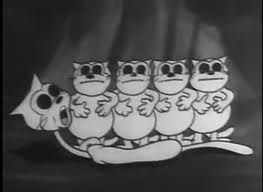
They seek refuge in a spooky cave, where a swaying, backwards-dancing walrus sings to a series of disturbing images: skeletons drink poison, collapse, and become ghosts; ghost inmates are sent to the electric chair, and die; pupil-less kittens suck the life force from a dour mother cat.

What sort of cartoon was this, I wondered, to so adroitly combine a morality play with the stuff of Freudian nightmares?  To so disturbingly disrupt the images of life and death, human and animal, male and female? And then I wondered: could it also have some gay symbolism?

Matinee at the Bijou eventually broadcast a few more Betty Boop cartoons.  There weren't many.  Introduced by Fleischer Studios in 1930, the stylized flapper with the baby-doll voice roamed her crazy, nightmarish world until 1934, when the Production Code forced her to settle down to more conventional cartoons about kids and dogs.


During her heyday, Betty had gay friends -- a "pansy" appears as one of the guests at her party, and at her diner, another lisps "Pass me the cold cuts -- they look delish."  But was there any other gay symbolism?

1. The fluidity of identity, men becoming women, animals becoming human, boys becoming men, suggests that desire, too, is fluid, not merely male desiring female.

2. Betty's attractiveness produces a transformative, healing desire that can heal broken bones and make old men young again.  The transformative power of desire is a palliative for gay people told over and over that their desire is wrong, abnormal, or doesn't exist.

3. The cartoons are run through with men desiring men as well as women.

Most blatantly in "Bimbo's Initiation (1931).  Bimbo is kidnapped by a secret society of men with melted black faces and candles on their heads, suggesting the transience of life.  They sing "Wanna be a member?" Bimbo refuses, so they torture him with sinister pit-and-pendulum devices, a sword that pops out of the wall, symbolic doors that open to skeletons and mirrors (self-knowledge, perhaps). The men turn out to be an army of Bettys, so Bimbo agrees to become a member.

The men want Bimbo, and pursue him lustfully.  Even the sword licks its lips in anticipation of his flesh.  The fluidity of gender, male as female disguise, only adds to the homoeroticism.

See also: Betty Boop Comics: Masculine Women, Feminine Men
Related Posts Plugin for WordPress, Blogger...