Showing posts with label summer of 1981. Show all posts

Jul 1, 2025

Male Nudity in English Class: The Canterbury Tales


During my junior year in college, I heard The Word in my college class for the first time.  My Culture and Civilization of Modern Germany class was devoted to proving that no German ever wrote about homosexualitat, but the professor in my Chaucer class, a big, hoarse-voiced woman named Dr. Dorothy, thought that The Canterbury Tales was all about how terrible "homosexuality" was.

Ok, but the Pasolini adaption of The Canterbury Tales had the most impressive male nudity I had ever seen at that point.  I can't show a picture here, but those guys were huge.


The Pardoner, one of the pilgrims who tell stories on the road to Canterbury, was thin and willowy, beardless, with long yellow hair and a high pitched voice.

"An effeminate homosexual!" Dr. Dorothy cried, obviously delighted to say a forbidden word.  "How grotesque!"

Ok, but look at the Squire: a powerfully built young man of about twenty.  But instead of jousting and fighting dragons, he spends his time dancing, singing, and embroidering, quite feminine pursuits. He is a "lover and a lusty bachelor," so busy having sex that he doesn't sleep much at night.  Yet who does he have sex with?  Chaucer leaves this vague, but traditionally squires were devoted to the knights they served.


In The Miller's Tale, a parish clerk named Absolon is infatuated with the Miller's wife, and asks her for a kiss through a peep-hole.  Instead, the Miller shoves his bare butt through and farts in Absolon's face.  But Absolon gets revenge by shoving a red-hot poker into the Miller's butt.

"Symbolic homosexuality!" Dr. Dorothy cried, enjoying the shocked expressions on the students' faces. "How humiliating for the Miller!"

Ok, but look at The Knight's Tale, about two bosom buddies, Arcite and Palamon, who are both in love with Emily.  A classic triangulation, with the quarrel over the girl an impediment to their love, which is described in lushly romantic terms:

Sworn as we are, and each unto the other,
That never, though for death in any pain,
Never, indeed, till death shall part us twain.


Medieval literature was filled with men in love, like Roland and Oliver.  Shakespeare and John Fletcher used the same story as the basis for The Two Noble Kinsmen (1634), here performed by Tyler Neale and Tim Elliott.


A Knight's Tale (2001), starring Heath Ledger, tells a different story, but it does feature a nude Geoffrey Chaucer (Paul Bettany), plus a gay couple, the Knight's humorous sidekicks, Roland and Wat (Mark Addy, Alan Tudyk).

As I discovered in my classes in Modern British and American Literature, you can't always believe what you hear from a college professor.

See also: Pasolini's Canterbury Tales: More gay characters and cocks than Chaucer imagined

May 1, 2024

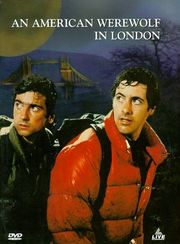
American Werewolf in London

There have been many gay-coded werewolves  on tv and in comics, but not a lot in movies.  David Kessler (David Naughton) in An American Werewolf in London  (1981) is the most famous, and the most evocative.


Born in 1951, David Naughton became famous in the late 1970s for dancing, singing, and bulging in a series of energetic, well-choreographed tv commercials for the soft drink Dr. Pepper.  In the spring of 1979, he starred in Makin' It, an adaption of the hit Saturday Night Fever (1977).  Although the sitcom aired for only 8 weeks, David's rendition of the theme song became a Top 40 hit, and resulted in a teen idol album.


In American Werewolf,  American college students David and Jack (Griffin Dunne, son of Hollywood novelist Dominic Dunne) are hiking through the moors of Britain, when they're attacked by a wolf. Jack is killed, and David turns into a werewolf, destined to kill innocent people at every full moon.  Furthermore, Jack -- along with every werewolf victim --  is trapped in a limbo state, unable to go on to the afterlife until the last werewolf, David dies.  "Kill yourself, David!"  Jack pleads.

David is hesitant -- he has fallen in love with a girl, Alex (Jenny Agutter), so according to the myth of the "fade out kiss," his life now has meaning.  Besides, he reasons, maybe her love can tame the beast with in.  But after a killing spree, he is cornered by the police, shot, and killed.  He dies as Alex murmurs "I love you."

Sounds enormously heterosexist so far.  The same-sex bond represents death, and the heterosexual bond, life.  David himself is homophobic: trying to get arrested, he stands in Trafalgar Square and yells insults, like "Prince Charles is a faggot!"

So why was it so evocative for gay teenagers in 1981?

1. An enormous amount of beefcake.  Everyone in the movie is obsessed with David's body.  He's fully nude for an extended sequence, with both frontal and rear shots.

There's a graphic werewolf transformation scene, with David rolling around nude.

He's naked in a hospital bed, where the nurses all gawk at him, and one states "He's Jewish -- I've had a look."


The last scene zeros in on David's body, tastefully posed like a Medieval martyr, with the bullet wounds carefully placed to not detract from his beauty.


2. Jack is rather obviously in love with David.  He is jealous of "the girl"; he wants David to kill himself so that they can "be together."  In one scene, he berates David: "We had a good thing going, and you ruined it." David wasn't responsible for his death, so Jack must be referring to something else, like David abandoning their same-sex bond to go chasing after some girl.

After American Werewolf, David Naughton found himself famous for appearing fully nude on film.  He worked primarily in horror (Amityville: A New Generation, Body Bags, The Ice Cream Man).  Griffin Dunne went on to star in After Hours (1985).

Mar 2, 2024

Harry Hamlin Making Love


Harry Hamlin hirsute, handsome, and pleasantly muscular, but not a bodybuilder -- he was kin more to Tom Selleck and  Gregory Harrison than Sylvester Stallone. But gay teenagers in the early 1980s looked beyond his muscles, for his role as the first positive gay character in a Hollywood movie.


Aspiring to be a great actor, not a hunk-of-the-week, Harry graduated from Yale with a degree in drama and then received his Master of Fine Arts degree.  He appeared in two serious adaptations of the classics: The Taming of the Shrew (1976) and Studs Lonigan (1979) before relenting and appearing in a toga, or out of a toga, in Clash of the Titans (1981), a retelling of the Perseus myth of ancient Greece.

It's heterosexist, with Perseus getting the girl at the end, and there is little or no buddy-bonding, but it was one of the few movies of the period where the hero was nude or shirtless throughout.

The next summer Harry starred in Making Love (1982), as successful writer Bart McGuire. The producers really, really wanted us to like him.  There is a long montage at the beginning that demonstrated just how good, noble, and kind he is.  Also not at all stereotypic, except he likes Gilbert and Sullivan, the precursor to show tunes.

Another long montage establishes that successful doctor Zack Elliot (Michael Ontkean), is also good, noble, and kind.  So is his wife, Claire (Kate Jackson, then famous for the babe-detective series Charlie's Angels).  


The superhuman virtue of the three main characters established, Bart and Zack become friends.  Bart tells Zack he's gay. He responds nobly. Bart offers Zack a back rub that turns into sex.

Zack tells Claire that he's gay.  She responds nobly.  They break up so Zack can move in with Bart.

Bart wasn't really looking for a romance, so they break up. But not to worry, Zack finds a new boyfriend instantly.


Everyone is affluent, tolerant, noble, and perfectly coiffed, with no anxieties, no conflict; everything works out fabulously.  It's awful.  I can't watch it today.  But in 1982, we were watching and saying: "Look, a gay character on a movie screen!  Who isn't leering and decadent, and doesn't die at the end!"

Harry Hamlin has been busy, starring in over 30 movies and 12 tv series.  Michael Ontkean, too. But Boomer kids will always remember the summer of 1982, when they were Making Love.


Oct 25, 2023

Grease 2: The Gay Connection

Grease (1978) played into the 1950s nostalgia craze, united two of the biggest stars of the era, and featured songs that wowed audiences on Broadway.

The sequel, Grease 2 (1981), did none of those things.

Everyone expected another mega hit which would make the careers of stars Maxwell Caulfield (left), Michelle Pfeiffer, and Adrian Zmed.

The plot was a reverse of the original, in which the innocent Australian transplant Sandy (Olivia Newton John) adopts a cool facade to attract the attention of Danny (John Travolta) and wrest him from his greaser buddies.


This time innocent British transplant Michael (Caulfield) adopts a cool facade (as the mysterious Cool Rider) to attract the attention of Stephanie (Michelle Pfeiffer) and, not coincidentally, her boyfriend Johnny (Adrian Zmed).  He manages to snare them both, sort of: Stephanie becomes his girlfriend, and Johnny offers him a membership in the T-Bird gang (left).


By the way, the bulge on the far right belongs to Leif Green (comic relief character Danny Jaworski), who went on to organize the first AIDS Walk in Los Angeles in 1985, and many other AIDS Walks and Dance-a-Thons over the next 25 years.


The gay subtext is helped along by Caulfield and Zmed, who were widely rumored to be gay at the time, like John Travolta and Olivia Newton-John before them.  Both posed in the gay-vague After Dark magazine.

The movie didn't exactly bomb at the box office, but it was by no means a hit.

Maybe because the nostalgia craze was over.  Audiences wanted heroic fantasy like Clash of the Titansor epic adventures like Raiders of the Lost Ark. or werewolves.

Maybe because the actors were unknowns.

Maybe because the songs were terrible.  Instead of "You're the One that I Want," "Rock-a-Hula Luau."

Still, the cast went on to respectable careers.

Maxwell Caulfield went on to some homophobic movies and soap operas, including starring roles on Dynasty, The Colbys, and Emmerdale.

Adrian Zmed (left) starred in T.J. Hooker and any number of Circus of the Stars tv specials.

Both were not at all shy about posing for semi-nude and Speedo pics.

Jan 17, 2017

On the Road: The Gay Beat Generation

On June 21st, 1985, I drove cross-country 1860 miles from my parents' house in Rock Island, Illinois to West Hollywood, my 10-year old Dodge Dart packed with bedding, dishes, clothes, and mementos.  There was only room for one box of books, so I took an Italian-English dictionary, a world atlas, Death in Venice, Les fleurs du mal, EarthfastsAlice in Wonderland, The Gayellow Pages, Pidgin to da Maxa complete Edgar Allen Poe, a guide to old movies, three Alix and Enak comics, three books from the Green LibraryThe Lord of the Rings trilogy -- and On the Road, by Jack Kerouac.

My heterosexist Modern American Literature professor mentioned the Beat Generation, briefly, as a literary movement that rebelled against 1950s conformity with drugs, jazz music, Eastern mysticism, and free love.  He didn't mention that the "free love" was often gay.  In fact, the main poem he assigned was: "Woman woman woman woman woman woman woman woman woman woman."


But when I looked more closely into the movement during the famous summer of 1981, I discovered lots of gay content:

William S. Burroughs, who wrote weird impenetrable "cut up" novel (where he tore the pages up and reassembled them at random), but the heroes were gay junkie outsiders.

Paul Bowles (right), who moved to Morocco in 1947, drawn by the Muslim nonchalance to same-sex practices.  In 1960 he met a young Berber named Mohammed Mrabet (left), and translated his autobiographical novel about rent-boys, Love with a Few Hairs. 

By the way, the 1959 movie The Beat Generation, with Steve Cochran, has nothing to do with the Beat Generation.

Allen Ginsberg (played by James Franco, top photo, in 2010), whose long poem Howl (1957) was about his alienation from materialist, heterosexist American society. It was tried for obscenity due to the overt references to gay sex.

Ginsberg's long-time lover Peter Orlovsky (right, with his brother), whose poetry was even more overtly homoerotic.

My friend Fangorn claimed that his first sexual experience was a three-way with Ginsberg and Orlovsky.

Leroi Jones, later Amiri Baraka, who renounced his gay identity to proclaim that gay men were devils.


And the counterculture classic that every hipster at Augustana College read, or claimed to: On the Road (1957), by bisexual Beat Generation guru Jack Kerouac (right), about his mostly unrequited love for Neal Cassidy.  In the novel, Sal Paradise is in love with Dean Moriarity (played by Sam Riley and Garrett Hedlund in the 2012 movie), who keeps talking him into leaving The Girl for wild homerotic jaunts across American.

They like sex with both men and women (they disapprove of "fags," who like only men), but are suspicious of women, who lead to marriage, settling down, domesticity, and conformity, a loss of something essential and noble.  Men represent freedom, adventure, nonconformity, being true to yourself.  In the end Sal chooses domesticity and rejects homoromance as "selfishness."

But on the way they are obviously lovers, and that in itself was freedom enough in the dull furrowed Midwest in 1981.

See also: Fangorn's Hookup with Allen Ginsberg.


Jan 28, 2016

The Gay Arab World

During the famous summer of 1981, when I was working in the college library, taking classes in Chaucer and Modern German Culture, going to see Clash of the Titans, Raiders of the Lost Ark, Wolfen, Arthur, American Werewolf in London, Hell Night, and The Chosen, and finding subtext songs on the radio, the Film Club took a field trip to Madison Wisconsin for an Italian Film Festival, and I saw Pasolini's Arabian Nights.  


Somebody told me there was gay content.  Maybe a little.  But only as an aside in the main plot, where he searches for his lost girlfriend Zumurrud (Ines Pellegrini). In the final scene, Zumurrud, disguised as a man, buys Nur-e-Din as "his" slave.  "He" orders the boy to strip and lie face down on the bed.  Preparing for a sexual assault, Nur-e-Din complies.  Then Zumurrud reveals her true identity.  Heterosexual love wins out over a threat of homoerotic assault.  I left the theater sick to my stomach.  My complete review is here.


I was amazed to discover, years later, that Pasolini was gay.  Homophobic, but gay nonetheless.

Throughout my childhood, movies about the Arab world provided few hints of a "good place." They were mostly adaptations of the Arabian Nights, replete with Sinbads and Aladdins and Ali Babas who get girls, even when they were played by gay actors like Kerwin Mathews (I hadn't yet seen Sabu's homoromantic Arabian adventures.)

TV offered only I Dream of Jeannie, a heterosexist fable, and Shazzan, about a boy and a girl trapped in an Arabian Nights world.  


I was not yet aware of the homoeroticism of Medieval Arab, Turkish, and Persian poets, such as Abu Nuwas: 


I die of love for him, perfect in every way,
Lost in the strains of wafting music.
My eyes are fixed upon his delightful body
And I do not wonder at his beauty.

Or of the Orientalist fervor that sent hundreds of gay Europeans, including Oscar Wilde, W.H. Auden, and Andre Gide, to North Africa in search of Arab lovers.


But there were tantalizing hints in books.  Sonia and Tim Gidal's Sons of the Desert was about two Bedouin boys. 

The Stone of Peace, by Karah Feder Tal, has a Jewish teenager running away from his kibbutz in the Negev and befriending the Bedouin Ahmad. 

James Forman's My Enemy, My Brother had another Jewish-Arab friendship.

And Passing Brave was a real-life adventure about two Americans, William Polk and William Mares, armed only with a knowledge of Classical Arabic, crossing the desert in search of a "good place." 

See also: The Egyptian Professor of Political Science

Sep 29, 2012

Hell Night

Almost every psycho-slasher movie features teenage girls in their underwear, or taking a shower, or having sex with full-nude backsides, while the teenage boys stay full-clothed, even during sex.  The opposite, fully-clothed girls and and nude boys, is vanishingly rare.

So Hell Night (1981) stands out as a non-heterosexist gem.  It's about some fraternity pledges, including Seth (Vincent Van Patten) and Jeff (Peter Barton), who have to spend the night in a haunted house occupied by a psycho-slasher. The girlfriends go along, too.

But the girls are fully clothed or hidden under the covers of the bed the whole time.  And Seth and Jeff spend about half the movie showering or dressed only in boxers.


But it's not just about the beefcake.  I could swear that Seth and Jeff were being presented a same-sex couple, in spite of some heterosexual dalliances.

1. When in danger, the two together as tightly as boy-girl couples in heterosexist flicks.

2. Jeff investigates a mysterious noise twice, once with girlfriend Marti (Linda Blair) clinging fearfully to his back, and then with Seth clinging to him in the exact same position.

3. Jeff escapes from the haunted house and runs into town.  When no one believes him he steals a gun, uses it to hijack a car, and rushes back to rescue -- not his girlfriend, who is already dead -- but boyfriend Seth.

4. They escape together and walk off into the sunrise together, a gay reversal of the standard "fade-out kiss."

Director Tom DeSimone got his start directing gay porn in the 1970s, so it is understandable that he might accentuate the beefcake and the bonding.


Related Posts Plugin for WordPress, Blogger...