Showing posts with label workplace comedy. Show all posts

Sep 22, 2026

Peter MacNicol: Not a Teen Idol


Peter MacNicol was not related to Jimmy and Kristy McNichol -- notice the name is spelled differently -- but everyone thought he was.  In fact, everyone at Augustana College went to Dragonslayer in 1981 because they  mistakenly believed that Peter was the buffed 21-year old teen idol.


It wasn't good.  Derivative, heterosexist...and sword-and-sorcery heroes are supposed to be man-mountains, like Arnold Schwarzenegger.  Or Jimmy McNichol.  But Peter was skinny!


In Sophie's Choice (1982), he plays a young aspiring writer in the 1950s South, who inexplicably starts a romance with an elderly Jewish lady named Sophie (played by Meryl Streep).  She's a concentration camp survivor who had to make a terrible choice -- I'm not going to tell you what it was -- that renders her forever incapable of falling in love.

But we get to see Peter's physique and backside, and there's a gay subtext with the always flamboyant Kevin Kline.


A couple of dramas followed, which nobody saw, but might have some more gay subtexts -- with Burt Reynolds in Heat (1986) and Tim Guinee in American Blue Note (1989).

Remember in Ghostbusters (1984), Rich Moranis plays a nerd with a crush on Dana, who becomes possessed by the evil spirit?  Ghostbusters II (1989), which nobody saw, had precisely the same plot, with Peter as the nerd with a crush on Dana who's possessed by the evil spirit.

You probably saw him as the nerdy villain Gary Granger, summer camp manager who tried to force Wednesday and Pugsley into conformity in Addams Family Values (1993).

And as Renfield, snively servant of the wisecracking vampire in Mel Brooks' parody Dracula: Dead and Loving It (1995).


But he didn't really find his niche until he played John Cage, eccentric co-founder of Allie's law firm in Allie McBeal (1997-2002).  The program was generally heterosexist, and occasionally homophobic, but it did give John a gay-subtext friendship with his best bud Richard Fish (Greg Germann). 

He got into a bit of a controversery in 2001, when John romances a woman played by Anne Heche, who had just announced that she had "become" a lesbian.  Would audiences accept a hetero-romance played by a lesbian?

Apparently it wasn't a problem, and later Heche "turned back" to straight.

Since Allie McBeal, Peter has starred in Numb3rs, 24, and Grey's Anatomy, and done a lot of voice work, notably playing X the Eliminator, gay-vague fanboy and wannabe arch-nemesis of Harvey Birdman on Adult Swim.

See also: Jimmy McNichol and the Gay Coach

Feb 12, 2025

Paul Sand in Friends and Lovers

September 1974: My friends and I are in ninth grade at Washington Junior High, 13 or 14 years old, aspiring to be cool, hip, and intellectual.  So we watch all of the hip sitcoms that would later be lauded as part of the Golden Age of Television.

Like Paul Sand in Friends and Lovers.

Never heard of it?

It was famous in the fall of 1974.

MTM Enterprises was changing the face of television, making it hip, modern, and "real," set in real places like Cincinnati and Minneapolis, starring people with real home and work lives (they even had sex).  It already had two hits, Mary Tyler Moore and Bob Newhart, and Paul Sand looked like a third.

Especially when CBS put it into the fall schedule between its #1 show,  All in the Family and the Mary Tyler Moore/Bob Newhart block

I wanted to like it:

1. Cute, dour-faced comedian Paul Sand starred.
2. He was a bass player with the Boston Philharmonic (I was in the orchestra!).
3. Friends and Lovers sounded dirty.
4. There was a hot athletic older brother (Michael Pataki, left).  Maybe there'd be some beefcake.
5. And a workplace friend (Steve Landesberg, later of Barney Miller). Maybe there'd be some buddy-bonding.


I was only home to see a few episodes, and they weren't very good.

1. Paul Sand was not at all likeable -- his self-deprecating humor was...well, deprecating
2. The brother never took his shirt off, although Max Gail (later of Barney Miller) flexed in one episode.
3. And everyone was obsessed with heterosexual sex.  It was like Three's Company, a few years later.

It actually became the #25 most watched show of the season, doing better than its competition, Emergency! and The New Land, but by January it was cancelled, replaced by the mega-hit The Jeffersons.

Which also suffered from a lack of beefcake.

Jan 28, 2025

Just Shoot Me: Buddy Bonding and Snark

Beginning with The Mary Tyler Moore Show, many, many sitcom have featured a gung-ho female journalist paired with a stick-in-the-mud male boss.  Usually a romance develops.  But not in Just Shoot Me (1997-2003). 

 Its premise: aging playboy Jack Gallo (George Segal) runs a women's magazine, Blush, which offers frothy fashion and sex tips.  His daughter Maya (Laura San Giocomo) arrives, all but waving a "Women's Lib" sign, ready to fight the objectification of women and write hard-hitting articles about human trafficking and date r*pe.

She is shocked to discover that everyone at Blush is extraordinarily horny.  S*xual desires, exploits, adventures, and come-ons occupy all of their free time, which is all of the workday.

Photographer Elliot DiMauro (Enrico Colantoni) sleeps with every female model, no exceptions.

Wise-cracking secretary Davis Finch (David Spade) makes crude come-ons to every women in sight, no exceptions.

Fashion editor and former supermodel Nina Van Horn (Wendie Malick) sleeps with every man she sees, no exceptions.

There are episodes about the clash between hard-hitting journalism and froth, but mostly the series is about relationships.  Maya bickers with her Dad, clashes with his new wife, and gets boyfriends, eventually Elliot.

Nina competes with other supermodels, falls in love with the wrong man, pretends to be things that she's not, and gets her comeuppance.

Davis pursues a father-son relationship with Jack, pursues a relationship with his real father, and has the insecurities beneath the snark revealed.

They all become close friends.

There was some gay interest:

Nina Van Horn was an outrageous, boozy, profane type, the sort gay men like to emulate in their drag queen personae.

Everyone is shocked to discover that Davis is an extra-extra large (he didn't know himself, assuming that the guys in porn movies were about average, and he was just a little bigger than them).


Enrico Colantoni,  hairy and rather muscular, took off his shirt often (he even posed semi-n*de for Playgirl).

Gay people were referenced on occasion, the usual "mistaken for gay" and "pretending to be gay to enjoy the tremendous advantages gay people have" episodes.

Only two actual LGBT persons: the high school buddy who had a sex change; and a female model has a crush on Maya.

Typical for how the 1990s handled gay "issues," as a problem for the heterosexuals to solve.

You'd think they could do better, and have an actual gay character in a recurring role.  But it came on just before or just after Will and Grace, and network execs probably figured that viewers couldn't stand two programs with gay characters on the same night.

See also: Suddenly, Susan

Oct 2, 2024

Mary and Rhoda and Gordie the Weatherman: 1970s Hip Sitcoms

During the 1970s, the success of All in the Family led to a fad for sitcoms with hip, relevant, "mature" themes.  Most were set in "real places,"  not New York or L.A., and juxtaposed the work and home lives of young adult professionals (if they were white) or poor families (if they were African-American).

All of the adults watched, but kids were leery, unless there were teenagers in the cast.

But who wanted to watch The Mary Tyler Moore Show (1970-77), with the former star of  The Dick Van Dyke Show as a Minneapolis tv writer, when the other channel had The Most Deadly Game, with gay actor George Maharis (left) as a crime-fighting criminologist?

Or The Bob Newhart Show (1972-78), about a psychologist with wacky patients, when the other channel had The Streets of San Francisco, with the hunky Michael Douglas as a detective?

Or Rhoda, Phyllis, Maud, Good Times, That's My Mama, MASH, Sanford and Son, Chico and the Man, Archie Bunker's Place....

So I didn't begin watching until 1974, when I was in ninth grade and trying to fit in with a hipster crowd, and then only occasionally, when I had nothing else to do.  I found some gay content.

1. Beefcake.  Not a lot, but occasional bulges or hints of hairy chests. Paul Sand had a hot older brother.  Joe (David Groh), the contractor who married Rhoda, deserved special attention.


As did John Amos, who played Gordie the Weatherman on Mary Tyler Moore before scoring his own sitcom, Good Times.  He also starred as the older Kunta Kinte on Roots (1977).


2. Bonding.  I missed the overt homoromantic bond between Mary and Rhoda on Mary Tyler Moore (left), but what about Hawkeye and Trapper John on MASH, or odd couple Chico and Ed on Chico and the Man?


3. Gay-vague characters. Not a lot, but I wondered about Howard Borden (Bill Daily, right), the next-door  neighbor who dropped in every five seconds on The Bob Newhart Show.  Bill Daily also played Tony Nelson's best friend on I Dream of Jeannie, and Leif Garrett's boyfriend on an episode of Chips..

4. The first gay characters on television.


Jul 10, 2024

Throb: How We Watched TV in West Hollywood

The 1980s were extremely homophobic.  If you could manage it, you took refuge in a gay neighborhood, and rarely spoke to a heterosexual.  You absolutely never came out to any heterosexual. If anyone found out accidentally, you could expect, at best, a deer-in-the-headlights stare and a stumbling protest that "I'm...I'm...not gay."  More commonly they would rush off in horror, never to speak to you again.

And you absolutely stayed away from mainstream media.  Newspapers were full of shrieking editorials about how "They're sick!!!!  They're disgusting!  Put them in concentration camps!"

Movies couldn't go five minutes without a homophobic slur.

TV was a little better, generally presenting a world where gay people did not exist.  Still, most programs were incessantly heterosexist, so it was best to keep the tv off.

So in high school and college, I watched eight or nine hours prime-time network tv shows every week, but when I moved to West Hollywood, the number decreased to a non-heterosexist two or three:  

21 Jump Street: Buddy-bonding among undercover cops, including Johnny Depp (left).

Night Court: Buddy-bonding among the denizens of a night court.

Head of the Class: Buddy-bonding among high school overachievers.

 The Golden Girls: Four heterosexual women live together and form an alternative family.

Kate & Allie: Two heterosexual women live together and form an alternative family.

But you had to be careful: even the most "gay friendly" could turn on you at any moment, with a limp-wristed hairdresser swishing in or a visiting relative coming out to horrified gasps and "I just don't get it." 

I don't remember any limp-wristed hairdressers or visiting gay relatives on the workplace comedy Throb (1986-88).

It starred Diana Canova of Soap as Sandy (right), the decidedly unhip newly-divorced 30-something who finds herself a fish-out-of-water in the young, ultra-cool, hipster office of a New Wave record company.

She was heir of Mary Richards of The Mary Tyler Moore Show, and the precursor of the dozen or so women in workplace comedies of the 1990s, such as Caroline in the City and Just Shoot Me.  

Her coworkers included:

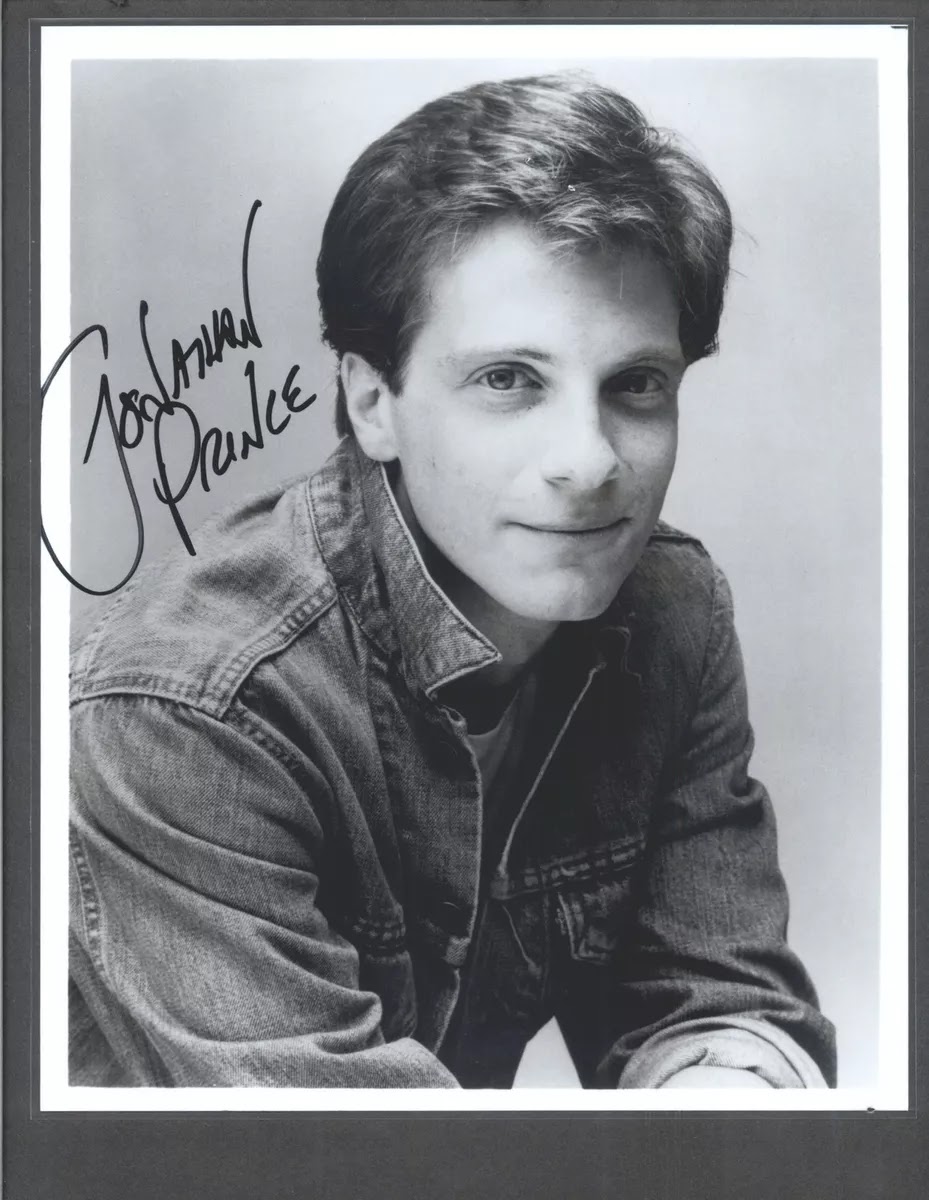
1. The boss,  diminuitive go-getter Zach (Jonathan Prince) channeling Michael J. Fox.  Today a writer and producer, Prince was at the height of a brief 1980s acting career: he played Johnny Depp's buddy in the sex comedy Private Resort and Clark Brandon's buddy on Mr. Merlin.


One of the cutest guys on the planet.  

2.  Hip business manager Phil (Richard Cummings, Jr., later to star in Northern Exposure).

3.  Spaced-out former singer Blue, probably based on the Andy Warhol superstar Ultra Violet (Jane Leeves, who would go on to play psychic therapist/housekeeper Daphne on Frasier).


4. Sandy had a 12-year old son at home, played in the first season by future screen hunk Paul Walker, and then by Paul Walker lookalike Sean de Veritch.

I actually don't remember any particular episodes, just the jazzy theme song, some buddy-bonding moments between Sandy and Blue, and the super-cute Jonathan Prince.

But I remember watching, and finding it a moment of freedom from the incessant homophobia of 1980s tv


Jun 25, 2024

Cheers: Where Nobody Knows Your Name

In the mid-1980s, Americans were afraid.  We had a crazy president who wanted to start a nuclear war (not as crazy as the Orange Goblin, though). People thought that AIDS could be transmitted through drinking water and mosquitoes.  Unemployment was as high as during the Depression, the violent crime rate higher than ever before in history.

 No wonder people wanted to go to a place "where everybody knows your name, and they're always glad you came."

Cheers (1982-93) was must-see tv, as in all your relatives and everybody at work talked about it constantly, so you had no choice but to watch.

The premise: Sam Malone (Ted Danson) flopped as a ball player due to his alcoholism, so he opens a bar in Boston (really?) and begins love-hate sniping with his stuck-up Ivy-League grad student barmaid Diane (Shelley Long), and later with neurotic bar manager Rebecca (Kirstie Alley).

Other cast members included earthy barmaid Carla (Rhea Pearlman), dimwitted bartender Coach (Nicholas Colassanto), replaced after the actor's death by Woody (Woody Harrelson), and two bar patrons, the rotund Norm (George Wendt) and the talkative Cliff (John Ratzenberger).

In spite of the theme song,  no one knew any gay names.

Gay patrons came to the bar in only one episode.  The gang sees two metrosexual guys talking and laughing, thinks they're gay, and is about ready to string them up, when Diane reveals that the real gay guys, two bears, have been masquerading as part of the mob.

Carla is particularly homophobic.  "If they keep coming out of the closet, there won't be any men left, and I'll have to. . .ugh!" she says, imagining sex with Diane.

Not only is the bar gay-free, there aren't any significant homoerotic subtexts.  Cliff and Norm are buddies, but reject any hint of affection.  The female characters seem as boy- crazy as Betty and Veronica in Archie comics: Carla has a dozen kids with many different men; Diane leaves two men at the altar; Rebecca has an unrequited golddigger crush on a millionaire.

Sam was the hunk of the series -- Ted Danson even posed for Playgirl (not nude) -- and two other male cast members warranted gazing.

 1. Woody (before Woody Harrelson, left, got craggy and redneck).


2. Hockey player Eddie (radio personality Jay Thomas, previously seen on Mork and Mindy), Carla's love interest for a season.  But since almost all of the action occurred on two sets, the bar and Sam's office, there was little opportunity for disrobing, thus no beefcake.

Not a lot of gay allies in the cast.  Kirstie Alley was rather aggressive in "defending" John Travolta from the "insult" of gay rumors. Ted Danson and Woody Harrelson have both played swishy gay stereotype.

In 1993, stuffy psychiatrist Frasier Crane (Kelsey Grammer) spun off onto his own series, Frasier, which lasted for another 11 years.

Jan 30, 2024

Suddenly Susan: Biceps, Brooke Shields, and Pete the Gay Mail Boy


In the fall of 1997, you had four main tv choices on Monday nights: America's Funniest Home Videos, the hundredth series starring Bill Cosby, the uber-religious Seventh Heaven, and Suddenly Susan (1996-2000).  Guess which won?

It was one of many workplace sitcoms about Young Female Journalists with Big Ideas who butt heads with stick-in-the-mud magazine or newspaper editors, in this case Susan (Brooke Shields, best known for Blue Lagoon nearly twenty years before) and Jack (Judd Nelson, the homophobic bigot best known for Breakfast Club nearly twenty years before).


Suddenly single after a long engagement, Susan is assigned to write a column about what it's like to be...um...single in contemporary San Francisco.  But she, naturally, wants to do more.  And, of course, she and Jack have a "You're so arrogant!" Sam-and-Diane romance going on.

Her main coworkers included:

1. Photographer Luis (Nestor Carbonell, top photo), a Latino hunk ("Today is the day I work on my biceps.")
2. Sardonic restaurant critic Vickie (gay-positive comedian Kathy Griffin, right)
3. Susan's arch-nemesis, tough-as-nails reporter Maddy (Andrea Bendewald).
4. Pete (Billy Stevenson), the mail boy.


5. Hip music reporter Todd (David Strickland).

Two things made Suddenly Susan memorable (excluding Nestor Carbonell's biceps).

1. On March 22, 1999, David Strickland committed suicide.  Instead of replacing him without comment, the producers decided to incorporate his death into the series.

When Todd fails to report for work and doesn't respond to his pager, his coworkers spend the day searching for him and worrying.  Finally they congregate in his apartment.  The episode ends with the telephone ringing.  Everyone looks around, afraid to answer, knowing what news is coming.  It gave me goosebumps. Very effective.


2. Pete the Mail Boy.  Although he appeared in only 15 of the 93 episodes, he was still memorable as just about the only gay character on television who wasn't portrayed as a swishy stereotype.  In fact, he was dimwitted and rather a nerd.

When he married his boyfriend, the equally nerdish Hank (Fred Stoller, left), he talked the homophobic Jack into participating -- quite a memorable accomplishment for the 1990s.

See also: Just Shoot Me

Jan 15, 2023

Looking for Muscle on "The Dick Van Dyke Show"


The Dick Van Dyke Show won 15 Emmies during its five seasons (1961-1966), and is constantly praised today as one of the greatest TV shows of all time (TV Guide ranks it at #13).

It came on before my bedtime during its original run, but it was constantly being rerun during my childhood, often at lunchtime during the summer, so my brother and I watched while waiting for Mom to fry our  baloney or egg sandwiches

I know, it's a classic, and it won lots of Emmies, and all, but I didn't like it.


1. The premise: Rob Petrie (Dick Van Dyke) was head writer for a weekly comedy-variety show.  Stories alternated between work and home.  Father of beefcake actor Barry Van Dyke (but no relation to Philip Van Dyke), Dick was tall, gawky, and rubbery-limbed, not at all attractive.

Plus he was hetero-horny in that obnoxious eye-bulging 1950s way, although devoted to his wife, Laura (Mary Tyler Moore, who would get her own iconic tv sitcom in the 1970s).

2. Rob's writing staff included the unhappily single, man-hungry Sally Rogers (Rose Marie), who was desperate to get married, even though that would mean giving up her successful comedy-writing career.


And short, sarcastic Buddy Sorrell (Morey Amsterdam).  Cute, but in his 50s, a bit too old to be attractive to a preteen.

He was as hetero-horney as Rob, and married to a former chorus girl with the ridiculous name Pickles.

3. Buddy had a sparring love-hate relationship with Mel Cooley (Richard Deacon), the balding, stuffy producer of the tv show.  But it was mostly hate.  You have to push really hard to find an undertow of homoerotic attraction.

Richard Deacon was gay in real life, and a fixture in West Hollywood bars during the 1970s.  My friend Levi dated him.


4. Back home, Rob and Laura had a son, Ritchie (Larry Mathews), who was about my age.  But I don't recall him being the focus of any episode, except one where they explain how he got the feminine middle name "Rosebud."  He was mostly a non-entity.

5. The only regular cast member who was marginally attractive was next door neighbor Jerry Helper, played Jerry Paris, who starred in some sex comedies during the 1960s.  But he was married, too.


6. And maybe an occasional guest star, such as Jerry Van Dyke (left), Jamie Farr, and Jacques Bergerac.

No muscles, no buddy-bonding, a lot of hetero-horniness.  No wonder I didn't like it.

Besides, the episode "It May Look Like a Walnut" scared me to death.


Feb 9, 2021

WKRP in Cincinnati

During the late 1970s, there was a fad of hip, urban workplace sitcoms that were very popular but had little to offer gay teens.  The office setting meant no shirtless scenes, the business plots meant no daring rescues, and buddy-bonding was all but absent in casts full of New Sensitive Men seeking out boogie nights.

WKRP in Cincinnati (1978-82), about a struggling radio station, was the worst of the lot.  I watched it -- everybody watched it -- but I didn't like much except the catchy theme song: "Got kind of tired of packing and unpacking, in town to town, up and down the dial").

1. The male actors not only displayed no beefcake, they weren't even cute to look at fully-clothed. Rock dj Dr. Johnny Fever (Howard Hesseman) was scraggly, reporter Les Nessman (Richard Sanders) mousy, and advertising manager Herb Tarlek (Frank Bonner) smarmy.  That left station manager Andy Travis (Gary Sandy), who at least could fill out a flannel shirt and pair of 1970s extra-tight jeans (and appeared fully nude in Playgirl). 

2. No buddy-bonding, not even a lot of same-sex friendships.  Most of the conflict involved not external threats, but the various on-air personalities and support staff bickering with each other.

3. Most of the hip urban comedies had at least one "very special episode" with someone's visiting brother or college buddy informing the cast that he was gay, resulting in "hilarious" spit-takes, denials, some homophobic comments, and finally tolerance.  Not WKRP. Instead, tt had:

Les Nessman so upset by an unfounded "accusation" that he tries to commit suicide (see "Most Homophobic Moments in College #4).

A smarmy photographer with incriminating photos claims to be gay, so Herb Tarlek puts on his most effeminate facade to flirt with him and try to retrieve them.  

Dr. Johnny Fever wants to get out of his condo lease, so he pretends to be gay, and the condo board, aghast, practically kicks him out the door.

4. No gay-friendly actors.  Howard Hesseman had played gay before, but only negative stereotypes.  Gary Sandy had a few connections with gay people: he shared an apartment with gay superstar Sal Mineo, and got his start playing a hustler who beats up Candy Darling in Some of My Best Friends Are (1971).  But, all accounts suggest that he is even more homophobic in real life than his character was.

Better stick to the catchy theme song.

See also: Frasier, another sitcom about a radio station.


Sep 19, 2020

Les on the Ledge

May 1979: the end of my first year at Augustana College.  I'm working on the college radio station, WVIK, broadcasting "The International Pop Hour" on Monday nights: Lorenzo Santamaria (Spanish), Claude Francois (French), Roy Black (German, left), Heintje (Dutch), whatever I can find.

Jim, the station manager, is praising a new tv show: WKRP in Cincinnati (1978-82), a hip, urban workplace comedy about the misadventures of the new dj at a struggling radio station.

So when my program ends for the summer, I watch a few episodes.  

It's pleasant enough, but not very interesting: no beefcake, no bonding, no subtexts, just Dr. Johnny Fever head-butting with the conservative radio station owner.

Then comes a rerun of "Les on the Ledge," actually the third episode of the series, originally broadcast last October.

Mousy reporter Les Nessman (Richard Sanders) is banned from interviewing athletes in locker rooms, because they think he's gay.  

When Les finds out, he is so traumatized that he rushes out onto a window ledge, intending to jump.  He is not actually gay, but the rumor is so humiliating that he wants to die.   


The reaction of his coworkers is mixed. 

Station manager Andy Travis freaks out just hearing the word "gay."

Jennifer Marlowe, the receptionist, says "So what if Les is gay?  His sex life is nobody's business."  

Advertising manager Herb Tarlek ruminates, and finally says "It's ok if you're gay."  

However, they all agree that being "falsely accused" of being gay is the worst thing in the world, and they understand why Les is on the ledge.

But in 1979 using the word "gay" on the air at all, in any context, is a triumph.  Suddenly I am a big fan of WKRP in Cincinnati.

Feb 4, 2020

The Drew Carey Show: Why was this my favorite program in 1999?

When I was living in New York, my favorite tv program was The Drew Carey Show (1995-2004).  I'm still not sure why.

Not because of the beefcake: Diedrich Bader (left) rarely disrobed on screen, and the other male characters were not particularly attractive.

It starred dumpy, nerd-eyeglassed comedian Drew Carey as a human resources drone at the Winfred-Louder Department Store in Cleveland.


His work life is bedeviled by a series of horrible bosses and his worst enemy, the over-made up, abrasive Mimi (Kathy Kinney).

At home, he has three friends: Kate (Christa Miller), with whom he has the obligatory "will they or won't they?" quasi-romance; and slackers Oswald and Lewis (Ryan Styles, Diedrich Bader).

Heterosexism was everywhere:

1. One of the theme songs, "Five O'Clock World," was about how all of the little miseries of the workday get better when the man goes home to his wife.

2. Drew was supremely attractive to women.  His show, his rules.

3. Oswald and Lewis had been living together for 20 years, yet no one ever treated them as a couple. In one episode Mom showed up and tried to fix them up with women, explaining, "I don't want you to be alone,"  Um...they weren't alone.

4. Drew's brother Steve (John Carroll Lynch) was probably the only heterosexual crossdresser on tv at the time.  But when he arrives for a date with Mimi in drag, she is upset: a date is a boy-girl activity, and she's the girl, so he should dress as a boy, right?

Hey, Mimi, gay people go on dates, too!

When the romance with Mimi blossoms, the drag is summarily abandoned, and never mentioned again.

5. Gay characters appeared only in the standard 1990s sitcom plotlines:

Oswald dates a guy for two weeks without realizing it (come on, two weeks without any physical attention?)

Drew is mistaken for gay.

The guys pretend to be gay to get some of the wonderful "privileges" that gay people enjoy.

So why did I like The Drew Carey Show so much?

Maybe because I was homesick for West Hollywood, and Drew Carey was all about finding a home.

Or because it was set in Cleveland, one of my favorite cities.

Maybe it was Mimi and Drew's pleasantly weird sparring enemy-ship.

Or the cool musical numbers.  Here a duel between the "old drag" of The Rocky Horror Picture Show and the "new drag" of Priscilla Queen of the Desert.

Or maybe it because of the beefcake after all.

Jun 8, 2019

"Schooled": "Welcome Back, Kotter" for the 1990s

I got pulled into buying the $1.99 premiere episode of  Schooled (2019) with this shot of the abs of star Christian Gehring.

Turns out that it's a spin-off of The Goldbergs (2013-), the sitcom about future filmmaker Adam Goldberg's high school years in the 1980s.

Spin-offs usually take a wacky supporting character and push them into a starring role, then find out too late that wacky doesn't work for the central character.  So "Kiss mah grits" Flo was great on Alice, but bombed on Flo, and the bickering landlords on the top-rated Three's Company hit the bottom of the ratings barrel on The Ropers

In this case, it's the wacky Lainey Lewis (A. J. Michaelka), Erica's school friend and eventually Barry's girlfriend.  Sometime during the 1990s, after a failed musical career, Lainey returns to Philadelphia and takes a job as a music teacher at William Penn Academy, "the same old place that she laughed about."

Shades of Welcome Back, Kotter, except Kotter actually had a teaching degree, and Lainey has no degree, no certification, no practicum, no nothng. She doesn't even know what a syllabus is.  But the Principal (Tim Meadows) and Coach Mellor (Bryan Callen), who knew her a a student, "believe" in her.

The music class is, naturally, full of slackers, losers, and wise guys, but Lainey "gets through to them" by switching from the "Do Wop" music on the syllabus to Grunge. So this is more like Glee without the gay kid?

But things go wrong when Lainey tries to expell Felicia (who happens to be the Principal's niece) for asking to go to the nurse's office (an act which would immediately get a real-life teacher fired, but here has no consequences).  But she finally bonds with Felicia.

Meanwhile, the ridiculously fit Coach Mellor, who actually doesn't have much of a physique, is having his own problems adjusting to the 1990s (wait -- wasn't he there all along?).  He hates the new Be Like Mike non-teamwork basketball style and short-short uniforms that show everything you got (well, I'd like to see those).

In a parallel to Lainey-Felicia, he butts heads with the showboating Matty (Hunter Doohan),the best athlete at the school, who quits the team in protest.  Not to worry, they bond, and the Coach suggests that he try out for football instead.

We finish with cameos by "the real Matty," Matt Ryan of the Atlanta Falcons football team,  who really  did attend the William Penn Charter School in Philadelphia, started as a basketball player before "the real Coach Mellor" convinced him to take football instead.

My head is exploding.  Are these all real people?  Are we going to get more interviews with famous graduates of William Penn Academy in future episodes?  I almost want to buy more episodes to see.

Gay References:  They will be performing Rent later on..

Gay Characters: None that I know of.

Beefcake.  Maybe I've been spoiled by Riverdale, but those team members are scrawny, and always fully clothed.

Lainey: Super annoying.

And where's Christian?

Back to Schooled:  It turns out that Matty appears only in the pilot.  The main students will be Ed (Israel Johson), Aaron (Dallas Edwards), Weasel (Gabe Gibbs), and Ronnie (Christian Gehring, finally).  There will also be another teacher, C.B> (Brett Dior, left), who will have a crush on Lainey.

Oh, and most of The Goldbergs will make cameos.

My grade:  D.  I'd rather watch Welcome Back, Kotter. Or Glee.  Or Riverdale.
Or The Goldbergs.

See also: The Goldbergs; 

Jan 30, 2019

Superstore: Just Leave It on and Watch

Superstore (2015-) is a workplace sitcom set in the vast Wal-Mart like Cloud 9, where responsible, by-the-books Amy (America Ferrara, best known from Ugly Betty) butts heads with the free-spirit Jonah (Ben Feldman, who bears an eerie resemblance to Charles in Charge-era Scott Baio).

We've seen this free-spirit/by the books pairing a thousand times.  Sam and Diane.  Sam and Rebecca.  Scully and Mulder.  But the twist here is: Amy is married.

Her husband Adam (Ryan Gaul) hosts a barbecuing podcast, watches football, fools around with tools, and basically acts like the uber-sterotypic Macho Man, in stark contrast to the sensitive, feminine-coded Jonah.

So this is the real-life aftermath of a teen nerd movie from the 1980s.  Instead of the teen nerd using his sexual prowess to steal The Girl away from her loud-mouth jerk boyfriend, she marries him. 

Of course, Jonah and Amy will hook up eventually anyway, but adding a husband delays the inevitable enough for the first two seasons to be palatable.

The other characters are the eclectic bunch familiar from other workplace comedies:

1. Lauren Ash as Dinah, the gun-toting, karate-chopping assistant manager/security specialist, who skins wildebeests before breakfast and dropped out of the marines because everyone was too wimpy.  She has a crush on Jonah.

2. Colton Dunn (left) as Garrett, the sarcastic, street-smart black guy who knows how to work the system to his advantage.  He's also in a wheelchair.


3. Nicole Bloom as Cheyenne, an airheaded 17-year old high schooler who got pregnant by her boyfriend (Johnny Pemberton), an aspiring rapper with extremely progressive, pro-choice, pro-gay, anti-racist lyrics: "God is a black woman, yo!"  They get married, and name their daughter Harmonica. 


4. Josh Lawson as Tate, a sadistic pharmacist who makes Jonah his personal slave.

5. Jon Barinholtz as Marcus, a doofus who gets everything wrong and often is injured ("My spleen!").

I was concerned about two characters.

6. Nico Santos as Mateo, who starts out as a priggish tattletale and brown-nosing sycophant, self-righteous, condescending, scheming, manipulative, a gay villan in training.  Over the first season, he softens and becomes more likeable, and in the second season he begins dating.  I still don't like him, but at least his character is not entirely homophobic, a source of laughter rather than disdain.

7. Mark McKinney as store manager Glenn.  McKinney was an original member of the Canadian comedy troupe The Kids in the Hall in the 1980s.  He plays Glenn with a squeaky cartoon-character voice, and as so completely clueless that he comes across as mentally challenged.  And he's a born-again Christian who reads the Bible aloud  and asks for Jesus' blessings during staff meetings.

Born-again Christian usually means homophobic, so I was cringing when a gay couple came into the store to plan their wedding.  He asks "Which is the lucky groom?", and upon hearing "Both of us," assumes that it's a double male-female wedding.  Upon being apprised that it's a gay couple, he is surprised but not angry, and overdoes the enthusiasm: "Oh, you're gay?  That's terrific!  I'm totally supportive! I think gay people are great!"  Finding out that Mateo is gay provokes the same reaction.

Ok, not homophobic.  Scarily out of touch, but not homophobic.

Superstore is not the most innovative of shows; it's mostly what we've seen before.  But it's pleasant enough.  It reminds me of the old days of network tv, where they put a C+ show in between two A+ shows, so you could either turn off the tv for a half hour or just leave it on and watch.

I'll just leave it on and watch.

Feb 24, 2018

Episodes: Matt LeBlanc Discusses His Penis

Matt LeBlanc was easy on the eye as Joey on Friends (1994-2004), and he's still quite photogenic, even when playing "himself" as an insufferable jerk.

Of course, in Hollywood, everybody, without exception, is a jerk.

That's one of the takeaway points of the regrettably named Episodes (2011-2017), the British/American sitcom about a British couple, Sean and Beverly (Stephen Mangan, Tamsin Grieg), who produce sitcoms of breathtaking brilliance in Britain, only to find them dumbed down into drivel in America.

The second takeaway point: all Americans are idiots.


The fabulously brilliant sitcom about an elderly headmaster of a boys' school suffering through an unrequited love for the lesbian librarian is transformed into Pucks!, with Matt as the hockey coach at a school for teenage hunks with nice hair.

They're playing teenagers, but they're actually in their 20s, with wives and houses -- a fact which Sean and Bev find incredibly disconcerting.  In Britain, actors play their age.

The teenage hunks can't act, but they're immediately rich and famous, and wallowing in movie offers.  But paradoxically Pucks! is airing opposite a show about a talking dog, so it tanks in the ratings, and is quickly cancelled.


Not that Sean and Beverly mind.  They hate, hate, hate, America, where everyone makes fun of their accents and vocabulary, everyone is incredibly stupid, and everyone is morally bankrupt.

Matt sleeps with every woman in sight, including Beverly --- a transgression that Sean can't get over, because he is fixated with the size of Matt's schlong.

To be fair, Matt discusses his penis a lot.  So do many of the other male characters. 

They are also irked by the fact that their incredibly stupid, talentless former personal assistant, Andrew Leslie (Oliver Kieran-Jones), is a huge success, selling script after script.


They almost escape back to Britain, where no one makes fun of their accent and people are smarter than rocks, but then they are drawn into a new tv series based on their incredibly brilliant script about actors playing two different roles.

But that's destroyed, too.

And Matt becomes a game show host.  His incredibly popular show is about people who spend the whole season trapped in boxes, getting points to acquire comforts like beds and food, or to torture each other with bugs and Gilbert Gottfried.

See how stupid Americans are?  They actually like this drivel.

Meanwhile the bedroom shenanigans go on and on.  Network executive Carol Rance (Kathleen Rose Perkins) has affairs with each of her bosses in turn: Merc (John Pankow), Castor (Chris Diamantopoulous), Helen (Andrea Savage), and then back to Merc.  They all turn out to be cheating, sniveling scum or crazy as a loon.

Doesn't that affair with Helen means that Carol is coming out as gay or bisexual?  Nope, she's not attracted to women, just to bosses.


At least there's a gay presence.  Casting director Andrew Button (Joseph May) is gay, although he never actually dates anyone or discusses cute guys.  He's basically gay because he says he is.

There are also a lot of cute guys walking around in towels and talking about their penises.


Related Posts Plugin for WordPress, Blogger...