My junior year in Augustana College (1980-81) was very busy: cruising at the levee, tricking my friend Haldor into a date, going to Professor Burton's Handcuff Party, hanging out with the Bookstore Gang, reading Death in Venice in my German literature class.
It was all done to a backdrop of Olivia Newton-John, Rex Smith, and especially Neil Diamond. You couldn't turn on the radio without hearing "Hello Again," "America," or "Love on the Rocks."
Or walk down a dormitory hallway without hearing "September Morn" or "You Don't Bring Me Flowers" playing from someone's room.
In December 1980, everyone went to see Neil Diamond starring in the update of The Jazz Singer.
In March 1981, everyone went to see him in concert in Davenport.
My friend Bruce called him the most handsome man in the world.
I wasn't a big fan. His songs were earnest, heart-wrenching, and ultimately depressing, and I preferred light-hearted and joyous.
And with greater gay symbolism, like "Physical" by Olivia Newton-John, or "I'm Coming Out," by Diana Ross.
Still, he had a nice hairy chest, and I figured he was gay due to his habit of dropping pronouns, so his lost loves could be male or female. Check out "Hello Again":
Hello, my friend, hello
Just called to let you know
I think about you ev'ry night
My friend?
Or "Love on the Rocks":
First they say they want you
How they really need you
Suddenly you find you're out there
Walking in a storm
They say they want you?
Ok, so I was mistaken. With three heterosexual marriages and a number of hetero-romances on his resume, Neil Diamond is probably straight.
But gay-friendly.
In contemporary performances of "Brother Love," he does a call out: "white or black, gay or straight, big or small, we are all God's children."
Beefcake, gay subtexts, and queer representation in tv and other pop culture from the 1950s to the present
Mar 31, 2014
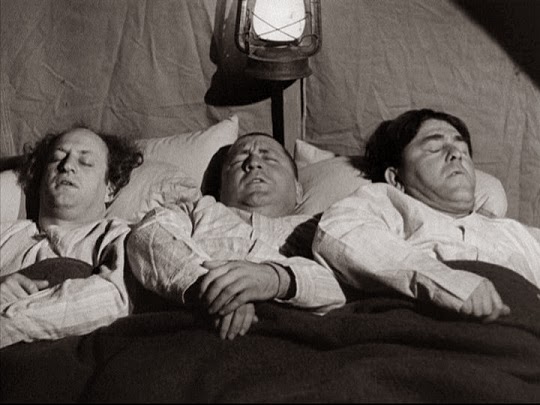
The Three Stooges: Gay Symbolism on "Cartoon Showboat"
When I was a kid in the 1960s, every day after school I rushed home or to my boyfriend Bill's house to watch Captain Ernie's Cartoon Showboat. Captain Ernie (later weatherman Ernie Mims) showed old Bugs Bunny and Popeye cartoons, and with the proviso "Don't try this at home," The Three Stooges.
I didn't realize that the comedy shorts were originally shown in theaters 30 or more years before, or that the three "stooges" belonged to a long tradition of comedy teams. I found them bizarre, somewhat disgusting, and fascinating.
What was this world of boarding houses, boxing rings, hobos riding the rails, jitterbug music, and machine-gun toting gangsters?
Why did Moe, Larry, and Curly/Shemp have different jobs and living situations in every episode?
Why was their theme song Three Blind Mice?
Why was third member of the trio so changeable, sometimes Curly, sometimes Shemp?
The role of the Third Stooge was sometimes filled by two flamboyantly gay-coded actors, Joe Besser in the shorts and Joe DeRita in the movies (seen here with Samson Burke in The Three Stooges Meet Hercules). But they never appeared on Cartoon Showboat.
And the most important question: why did the men live together (and sleep together)? Where were their wives?
All of the adult men I knew, or had seen on tv, or had ever heard of, had wives. My parents and other relatives constantly talked about the far-off day when I would be "grown up" and "married," as if the two states were identical.
Yet these three men were obviously grown up, and obviously not married. Men building a life together, not needing or wanting wives (I missed or ignored the scenes where they flirt with women).
I didn't think there was any romance between them, not even friendship -- Moe was painfully abusive to the others, and they treated him with open contempt.
But, as with the Hanna Barbara cartoons of my earliest childhood (Yogi Bear, The Flintstones), the domesticity itself was evocative.
There was a recast, The Three Stooges, in 2012, with Chris Diamantoupoulos (top photo) as a rather muscular Moe. Again, they don't get girlfriends or wives; the hetero-romantic plot is given to a new character.
See also: Samson Burke.
Mar 26, 2014
Ross Lynch's Top 10 Hunks
Austin & Ally has become the Disney Channel's most popular teencom, due primarily to the charm and charisma of Ross Lynch as aspiring singer Austin Moon, and his chemistry with Calum Worthy as goofy sidekick Dez.
But they aren't alone. Disney has done a good job of filling the screen with models, beefcake actors, muscular physiques of all sizes and shapes. Here are the top 10 Austin & Ally hunks:
1. Noah Centineo (left) as Ally's crush Dallas. The actor has also appeared on Jessie, Shake It Up, and Marvin Marvin, and he will be starring in the upcoming How to Build a Better Boy (2014).
2. Cameron Deane Stewart (left), who starred in the gay-themed Geography Club (2013), as Jace, boyfriend of the exuberant Trish.
3. Gabriel Benitez as a keyboard player in the episode "Secrets & Songbooks."
4. Singer/songwriter Trevor Jackson as Trent, Trish's ex-boyfriend.
5. Gregory Marcel (left), star of the gay-themed Sun-Kissed (2006), as Austin & Ally's Stage Manager.
6. Little Person actor/comedian Nic Novicki as "Larry" in the episode "Mixups & Mistletoes"
7. Troy Osterberg (left) as Ethan, a boy who flirts with Trish in "Costumes & Courage."
8. Greg Worswick as Bill, who works at the Surf Shop.
9. Travis Wong as a Ninja in the episode "Real Life and Reel Life" and a dancer in "Viral Videos and Very Bad Dancing." He also had a recurring role as Yamato the Fighting Robot on Supah Ninjas.
10. Cody Allen Christian, Mike Montgomery on Pretty Little Liars, as Ally's old friend Elliot.
Mar 25, 2014
A Gay Scandal on London's Museum Circuit
London is the City of Museums, with 240, including some that top every tourist's to-do list: The British Museum, the Victoria & Albert, the Tate Modern, the Museum of London. But leave some time for the Soane Museum, site of a major gay scandal.
Sir John Soane (1753-1837) was a famous architect who designed or renovated many London landmarks, including the Bank of London, Freemason's Hall, the New Law Courts, and the Palace of Westminster. He was an antiquarian, a neoclassicist, a traditionalist in a world rocked by revolution and changing sexual mores.
He designed his own home at 13 Lincoln Inn Fields, filled it with a huge collection of art and antiquities, and turned it into a mausoleum, a memory of a long-dead world.
He hoped that his sons would follow him into architecture, but John (born 1786) was sickly and artistic, and George (born 1789) preferred literature and the theater. Their relationship was so strained that Soane insisted that he was a "changeling," not his real son at all.
After he left home, George published two anonymous articles savaging his father's architectural style. But the last straw was the revelation that George was living in sin with his wife Agnes and her sister. Scandalized, Soane cut off all contact.
Then Agnes wrote, complaining that George was violently abusive to her and her young son Frederick (born in 1816). At first Soane ignored her, but then it occurred to him that Frederick might yet become an architect and carry on his name. So he encouraged Agnes to leave George, and sent her 200 pounds per year to pay for Frederick's education.
When Frederic graduated in 1834, Soane got him an apprenticeship with his friend, architect John Tarring.
But 1835 Tarring complained that Frederick was involved in the gay demimonde, carousing with a Captain Wentworth (whose military career had been cut short in a scandal involving the suicide of a young officer rumored to be his lover).
Scandalized again, Soane sent one of his clerks to follow Frederick and report back on any "inappropriate behavior."
In Soane's youth gay men and transvestites patronized clandestine Molly Houses (top photo from the Mark Ravenhill play Mother Clap's Molly House), but in 1835 London they could choose from private parties, drag bars, and all-gay brothels.
Evidently the clerk found something, since Soane cut off Frederick's "per annum" and cut off all contact, "for motives which it does not become me to explain," Frederick wrote later. He also refused to "article" Frederick, so he could never work as an architect; by 1837, when Soane died, he was living in poverty in a single room with his pregnant wife.
Soane bequeathed his house and its contents, valued at 150,000 pounds, to the British Nation as a museum. Frederick begged to be appointed curator, but was denied. Finally his cousin Frederick Chamier petitioned the Prime Minister, and got him appointed to a post at the Stamp and Tax Office. He died in 1880.
You can visit the Soane Museum from 10 to 5 Tuesday through Saturday. There are no statues of naked men. Or portraits of Frederick.
Subscribe to:
Posts (Atom)