Nov 2, 2012

The Lord of the Rings


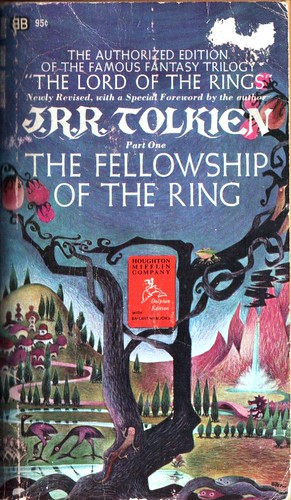
I had a friend in high school who claimed to have read J.R.R. Tolkien's  Lord of the Rings trilogy straight through 38 times (for a fast reader, that would take 2 hours per day, every day, for 5 years). I barely made it through once, with lots of skimming, , but I returned to certain passages over and over again.  They were "good beyond hope."

A company of men.  Working together, fighting, rescuing each other, hugging, saving the world.

Heterosexual desire almost absent: Tom Bombadil is devoted to Goldberry, the Ents pine away for the Entwives, Aragorn pines for Arwen (though not as much as in the movie series), and a few poems and songs say things like "Little Princess Mee -- Lovely was she," but nobody read them anyway.

And lots of same-sex romance.


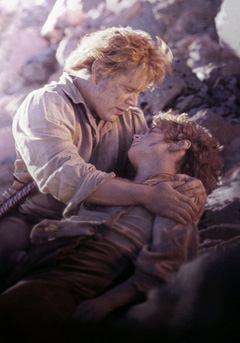
1.  Everyone today sees a romance between Frodo and Sam, especially as portrayed by Elijah Wood and Sean Astin in the movie series.  But I didn't see it.  Tolkien was highly class conscious, and Frodo and Sam are master and devoted servant.  At the end of the story, Frodo goes to the Undying Lands by himself, and Sam goes home to his wife.

But I did notice that Frodo is gay.  He surrounds himself with men and never once mentions a woman.  (He reveres Galadriel, but as a goddess to be worshipped, not as an object of desire). 


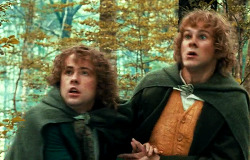
2. Merry and Pippin (played by Dominic Monaghan and Billy Boyd in the movie) are devoted to each other.  They go through deadly danger for each other, and when they are split up, each pines for the other.  After the War of the Ring, they go to work for Aragorn, so they can stay together forever.


3. The Elf Legolas and the Dwarf Gimli (played by Orlando Bloom and John Rhys-Davies in the movie) are sworn enemies, working together only to fight a greater evil.  But as the novels progress, they develop a grudging admiration, then a friendship, then a romance.  Neither seeks out a wife.

After the War of the Rings, when Legolas goes to the Undying Lands, Gimli comes with him. Tolkien comments:

It is strange that a Dwarf should be willing to leave Middle Earth for any love, or that the Eldar (Elvish Gods) should receive him, or that the Lords of the West should permit it. . .More cannot be said about this matter.

This is a curious way to end the discussion, suggesting not that Tolkien has no more information on the subject (of course he does, he wrote the books and he could invent any information he wanted), but that he is forbidden from saying more.  What is forbidding him?  It seems that, in attempting to understand Legolas and Gimli, their love for each other, and their motive for forsaking Middle Earth together, Tolkien is drawing dangerously close to acknowledging a love that he dare not acknowledge, and he abruptly forbids himself from considering the matter further.

 Tolkien was no doubt quite as homophobic as others of his generation, or moreso, a conservative Roman Catholic who eschewed the modern era.  But his subject matter  -- Medieval epics like Beowulf and The Nibelungenlied -- traditionally minimize heterosexual exploits to concentrate on the manly love of comrades.  Tolkien couldn't help but acknowledge it, on some level, whether he wanted to or not.
Nov 1, 2012

Classics Illustrated

A decade after the Seduction of the Innocent scandal that blamed comic books for single-handedly causing the downfall of society, teachers still thought they were cesspools of corruption.  Archie, Casper the Friendly Ghost, Little Lulu -- it didn't matter.  The only comics we could read with impunity at recess or summer camp were Classics Illustrated, the long-running series of comic adaption of adventure classics: Moby Dick, The Last of the Mohicans, Around the World in 80 Days.  

The publishers quickly ran out of adventure classics and began presenting adaptions of obscure works that no one except literary scholars ever read, like Eugene Sue's Mysteries of Paris, Emile Zola's The Downfall, Jules Verne's Michael Strogoffand Charles Nordhoff & James Hall's The Hurricane. 


But regardless of the "classic," you could always depend on shirtless and semi-nude muscle shots to draw the eye to the cover art.  Who knew that Mark Twain's Connecticut Yankee in King Arthur's Court had such a buffed physique?


There was also a Classics Junior series, with fairy tales and mythology.  The Magic Pitcher was about the muscular Hermes of Greek mythology dishing out a cornucopia, with disastrous consequences.


Oct 27, 2012

Motorama and the Girl of Your Dreams

In 1991, 12-year old Jordan Christopher Michael starred in Motorama, about a boy named Gus who runs away from his abusive parents and drives cross-country,  through an arid wilderness something like the Western United States.  His goal is to acquire enough coupons from Chimera Gas stations to win a fabulous prize.


Early on, Gus meets a gas station attendant, Phil (John Diehl), who is lonely and asks him to stay.


But Gus refuses and continues on through the bleak landscape, having unsavory adventures and meeting nasty people.  He is kidnapped and sexually assaulted. He loses an eye.  His arm is forcibly tattooed.  Years pass, and Gus grows old (though he is still played by the same actor).  Finally he claims his prize, but it turns out to be a chimera.  He ends up back where he started, outside the gas station where Phil works.  He decides to stay after all.  The film ends with their hug.


A father-foster son bonding moment?  Or since Gus's age is unclear, he could be a teenager or an adult -- a homoromantic conclusion?

But the video cover shows a picture of Drew Barrymore -- overwhelming Gus -- with the caption: "There's only one way to win the girl of your dreams -- floor it!"

Except Gus never wins her, never tries to win her.  She's not the girl of his dreams.  He only dreams about her because she is holding out the Chimera prize.  He wants the prize, not her.

Gus experiences no heterosexual interest, at all, ever.  And every heterosexual relationship depicted in the movie is abusive and nasty.

Leave it to Hollywood to try to sell a same-sex romance  as a heterosexual romance.

After a few more projects, including Full House, Jordan Christopher Michael retired from acting (left, recent photo).


Village of the Giants


Tommy Kirk's first movie after he was outed and fired by Disney was Village of the Giants (1965), which I saw at a kiddie matinee on my first date in October 1968.

A small town full of rednecks and inept police officers, the sort frequently overrun by giant ants or Commie body snatchers during the 1950s, gets a different sort of invasion: six hippies who play loud music and smart off to authority figures.  Oddly, though the group is of mixed sexes, none of them seem to be heterosexually involved, and no one displays more than a passing interest in the ogling of the other sex: it’s boys on one side, girls on the other.


Meanwhile, nice teenager Mike (Tommy Kirk) spends about ten minutes demonstrating that he is heterosexual by kissing up a girl, but then he descends to the basement nightworld of her pint-sized brother Genius (Ronnie Howard, future star of Happy Days).  Genius has invented a concoction called “goo,” which transforms dogs, birds, and people into giants.

After ridiculing the nice teens at a local hotspot, the hippies steal the goo, figuring that they can use it to create more mischief.  They eat it and shoot up to thirty feet tall, in the process shredding their clothes.

Director Bert I. Gordon previously accentuated the beefcake in several B-movies, including The Amazing Colossal Man (1957) and The Boy and the Pirates (1960), and his camera lingers lovingly on the thick arms and sculpted torsos of the boys, including a young Beau Bridges.


And a very sexy Tim Rooney (Mickey Rooney’s son), while all but ignoring the girls.

The giant hippies conclude that the Revolution has come, the Establishment has been defeated, and youth are in charge of this brave new world.  They don Roman-style togas that enhance the boys’ musculature, and celebrate by dancing semi-nude  in slow motion in the town square.


So far, in spite of the beefcake, we have a heterosexist fable, like A Cold Day in the Park, in which establishment heterosexuals face off against the sexual ambiguity of the counterculture.


But when Genius develops an antidote to the goo, Mike dumps his girl to hook up with Horsey (Johnny Crawford of The Rifleman, left, looking jealous on a title card).  They administer the antidote by catapulting Horsey directly onto the bosom of one of the giant girls.

In many situations a human missile fired onto a bosom would be overbrimming with heterosexual undertones, but in this case Horsey is attacking, literally trying to destroy the symbol of monstrous femininity.  When he falls and seems stunned, Mike rushes to his aid.  The manly love of comrades  wins out over heterosexual practice, however aggressively pursued.


Related Posts Plugin for WordPress, Blogger...