Showing posts with label hippies. Show all posts

May 12, 2025

The Bugaloos: A male ladybug with biceps starts a rock band. With Gavin Lewis and Glenn Scarpelli's neighbor


17 episodes of The Bugaloos aired during the 1970-71 season, and were rerun in 1971-72.  That's a little short, even for a Sid and Marty Krofft live action-animatronic series: Sigmund and the Sea Monsters had 29, and Land of the Lost had 43.


But millions of 1960s kids fondly recall the 17 episodes, and the infinite array of tie-in merchandise: a record album, a lunchbox, a board game, a 4-issue comic book series, costumes for Halloween, 3 novels.


The Bugaloos were a hippie family/rock band composed of  British insect people, all named after virtues.

1. I.Q. (John McIndoe), a gangly blond grasshopper
2. Harmony (Wayne Laryea) a black bumblebee
3. Joy (Caroline Ellis) a female butterfly
4. Courage (John Philpott, left) a muscular male ladybug.

Very muscular.  Always wearing a tight red shirt that highlighted his pecs and lay bare his arms and shoulders.

And exceptionally tight pants.


Unlike most Krofft shows, they were not trapped far from home: they lived in a hippie commune, the Tranquility Forest, singing, dancing, flying, and displaying no heterosexual interest

But their Eden was threatened by Benita Bizarre (Martha Raye), who hated their youth, their beauty, their freedom, their talent, and. . .well, their tranquility.  She stole Joy's voice and IQ's wings; she kidnapped and branwashed Courage; she tried to drive them out of their forest.

Establishment fear of the youth counterculture,but from the counterculture's point of view.  Clash of innocence and experience, age and. . um, obviously a metaphor for. . .um. . .

Who could think about anything but the male ladybug, with his sleeveless shirt and obvious bulge?

More after the break

Apr 11, 2025

Don Johnson and the Gay Community

Don Johnson had a close relationship with the gay community from the start.  In 1968 he dropped out of the University of Kansas to enroll in the American Conservatory Theater in San Francisco, and immediately landed the starring role in Fortune and Men's Eyes, a play about a teenager who is sexually assaulted in prison.  He moved to Los Angeles to play the lead in the 1971 film version, directed by famous gay actor (who became his roommate).

And lover (according to the rumor mill).  But then, if Sal Mineo really had relationships with everyone the rumor mill said he did, he would have been too tired to act.


Don also played the titular character, who grooves on both men and women in  The Magic Garden of Stanley Sweetheart (1970) -- one of the songs, "Sweet Gingerbread Man," was covered by Bobby Sherman

A boy at an experimental college, where he was naked and having sex with ladies all the time, in The Harrad Experiment (1973).  Gregory Harrison played one of his classmates, also naked and having sex all the time.

Traveling through a bleak postapocalyptic world in A Boy and His Dog (1975), who gets captured and used as a breeder in a crazy underground city where the men are mostly sterile.  It was re-envisioned in 2010 in Cartoon Network's Adventure Time. 


And so on through the 1970s, in vehicles that were sometimes gritty, sometimes surreal, but always emphasized Don's sexual desirability -- to both men and women.

As the counterculture waned, he found himself in conventional heterosexist roles in tv series like The Rookies, Streets of San Francisco, and Barnaby Jones, and tv movies like The Rebels, Revenge of the Stepford Wives, and Six Pack.  


He made something of a comeback in Miami Vice (1984-1990),about an odd-couple of vice cops making the scene with fast cars, stylish clothes, and lots of buddy-bonding.  Crockett (Don Johnson) was the good old boy who grew up in rural northern Florida and had a pet alligator named Elvis; Tubbs (Philip Michael Thomas) was the streetwise New Yorker.

The buddy-bonding  is not nearly as intense as in Starsky and Hutch decade before, and interspersed with lots of heterosexual hijinks.  But during the homophobic 1980s, it was about all you could expect.


Oct 25, 2024

Confusing Children and Angels: Laugh-In

When I was a kid, my  friends and I hated variety shows: Ed Sullivan, Red Skelton, Carol Burnette, Andy Williams, Glen Campbell (left).  They were old, square, has-beens.  And what could be more boring than someone standing in front of a microphone, singing?

But Rowan and Martin's Laugh-In (1968-73) was for us: not exactly variety, or even sketch comedy, but comedic slogans zapped across the screen at lightning speed.

1. Judy Carne yells "Sock it to me!" and gets socked.

2. Rowan and Martin give the "Flying Fickle Finger of Fate" award.

3. Zsa Zsa Gabor gets big  laughs by saying the word "bippy."

4. A Nazi spy peers from the undergrowth ("Verry interesting")

5. A spaced-out Goldie Hawn forgets her line and giggles.

6. Flip Wilson's drag persona Geraldine offers herself to all comers: "What you see is what you get."

7. Pigmeat Martin struts across the stage, jive-talking "Here come da judge!"

8. A dirty old man makes mumbling propositions to a purse-wielding spinster.

9. Gary Owens as a baritone-voiced announcer makes nonsequiter announcements.

10. Jo Anne Worley says "Blow in my ear, and I'll follow you anywhere," and giggles.

Episodes are streaming on Amazon Prime, but today they're unwatchable.  The lightning speed gives me a headache, and the jokes are sophomoric; only children would think it hilarious to say "Look that up in your Funk and Wagnells."  The cast members are just big kids, saying things that sound dirty on the playground.

But between 1968 and 1973, the jokes were bright and fresh, and risque and cool.  Most importantly, they were ours.

No beefcake, except for an occasional hot guest star, like Davy Jones of The Monkees.  
Not much bonding, not even from hosts Dan Rowan and Dick Martin, a comedy team since 1952.
No one ever acknowledged the existence of gay people.


But there was lots of gender nonconformity.  Years later we remembered it fondly, as the first hint of gay potential.

1. Alan Sues played Big Al, a feminine sports announcer who had an obsession with a bell he called his "tinkle."

Gay but never out, Alan Sues also played a fey grown-up Peter Pan on peanut butter commercials.


2. Tiny Tim, who looked like a long-haired Dracula, played the ukelele and sang "Tiptoe through the Tulips" in a fey falsetto.  He proved he was heterosexual by marrying a woman named Miss Vicky on The Tonight Show.


3. Flower child Henry Gibson appeared with a gigantic artificial flower and recited nonsequiter poems.  He was often assumed gay, although he was married to a woman for 40 years.

In his last role of note, Magnolia (1999), he played a cranky older gay man named Thurston Howell (after the millionaire on Gilligan's Islandd), competing with another guy for the attention of hunky Brad the Bartender.  He advises: "It's a dangerous thing to confuse children with angels!"

In those days we often confused children with angels.

Apr 19, 2024

Guy Madison: the Strong Silent Type

Hollywood hunks of the 1950s were often gay or gay-friendly; whole cadres hung out at talent agent Henry Willson's infamous all-male parties in the Hollywood Hills.  In a studio attempt to quell gay rumors, Willson gave them "manly" names consisting of  a single-syllable (Van, Rock, Tab, Nick, Guy) followed by a recognizable Anglo sirname  (Williams, Hudson, Hunter, Adams, Madison).

Born in 1922, former physique model Guy Madison (second from left) stood out from the crowd of Hollywood hunks by displaying his physique whenever possible.  He had no qualms about shirtless and swimsuit shots and even full frontal nudity.  In fact, he was the inspiration for the term "beefcake," first introduced in 1949.

As an actor, Guy played the strong, silent type in many Westerns of the 1950s, but he is best remembered by the first Boomer generation for The Adventures of Wild Bill Hickok (1951-58).  There was a real Wild Bill, a morally ambiguous lawman and gunfighter who died in 1876, but Guy's Wild Bill was a strictly white-hat proponent of law and order.
Andy Devine, who played his hefty, braying sidekick, went on to star in Andy's Gang on 1950s children's tv.

Hickok was immensely popular among the Ovaltine set.  There were feature films (spliced from the tv series), a radio program, toys, games, and lots of advertising tie-ins.  I haven't seen it, but apparently Wild Bill did a bit of 1950s Western buddy-bonding and wasn't particularly interested in girls.


During the 1960s and 1970s, Guy starred in some Italian sword-and-sandal movies, such as Slave of Rome (1961) and Blood of the Executioner (1963), plus some Westerns and actioners.  He played James Bond-style secret agent Rex Miller in the anti-counterculture LSD: Flesh of the Devil (1967).  But mostly he appeared as himself, a Western icon fondly remembered by millions of Boomer kids.

Although rumored to be gay, Guy was married and divorced twice.  He died in 1996.

Jul 28, 2023

David Macklin: The Boy with Something Extra


I don't remember much from 1965, when we were living in Racine, Wisconsin, but I remember my dismal, depressing 5th birthday on November 19th.  My mother and I were both sick.

I got a Tell-the-Time Clock with a smiley face and gloves on its hands, but I was too sick to play with it.  There wasn't any cake.  I sat on the couch, sipping 7-Up and watching tv.  First The Flintstones, and then Tammy, with a sugary mawdlin song that's still etched into my brain.

I hear the cottonwoods whisperin' above.
Tammy--Tammy-Tammy's in love.

It was a hayseed sitcom (1965-66) about a bayou gal who becomes the secretary for a powerful industrialist and sets her sights on his fey son.

An earlier movie series (1957, 1961, 1963) had the bayou gal (Debbie Reynolds, Sandra Dee) bringing joie de vivre to effete city folk, and meanwhile falling in love with a different rich boy in each installment (Leslie Nielsen, John Gavin, Peter Fonda).  The theme song peaked at #1 on the pop charts in 1957.

My parents liked it so much that they named my sister "Tammy."

I hated the song (maybe because my father sang it at random moments for the next twenty years), but I liked the tv show, because Tammy was courting a boy (David Macklin) who didn't really like girls.  He was just playing along.

And he obviously had something extra beneath the belt.


David Macklin popped up again and again during my childhood.  A teen surfer on Gidget (1966).  A fratboy on The Munsters (1966).  A hippie on Ironside (1968). An abused rich kid on Cannon (1973). A boy who hosts his visiting aunt without realizing that she's dead on The Twilight Zone (1960, but I saw it around 1974).

His characters never liked girls, unless they were forced to, and he had a thin, haughty face and haunted eyes that made him look like he knew about the Tripods.

You never saw David nude, or even shirtless, but if you looked closely, you could tell that he belonged to the Burt Ward, Frank Gorshin, and Ken Clark club of beneath-the-belt hugeness.


He had only a few significant movie roles.  In The Young Animals (1968), new kid in town Tony (Tom Nardino, who would go on to star in the gay-themed Siege) tries to make peace between warring gangs, especially the white gang led by Bruce (David).  The Mexican was led by Paco (Zooey Hall, who would go on to star in the gay-themed Fortune and Men's Eyes with Sal Mineo).  I haven't seen it, but apparently there's some substantial gay subtexts.

Welcome to Arrow Beach (1974) is about a brother and sister who eat people.  David plays a hospital orderly who stumbles onto their nefarious plot.


David disappeared from the screen in the 1980s.  Today he lives in Albuquerque, New Mexico, where he makes ceramics, collects Sherlock Holmes memorability (especially involving Basil Rathbone), and teaches acting.  He also runs a yahoo group for movie fans, where he often publicizes issues of gay and lesbian interest.

Maybe he's gay.  His characters were gay enough for a 5 year old.


Dec 16, 2022

The Gay-Positive Episode of "Here's Lucy"

The last of the trilogy of Lucille Ball tv series, Here's Lucy (1968-74), made Lucy Carter a widow with two high school-aged kids, Kim and Craig (played by her real life children,18-year old  Lucie Arnaz and 15-year old Desi Arnaz Jr.).  Gale Gordon reprised his blustering Mr. Mooney role, but as Harry Carter, Lucy's brother-in-law and her employer at Carter's Unique Employment Agency.

Plotlines involved the unique characters seeking employment, generation gap antics between Lucy and her kids, and the usual stream of celebrity guest stars (celebrity to the Establishment, that is): Jack Benny, Eva Gabor, Liberace, Lawrence Welk, Richard Burton, even Lucille Ball herself (when "Lucy Carter" meets the famous actress).

Notice: not a lot of teen stars.

It was definitely Lucy's vehicle; she got the best lines and all of the slapstick comedy.   Craig was cute, nicely tanned, with a penchant for wearing shirts open to his navel, but he had only a few lines per episode, and in the first three seasons he had maybe three centrics (episodes devoted to him).  He sang a few times, but usually when sharing a stage with his mother.  After three seasons, he was written out of the series.

They weren't even trying to draw in a youth audience.  Craig is a fan of Frank Sinatra, not the Beatles.  In one episode, Lucy roils when Kim begins dating a boy who graduated from Berkeley -- with all the sit-ins and protests and...

As a result, Here's Lucy seems less hip, less energetic, and with fewer gay subtexts than the earlier Lucy Show.  


No beefcake to speak of.  No bonding.  No symbolism.

But there was a LGBT-positive episode on November 6,  1972.

Phyllis Diller is scheduled to perform at a benefit, but she can't make it, so Kim finds a replacement, female impersonator Jim Bailey.  Lucy  is shocked at the very idea of a man impersonating a woman, but Kim and Craig are perfectly nonchalant.

I was shocked, too; at the age of 11, I had never heard of such a thing before.

In real life, Miss Ball was gay-positive.  Jim Bailey was a friend of hers.

Mar 2, 2022

A Fashion Photographer Tied to a Merry-go-round in his Underwear

David Anthony was a fashion photographer on Swinging Sixties Carnaby Street, who had a brief career as a singer, under the name "Charles Dickens."

Apparently Mr. Dickens released three singles: "That's the Way Love Goes" (1965), "I Stand Alone" (1966), and "So Much in Love" (1966).

In 1968, he was cast in the film The Touchables (1968), a take on the gangster tv series The Untouchables (1959-63).


The plot is minimal, just an excuse for some "hush-hush wink-wink" British naughtiness.  Pop star Christian is kidnapped by four girls, who take him to a Buckmeister Fuller geodesic dome and then a merry-go-round, tie him up, and have sex with him.  Meanwhile his friends are trying to rescue him, and there are some gangsters.


It was directed by Robert Freeman, the Beatles' favorite photographer during the 1960s.  The song "Norwegian Wood" was based on John Lennon's affair with Freeman's wife.

This was his only directorial credit.


  Other performers include Harry Baird as a gangster named Lily white, and professional wrestler Ricky Starr, who also took his shirt off for an episode of the American sitcom Mr. Ed.


No gay content in the movie, and I can't find anything else out about David Anthony: there's another photographer AND another musician named David Anthony active now, plus celebrities named David Anthony Higgins, David Anthony Kennedy, and so on.

But this post is really about the fashion photographer turned actor stripped to his underwear and tied spreadeagle to a merry-go-round.

May 9, 2021

Firesign Theatre: We're All Bozos on This Bus

The youth counterculture of the 1960s listened to JeffersonAirplane, Donovan, -- and the Firesign Theatre.

They were a comedy troupe consisting of  Phil Austin, Peter Bergman, David Ossman, and Philip Proctor. Beginning in 1966, they performed parodies of mass media on L.A. radio --  tv commercials, soap operas, film noir -- switching from sketch to sketch randomly, with a surrealism that presaged Monty Python's Flying Circus.  

Soon they were releasing comedy albums, with seemingly nonsensical titles that actually take on meaning as the story progresses:
Waiting for the Electrician, or Someone Like Him
How Can You Be in Two Places at Once, if You're Not Anywhere at All?
Don't Crush that Dwarf, Hand Me the Pliers
I Think We're All Bozos on this Bus
Everything You Know is Wrong


Roller Maidens from Outer Space (1974) is Phil Austin's solo album.

No gay characters per se, but they skewered everything, including heterosexual romance, the heterosexual nuclear family, even American exceptionalism:

This land is full of mountains, this land is full of mud.
This land is full of everything, for me and Elmer Fudd.

And the fluidity of desire was included gleefully, un-selfconsciously:

Ralph: Look at the muscles on that dude!  He's got muscles in his ears!
Babe: That's Steve Reeves.
Ralph: No.
Babe: There he is!  That's Steve Reeves!
Ralph: No, that's Agnes Moorhead.

But their most important contribution to gay boomer kids was the parody itself.  When Peter Bergman died in 2010, one of the tributes on the Firesign website message board said:


"It was hard being a gay kid a backwater part of the country,  and Firesign made me realize that the world is nuts -- that we are all bozos on this bus -- and I was not the only person who perceived it."

In the album Radio Live Now (2001), the troupe decided to make long-term characters Hal and Ray, news anchor partners, a gay couple. Phil Proctor explains: "we were kind of implying that they were committed to one another for life, and they were living together, and treating all that with complete respect, as a normal aspect of the end of the century in American society."

Apr 21, 2021

Father Dear Father: Gay-Friendly Britcom without Gays

In the spring of 1977, during my junior year in high school, I couldn't wait for 10:00 pm on Thursday nights, for the logo of Thames TV, with Parliament, Big Ben, St. Paul's Cathedral, and London Bridge rising from a cloud-covered Thames, and the Britcom Father, Dear Father (1968-73).

 Although I don't remember it fondly as "good beyond hope," I have never laughed so hard at a tv series.  My parents finally forbade me from watching it in the living room, where they would be disturbed in their bedroom nearby.

The premise: gay actor Patrick Cargill played Patrick Glover, a rather uptight, easily-flummoxed novelist.  He had two teenage daughters, the effervescent, free-spirited Anna and Karen (same personality, impossible to tell apart).

Like Three's Company, Father Dear Father was about humorous misunderstandings, mostly involving sex.

Anna and Karen are looking after the pregnant cat of their friend Andrew (Clifton James), who is black, and Patrick thinks one of them is pregnant.  He interrogates Andrew, who says that when the babies come, he'll "keep the black ones and give the rest away."

Anna takes her own apartment, but when Patrick calls, neighbor Justin (Richard Fraser) answers the phone, and he thinks they're living in sin.

Karen and her boyfriend Howard (Richard O'Sullivan, a future Dick Turpin) are going camping, but Patrick thinks they're going to get married and live in a tent. "But what if children come?"  "We'll just chase them away."

Patrick disapproves of Anna's hippie boyfriend Dumbo (Brian Godfrey, who has made his career in drag) and tries to hook her up with a more conservative boy, but instead the boy's mother thinks he is proposing marriage.

Eventually Anna marries photographer Tim (Jeremy Child), whom of course Patrick doesn't like.

Not a lot of beefcake, and a lot of hetero-shenanigans going on.

But there were three points of interest:

1. The other British Invasion series were science fiction or anarchic comedies, but Father, Dear Father was set distinctly in modern Britain.  Patrick and his family live in Hampstead, a northern suburb or London.  I had not yet been to Britain, or anywhere outside the U.S. except Canada, so the glimpse into another country was fun and exciting.

2. Patrick displayed no heterosexual interest of any sort.  He had a number of male friends, including a ne-er do well brother, but the women in his life consisted of his housekeeper, his agent, and his draconian ex-wife.

3. Anna and Karen were gleefully tolerant of anyone and everyone.  None of their friends every specified that they were gay, but many could have been.

Jan 22, 2021

Woody Guthrie and his Clan: 4 Generations of Pro-Gay Folksingers

If you visit the facebook page of guitarist, drummer, and all-around cool guy Krishna Guthrie, you'll seem some nice beefcake photos.  And this sign:


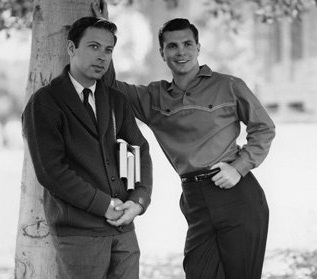
Krishna is the latest in a dynasty of gay allies.  His great-grandfather was folksinger Woody Guthrie (right), who was introduced to radical politics by the gay couple Will Geer (later Grandpa on The Waltons, center) and Harry Hay, founder of the Mattachine Society, the first modern gay rights organization.

Woody remained close to Will through his life.  No doubt he would have been outraged to hear his anthem, "This Land is Your Land," used by the anti-gay marriage NOM at their rallies.


Woody's son Arlo Guthrie (left, with Will Geer) became the poster boy for hippie androgyny, gleefully transgressing gender norms in dress, hair, and behavior.

He starred in the counterculture classic Alice's Restaurant, which contains as many gay subtexts as the censors would allow.

He often sneaked pro-gay messages into his songs, like lambasting the military's "Don't Ask, Don't Tell" policy in "Alices Restaurant."


Woody's granddaughter (Krishna's aunt), Sarah Lee Guthrie, and her husband, Johnny Irion, often perform at gay venues.

And that's not all.  Arlo and his wife Jackie had four children and ten grandchildren.  There's an entire Guthrie clan out there, all raised to believe that it's ok to be gay.


Nov 19, 2020

The Many Loves of Dobie Gillis

The Many Loves of Dobie Gillis (1959-63) was about a teenager (Dwayne Hickman of Love That Bob) so immensely girl-crazy that in the first season he announced it in every episode: "I'm Dobie Gillis, and I like girls.  What am I saying?  I love girls!  Beautiful, gorgeous, soft, round, creamy girls!"


Other people in Dobie's world are peculiarly low on straightness, however.  His proto-hippie buddy Maynard G. Krebs (Bob Denver, right, later of Gilligan's Island) shrinks away from the word "girl" as timidly as the word "work," both symbols of heterosexist destiny.

He expressed heterosexual interest only a few times, and usually in the first season.  In "The Gigolo," he is sought after for dates because his lack of heterosexual interest makes him safe.

Scripts sometimes "explain" this lack of interest as shyness, but in his autobiography, Bob Denver insists that Maynard "isn't afraid of girls; he just wants to pursue his own life."


Tomboy Zelda Gilroy (Sheila Kuehl) has a crush on Dobie, but withdraws in horror when he pretends to acquiesce; maybe she is using the crush to avoid any realistic attachments to boys (in 1994, Sheila Kuehl became the first open lesbian elected to the California state legislature).


Even the foppish Milton Armitage (Warren Beatty) seems uninterested in girls for their own sake, merely using them as tools to one-up Dobie.  After the first season, Warren Beatty left the series, replaced by the gay-coded cousin Chatsworth (Steve Franken), a mother-obsessed milquetoast who doesn't even bother with the pretense of liking girls.  Instead, he openly competes with Maynard for Dobie's affection.


Even the intensity of Dobie's attraction to girls is open to dispute.  The "I love girls" speech was dropped after the first season, and most episodes were about groups of friends rather than crushes and dates.

In one episode, Dobie is even suspected of being gay.  He dates a girl who belongs to a family of trapeze artists (Francis X. Bushman, Jud Beaumont, Tip McClure), who wander around the house in togas, discussing the benefits of "the Greek way," an obvious double entendre.

  To demonstrate their enthusiasm for Dobie, they mob him, rip his clothes off, and give him a toga of his own.  Dobie's Dad arrives, mistakes the togas for dresses, and concludes that Dobie has "gone funny" in a household of drag queens.

Dwayne Hickman went on to star in the buddy-bonding Cat Ballou, with Michael Callan.

Nov 16, 2020

The Naked Ape: Johnny Crawford's First Nude Scene

Other than Burt Reynolds posing on a bear skin rug for Cosmo, this is probably the most famous nude photo ever: a frontal of Johnny Crawford, a Boomer icon for his teen idol songs and his role as the squeaky-clean, innocent kid on The Rifleman, no longer squeaky-clean or innocent, letting it all hang out for the swinging 1970s.  It was used to advertise The Naked Ape (1973). 

But no one has actually seen the movie, unless you went to the theater on the three days in August 1973 when it was playing.


The book The Naked Ape (1967), by Desmond Morris, attributes our behavior today to the evolutionary advantages of our caveman ancestors.  Women are attracted to big muscles, for instance, because they were better for fighting off saber-toothed tigers, thereby enhancing survival.  Men are attracted to big breasts because they can nourish infants better, thereby enhancing offspring survival.

Wait...not every woman likes big muscles, and not every man likes big breasts.  Sometimes it's the other way around.  Physical attractiveness is primarily a matter of cultural norms.

Anthropologists thought it was ridiculous, but the back-to-nature set grabbed copies as fast as they could be printed, creating the first anthropological bestseller since Margaret Mead's Coming of Age in Samoa.  

But how do you make a movie out of an anthropological text?

Not very easily, apparently.

It seems to be about two college student (Johnny Crawford, Victoria Principal), who get all horny with each other and hang out naked, while a psychiatrist (John Hillerman) explains their behavior as cave-people grunting.  There are trippy animated sequences.  Robert Ito of Quincey plays a samurai.  Davis Olivieri of The New People is in there somewhere.  Since it was produced by Hugh Heffner of Playboy, I doubt that there is any gay content.


In spite of the word "naked" in the title, The Naked Ape came and went instantly.  Writer/director Donald Driver never wrote or directed any movie ever again.  It received no play on tv, hardly any on cable tv, it's not on youtube or Netflix, and there's no DVD available. It's hard to even find a plot synopsis.

Maybe it's for the best.  After seeing the nude frontal of Johnny Crawford so often for so many years, what movie could live up to the expectation?

You can see the uncensored photo on Tales of West Hollywood.


Oct 29, 2020

Head: More of the Monkees

After their spectacular, media-orchestrated rise to fame in 1966, with a top-rated tv show and several #1 hit songs, the Monkees were on top of the world.

 But not for long. They chafed at their "boy band" restrictions; they wanted be known as serious artists, to move beyond teeny-bopper love songs,  to tackle serious issues. They wanted to be free. Their handlers disapproved.

In the spring of 1968, they wrote and produced a movie, Head.  It premiered with great anticipation; fans thought that it would be a comedic documentary, like the Beatles' Hard Day's Night.

It wasn't.

You say we're manufactured -- to that we all agree.
So make your choice and we'll rejoice in never being free!


It consists of a series of sketches, most about the difference between reality and the manufactured plotlines of their tv series: Davy becomes a boxer; Micky is lost in the desert; they visit a haunted house and the Old West.  They constantly disrupt the stories, changing their lines, dropping character, or just saying "We don't want to do this anymore" and walking off the set.

But every set leads to a new story.

They think they have escaped, and settle down to throw a birthday party for Mike.  But he starts yelling that this is not his apartment, these are actors, not his real friends, it's all a fake.

They escape from a box only to find themselves in a bigger box.

They try to commit suicide, only to find that that, too, isn't real; there is no escape.

The constraint of modern life, the inability to ever be free, is a common thread in 1960s media, and resonated strongly for gay kids growing up in a constant drone of "What girl do you like?  What girl do you like?  What girl do you like?"

We've seen it in Easy Rider and Alice's Restaurantin the Tripods series of dystopian mind-control novels, in Richard Schaal trapped in The Cube; in Number 6 trapped in The Village, even in the Castaways trapped on Gilligan's Island.


Still, this version is worth a look for:
1. The clever "box inside a box" concept
2. The frequent beefcake.  You see more of Micky and Davy than ever before, constant shirtless and semi-nude scenes, and all of the guys gets close-ups of their very, very tight pants.
3. The homoerotic buddy bonding that shines through, in spite of the frequent girl-kissing.  These guys are into guys.


In a way, Head represented the suicide of the group.  Teen fans hated it, and the psychedelic generation stayed away.  Their tv series was cancelled, and their songs stopped charting.

But, 50 years later, the memory remains.

Head is streaming on Amazon Prime.
Related Posts Plugin for WordPress, Blogger...