Mar 5, 2022

Dennis the Menace


Newspaper comics aren't for kids.  They never have been.  We couldn't understand Blondie and Dagwood or Hi and Lois; if the husbands and wives hated each other so much, why didn't they just leave?  Comics starring kids, like Peanuts,  were even worse; references to contemporary sports and politics that we knew nothing about, using words that no real-life kid would even think of.

Dennis the Menace was an exception, a single-panel strip detailing the adventures of Boomer kid Dennis Mitchell, drawn as about five years old but enjoying the freedoms of someone much older.  Hank Ketchum's single panel strips first appeared in 1951, and could be seen in thousands of newspapers through the sixties, as well as an iconic sitcom and a featue film, as millions of parents of Boomer kids saw a reflection of their own lives.

 I encountered Dennis through the series of cheap paperback reprints that appeared regularly in garage sales and library book sales every summer: Dennis the Menace...Teacher's Threat, Dennis the Menace -- Nonstop Nuisance, almost thirty titles in all.


I noticed 3 things right away:

1. Dennis was my exact opposite.  I was quiet, mild-mannered, and didn't like to play outside.  He was rambunctious, aggressive, destructive, uninhibited, a “little savage."

I was occasionally scared, and I cried when I was upset, but Dennis never waivered from his hypermasculinity. He displayed not a moment of weakness.  He was, as adult characters kept saying, "all boy."

2. His foil, Margaret, was an absurdly exaggerated "girl."  Although extremely intelligent, she pushed a doll carriage, jumped rope, played “dress up,” and could think of no possible future except as a housewife, or maybe an airline stewardess.  She was not shy about her intentions: first civilizing Dennis, teaching him manners and fashions, and then marrying him.


But Dennis would have none of it:

He slugged Margaret in a Tunnel of Love because he thought she was trying to kissing him.

At a party, he anticipated that Margaret would want to play “post office,” a kissing game, so he brought a stamp to put on her nose.

3. Dennis was not only uninterested, he couldn't even recognize heterosexual desire when he saw it.

When he saw an adult couple kissing, he concluded that “They’re fighting.”

 A sailor kissing his girlfriend: “Makes you wonder what kinda guys they got protecting our country."

A cowboy with a woman on his arm: “She must be his sister.”


His Dad and neighbor Mr. Wilson ogling a cheesecake calendar: “They’re talking about football. 40-23-36 is signals.”


It didn't last.  Sometime during the 1970s, the reprint books introduced Italian immigrant Gina, tall and slim, in a mod outfit.  No prissy girl-stereotype, she liked skateboarding and soccer, didn’t disapprove of dirt and bugs, and could beat up any boy. Dennis was entranced. Maybe he never met a girl that he had anything in common with before.

"Gina makes me feel all funny inside," he announced to his parents.  And met his heterosexual destiny.

But in the 1960s, Dennis gave gay kids the freedom to not to be interested in "the opposite sex," in spite of what parents, teachers, and peers kept telling us.


Mar 4, 2022

Better Nate Than Ever: Gay Kids, Wacky Aunts, and Beefcake


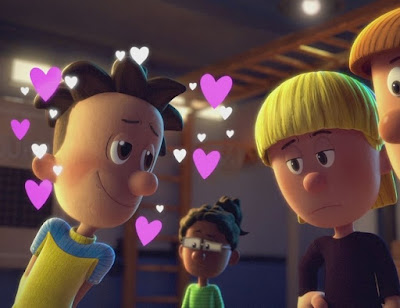
Big Nate
is a comic strip character who first appeared in 1990.  Since then, there have been many collections, a series of chapter books  with pun titles, some activity books, a musical, and an animated tv series (with Nate voiced by Ben Giroux).  A live action movie, Better Nate Than Ever, js set to appear in April 2022.  Creator Lincoln Peirce writes that in the original chapter book (2013), he included a subplot about a boy coming out, which caused homophobic schools to cancel his speaking engagements and libraries to ban all of his books.  But he also got "a lot of support" and won a Lambda Literary Award.  

I didn't want to wait for the movie, so I bought the book.  

Nate, age 13, lives with his working-class parents and older brother Anthony in a suburb of Pittsburg.  He loves musicals, and acts out various scenes with his friend Libby, who has a crush on him.  However, when she moves in for a kiss, he backs away.  He states that his sexual identity is unknown: "I'm 13.  Macaroni and cheese is my favorite dish.  How do I know who I want to hook up with?"

You generally know who you're attracted to at a very young age, even if you're not thinking in sexual terms yet.   But let's go with it.


The other chapter books and the tv series portray Nate as aspiring artist and chess player, never mention a musical, and give him friends named Francis and Teddy but not Libby.  He concocts wild plans to meet girls,  has had three girlfriends,  and dissolves into a slurry of hormones when he sees Jenny, the Girl of His Dreams.  

In the comic strip, we see the same characters and hetero-horny hijinks.  Nate is currently accusing his buddy Francis of being a jinx who caused their favorite sports team to lose.  

What's going on?   


Better Nate Than Ever
is not included in the list of Big Nate novels, nor are its sequels, Five Six Seven Nate (2014) and Nate Expectations (2018), "wonderful evocations of what it's like to be a theater kid."

Turns out that this is a new evocation of the character, written by Tim Federle (with Lincoln Peirce's permission, one assumes).

Nate's interest in musicals, and singing and dancing in general, gets him a lot of homophobic harassment.  His older brother calls him a "homo" and asks if he's practicing Gays and Dolls.  His father disapproves of his goal of becoming an actor and "hanging out with a bunch of queers."  Even his mother complains that the neighbors can see him prancing around in the back yard "like a fairy." 

He and Libby see a call for open auditions for the role of Elliott in E.T.: The Musical, to be held in New York City.  The day his parents happen to be going out of town.  They come up with a plan: Nate will "borrow" his mother's ATM card, take the bus five hours into New York, audition, then get back on the bus and home before Mom and Dad notice.  

The book details Nate's very funny adventures on the bus and at the audition, with some subplot involving his freespirited Aunt Heidi.  Nate tries to get a guy to ask her out, but he states that he "only dates men."  Nate is shocked for a moment, but then says "Hey, that's great!"   No subplots about boys coming out.  Could I have gotten the wrong book?

The 2022 live action movie will star Rueby Wood as Nate,  Lisa Kudrow as his wacky Aunt Heidi, and Joshua Bassett as older brother Anthony.


Joshua Bassett came out as gay while starring in High School Musical: The Musical: The Series (actually he said that he identifies as LGBTQ+, but there are many letters in the alphabet, and it's ok to still be figuring out which applies to you).  His Anthony  plays a bigger role than in the novel, as an ally rather than an antagonist (and he gets a shirtless shot in the trailer).  

Joshua promises that there will be "gay kids" in the movie, but I don't see any likely prospects on the IMDB cast list.  Unless it's Nate himself.   

Feb 18, 2022

"The Cuphead Show": Will Updating 1930s Fleischer Studio Animation Give Us Some Gay Characters?


 The Cuphead Show
, based on a video game, is drawn in the animation style of the Fleischer Studio of the 1930s: a worled where human, animal, and objects interact, bouncing constantly, singing to the latest jazz songs, and falling prey to the "heebie jeebies."  It has been criticized for not acknowledging the racism of those early cartoons, but really, why should it?  Movies and tv shows set in earlier generations almost always pretend that racism, sexism, and homophobia did not exist.  

Cuphead (Tru Valentino, left) and Mugman (Frank Todaro), who live in the Inkwell Isles (an homage to Fleischer's "Out of the Inkwell"), have teacups for heads, with bent straws protruding from the top and liquid sloshing around inside.  They form the standard aggressive/passive, "let's have an adventure"/ "that's not a good idea" pair.  


In the first episode, "Carn-Evil," they are brothers or foster brothers, living under the guardianship of Elder Kettle.  Cuphead talks Mugman into blowing off their job of painting a fence to go to a carnival, which turns out to be a "carn-evil": The Devil (Luke Millington-Drake), who scats like Cab Calloway, is using it to harvest souls.  

Gay subtext: Some hugging and rescuing each other..

1930s cartoons were not good at continuity: Betty Boop changes randomly from child to adult, and Bimbo could be her boyfriend, friend, or pet dog.  But in the second episode, "Baby Bottle," Cuphead and Mugman are still children, left home alone for the day.  A baby...um...penis with a condom partially rolled onto it?  --  is left on their doorstep.

Gay subtext: They move into maternal and paternal parenting roles, with marital-couple fights: "It's like you didn't even want to have this baby!"  

The third episode, "Ribby and Croaks," follows the boys as they try to break into a riverboat nightclub run by two Brooklyn-accented frogs.  

Gay subtext: the frogs sing about how there's only one women in their life, their "Mudda."  

Beefcake:  None.


Gay Characters:
  Cuphead and Mugman have the usual gay-subtext relationship, coupled with a lack of heterosexual interest.  In the last episode, they meet a girl cuphead (actually a chalice-head) who charms people into giving her stuff.  But they don't find her entrancing; they just want to know her secret, so they can charm people into giving them stuff, too.

But in a contemporary show on Netflix, I expect actual recognizeable gay characters.  I didn't see any.

Villain:  In the first episode, the Devil says "Cuphead still owes me his soul!"  So I expected him to be the Big Bad of an ongoing story arc, but he doesn't appear in any of the episodes I watched.

1930s Homages:  After the first episode, not many.  One gets the impression that the Fleischer-esque animation was just a tease; the producers expect the show to stand on its own merits.  

My Grade:  The Cuphead Show doesn't really stand up on its own.  I'd rather watch the old Betty Boop cartoons.  C.

See also: The Gay Symbolism of Betty Boop


Feb 13, 2022

"Just Friends": Dutch Rom-Com about RIch/Poor Boys and their Overbearing Mothers


 Just Friends, on Amazon Prime, a tv-movie from 2018: "Something beyond the pleasures of a young gay love story, and the conflicts with their families have nothing to do with their sexuality."  

It might be a change of pace from the endless autobiographical "coming out in a world where no gay institutions exist."  

Plus it's from the Netherlands. I'll check it out.

Scene 1:  The motorcycling Joris (Josha Stradowski) leaves Amsterdam, stops to play with his drone, and calls his mother.  At a shopping mall, the heavily-shopping, smoking socialite, who looks the same age as Joris, upbraids him for forgetting Mother's Day. Suddenly her heel catches on the escalator, and she falls on her face. Har-har.  Serves her right for being an entitled richster.    

Joris continues on the motorcycle, and finally meets Mom and snippy, entitled teenage Sister.  They criticize him for not visiting his father while he was sick, although they didn't visit, either.  

They've come to the cemetery to pick up Dad's ashes.  No one wants them, so Joris gets them by default.  


Scene 2:
Feet getting off a train. No doubt Yad (Majd Mardo), Syrian refugee, waiting at the train station.  He remembers working as a stripper (in a gay club, I assume) and overdosing on GHB and vodka.  A nice, non-critical middle-class Mom picks him up -- she even brings pastry!  She tells him not to use the name of Jesus in vain (fundamentalist -- is she going to be homophobic?  And not Muslim.  I guess there are Christians in Syria). 

At home, Dad is busily working on his book.  Yad hugs him and his baby sister.  Mom says that since he's moved back home, he'll pay rent and do his own laundry.  I get it -- rich is entitled and bitchy, poor (or middle class) is kind and virtuous.

Scene 3:  Yad goes to the beach and asks for his old job as a surfing instructor back.  Nope, full up.   A girl hugs him and welcomes him home -- he was in a downward spiral in Amsterdam.  They go surfing (surfboards with little sails attached). 

Meanwhile, Joris is at the same beach, playing with his drone.  He sees Yad, and sends his drone out to investigate. "Yum...what a hunk!"

Scene 4: Back home, Joris mixes up some muscle-building powder.  He passes Mom -- super-strung out on drugs -- and goes to the gym, where the personal trainer criticizes his technique (poor guy gets criticized by everybody).  He stops to gaze at the bulge of the guy doing bench presses (um...we already knew that he was gay before we started the movie.  He calls his grandmother, and promises to pick up milk.

Meanwhile Yad is filling out a job application. "It's just cleaning, no nursing or groceries, and it's just 14.5 per hour" ($16.45 U.S., which is double minimum wage.  What's the problem).  She gives him the job -- and her phone number.  Hey, that's sexual harassment!

Scene 5: Cut to Yad making an old lady's bed, while she bemoans world events, mentions that she lost her best friend Sophie to the Holocaust,  and asks where he's from.  He won't say.  Suddenly her grandson arrives with the milk.  Time for a meet-cute.

But first Grandma sits Grandson Joris down with chocolate milk to discuss family squabbles.  Yad comes in; Joris turns in slow motion.  His jaw drops to the floor.  The most beautiful man he's ever seen!  Geez, they do that old cliche even in gay romances. 

They shake hands.  Yad finds some reason to bend over to display his butt (I knew you were a bottom three scenes ago).   Unfortunately, Joris is too overcome by horniness to say anything.  

Joris goes out to trim Grandma's hedge, and takes off his shirt, but Yad is not impressed: he complains to Grandma about her grandson's use of  "ridiculous muscle-building machines."  It's called a gym, dude. You have to join one, or they take away your gay card.


Scene 6: 
 Upset over his inability to attract the hunk, Joris goes home and collapses onto the bed.  Meanwhile, Yad tells his Mom about his new job.  She disapproves; "You went to medical school!"  "I dropped out."  "Cleaning old ladies' rooms is beneath you!"  "I like it"

Scene 7:   Joris at a barbecue at his Sister's elegant house, chatting while her husband tries to grill while holding a baby. Give him a hand instead of ruminating over your problems!  He decides to take surfing lessons to impress the hunk, and doesn't stick around for dinner. 

Scene 8:  Joris paying for his surfing lessons.  The sign says "No Credit Cards" in English.  That's the problem with the Netherlands -- you rarely hear Dutch in public.  Whoops, he's assigned a girl teacher.  Nope, changed my mind!  

Next stop: Grandma's house, where apparently Yad has a full-time job cleaning and being hunky.  Yad asks: "What music are you listenng to?"  A conversation opener! Go for it!  But Joris is too overwhelmed by horniness to answer properly, so Yad takes the lead, going through his playlist and commenting.  

Overcome by horniness, Joris rushes off.  This guy is a basket case!  Is he not, like, aware that he is gay?  Yad yells "Hey, can I get your number?"  Grandma gives it to him.

Scene 9:  Joris on the exercise bike at the gym.  Yad sends him some sexy pics.  He texts a date request.  But Yad never responds! 

Scene 10: Mom is at Grandma's house to discuss her birthday.  Yad introduces himself.  Mom is prejudiced against refugees or Syrians: "he'll steal all your valuables."  But Grandma insists on giving him his own key. to the house.  

When she leaves, Grandma apologizes: She used to be a nice girl.  Then she got rich. 


Scene 11: 
 Back home, Mom rants at Joris about Grandma's new "Muslim type."  Finally the "Muslim type" texts him back; they set up the date.  The overjoyed Joris rushes to shower and change clothes.  Mom is suspicious.

While Joris picks up Yad for their date, Yad's Dad stares from an upstairs window.  Does he, like, not know that his son is gay?

Scene 12:  The date is hanging out at the beach -- where they go every day anyway.  How about something a little more elaborate, like a nice dinner -- in town?  I'm sick of looking at a beach.  They play with the drone, swim, and finally do a weird upside down kiss. 

I'll stop the scene-by-scene recap there. 

Yad and Joris are both out to all their relatives, so that's not a problem.  Everyone approves of the match except the Moms, each of whom thinks that the boyfriend isn't good enough for her son.  Conflict comes with....um...Joris's Dad had an affair before he died?  

Beefcake:  Joris has his shirt off a lot, and displays an underwear bulge.  Yad, not so much.  There are no other significant male characters, just sisters and mothers.

Gay Characters:  Just Joris and Yad.

Locations: Just the beach at Almere, 30 km from Amsterdam.  I wanted to see the Oude Kirke and some canals.

Rich/Poor Divide:  They appear to be trying a rich boy/poor boy conflict, but I can't really tell the difference between the two families.  Both are clearly affluent.

Title:  They're never just friends, that is, not-romantic.  Does "gewoon vrienden" mean something else in Dutch?

My Grade: B.

Related Posts Plugin for WordPress, Blogger...