Showing posts with label war. Show all posts

Apr 30, 2026

Andrew Stevens: Teen idol gave us queer codes in "The Fury," took off his shirt a lot, but never played a gay guy again


Nazarenes weren't allowed to go to movie theaters, so during my senior year in high school, I began telling my parents I was heading to the library or a friend's house, and sneaking out to the Showcase Cinemas to see The Chicken Chronicles (Steve Guttenberg, sigh), Close Encounters of the Third Kind, High Anxiety, Coma, The End, Big Wednesday, and in March 1978, The Fury:  Robin (Andrew Stevens, top), who has psychic powers, is kidnapped, so his Dad, former CIA agent Peter (Kirk Douglas, bottom) enlists a girl with psychic powers to find him.  


Everyone is heterosexual, and the guys both die at the end, which would be a major red flag today, but as a high schooler a few months away from recognizing that I was gay, I found many queer codes and a lot of beefcake. 


I had some idea that Andrew became a member of the Brat Pack in the 1980s, starred in some buddy-bonding angst dramas, and was called a "f*g" by Molly Ringwald (who would go on to play a pro-gay Mom in Stranger Things).  But that turns out to be Andrew McCarthy.  I haven't seen Andrew Stevens in anything else.  Here's why.


Born in 1955 in Memphis, Andrew started his career as a cute teenager, subtly muscular, with shaggy hair and a goofy smile, for "heartwarming" roles as cute or wounded kids in tv series like Apple's Way (1974), Police Story (1975), and Shazam! (1976).  I didn't like heartwarming.


In the 1980s, hair straightened, muscles bulging, tanned, Andrew began playing  suave playboys or con artists in the tv soaps Emerald Point N.A.S , Dallas, and Hotel.

Soap operas?  No way!


More after the break

Jan 5, 2025

That scene from C*A*U*G*H*T, the Australian hostage comedy. You can't see the television series, but you can see the d*cks


Link to the n*de photos

I've been looking at n*de guys in mainstream movies and tv shows for a long time. Accidental displays all the way back to Mark-Paul Goesselaer in Dead Man on Campus (1998), full, open displays on Europhia and The Righteous Gemstones.  But this morning I saw a screenshot so shocking that I couldn't believe it aired on a mainstream television program (after the break).

So I had to research the program: C*A*U*G*H*T, with asterisks, like M*A*S*H,  to distinguish it from the other tv series named Caught that premiered that year.  It is a six episode comedy produced, written, and directed by Kick Gurry (Kick?), which aired on the Stan network in Australia, in September 2023.  It was pulled from international release, so not available in the U.S., but I read an episode guide.

The plot: four Australian soldiers go on a secret mission to the war-torn island of Behati-Prinloo, where they are mistaken for American spies and captured by "freedom fighters."  They release a homemade hostage video that goes viral, resulting the U.S. Secretaryof State, played by Susan Sarandon, negotiating for their release and Sean Penn offering to exchange himself for the guys.

As far as I can tell, all of the characters and actors are heterosexual.  


The four are:

1. Lincoln Younes as Albhanis Mouwad.  The former Home and Away soap star is known for Down Under, Tangle, and Grand Hotel.

2. Kick Gurry (Kick?) as Dylan Fox.  He is best known as Sparky in Speed Racer and Griff in Edge of Tomorrow.  He's rather unattractive, so we'll skip his photo.


3. Ben O'Toole (shouldn't that be Rod O'Toole?) as Rowdy Gaines (Rowdy?).  He is best known as Snapper Webster in Barons (Snapper?).


4. Alexander England as Phil Choi.  He appeared as Mnevis in Gods of Egypt.

More after the break, including that scene

Oct 11, 2024

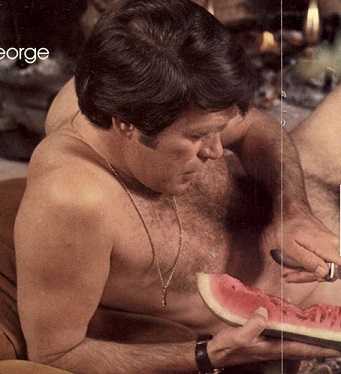
Christopher George: Marine, cowboy, spy, Hugh Hefner, warlock, fitness model. Is there a gay connection?


When Christopher George posed in June 1974, he was 43 years old and a Hollywood veteran, famous for The Rat Patrol and about 50 gung-ho, "can we win this time?" war and cowboy movies.

He reclines, eating watermelon, a little paunchy in middle age, but hirsute, tanned, gold-chained, the sharp phallic knife accentuating his obvious gifts beneath the belt.

IMDB calls him a "solidly built, boyishly handsome leading man.  He was born in 1931 to Greek immigrants, and didn't learn English until he was six years old.  In high school in Miami, he played football, soccer, and track, drove trucks, and shot alligators.  He was planning to become a Greek Orthodox priest, but in 1948 he dropped out of high school to join the Marines, and got the acting bug.  While waiting for his break, he held a variety of macho jobs, like bouncer, private investigator, and owner of a beer bar.  He started on the stage, roles in Cat on a Hot Tin Roof, Mr. Roberts, The Moon is Blue, and Stalag 17.

In 1965, he got a guest spot on Bewitched as George the Warlock, a Hugh Hefner-like playboy with a harem of women. Endora hires to seduce Samantha, but he likes her attractive neighbor more. 

He was also cast in In Harm's Way. with John Wayne as a naval officer who wants to beat the Japanese during World War II.  The two shared a gung-ho, macho philosophy, and became lifelong friends.Lots of rough, true-grit war and cowboy movies, flag-waving reactions to the pot-smoking, draft-card-burning, "can't tell the boys from the girls" hippies: Massacre Harber, The Thousand Plane Raid, The Devil's 8, Midway, Mayday at 40,000 Feet!


In Project X, 1968, Christopher plays a spy whose memories of a top-secret Commie weapon are being suppressed, so the good guys use advanced technology to extract them.  He has sex with the naked lady on the movie poster.


Christopher also did some modeling.  That's how he met Lynda Day, who became famous for her work on Mission Impossible and her Playboy centerfold.  They were married in 1970.

A heavy drinker and smoker throughout his life, Christopher died of a heart attack on November 28, 1983.  He received a Greek Orthodox funeral. In 2009, the Marines flew a flag at the Iwo Jima memorial.

Is there any gay potential to such an indefatigably macho, hetero-horny, beefy, boyishly handsome Hugh Hefner?

Answer after the break

Aug 8, 2023

Jackanapes: Boyfriends in a Victorian Children's Story


When I was a kid ,there were only a few books in the house, so I spent many hours leafing through the nine volume Junior Classics (1956), an anthology of antiquated stories that someone born before horseless carriages were invented thought that modern kids should read, such as Alice in Wonderland and King of the Golden River.

As a nine or ten-year old, I often found the words too hard, the references obscure, and the plots disturbing. Julia Horatia Ewing's Jackanapes (1883), from the ironically entitled Volume 5, Stories that Never Grow Old, certainly qualifies: it starts with villagers who live on the Green talking about a sexton "who would be ninety-nine come Martinmas, and whose father remembered a man who had carried arrows, as a boy, for the battle of Flodden Field."

Ok: I didn't know what a Green was, or a sexton, or Martinmas, or Flodden Field.

And when I skipped ahead to the end, Jackanapes, whoever that was, had died.  Depressing.

Years later, in my college Shakespeare class, I heard the word again: Jackanapes was the nickname of Sir William de la Pole, who appears in Henry VI.  So I returned to the story, and found a Victorian model of same-sex love: a Bart Simpson troublemaker and his friend Tony, weaker, more cautious, and described as "beautiful."  The two smoke cigars, get sick on a merry-go-round, and concoct schemes to get money to buy horses.

Fast forward twenty years, and they are British calvary officers (and not married).  In the heat of battle, Tony falls off his horse and breaks his leg.  The enemy is approaching fast, but Jackanapes rushes over and prepares to lift Tony onto his own horse.

"Jackanapes! It won't do. You must go on. Tell the fellows I gave you back to them, with all my heart. Jackanapes, if you love me, leave me!"

There was a daffodil light over the evening sky in front of them, and it shone strangely on Jackanapes' hair and face. He turned with an odd look in his eyes that a vainer man than Tony Johnson might have taken for brotherly pride. Then he shook his mop and laughed at him.

"Leave you? To save my skin? No, Tony, not to save my soul!"

Jackanapes then rescues Tony, though it means that he will die.

The rest of the novella involves the folk back home gossipping about Jackanapes' sacrifice, and the author moralizing about God and country.  But the gay subtext is strong, and clear, and survives the obscurity of the text.

Later I discovered that Victorian literature is filled with gay writers.  Julia Horatia Ewing was not among them.

Feb 21, 2023

Sad Sack

When I was a kid, I loved Harvey comics' supernatural titles, Casper, Spooky, and Hot Stuff having science-fiction and espionage adventures in the Enchanted Forest.  In a pinch, I didn't mind the kids-with-crazy-obsession titles, Little Dot, Little Lotta, and Richie Rich.  But I never even picked up Sad Sack.  

Military humor -- gross!  It was the middle of the Vietnam War.  Our fathers and older brothers were dying in Vietnam, or burning their draft cards and going into exile in Canada.  Who wanted to be reminded of all that?

But recently I came across an old book, The Sad Sack.  Apparently the character existed before Harvey Comics, in a pantomime strip published by Sergeant George Baker in the military magazine Yank during World War II.  The Sad Sack (short for "Sad Sack of Sh*) was a classic schmiel, beset-upon by bad luck, but tough, masculine, and sexually active (although here he's paying a woman to iron his pants).


Two hardcover compilations of Sad Sack strips appeared in 1944 and 1946.  There was a radio series (1946) starring Herb Vigran and a movie adaption (1957) starring Jerry Lewis.

Harvey took over the franchise in 1949, giving Sad Sack a voice, a nebbish personality, and surprisingly, a lot of shirtless and semi-nude shots (although he didn't have much of a physique).

 He was now a permanent private at Camp Calamity, so he would never go to war (like Beetle Bailey and Gomer Pyle), and he had a coterie of friends and superior officers, notably Sarge.


Sad Sack and Sarge have a "antagonistic best friend" relationship similar to that of Beetle Bailey and Sgt. Snorkel, with the same homoerotic subtext.


There were many spin-off titles, including Sad Sack's Funny Friends, Sad Sack's Gobs n Gals, Sad Sack and the Sarge, and Sad Sack Laugh Special.  Sounds like Archie spin-offs like Pals n Gals, and Laugh.

I never knew whether Sadie Sack was Sad in drag or just his girlfriend, but she turns out to be his female identical-twin cousin.  Rather a gender bender.


The Sad Sack title continued to be published for over thirty years, ending only when Harvey Comics folded in 1982.   so somebody was interested in Sad's chubby physique and buddy-bonding with the Sarge.

Just not me.


Nov 1, 2021

60 Movies I Will Never See (Or Saw and Regretted)

There are 6 basic emotions, 1 positive (happiness), 3 negative (sadness, anger, and disgust), and 2 which could be either (surprise, fear)  The function of a movie, book, song, or other work of art is to elicit positive emotions, to make the audience feel better after viewing than they did before.

So I don't understand movies that deliberately elicit sadness, anger, or disgust.  Why would anyone want to watch something that makes you feel bad?  Don't you get enough bad feelings in real life?

Here are 60 movies that I will never see, or that I saw and regretted.

No dying of long, slow, debilitating diseases.  With scenes of yelling at doctors, reconciling with estranged relatives, sobbing, sobbing, sobbing, and holding hands on death beds.

1. Terms of Endearment (1983). Shirley Maclain's daugher dies of cancer.

2. Beaches (1988).  No one surfing or swimming, just Bette Midler singing and crying.

3. Steel Magnolias (1989).  Women face tragedy in the South.

4. My Girl (1991).  Boy falls in love with a dying girl.

5. Lorenzo's Oil (1992).  Family tries to cure their dying son.

6. Stepmom (1998). Hugging and dying.

7. Here on Earth (2000).  Boy's girlfriend dies.

8. Bridge to Terabithia (2007). With Josh Hutcherson (top, recent photo). They fool you into thinking it's a fantasy movie, like Harry Potter.  It's actually about a boy befriending a dying girl.

9. Moulin Rouge (2008).  Fortunately, I walked out because it was so awful long before the deathbed scene.

10. The Fault in Our Stars (2014).  A support group for people dying of cancer.


Especially no dying-of-AIDS.  Yelling at doctors, reconciling with estranged relatives, sobbing, sobbing, and so on, but with homophobia.  Lovely way to spend an evening.

11. An Early Frost (1985).  Guy dies of AIDS.

12. Parting Glances (1986).  Guy dies of AIDS.

13. Longtime Companion (1989). Guy dies of AIDS.

14. Philadelphia (1993).  I was forced to watch this, but kept my nose in a book the whole time.  Guy faces discrimination because he's dying of AIDS.

15. And the Band Played On (1993). The government refuses to acknowledge that people are dying of AIDS.

16. The Cure (1995).  Guy dies of AIDS.

17. It's My Party (1996, left).  AIDS and suicide!  Fun!


No Holocaust as entertainment.  Um... 6,000,000 people died. How can that be turned into two hours of fun?

18.  Sophie's Choice (1982).  She has to choose which of her kids to kill, and later gets a couple of boyfriends.

19. Schindler's List (1993). He helps some people escape from the Holocaust.

20. Life is Beautiful (1997).  Set in a concentration camp. Are they kidding?

21. The Boy in the Striped Pajamas (2009).  More concentration camp hijinks.


No main characters dying, period. Who had th bright idea of killing off the protagonists in car accidents, gunshots to the head, or zombie bites?  Why would I want to get invested in a character, only to have them die?

22. Easy Rider (1969).  I saw this, not realizing that everybody dies, and the movie is ruined.

23. Butch Cassidy and the Sundance Kid (1969),  What's the point of a homoerotic buddy "comedy" if they're just going to die at the end?

24. Thelma and Louis (1991).  I watched this, too.  No one told me that they go over a cliff.

25. Titanic (1997). I was conned into seeing the musical.  Hint: they all drown.

26. The Perfect Storm (2000).  They all drown.

27. Children of Men (2006). Everybody is dying.

28. Pan's Labyrinth (2006).  Girl is dying.

29. Into the Wild (2007).  He starves to death!

30. 28 Weeks Later (2007).  Zombie movies are supposed to have survivors!

31. Burn After Reading This (2008).  I went into this thinking it was a comedy, and walked out when Brad Pitt's comic relief character suddenly was shot to death.

32. Apollo 18 (2011).  Dying astronauts.


No inmates on death row.  You know they're going to die from the beginning.  Why bother to watch?
 33. The Executioner's Song (1982).
34. Dead Man Walking (1995)
35. The Green Mile (1999)

No war.  War is one of the biggest tragedies of life, not a source of entertainment!  If the movie is about humorous hijinks far from the combat zone, ok.  But angst-ridden, somber music, people dying of bullet holes -- no way!  I don't care if the whole platoon struts around naked.
36. Platoon (1986)
37. Full Metal Jacket (1987)
38. Saving Private Ryan (1998)
39. We Were Soldiers (2002)


No ends of the world.  Nuclear holocaust, giant meteor, whatever.  Even worse than the main characters dying, the end of everybody and everything, the most depressing thing imaginable.

40. Dr. Strangelove (1965). Why would you yell "yahoo" while plummeting to your death on the back of a nuclear bomb? I actually saw this, under the impression that it was a "comedy."  It's not.

41. Miracle Mile (1988).  I actually saw this without realizing that the world ends -- until it was too late, and I was trapped there with a date.

42. 2012 (2009).  A flood kills everybody on Earth, except for two hetero couples.

43. Cabin in the Woods (2012). I thought it would be a standard horror movie, with survivors at the end, not "the old gods awaken and start the Apocalypse," and everybody dies.

44. Seeking a Friend for the End of the World (2012).  A "comedy" about a man and a woman (of course) falling in love just before an asteroid kills everybody on Earth.

45. This is the End (2013).  I actually watched this.  Everybody dies,but some of them go to heaven.


No LGBT people dealing with homophobia.  Getting yelled at, rejected, beat up, experiencing angst, and dying.

46. Get Real (1998).  I saw this, thinking it would be ok because no one dies.  Horrible!

47. Boys Don't Cry (1999). Transman is killed.

48. The Laramie Project (2002).  A movie about a real-life horrific hate crime!  Just the thing to brighten your day.

49. Brokeback Mountain (2005). Bisexual cowboys facing homophobia and dying.  No way!


No horrifying handicaps.  I don't care if they overcome adversity and find love, having a handicap is by definition bad, so no movie about it can be good.

50.  The Miracle Worker (1962). I got grossed out by the passage in the book where the child Helen Keller doesn't eat at the table, she just goes from plate to plate and grabs whatever she wants.

51. Johnny Got His Gun (1971).  A blind, deaf, and dumb quadriplegic?

52. Tommy (1975).  A blind, deaf, and dumb boy, plus homophobia.  I turned off the DVD and zapped it back to Netflix.

53. The Elephant Man (1980).

54. Mask (1985).  I don't know what it's about, but it sounds gross.

55. My Left Foot (1989). This one sounded even more gross.

56. The Sessions (2012).  A man living in an iron lung decides to have sex.  Gross.


No movies where the plot summary itself makes me nauseous.

57. Harold and Maude (1971).  I saw this one.  Sickening romance between a teenage boy and an 80-year old lady.  No, I don't think it's at all hypocritical that I'm 60 years old and dating twinks. Plus she commits suicide because she loves life so much.  Huh?


58. Pink Flamingos (1972).  Seen it.  According to John Waters, they offered Divine a substitute, but no, she wanted to really eat the dog poop.

59.
Birdy (1984).  A traumatized Vietnam vet thinks he can fly.  My stomach is queasy just thining about it, gay subtext or not.

60. The Curious Case of Benjamin Button (2008).  He ages backwards!  Can you think of anything more disgusting?  I couldn't even sit through the trailers.

See also: 10 Gay Movies  I Hated.

Aug 17, 2021

Balkan Ghosts: A Lost Gay World


When I was a kid in the 1960s and 1970s, teachers and textbooks never mentioned the Balkans, except for a few guarded references to the Soviet Bloc.  So in my earliest childhood, my information was scattered and spotty, dreamlike, whispering that the countries of the Balkan Peninsula -- especially Yugoslavia -- constituted a "good place."

1. My Village in Yugoslavia (1957), one of the Sonia and Tim Village Booksabout a shepherd boy named Marco, from the mountains of Macedonia, who had muscles and hugged his best buddy with joyful abandon.

2. A Cold War tv commercial displayed a boy with a rusty iron cage around his head, while the narrator intoned a list of countries enslaved by evil: Albania, Bulgaria, Czechoslovakia, Hungary, Poland, Romania, and finally Yugoslavia!  I ignored the message to concentrate on the enslaved boy, his dreamy angelic face and the promise of a muscular physique.

3. A Serbian folktale about a young prince who stumbles across a secret room in the castle, and inside a naked man, Bash Tchelik ("True Steel") bound with chains.  Bas Celik begs for water, and when the prince accidentally spills it on the chains, he breaks loose, develops enormous muscles, and flies away.  He turns out to be the villain of the story, but I was busy thinking about a naked man with enormous muscles.

4. A Serbian story about a boy named Biberice, who remains very small while his peers grow big, but when his village needs him, develops superhuman strength (picture is from a Serbian comic book).

5. One summer at a music festival at a small Lutheran college in Iowa, I came across a book of Serbo-Croatian poems in English translation. One depicted the ache of desire the poet felt as he accidentally watched a beautiful youth, or maybe a nature spirit, swimming at night, his body glowing in the moonlight. I never found the book again, and I don't remember the poet's name.


 6. Skanderbeg, the national hero of Albania, who fought for freedom from the Turks, is commemorated in this beefcake-heavy statue in Debar, Macedonia.


7. Le Feu aux Poudres (The Day the Earth Shook), by Jacqueline Cervon (1969). Four French cousins, vacationing in Yugoslavia, offer the Macedonian Filip a ride to Skopje.  Tragedy strikes when Filip is bitten by a snake, and Eric offers first aid.  Then an earthquake strikes, and Eric goes missing.  Filip goes off in search of his "breath brother."  They finally find each other and fade out into each other's arms.

This was before I moved to West Hollywood and dated the insanely jealous Bulgarian bodybuilder, before discussions of Bosnia and Kosovo became commonplace, before we learned of the war and terrorism and genocide, and the staunch homophobia of the Balkan governments.  When boys with muscles could still hug their best friends, and poets could still write about the ache of same-sex desire.

Jul 3, 2021

Steve Lawrence: All the Sad Young Men

Steve Lawrence and Eydie Gorme were mainstays of The Carol Burnett Show during the 1970s, appearing in 27 episodes.  He also appeared by himself on The Hollywood Palace, Ed Sullivan, Laugh-In, Here's Lucy, even Sanford and Son.


When I was a kid, I disapproved of adult music as a point of pride, so I avoided him whenever possible,  although I remember a gently anti-War song on Carol Burnett: Steve is recounting the horrors of War to his son (played by a teddy bear), who doesn't understand, and keeps asking eager questions like "Did you kill anyone?  Did you have any fun?"   Finally he says "Daddy, bring me some war," becoming a bona fide hawk (not likely for a kid during the Viet Nam era).

And "The Ballad of the Sad Young Men":

All the sad young men, sitting in the bars
Knowing neon nights, and missing all the stars

All the sad young men, drifting through the town
Drinking up the night, trying not to drown

All the sad young men, choking on their youth
Trying to be brave, running from the truth

I didn't know what "gay" meant yet, but I interpreted the song as a critique of gay men who were too stupid or scared to resist heterosexist brainwashing: they kowtowed to Big Brother, dutifully seeking out women to date and marry, and never experiencing real, true, meaningful same-sex romance.

(I may have been a little off in that interpretation: it's the title of a book of short stories by F. Scott Fitzgerald.)

Steve had the looks and the voice, but he never tried to make it as a teen idol.  Maybe he started a few years too early, in 1952, before the teen subculture really took off with Elvis and Ricky Nelson.  Or maybe his songs were too square even for the 1950s: "The Banana Boat Song," "Autumn Leaves," "Pretty Blue Eyes."   But he was on the Adult Contemporary Charts though the 1970s.

He acted in a few movies, playing a stay-at-home husband in the "women's lib" comedy Stand Up and Be Counted (1972), and as Maury Sline, manager to The Blues Brothers (1980).  

He's 85 years old in 2021, and struggling with Alzheimer's.  I haven't been able to discover if he was gay friendly earlier in his life.  Men of that generation always kept silent.

Feb 14, 2021

"1917": Laughable Torture Porn with a Final Heterosexist Dig

I went to a church once where the pastor was obsessed with death and dying.  It was in every sermon, regardless of the topic.  Every reading.  Most of the prayers.  It got ridiculously obsessive.  Finally one mornng, the pastor said "Today's reading is from a gem of a book about a nurse who works with terminally ill babies." I burst out laughing.  

I also burst out laughing during the war movie 1917 , which won three Oscars, seven British Academy Film Awards, four Critics' Choice Awards, and two Golden Globes.  I have just one question: did George MacKay read the script before agreeing to this?  The poor guy endures  countless hardships and tragedies, one piled atop the other, not to mention being killed at least three times.   The script writers must have gone through a list: "Ok, next a rabid wolf?  How about a space alien?  Well, why can't he be bitten by a vampire?"

The only reason I watched was for the gay subtext, which was intense and probably deliberate.  We begin with young World War I soldiers Will (George MacKay, below) and Tom (Dean-Charles Chapman. left) lying under a tree in an idyllic meadow, far from the trenches.  Why did they sneak off?  What had they been up to?  


Their commanding officer calls them in and tells them that there's a problem.  Colonel Mackenzie of the Second Battalion thinks that the Germans are retreating, and plans an attack tomorrow at dawn.  But it's really a trap, and all 1,600 soldiers will be killed.  The telephone lines are down, so Will and Tom must travel nine miles across the hostile German-occupied countryside to give him the order to stop the attack. In less than 24 hours.

They start out.  And the terrible things start piling onto each other.

1. They cross a no man's land of mud and corpses that look like zombies from The Walking Dead.

2. Will hurts his hand on barbed wire.

3. They look for food in abandoned German barracks (didn't they pack some rations?), but it's a trap.  A bomb explodes next to Will, killing him.

4. I guess not.  He's fine.  Next, they stop at an abandoned farmhouse.  A disabled German airplane crashes into it.  They rescue the pilot, who stabs Tom.  Long, agonizing death scene. 

For his final wishes, aside from  "Stay with me while I die!", Tom asks that Will write the letter to his mother announcing his death, and give his brother Joseph, who is with the Second Battalion, his rings and dog tags.


5. Will catches a ride with some sarcastic comic-relief soldiers.  The truck gets stuck in the mud, so he helps them push it, and is covered in mud.

6. The bridge is out, so he has to carefully tight-rope his way across the river, and gets soaked.

7. The abandoned town is not abandoned.  Will encounters a sniper, who shoots and kills him.  There are about 30 seconds of darkness while I wait for the closing credits to start.

8. He was just knocked unconscious (by a gunshot?)..  When he awakens, it is nearly dawn.  After giving a refugee girl some milk for her baby, Will runs, chased by about a thousand German soldiers who are really bad shots, to another river.

9.  He falls in, struggles against the current, and finally plummets over the world's biggest waterfall to his death.

10. I guess not.  Somehow Will survives, and is finally stopped by a dam of floating corpses.  He hears a male voice singing "The Wayfaring Stranger," and makes his waty to a clearing in the woods, where the Second Battalion is...um...enjoying a concert? 

11.  Now he has to rush through about a hundred miles of soldiers, pushing people aside, yelling "Where is Colonel Mackenzie?", and being told "Farther up" so many times that it goes beyond funny to ridiculous.  Finally he reaches the Colonel and convinces him to read the order and stop the troops.


12. Where's Tom's brother (Richard Madden)?  Oh, he was in the first wave, so he's already rushed into his death.  

Psych!  He's fine.  Will gives him the bad news about Tom, delivers the rings and dog tags, and shakes his hand.  

Then Will finds a meadow and sits under what looks like the same tree from the first scene.  

He takes out some photos of someone's wife and daughter.  His or Tom's -- I can't be sure, because neither of them mentioned a wife, or looked at a photo of a wife, or expressed any intereste in women whatsoever, not even in a dirty joke. 

What's going on?  Did the writers say "Oh, wait, we forgot to demonstrate that Will and Tom are straight."  So two hours of obvious gay subtext are ruined by a final, fleeting shot of  The Eternal Feminine. 

And I sat through two hours of torture porn for nothing.  

I should call my old pastor.  He'll definitely find this movie "a gem."

Dec 24, 2020

The Crosby Kids

Bing Crosby (1903-1977), roommate of gay jazz legend Bix Beiderbecke, grew up to be the laid-back crooner that had 1940s teenyboppers swooning, starred in White Christmas, and had six sons. Growing up as celebrity kids took its toll on them, as did Bing's harsh, authoritarian parenting style, and his insistence that they follow in his footsteps.  None of them became famous, but they had some success in the early 1960s performing as the Crosby Boys, and some of them were familiar to the Boomer generation as actors.

1. Gary (1933-1995), left, starred in some lightweight romantic comedies, such as Mardi Gras (1958) and Two Tickets to Paris (1962), and guest starred on many tv series.  In middle age he played authority figures on Adam-12 and Emergency.

2. Davis (1934-1991) acted only occasionally, notably with his brothers and the Rat Pack gang in Sergeants Three (1962).


3. Philip (1934-2004), Davis's twin brother, had two buddy bonding roles, in Robin and the Seven Hoods (1964)  and None But the Brave (1965).  Coincidentally, he buddied with Rat Packer Frank Sinatra in both.


4. Lindsay (1938-1989) starred in several outlaw-biker movies, including The Glory Stompers (1967) and Bigfoot (1970).

5. Harry (born 1958), left, was best known to the Boomer Generation, playing Bill, the camp counselor who plays strip Monopoly and gets slashed in Friday the 13th (1980). He had small roles in several other movies. Today he is an investment banker.


6. Nathaniel (born 1961) (left, hugging Harry) stayed out of acting, and coincidentally the only one who has any gay rumors.  He's a professional golfer.

Aug 13, 2020

Fall 1980: Billy Budd: Gay Sailor Romance

In the fall of my junior year in college, just after I cruised the Miracle Mile and bought my first gay book, I took a class in "The American Renaissance," the burst of creative energy in the mid-1800s: Emerson, Thoreau, Hawthorne, Whitman, Melville.

Our professor (not the one who taught the execrable class in Modern American Literature) admitted that Melville was "a little light in the loafers," but he tried to heterosexualize the texts as much as possible, so he merely claimed that Billy Budd (1888) was about a Christ figure destroyed by the world's evil.


The book cover tried to heterosexualize Billy Budd, too, conveniently placing a woman in the background.  But how could you miss the same-sex desire?  During the Napoleonic Wars, a young cabin boy, described over and over as stunningly handsome, draws the wordless longing of Captain Vere ("Truth") -- and the homophobic ire of Claggart, who falsely accuses him of conspiring to mutiny. While being interrogated, Billy accidentally strikes and kills Claggart, so under British naval law he must be hanged.

Billy forgives the Captain; his last words are "God bless Captain Vere."  But carrying out the sentence destroys Vere; his dying words are "Billy Budd."  I couldn't help but think of Aschenbach, destroyed by his obsession for the beautiful Tadzio in Death in Venice. 


TV adaptions of the novella have appeared twice, in 1955 (with William Shatner) and in 1959 (with Don Murray).


 There's also a 1962 feature film, with Billy played by Terence Stamp (later in Meetings with Remarkable Men and Priscilla Queen of the Desert). 


In 1951, gay composer Benjamin Britten produced an opera version, with libretto by gay novelist E.M. Forster.  It  has Vere survive to old age, when he reflects that once he knew what true beauty was.  It has been filmed in 1988 (with Thomas Allen) and 1998 (with Dwayne Croft), and remains a staple of the theater.  

Recent productions feature a shirtless, muscular Billy, such as those performed by Nathan Gunn (above) and Simon Keenlyside (left).

Also see his gay-subtext filled Benito Cereno.

Jun 5, 2020

A Roland for an Oliver: Gay Medieval Lovers

"A Roland for an Oliver" is apparently a common expression, although I've only seen it in British fiction.  It means that you're equally matched (for instance, these brothers can both bench press exactly 320 pounds each).

It's derived from the Medieval gay lovers that I first read about in The Young Folks' Shelf of Books during my early childhood.

I heard about them again in college, when my French Literature class was assigned a modern version of the 12th century Song of Roland, the national epic of France.


During the siege of Viana, Emperor Charlemagne agreed to let the outcome rest on single combat between two champions.  He sent his nephew, the bold, heavily-muscled Roland, the Prince Valiant of France.  Count Gerard of Viana sent his grandson, the handsome, quick-witted Oliver (or Olivier).  Their talents were complementary; they were perfectly matched.

As they fought, an angel appeared, separated them, and bade them become friends (the same thing happened to Simon and Milo a few generations later).

They spent the rest of their lives together, fighting side by side, and their love, with its divine mandate, was acclaimed in every corner of Charlemagne's Empire.

Then the Saracens began wending their way through Basque country,  If they entered France through the pass at Roncevaux, they would take all of Europe.  Charlemagne and his troops tried to stop them.  In the heat of battle, Oliver was killed, and the distraught Roland cried:

So many days and years gone by
We lived together.
Since thou art dead, to live is pain.


Then he died as well.

I didn't bother to point out the homoromance to my French professor, who no doubt would have insisted that Roland, like Aschenbach in Death in Venice wasn't Wearing a Sign.  He was betrothed to Oliver's sister, after all, and in the Italian epic Orlando Furioso, he falls in love with a woman (and flies to the moon).

The 1978 movie version of La Chanson de Roland gives Roland (Klaus Kinski) an overwhelming hetero-passion.  Oliver (Pierre Clementi, left) looks on with an unacknowledged, unrequited love.


Related Posts Plugin for WordPress, Blogger...