Jun 21, 2018

The Gay World of Pablo Picasso

When I visited the Pablo Picasso Museum in Barcelona, I saw many portraits of women, but only a few of men, and they were all fully clothed.  I concluded that the artist (1881-1973), well known for his many wives and girlfriends, was simply not interested in the male form.

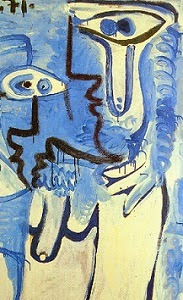
But it turns out that the museum was keeping some of his works under wraps.  Such as this Cubist fragment of a man who is all eyes and penis.


In fact, during his years as a student in Barcelona, Picasso produced many realistic paintings and drawings of nude men, such as this model from 1897.


During his Blue Period (1901-1904), when he fell into a deep depression after the death of his friend Carlos Casagemas, Picasso consoled himself with a number of nude images.


He was in a cheerier mood during his Rose Period (1904-1906), when he was living in Paris.  He continued to produce male nudes, but specialized in adolescents, such as Boy Leading a Horse.

Picasso was very prolific during his long life, producing thousands of paintings and drawings. But, except for a few adolescent boys, his male portraits are often censored, left out of books, not displayed in museums, to give us the impression that he only ever used female models, and perhaps to erase the awareness of same-sex desire from the world.


Did Picasso have any same-sex interests of his own?  Probably -- he wanted to try everything in life, so he must have taken time out from his pursuit of the feminine for some same-sex dalliances.  His biography uncovers an affair with a gypsy boy when he was 17, and suggests that he and Casamegas were romantic partners.

We know that he was nonchalant about gay identity.  He had many gay friends, including Gertrudge Stein and Alice B. Toklas, Sergei Diaghilev, Jean Cocteau, art dealer Paul Rosenberg, and collector John Richardson.  He enjoyed surrounding himself with gay men, if only because they adored him for reasons other than his art.

Jun 20, 2018

"German Culture and Civilization": Dr. Webber tries to prove that homosexualitat does not exist in Germany, in spite of the n*de photos

During the fall of my junior year at Augustana College, I took Introduction to German Literature, where Dr. Weber tried hard to prove that Death in Venice had nothing to do with gay people.  That summer, I had him for German Culture and Civilization, and the gloves were off Homosexualität 'absolutely, emphatically, did not exist in 20th century Germany.

Photographer Wilhelm van Gloeden (1856-1931) moved to Taormina,, Sicily, where he specialized in placing local men and boys in classical settings with pillars and laurel leaves, usually nude, channeling the homoerotic glory of ancient Rome. According to Dr. Weber, he was trying to evoke the military might of ancient Rome as a model for Germany's future. No Homosexualität 


What about Stefan George (1868-1933), who became obsessed with an adolescent named Maximilian Kronberger?   When the boy died of meningitis on the day after his sixteenth birthday in 1904, George wrote a series of poems, The Seventh Ring (1907)which described their encounter as that of a mortal meeting a god (in Dante's Inferno, the seventh "ring" of hell  is inhabited by sodomites).  Eventually the "Cult of Maximin" drew a circle of gay artists and writers.

According to Dr. Weber, Maximin represented the symbolist quest for beauty for its own sake.  No Homosexualität 


What about the physical culture movement, a celebration of the male body, often nude, a fascination with gymnastics, boxing, and track and field, arguably the origin of modern athletics?  (Franz Kafka, author of The Metamorphosis, was a devotee).


Dr. Weber: the glorification of male bodies was a remedy to the feminization of German culture among the symbolists.  No Homosexualität 


At least he Said the Word several times.

He positively refused to discuss the gay symbolism of Steppenwolf, by Herman Hesse, or Der Eigene, the first gay magazine in the world, published from 1896 to 1932.  An offshoot of the physical culture movement, it had over 1500 subscribers and contributors like Thomas Mann and Wilhelm von Gloeden.

See also: The Gay Werewolf of Steppenwolf; and Death in Venice.


Jun 17, 2018

Batman and the Boy Wonder


The Batman tv series (1966-68), like The Adventures of Superman and  The Green Hornet (1966-67) was based on a long-standing comic book series.  But only loosely. The characters were the same -- superhero with no superpowers Batman/Bruce Wayne (Adam West), his teen sidekick Robin/Dick Grayson (Burt Ward), butler Alfred, police chief Gordon, even some of the villains -- Joker, Riddler, Penguin, Louie the Lilac (played by comedy legend Milton Berle). But they infused their characters with a "gee-gosh" earnestness that the hippie generation found hilarious.

Playing along, the producers came up with crazier and crazier villains, as famous actors lined up for guest villain spots -- Cliff Robertson as "Shame," Vincent Price as "Egghead," Roddy McDowell as "Bookworm," William Smith as "Adonis."  Boxer Jerry Quarry played a boxer.


And the predicaments that the Dynamic Duo got into during their weekly cliffhangers became more and more ludicrous.  But what gay kid noticed, or cared?  They were tied up and struggling, muscles were straining, and you had to wait a whole 24 hours to see what clever -- or exceptionally lucky -- strategy they would use to escape.

Sometimes Robin was tied up alone, and Batman had to rush to the rescue, providing a "my hero" moment and the only buddy-bonding.  Otherwise Dick and Bruce were aggressively portrayed as adopted father and son, not as boyfriends, as they had been in the original comic stories (why, precisely, do they sleep in the same bed in a 100-room mansion, or need a cold shower afterwards)?


But what gay kid was paying attention?  Both Adam West and Burt Ward were pleasantly muscular.


And both Burt Ward and Frank Gorshin, who played the Riddler, had extra advantages -- jaw-droppingly obvious even to kids -- that rivaled the enormity of Rupert Grint, 30 years later.  After the first season, complaints from the Catholic League of Decency forced them to tape it down.


Burt's  autobiography, Boy Wonder: My Life in Tights, describes his endowment in intimate detail, and it's also discussed in the Batman biopic starring Jason Marsden, but gay men who had grown up with him were already quite aware.  They had missed the plot details of any number of episodes because it took up the entire tv screen.

See also: Lane's Celebrity Date

Jun 11, 2018

Ken Olandt

During the 1980s, it seemed that every adult actor and teen idol spent eight hours per day pumping iron, so physiques that were merely stunning risked being overlooked in the exalted company of Robby Benson, Allan Kayser, Jon-Erik Hexum, Adrian Zmed, and Sylvester Stallone.

Ken Olandt was almost overlooked.  Trained as an advertising agent, he and his physique started making the rounds of tv guest shots in 1983 -- Love Boat, The A-Team, Simon & Simon, Hotel.  He got a recurring role as a streetwise dock boy on the short-lived Riptide (1984-85).  But he was rarely asked to do as much as unbutton a button by casting agents accustomed to walking, talking versions of Michelangelo's David.

 And the teen magazines, when they paid attention to him at all, showed off his smile (which, to be fair, was very nice).


In 1986, Ken -- or his agent -- hit on a gimmick to get him noticed.  If his pecs and abs were merely spectacular, why not show off the regions where he really surpassed mortal expectatons?  Most other actors were too timid or inadequately superhuman to agree to underwear and jockstrap shots, but Ken was more than qualified, and not at all timid.


April Fool's Day (1986) was a psycho-slasher -- a genre not generally known for male nudity, with the possible exception of Hell Night -- but Ken spent a long scene in his underwear (and, incidentally, buddy-bonding), and gay men and straight women finally started paying attention.


Summer School (1987), a comedy about a substitute teacher (Mark Harmon) who bonds with his students on the way to the beach, featured Ken as a student moonlighting as a stripper.

And so it went for the next decade.  Whether he guest-starred on a remake of the 1960s tv show Gidget,  set mostly on the beach, or Murder, She Wrote, set elsewhere, more likely than not, Ken would be asked to strip down to his underwear or appear nude except for a g-string or swimsuit.

Not that anyone was complaining.
Related Posts Plugin for WordPress, Blogger...