Oct 28, 2020

Vampires vs. The Bronx: Gentrification, Vampires, and The Girl


The adults don't believe in the threat of monsters, goblins, vampires, witches, or zombies, so it's up to the kids to save their town or the world: the teen nerd (who wins the Girl of His Dreams along the way), his wisecracking best friend (who has a gay-subtext attraction to him), and the outsider who derives vital monster-fighting information from classic movies.

Sound familiar?  It's the plot of about a hundred movies from the 1980s, everything from Monster Squad to The Goonies to Hocus Pocus.  But Vampires vs. The Bronx has an interesting twist: gentrification, rich white people squeezing out the black and Hispanic residents (who moved there in the first place because redlining kept them out of "white" neighborhoods).

Scene 1: Establishing shot of the Bronx.  Becki the manicurist has been bought out by Frank Polidori , who comes in to finish the paperwork (uh-oh, John Polidori wrote "The Vampire" in 1819!)  For Murnau Properties (uh-oh, Murnau directed "Nosferatu" in 1922).  After she signs, a vampire sneaks in and bites her.

Meanwhile, a teeange boy is riding his bike through the Bronx, putting up fliers: "Save the Bodega Block Party."  He wants to keep the bodega (grocery store) from being bought out by rich white people.

Scene 2: More establishing shots of the Bronx: people lifting weights, playing cards, buying a slushie. Teenage boy is greeted as "Little Mayor," but his actual name is Miguel.  Meanwhile Gloria the social influencer asks about all the missing person fliers.

Miguel continues to be greeted by so many people that it's annoying.  Does everybody love this kid?

He stops into the bodega, talks to the owner and his friend Bobby.  Then he sees The Girl and gets all gooey-eyed.  I thought in 2020, we would be more inclusive, but nope, there always has to be a scene e demonstrating that the kid isn't gay.  

I'm fast-forwarding.

Miguel solves the vampire problem with the help of his two friends: bad boy Bobby, who has been expelled from school is being groomed to join a gang; and Luis the standard eyeglass-wearing monster-movie expert.

Miguel finally gets rejected by The Girl.  His friends say "Don't forget your boys," and he hugs them and says "I love you guys."  So there's a homosocial ending, anyway.

Two weeks later, he's at a "vampire-free" block party with his two friends and The Girl.  So maybe it's a heteronormative ending.

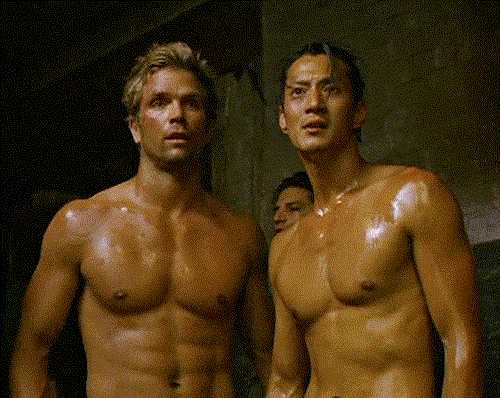
Beefcake: none.  There are various attractive adults in the cast, including Cliff "Method Man" Smith and Joel "The Kid Mero" Martinez, but nothing comes off, either in the movie or in a google search.  (The top photo is just a random hunk.)


Gay Characters:
Miguel moons over The Girl; Bobby flirts with girls constantly; but Luis doesn't express any heterosexual interest.  Maybe he's gay, but if so, it's unstated and very well hidden.  A google search on "Vampires vs. the Bronx"  and "gay" reveals only advertisements for The Boys in the Band.

My Grade:  The gentrification angle doesn't outweigh the heterosexism. C.


Oct 26, 2020

Elvira, Mistress of the Dark

When I moved to West Hollywood in 1985, everyone was watching Movie Macabre (1981-86), starring Elvira, Mistress of the Dark (Cassandra Peterson).  A throwback to the horror movie hosts of the 1950s and 1960s, Elvira was vampire-like being with a Valley Girl accent ("As if!") and a revealing Morticia Addams outfit.
She showed bad movies like The Fall of the House of Usher (with peplum star Mark Damon not taking his clothes off), Horror Hospital (with Robin Askwith threatened by gay psycho surgeons), and Werewolf of Washington (with Dean Stockwell, werewolves, hippies, and hippie werewolves).


In a tradition that would extend to Mystery Science Theater 3000, Elvira made snarky comments about the movies.  And in the tradition of drag queen performers, she made lots of self-referential jokes about her sexual escapades and cleavage ("I'm glad to see you're back...and you're glad to see my front!").  

Gay fans loved her, and she returned the affection, appearing at AIDS benefits and Gay Pride parades through the 1980s.


And not only gay fans.  She was everywhere, branding her image to sell everything from beer to Halloween costumes.

The feature film Elvira, Mistress of the Dark (1988) sends Elvira to the small town of Falwell (named after Jerry Falwell, the poster boy for 1980s homophobia), where she befriends all of the town's outcasts, butts heads with local bigots and romances an uptight theater manager (professional hunk Danny Greene).

Since Elvira is immortal, she continues to perform, cleavage and all.  She continually hosts new versionfs of Elvira's Movie Macabre., on cable in the 2000s and now on Amazon Prime.

Oct 25, 2020

The Wolverine: In a World of Evil, Backstabbing Men and Kind Supportive Women, Who Are You Gonna Date?

 I'm having a bad week in mass media, looking for gay representation and finding heterosexism or homophobia: Pass the Light,  A Babysitter's Guide to Monster Hunting, Redneck Roots, The Queen's Gambit...and now it's Saturday night, when we watch the X-Men movies in order (Bob's idea, not mine).

The X-Men are mutants with an X-gene that gives them varying types of superheroic powers.  Tonight: The Wolverine (2013) features the hard-drinking, hard-fighting, annoyingly surly Logan (Hugh Jackman), whose ability to instantly regenerate cells makes him immortal.  And depressed.  Plus his hands sprout Freddy Krueger-style blades whenever he's angry or upset, or sometimes at random and inopportune moments.

Logan still feels pain, so one would expect him to spend his immortality in quiet contemplation of the Divine, or take a nice teaching job at Dr. Xavier's X-Men Academy, but no, he enlists in whatever war is going on at this moment: American Civil War (even though he''s Canadian), World War I, World War II.  


Scene 1: 
Logan in a pit, a prisoner of war in Nagoya, Japan on July 26th, 1945.  Everyone is evacuating or committing ritual suicide as the Enola Gay approaches with nuclear bombs.  Young soldier Ichiro (Ken Yamamura) tries to release Logan, but he states that the pit is the safest place, and shields Ichiro with his own body.  

A homoerotic buddy bonding scene!  Things are lookng up. Maybe Ichiro will stick around, and they will go on adventures together.   Wouldn't that be great!  Even if they're not a gay couple, just heterosexual life partners.

Scene 2: Logan in bed with a woman, kissing and hugging.

Way to burst my bubble in the first five minutes!  Ok, same-sex relationships are trivial and disposable, heterosexual romance eternal.  I get it!

Scene 3: After some machinations to demonstrate that he likes woodland creatures, Logan looks up with a kick-ass babe, who tells him that the now-elderly and dying Ichiro wants to see him again, to "say goodbye."

So he has fond memories of their time together, after all these years?  Memories of a homoerotic buddy-bond?  Things are looking up.

Scene 4: Logan and Kick-Ass Babe fly to Japan on a private jet.  Turns out that Ichiro is a multi-billionaire electronics mogul, and also a bit of a kook: he likes to pretend that he's living in traditional Japan, with rice-paper walls, samurai swords, and women in kimonos.  

He actually doesn't want to say goodbye: he wants to modify Logan's X-gene so he can experience cellular decay.  He will therefore age normally and eventually die, and in the meantime "fall in love, get married, raise a family."

Ok, ok, the sole purpose of existence is heterosexual marriage and reproduction.  Same-sex friendships are worthless.  I get it.


Scene 5:
Logan meets Ichiro's snarling, surly, ninja-fighting son Shingen (Hiroyuki Sanada) and quiet, passive, impossibly virtuous granddaughter Mariko.

Uh-oh, Ichiro is dead.  That means that Mariko inherits everything, and everyone wants to kill her, including her dad.


And her fiancee, corrupt finance minister Norobuku Mori (Brian Tee)

Geez, are all the men in this movie evil, and all the women good?  

Well, slinky Bond Girl scientist Dr. Green is evil, a mutant whose super power involves poisoning men to death by kissing them.  Fortunately she's not attracted to men, so she doesn't have to worry about kiss/killing someone she likes.

No heterosexual interest means evil?   This is getting very close to stereotyped gay villain territory. Do we have to keep watching?

To be fair, I got the "no heterosexual interest" from the line "I'm immune to men."  In the comics the character is heterosexual, and even marries Logan at one point.


Kenouchi Haruda (Will Yun Lee) may be the only male character other than Ichiro who isn't evil.  According to Wikipedia, he's a ninja "sworn to protect the Yamada family."  I don't really remember him, though.  I stop paying attention.

I wish I was watching whatever movie this photo is from, instead.

I start paying attention again in the final scene plot twist: 

Spoiler alert:

Ichiro is alive!  He has transformed into a man-machine supervillain, Logan's arch-nemesis.

Moral: All men are evil, they wiall same-sex relationships are destructive and dangerous. But women -- at least heterosexual women -- are unfailingly good, kind, and supportive.

I suppose you're going to tell me that this director is gay

Oct 22, 2020

The Beverly Hillbillies

The Beverly Hillbillies, one of the 1960s line of hayseed comedies (others included Petticoat Junction, Green Acres, Gomer Pyle, and The Andy Griffith Show), slogged on from 1962 to 1971, and your parents watched every week, so you couldn't avoid it.  It was amazingly popular with adults: some of the regular episodes -- not even Christmas specials -- became the most watched episodes of all time.

The basic premise: a hillbilly from Bugtussle, Tennessee or Arkansas, Jed Clampett (Buddy Ebsen), becomes unbelievably rich when oil is discovered on his property, so he moves to a mansion in Beverly Hills, along with his crotchety mother-in-law Granny (Irene Ryan), his daughter Ellie Mae (Donna Douglas), and his dumb-lunk nephew Jethro (Max Baer Jr.).

Though they became marginally assimilated after nine years, they still wore hillbilly clothes, ate possum pie, and referred to their swimming pool as a "cement pond."  Plots usually involved big city types trying to dupe and manipulate them, but their backwoods wisdom, orneriness, or dumb luck win out in the end.

The message: big city life is dehumanizing.  Only in the country can real be real.

Other plots involved Ellie Mae's dating, Jethro's get-rich quick schemes (odd, since he already was rich), and Granny's dislike of all things big city.

There was never much beefcake in hillbilly comedies.  Max Baer Jr., son of the famous boxer Max Baer, had a nice physique, but rarely showed it on camera.  We were supposed to laugh at his dopiness, not sigh over his muscles.

Bonding was also rather uncommon.  Most of the primary relationships were platonically male-female: Jed and Granny, Ellie Mae and Jethro, bank president Mr. Drysdale and his secretary, Miss Hathaway (Nancy Culp, who incidentally was gay in real life.)


But gay-vague was everywhere.

1. Mr. Drysdale's son, Sonny (Louis Nye) is sophisticated, well-educated, and not interested in girls.  His parents keep trying to hook him up with Ellie Mae (so he will eventually inherit the Clampett millions), but he will have none of it.  He and Ellie are just friends.


2. Hollywood star Dash Riprock (Larry Pennell), a parody of Rock Hudson, is handsome, suave, and not interested in girls.  He vaguely courts Ellie Mae, but his heart isn't in it,  regardless of how much his studio pushes them together.


Apparently the producers thought it hilarious to keep having Ellie Mae run into men who were not interested in girls.


3. Jethro had a "twin sister," Jethrine.  She stayed back in the hills, and didn't show up often, but when she did, it was obvious that it was Jethro in drag.  I got the distinct impression that everyone was just playing along, responding to his drag persona as if she was a different person.

See also: Petticoat Junction; Green Acres


Related Posts Plugin for WordPress, Blogger...